You're Not an Apprentice: Why Experienced Painters Avoid Formal Qualifications (And Why That's the Wrong Call)
Experienced painters avoid the Certificate 3 in Painting and Decorating because it feels like going backwards. Here's why that thinking is costing you work.
The qualification that feels like an insult
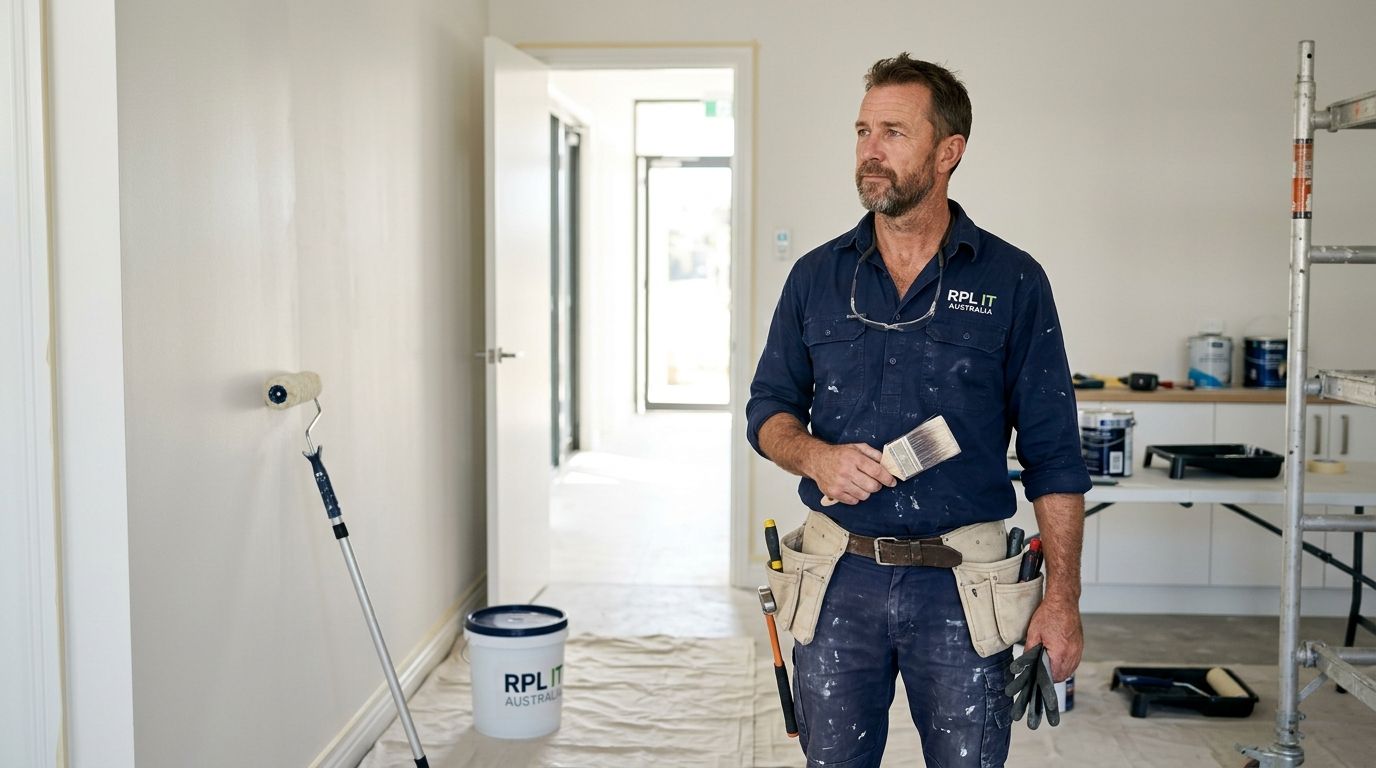
You have been painting for years. Residential repaint, commercial fit-out, new construction — you have done it all. You know how to prep a surface properly, how to read a spec sheet, how to manage a job from quote to completion. The work speaks for itself.
Then someone tells you that you need to get your Certificate 3 in Painting and Decorating. And something in you bristles.
Not because you can't do the work. You can. The bristle is something else — a quiet sense that the whole framing is wrong. Getting qualified sounds like starting over. It sounds like sitting in a classroom with teenagers who have never held a brush. It sounds like the system is telling you that your years on the tools don't count.
That feeling is understandable. And it is also costing you work.
The painting and decorating industry in Australia employs tens of thousands of people. According to IBISWorld, the sector employed an estimated 55,873 people as of 2026. A significant portion of that workforce has built genuine expertise through years of practical work — expertise that formal systems have historically been slow to recognise. A stakeholder submission to a Productivity Commission inquiry into the VET workforce noted that RPL is widely considered under-used, and that learning acquired through experience can and should be accredited within the Australian Qualifications Framework through a systematic and valid process.
The problem is not your competence. The problem is that the system was not originally designed to see it.
Why the Certificate III was designed for someone else
The Certificate III in Painting and Decorating — qualification code CPC30620 — is a nationally recognised trade qualification listed on the Australian government's training register. According to the official training.gov.au record, it requires 29 units of competency: 26 core units and 3 elective units. There are no formal entry requirements.
The qualification is described by registered training organisations as suitable for an Australian Apprenticeship pathway — a multi-year journey that combines on-the-job training with structured off-the-job learning at a TAFE or RTO.
According to the WA Government's Construction Training Fund, qualifying as a painter and decorator through an apprenticeship typically takes 3 to 4 years, depending on progress and state requirements. That structure — years of structured learning, classroom attendance, formal assessment at each stage — was built for someone entering the trade from scratch.
It was not built for someone who already knows the trade.
This is not a criticism of the apprenticeship model. It is an accurate description of what it was designed to do. The problem arises when experienced practitioners assume that the apprenticeship pathway is the only pathway. It is not.
The mental model that's keeping you unlicenced
Here is the core misconception: getting qualified and learning a trade are the same thing.

For an apprentice, they are. The qualification is the record of learning. For an experienced painter with years on the tools, they are not. The qualification is a formal statement about competency. What changes is how that statement is generated.
Recognition of Prior Learning — RPL — is a formal assessment pathway within the Australian Qualifications Framework. It is not a shortcut. It is not a workaround. It is a legitimate, structured process in which a qualified assessor evaluates your existing skills and knowledge against the requirements of a nationally recognised qualification. If your competency meets the standard, the qualification is issued. The resulting certificate carries the same standing as one earned through conventional study.
The assessment is genuine. The assessor is qualified. The outcome is real. What is different is the evidence base.
In a traditional apprenticeship, the evidence is accumulated learning — assignments, supervised practice, formal assessments over years of structured training. In an RPL assessment, the evidence is your existing work — documentation of what you already do, every day, on the job.
You are not a student seeking a certificate. You are a practitioner seeking formal recognition of what you already know.
That is a different thing entirely. And it changes everything about how you should approach the process.
If the classroom fear has been part of what's held you back, it's worth understanding that RPL for painting and decorating doesn't require returning to a classroom — the assessment is built around your existing work, not new learning.
What RPL actually looks like for an experienced painter
The RPL process for CPC30620 varies between registered training organisations, but the general shape is consistent. A qualified assessor reviews evidence of your existing competency against the 29 units of the qualification. Where your evidence demonstrates competency, those units are recognised. Where gaps exist, the RTO will typically offer gap training to address them.
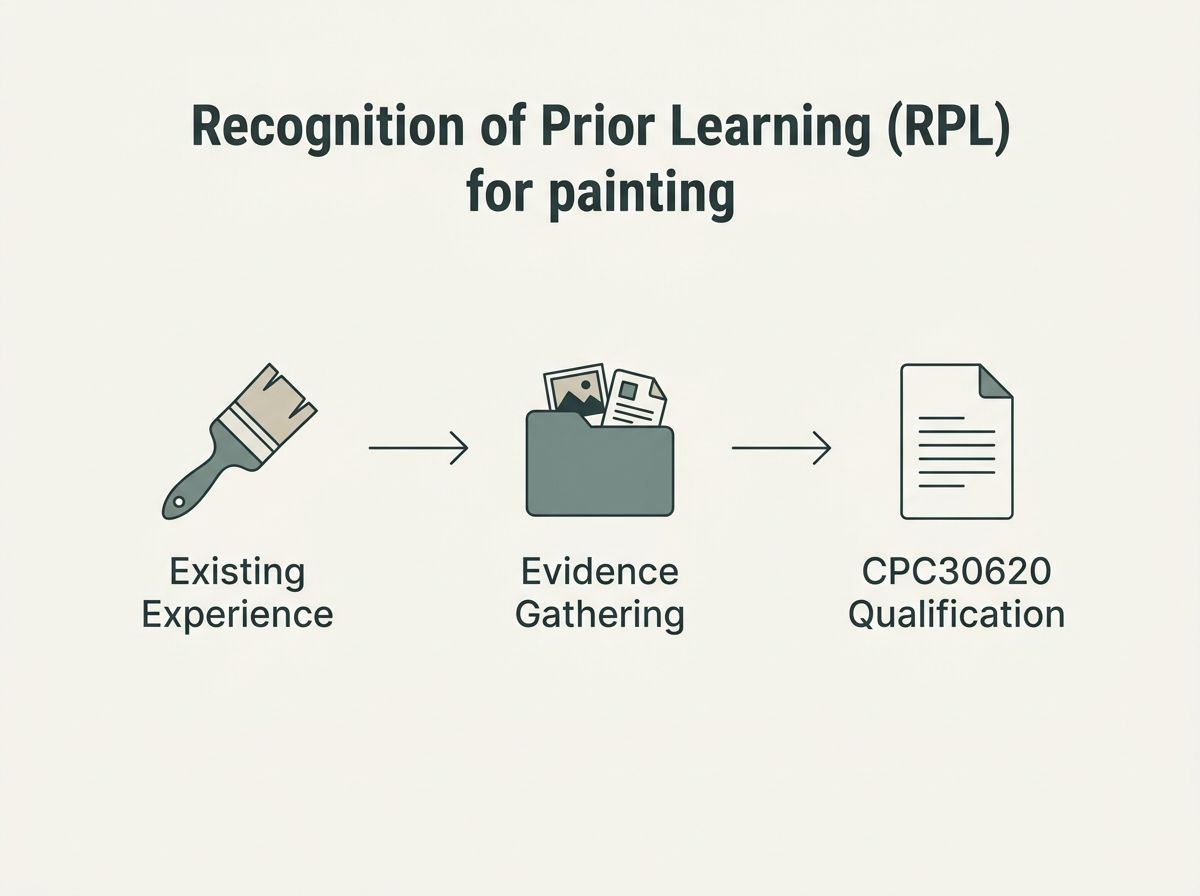
What does the evidence look like? Based on how RTOs currently delivering CPC30620 via RPL describe their processes, experienced painters are typically asked to provide:
- Photos of completed work — before and after, showing surface preparation, application, and finish quality
- References or statutory declarations from supervisors, builders, or clients who can verify your work
- Job records, invoices, or contracts that document the scope and nature of your painting experience
- A competency conversation with an assessor — a structured discussion about how you approach specific tasks, troubleshoot problems, and apply trade knowledge in practice
Some RTOs also include a simulated industry assessment or practical demonstration as part of the process. Career Skills Australia, for example, describes their CPC30620 RPL assessment mode as including both workplace-based evidence and simulated industry assessment.
Everthought Education, another RTO delivering CPC30620 via RPL, notes that most experienced painters will meet the majority of the qualification's 29 units through their day-to-day work — the task is demonstrating that competency through evidence, not acquiring it through study.
It is worth being honest about one thing: RPL is not a rubber stamp. The assessor makes a genuine determination. If gaps are identified, gap training is required. The qualification is nationally recognised precisely because the assessment is genuine. What the RPL pathway changes is not the standard — it is the evidence base.
Everthought's RPL process for CPC30620 involves an eligibility conversation, evidence gathering, a competency conversation with a trainer, and issuance of the certificate once requirements are met — a structured process that respects both the rigour of the qualification and the reality of the candidate's existing expertise.
Who this pathway is — and isn't — for
Honest suitability guidance matters here. RPL for the Certificate III in Painting and Decorating suits experienced painters who have worked across the core competency areas covered by the qualification — surface preparation, paint and coating application, colour theory in practice, workplace health and safety, and the full range of tasks that make up a painting and decorating trade.
If your experience is broad and you have worked across residential, commercial, or industrial painting contexts over a number of years, the RPL pathway is worth exploring seriously. Everthought states that their CPC30620 RPL entry requires 3 to 4 years of demonstrated experience, while Career Skills Australia requires at least 2 years of industry experience along with employer or supervisor support.
If your experience is highly specialised — say, you have worked exclusively in one narrow area and have not covered the full scope of the qualification — RPL may identify gaps that require additional training before the qualification can be issued. That is not a failure of the process; it is the process working as it should.
RPL is not suitable for everyone. The right starting point is an honest assessment of whether your experience maps to the qualification's requirements — before you commit to anything.
The real cost of staying unlicenced
The identity barrier — 'that qualification is for apprentices, not me' — has a financial consequence worth naming directly.
Painter contractor licensing requirements vary across Australian states and territories. In a number of states, formal qualifications are required or recognised as part of the licensing process for painting contractors. The specific requirements depend on your state — and they are worth checking with your state licensing authority. What is consistent across the country is that commercial clients, principal contractors, and tier-one builders increasingly require documented qualifications as a condition of engagement.
Without CPC30620, experienced painters may find themselves unable to tender directly for certain commercial jobs, required to work under another contractor's licence, or exposed to compliance risk on sites with strict qualification requirements. The qualification doesn't change what you can do. It changes what the formal system can see — and what clients and contractors are willing to sign off on.
There is also the insurance dimension. Working without formal qualifications can affect the terms of your public liability and professional indemnity coverage. This is worth discussing with your insurer, but it is a real consideration for painters operating as sole traders or running small businesses.
The compliance pressure that's locking experienced painters out of commercial work is a pattern that has been building for years — and the painters who have moved to address it are finding themselves better positioned for the work that matters.
The cost of the identity barrier is not abstract. It shows up in the jobs you don't win, the contracts you can't tender for, and the ceiling on what your business can become.
Recognition, not repetition
The Certificate III in Painting and Decorating via RPL is not about going back to the beginning. It is about having your existing expertise formally witnessed and recorded.
The qualification doesn't change what you know. It changes what the formal system can see.
For experienced painters, RPL is the pathway that makes invisible expertise visible. Your experience is real. Your skills are proven. Recognition is earned — not through years of classroom attendance, but through the rigorous, honest documentation of what you already do every day.
Experience can be evidence. The RPL pathway exists because the Australian qualifications system recognised that experienced tradespeople shouldn't have to pretend they're beginners. Recognition shouldn't require starting over.
The decision is yours. But if you have been putting this off because the whole idea felt like it was designed for someone else — it's worth knowing that RPL was designed precisely for you.
Ready to Get Recognised?
Start with a free skills review to find out if RPL is right for you.