The Compliance Trap: Why Experienced Painters Are Losing Commercial Jobs to a Missing Certificate
Experienced painters are being locked out of commercial and government jobs — not for lack of skill, but for missing a Certificate III. Here's what's happening and what to do about it.

The Job You Quoted, Priced, and Lost — Because of a Certificate
You put in the quote. You know the site. You have done this kind of work for years — commercial fit-outs, repaint programs, large-scale residential developments. Then the call comes back. Not because your price was wrong. Not because your work is in question. Because someone on the procurement side checked the qualifications box, and your crew does not have a Certificate III in Painting and Decorating on file.
It is a particular kind of frustration. The skills are there. The experience is real. But the paperwork is not, and in an increasing number of commercial, government, and union-aligned painting contracts across Australia, the paperwork is what gets you through the door.
This is not a story about individual failure. It is a story about how the painting industry has shifted — and what experienced contractors can do about it.
What Has Actually Changed in the Painting Industry
Qualification requirements for painting contractors have not always been enforced with the same rigour across Australia. For many years, experience and reputation carried significant weight on their own. That is changing.
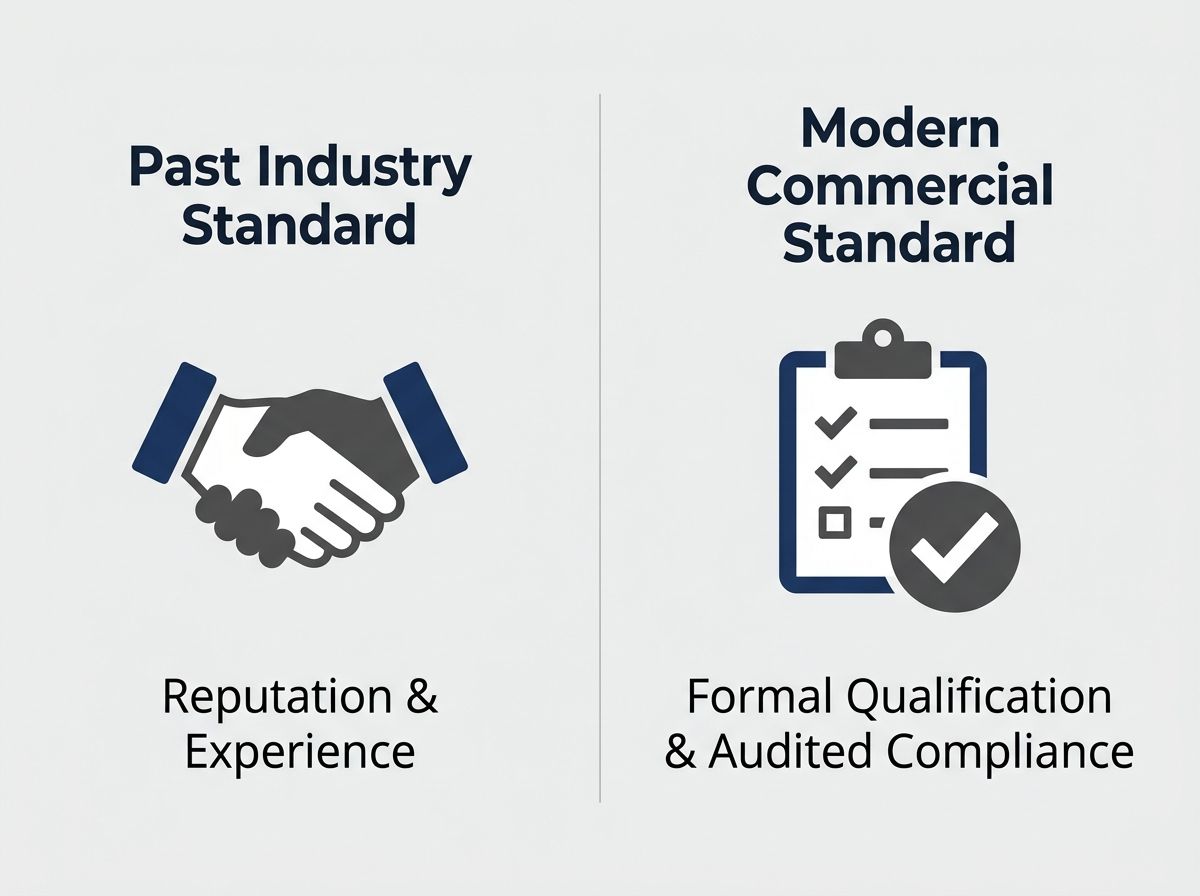
Across the construction sector, procurement frameworks — particularly in government and commercial work — have moved toward requiring formally qualified tradespeople on site. Several things are driving this: tighter WHS obligations, insurance requirements that reference formal qualifications, and enterprise agreements that specify credentialled workers for certain scopes of work. Painting and decorating has not been exempt from that trend.
Licensing requirements for painting contractors vary by state and territory in Australia. Some states require a contractor's licence to operate a painting business, and those licence pathways typically reference formal qualifications as part of the eligibility criteria. The practical effect is that contractors without a Certificate III in Painting and Decorating (CPC30620) — or an equivalent recognised qualification — can find themselves ineligible for certain licence categories, which in turn affects the contracts they can bid for or work on.
The point is not that the rules changed overnight. It is that enforcement and the expectations written into commercial contracts have tightened. What was once a soft preference has become a hard requirement in a growing number of contexts.
The Jobs That Now Require a Certificate III — and the Ones That Will Soon
Not every painting job in Australia requires a formal qualification. Residential work, particularly smaller domestic repaint jobs, often does not. But the category of work where formal credentials are required — or where they provide a decisive advantage — is expanding.
The job types where a Certificate III in Painting and Decorating is increasingly relevant or required include:
- Government maintenance and repaint contracts — federal, state, and local government facilities often require formally qualified tradespeople as part of their procurement conditions
- Social housing and public housing programs — state housing authorities typically specify qualification requirements for contractors working on their properties
- Commercial fit-outs and refurbishments — particularly where head contractors or project managers are managing their own compliance obligations
- Union-aligned construction sites — enterprise agreements on major construction projects often specify that workers hold relevant formal qualifications
- Large-scale residential developments — developers and builders managing compliance risk increasingly require sub-contractors to hold formal qualifications
- Insurance-sensitive environments — some commercial insurance policies reference the qualifications of tradespeople as part of their coverage conditions
The pattern is clear. The higher the contract value, the more likely it is that formal qualifications will be checked. Contractors who hold a Certificate III in Painting and Decorating are able to bid for work that is, in many cases, more stable and better-paid than purely residential jobs.
Why Years of Experience Is Not Enough Anymore — and Why That Is Not a Reflection on Your Work
Here is the part that is genuinely frustrating, and worth saying plainly: the formal system does not automatically recognise what you know how to do. It recognises what has been assessed and documented.
That is not a judgement on the quality of your work. Experienced painting contractors who have spent years on commercial sites, managing crews, specifying products, and delivering complex finishes to specification — they are not being told their skills are inadequate. They are being told that their skills exist in the wrong form for the formal system to process.
Your work is real. The system needs to see it differently.
This is a structural feature of how formal qualifications work in Australia, not a personal failing. The national training system is built around assessed competency — which means competency needs to be demonstrated and recorded, not just assumed from years of practice. For experienced tradespeople, this creates a gap that feels deeply unjust: the skills are there, but the evidence is not in the right format.
Recognition of Prior Learning (RPL) exists to address this gap. It is the formal mechanism by which existing skills and experience can be assessed against a qualification's requirements — without requiring the candidate to re-learn what they already know.
What the Certificate III in Painting and Decorating Actually Covers
One of the most common assumptions experienced painters make about the Certificate III in Painting and Decorating (CPC30620) is that it is a beginner qualification — something designed for apprentices, not for contractors who have been running commercial jobs for a decade.
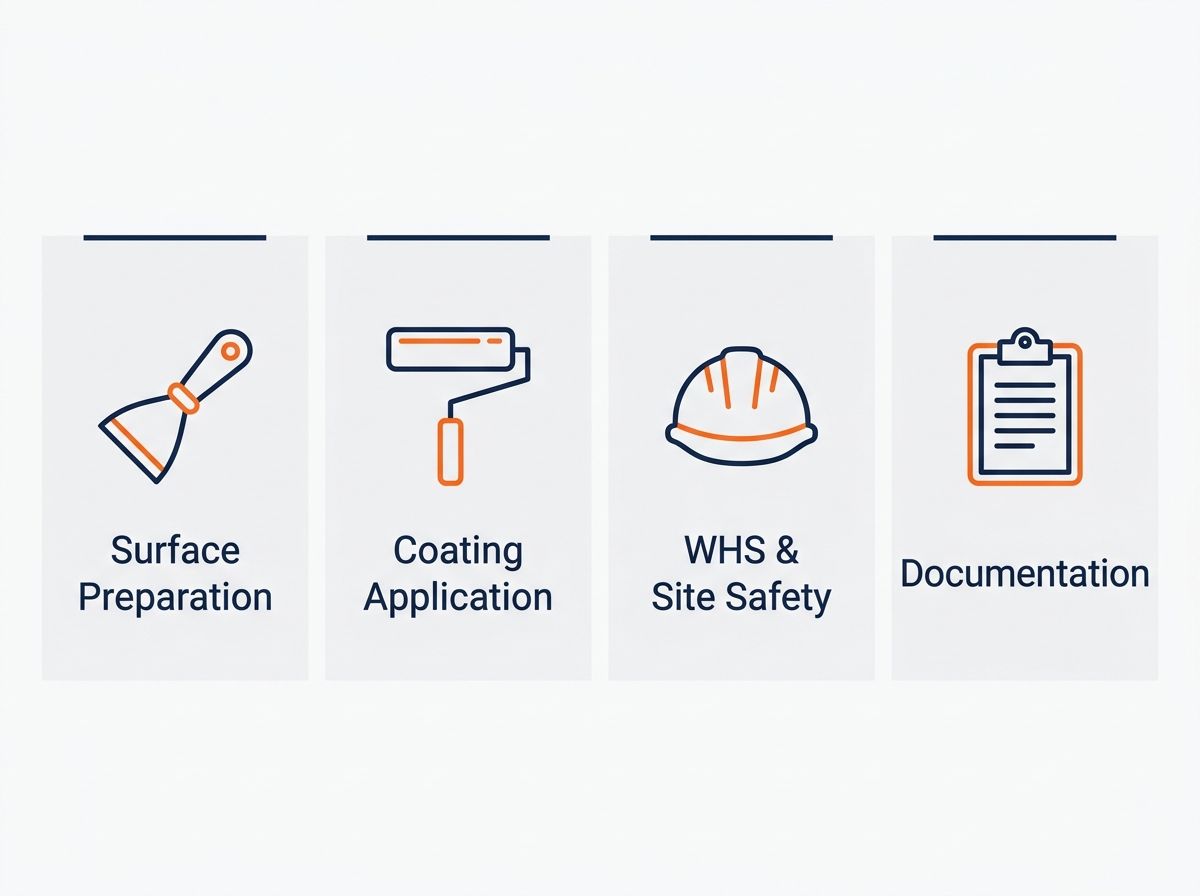
That assumption is worth examining. The CPC30620 covers the full range of competencies expected of a trade-qualified painter and decorator in Australia. The core areas include:
- Surface preparation — assessing and preparing a range of surfaces for painting, including identifying defects and selecting appropriate preparation methods
- Paint and coating application — applying a range of paint systems and coatings using appropriate techniques and equipment
- Colour and design — applying colour theory and decorative techniques to meet client and specification requirements
- WHS compliance — identifying and managing workplace health and safety requirements specific to painting and decorating work
- Work documentation — reading and interpreting plans, specifications, and work orders; completing relevant documentation
- Estimating and planning — calculating materials and planning work sequences for painting projects
For an experienced painting contractor, most of these areas will be very familiar. The question the RPL process asks is not 'can you do this?' — it is 'can you demonstrate that you do this, to the standard required by the qualification?'
How RPL Works for Experienced Painting Contractors
Recognition of Prior Learning is not a shortcut. It is a rigorous assessment process conducted by a Registered Training Organisation (RTO). What it does differently from traditional study is this: instead of requiring you to complete training in skills you already have, it assesses the skills you already have against the qualification's requirements.
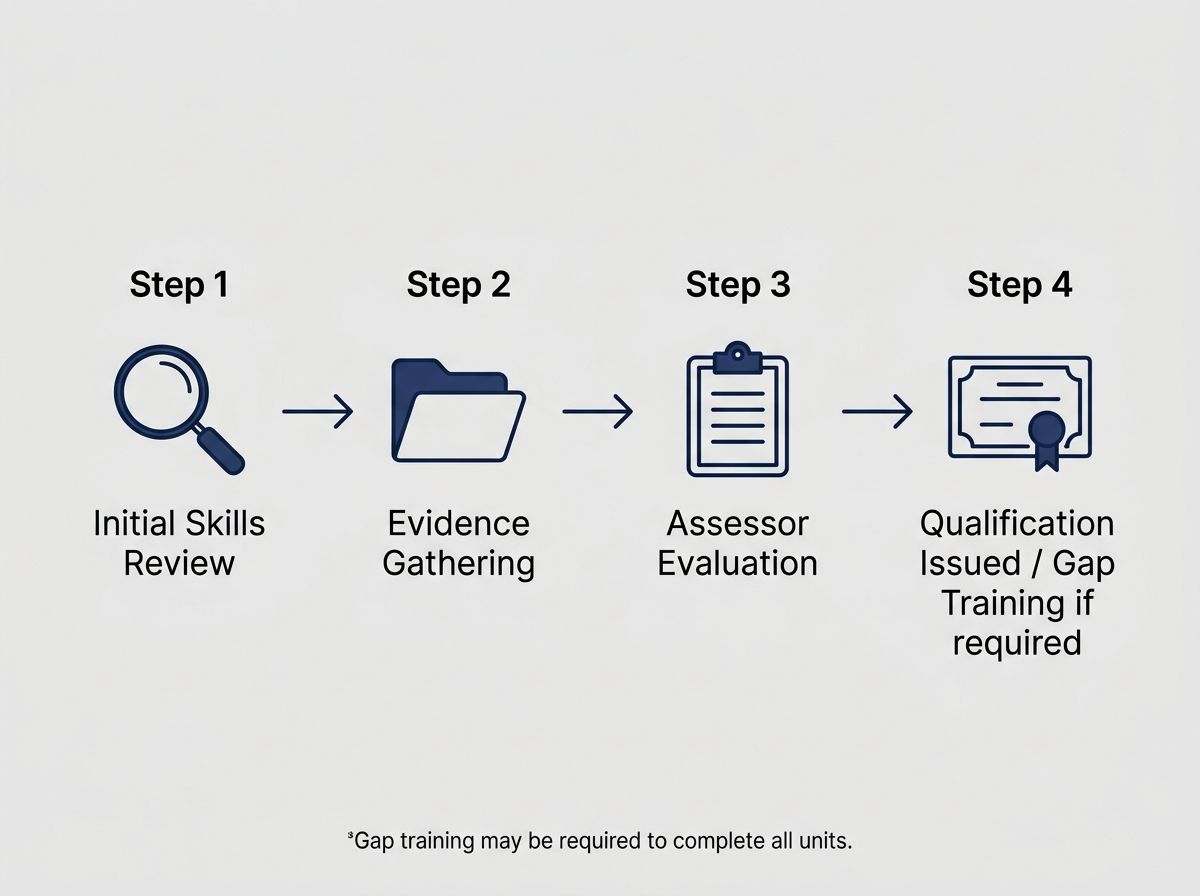
For a painting contractor, the RPL process typically involves the following stages:
- Skills Review — an initial assessment of your background against the qualification's requirements, to identify whether RPL is likely to be suitable for your situation
- Evidence Gathering — compiling documentation that demonstrates your existing competency. For painting contractors, this typically includes photos of completed work across different surface types and applications, Safe Work Method Statements (SWMS) you have prepared or worked under, employer or client references, logbooks or job records, and any relevant licences or previous training
- Assessment — a qualified assessor from the RTO reviews your evidence portfolio and may conduct a practical observation or structured conversation to verify your competency
- Outcome — if your evidence demonstrates competency across all required units, the qualification is issued. If gaps are identified in specific areas, gap training is provided to address those areas before the qualification is issued
It is worth being clear about that last point: gap training may be required. Not every RPL candidate will have demonstrable evidence across every unit of the qualification. Where gaps exist, the RTO will provide the training needed to address them. This is part of the process, not a failure of it.
The qualification issued through RPL is the same nationally recognised qualification as one earned through traditional study. It carries the same weight with employers, procurement teams, and licensing bodies.
The Practical Move: Getting Qualified Before the Next Tender Drops
The compliance shift in the painting industry is not going to reverse. Commercial and government procurement frameworks are not becoming less rigorous — they are becoming more so. Contractors who hold a Certificate III in Painting and Decorating are able to access a category of work that is increasingly closed to those without it.
Pursuing the qualification through RPL is, at its core, a business decision. It is about unlocking contracts that are currently out of reach — not about satisfying a bureaucratic requirement for its own sake. Government maintenance programs, commercial fit-out work, and social housing contracts tend to offer more stable, longer-term work than purely residential painting. The qualification is what gets you into that category.
This pattern is playing out across the trades. Other trades are navigating the same compliance shift — painting is not unique in this respect, and the RPL pathway is well-established as the practical response for experienced tradespeople who need to formalise their skills without stepping away from the work.
If you want to understand the broader business case for getting qualified through RPL — beyond just meeting a compliance requirement — this article on the business case for getting qualified through RPL is worth reading.
The decision is yours. But the window for acting before the next tender — or the next contract that requires formal credentials — is now.
Find Out If Your Experience Qualifies — Before You Commit to Anything
The first step is not enrolment. It is an honest assessment of whether your experience maps to the Certificate III in Painting and Decorating — and whether RPL is the right pathway for your specific situation.
That is what the Free Skills Review is for. It is a no-obligation conversation that gives you a straight answer about where your experience sits relative to the qualification's requirements. If RPL is suitable, you will understand what the process looks like. If it is not the right fit, you will know that too — before you have committed to anything.
You can also review the full qualification details, including what the RPL pathway covers, on the Certificate III in Painting and Decorating page.
Ready to Get Recognised?
Start with a free skills review to find out if RPL is right for you.