Turned away at the gate: When your painting experience isn't enough for site access
Experienced painters are being denied site access without a Certificate III. Find out how RPL turns your years on the tools into the credential you need.

The gate that didn't open
You arrive at site with your tools in the ute and work lined up. You have done this exact type of job hundreds of times before. But when the site supervisor checks the induction list and asks for your Certificate III in Painting and Decorating, you cannot produce it. The gate stays closed.
This situation is not hypothetical. Across commercial construction sites and government projects in Australia, principal contractors are tightening their subcontractor induction requirements. Formal trade qualifications are now checked at the gate. This is not a reflection of your actual skill, but a compliance check that the system can quickly verify. Experience that lives in your hands and your work history does not show up on an induction checklist. A qualification does.
For painters who have spent years, or even decades, working to a high standard on commercial and residential projects, this causes real frustration. Your work is real and your competence is proven. However, without formal documentation, the compliance system cannot recognise it.
Why the rules changed and why experience alone no longer opens doors
This shift is structural. Principal contractors managing large commercial and government projects carry significant liability. Their subcontractor compliance frameworks, which determine who can enter a site, now strictly require evidence of nationally recognised qualifications. This change is driven by workplace health and safety obligations, insurance and procurement rules, and the general professionalisation of the construction industry.
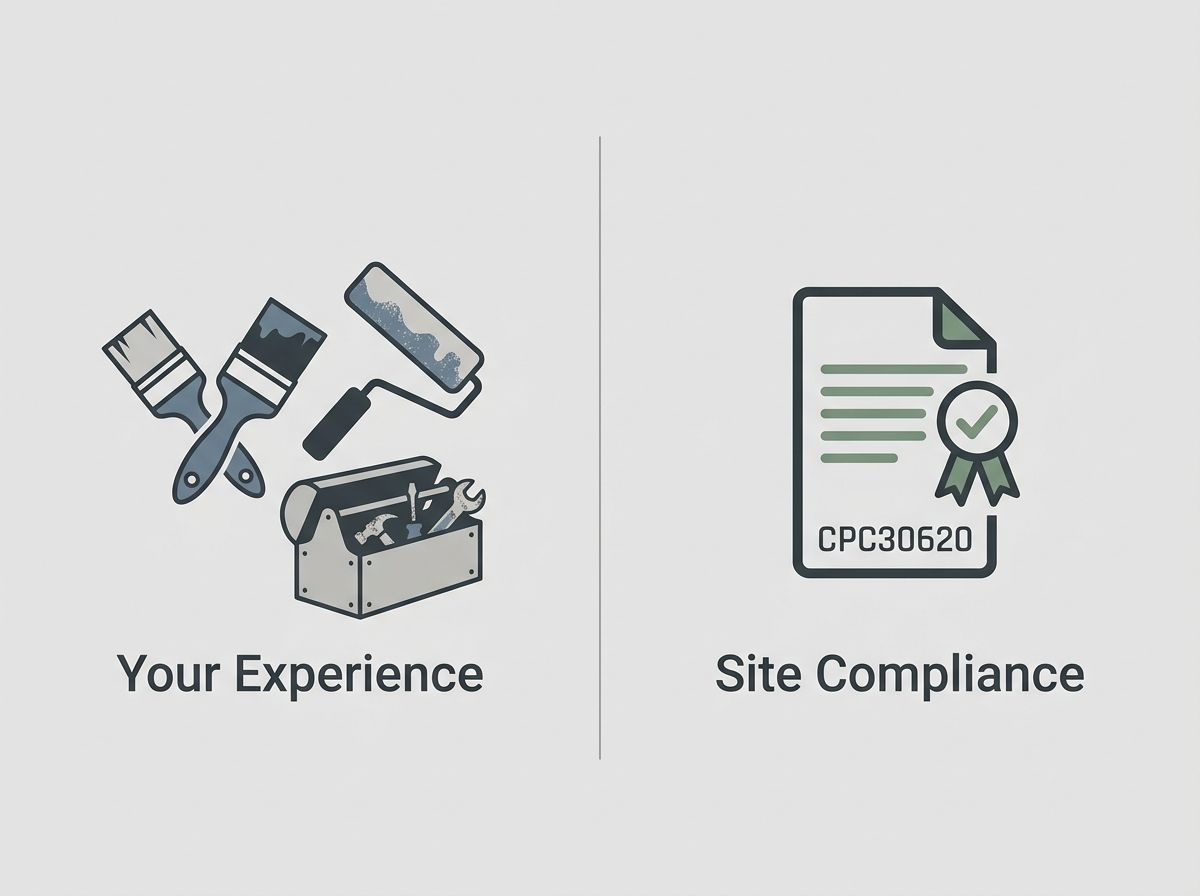
As a result, formal qualifications act as gatekeepers. This is not because they are the sole measure of competence, but because they provide a standardized, verifiable record that compliance systems can process. On an induction spreadsheet, an experienced painter with fifteen years on the tools looks identical to an unqualified worker.
This is the core issue. Experience is not worth less than formal training, but it is a different form of proof. Unfortunately, the current system struggles to recognise your years on the job without a structured pathway to make those skills visible.
What the Certificate III in Painting and Decorating actually covers
The Certificate III in Painting and Decorating (CPC30620) is a nationally recognised qualification under the Australian Qualifications Framework. This is the specific credential that principal contractors, site managers, and compliance systems look for when verifying whether a painter is qualified to work on commercial or government projects.
For an experienced trade professional, the units of competency within this qualification cover familiar territory. They focus on the everyday work of a professional painter, such as surface preparation, applying coatings, following workplace safety rules, working at heights, and reading plans. Experienced painters do these tasks routinely. The qualification does not teach you new skills if you already know the trade; instead, it provides a formal, national framework to assess and document what you can already do.
This distinction is important. The Certificate III in Painting and Decorating is not a classroom course you must start from scratch if you already work to industry standards. It is a benchmark against which your practical experience is assessed.
The gap between what you know and what you can prove
Here is the problem in its simplest form. You have the practical skills, but the system needs paperwork. Those are two different things, and the space between them is where many experienced painters find themselves stuck.
Recognition of Prior Learning (RPL) is the formal pathway within the Australian vocational education and training system designed to bridge this gap. It is not a shortcut or a quick fix. It is a legitimate assessment process governed by national training standards. A qualified assessor reviews your existing skills and knowledge to see if they meet the requirements of the Certificate III in Painting and Decorating.
The primary difference between RPL and traditional study is the entry point. In a traditional course, you build knowledge from the ground up through classes and assignments. In an RPL pathway, you demonstrate competency by providing evidence of what you already know and do daily. While the assessment is rigorous, successful candidates receive the exact same nationally recognised qualification.
For a painter with years of commercial experience, the main challenge is not your actual capability. The task is organizing your skills into clear documentation that an assessor can evaluate against national standards.
How RPL works for the Certificate III in Painting and Decorating
The RPL process for this qualification follows a clear, structured pathway. Understanding the steps can help you decide if it is the right choice for your business or career.
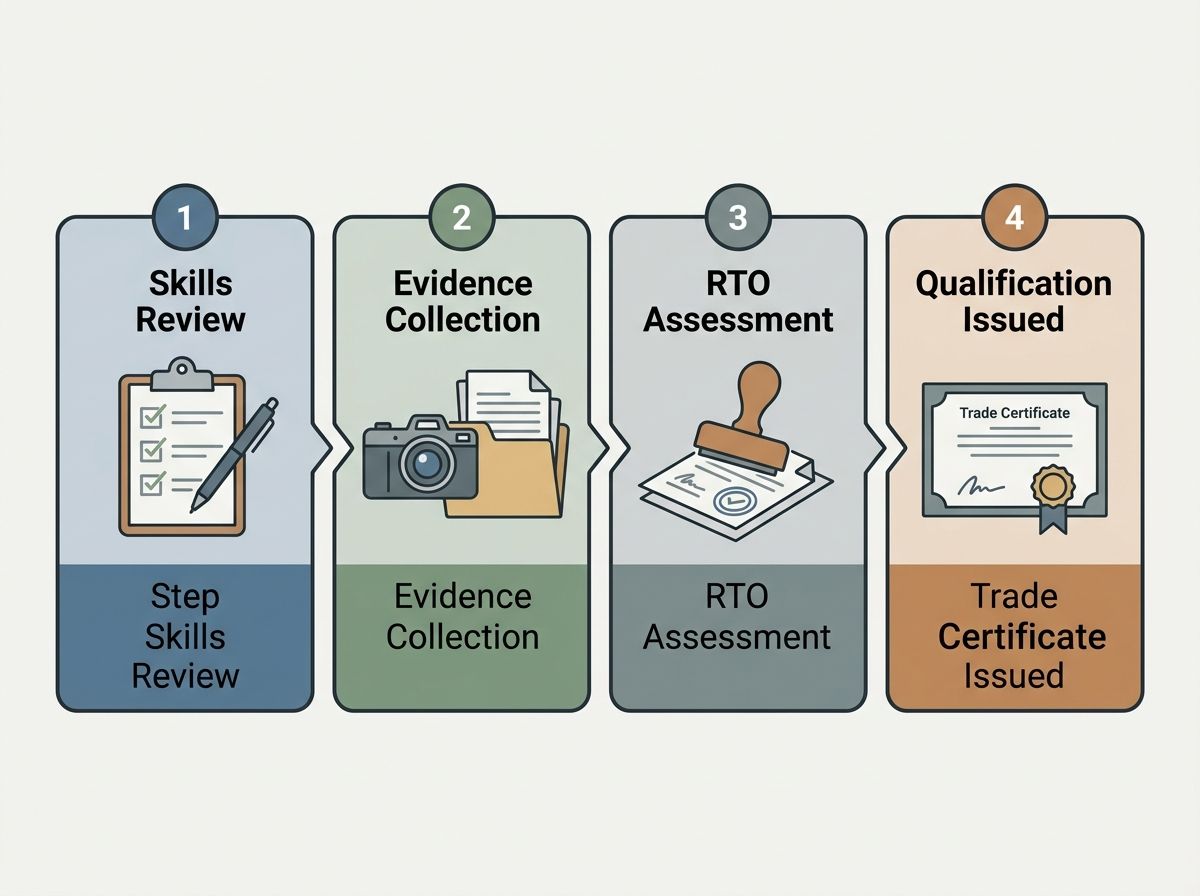
- We start with a skills review to determine whether your trade background and industry experience support an RPL pathway for CPC30620. This initial assessment is designed to give you clear, honest guidance about your suitability before you make any decisions.
- If the skills review indicates RPL is a viable option, you will begin gathering practical evidence of your work. This involves documenting your employment history, compiling records or photos of completed projects, getting references from supervisors or clients, and showing your knowledge of safety standards. The specific evidence needed depends on the units of competency being assessed.
- A qualified assessor from a registered training organisation (RTO) reviews your evidence package against the official standards of the Certificate III in Painting and Decorating. The assessor makes an independent professional judgement on whether your documented experience demonstrates competence in each required unit.
- When competency is demonstrated across all required units, the RTO issues your Certificate III in Painting and Decorating. If any gaps are identified where your evidence is not quite sufficient, the RTO will provide targeted gap training. This is a standard part of the process to ensure your qualification is fully compliant.
To be completely clear, RPL it guides you through this process, but the formal assessment is conducted by an assessor from a registered training organisation (RTO). The final qualification is issued directly by that RTO. The process is rigorous because the qualification must be genuine to guarantee site access.
Who is a strong candidate for RPL in painting and decorating?
RPL is not suitable for everyone. We believe in providing upfront, honest guidance, which is why it is helpful to outline what makes an ideal candidate.
You are likely a strong candidate for a Certificate III RPL pathway if you have extensive, hands-on experience in painting and decorating across various project types and surfaces, and if you can document this work. This documentation can include records of previous projects, employer or client references, photos of your completed work, safe work method statements (SWMS) you have used, and proof of your compliance with safety regulations.
Conversely, RPL may not be appropriate if your experience is limited, if you have only performed a narrow range of painting tasks, or if you cannot provide documentation to support your experience. In these situations, a traditional training pathway may be a better fit, and a skills review can help clarify the most practical option for you.
The purpose of assessing your suitability is not to turn you away. It is to ensure that the pathway you choose gives you the best chance of success, preventing you from investing time and resources into a process that does not match your professional background.
The first step: A free skills review
The Free Skills Review is your starting point. It is a straightforward, no-obligation discussion about your trade background, your hands-on experience, and whether an RPL pathway for the Certificate III in Painting and Decorating makes sense for you.
This review costs nothing and carries no commitment. It is designed to give you honest, practical information before you spend any money. If you decide to proceed, you will do so with a clear understanding of the process and confidence that it fits your career goals.
Your experience has value. The system just needs to see it.
When a gate remains closed, it is not because you lack the trade skills, but because the compliance system cannot see your evidence. That is the critical distinction.
You have the years on the job, but site compliance requires formal proof. Recognition of Prior Learning is a structured process that takes your existing skills and organizes them into a clear format. This allows a qualified assessor to evaluate your practical capabilities against the standards of the Certificate III in Painting and Decorating.
The process is thorough and requires real evidence; it is not a shortcut or a guaranteed pass. However, for experienced painters who can document their work, it is a direct and legitimate path to securing the credential that gets you onto site.
Your experience can serve as formal evidence. The choice to find out if yours qualifies is entirely up to you.
Learn more about the Certificate III in Painting and Decorating RPL pathway at RPL it.
Ready to Get Recognised?
Start with a free skills review to find out if RPL is right for you.