You do not need to go back to TAFE: how experienced painters get qualified
Experienced painters do not need to sit in TAFE classrooms. Learn how to get your Certificate III in Painting and Decorating through RPL.

The assumption costing experienced painters time they do not have
You have been painting for years. You know surface preparation, you understand coatings, and you know how to run a job site safely and efficiently. Then someone tells you that you need a Certificate III in Painting and Decorating, and your first thought is that you are not going back to TAFE.
That assumption is understandable, but it is incorrect.
The belief that getting qualified requires sitting in a classroom, working through modules you mastered years ago, and taking time off the tools is the main reason experienced painters delay formalising their skills. This delay is not due to a lack of competence or time, but a training model that does not apply to experienced tradespeople.
There is a formal pathway designed specifically for people who already know the trade. It does not require you to re-learn what you do every day on site; it requires you to prove it. This distinction is significant, and it changes the entire approach to formal qualification.
What qualification actually means for an experienced painter
For someone who has never worked in the industry, getting a Certificate III in Painting and Decorating means learning the trade from scratch. The qualification is how they acquire skills they do not yet possess.
For someone who has been working in the trade for years, the process is different. It means demonstrating that your daily work meets the national standard. These are two completely different pathways.
Recognition of Prior Learning, or RPL, is a formal assessment pathway within the Australian national training framework. It is not a training course or a study program. Instead, it is a structured process where a qualified assessor evaluates evidence of your existing competence against national qualification requirements. If your evidence shows you meet the standard, the qualification is issued.
The qualification recognises your existing capability rather than creating it.
This is the core distinction that many experienced painters miss. They associate qualifications with classroom study, but for someone with genuine trade experience, the pathway relies on assessment rather than retraining.
What the Certificate III in Painting and Decorating covers
The Certificate III in Painting and Decorating (CPC30620) covers the skills and knowledge that define competent trade practice. When you review what the qualification assesses, it becomes clear that if you have worked in the trade for years, you are already doing this work daily.
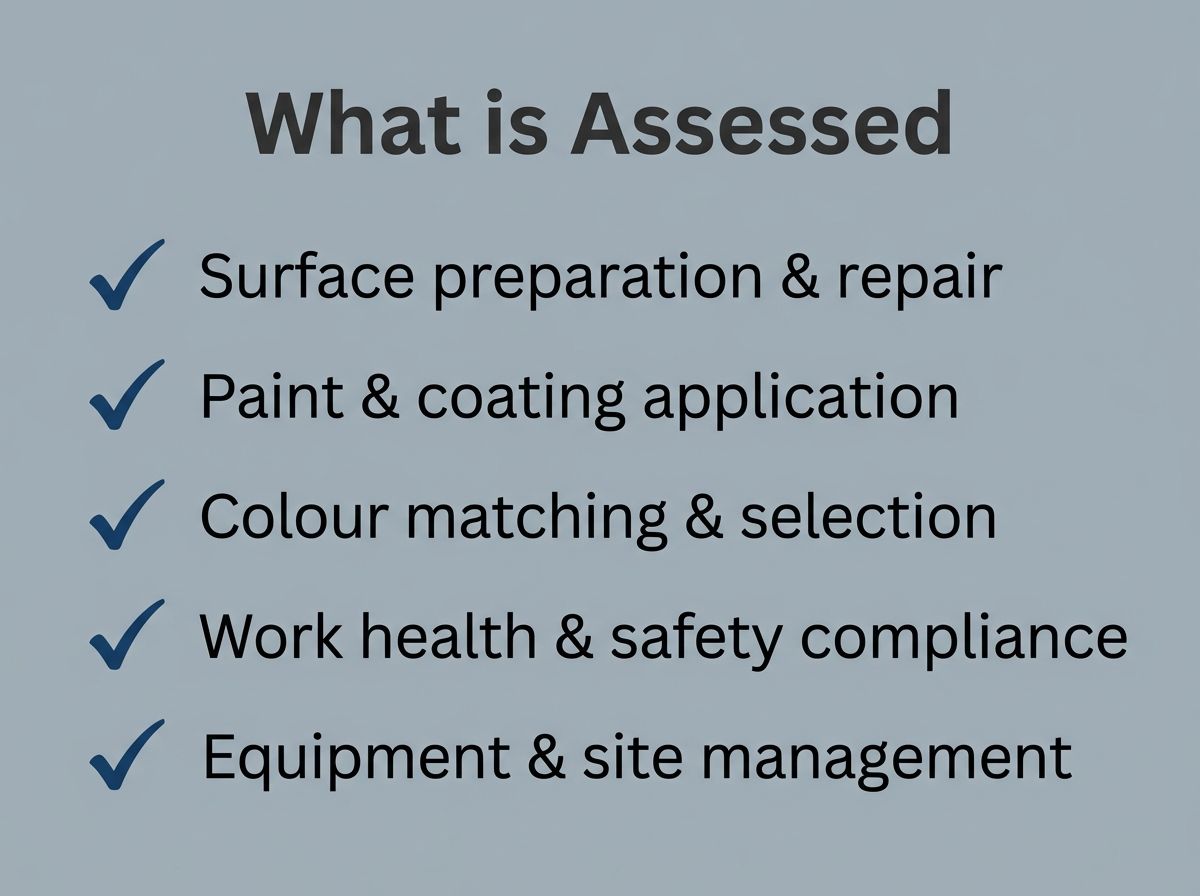
The qualification covers key practical areas including:
- Surface preparation: assessing and preparing substrates for coating application
- Application of paint and coatings: using correct techniques and materials for various surfaces and environments
- Colour selection and application: understanding colour specifications and applying them in practice
- Work health and safety: managing hazards, working safely at heights, and handling materials safely
- Reading plans and specifications: understanding job specifications and requirements before starting work
- Site management: organising work, managing materials, and meeting quality standards on site
These are not theoretical concepts; they are the daily realities of running a job. The assessment process verifies your competence in these practical areas rather than asking you to describe them in a classroom.
RPL is an evidence-gathering process, not a study program
RPL is a formal assessment pathway, not a classroom course. The process involves compiling evidence that proves your existing skills meet the units of competency, which is then evaluated by a qualified assessor from a registered training organisation.
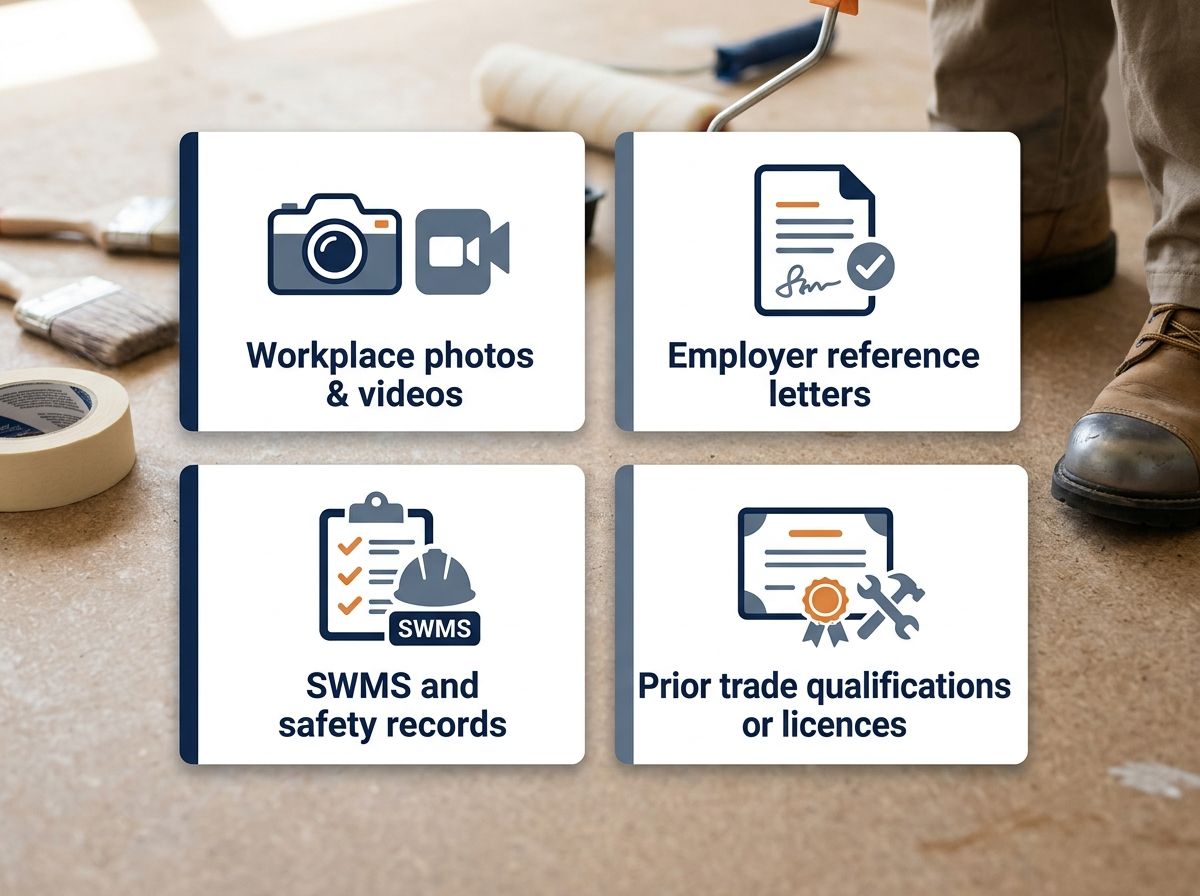
For experienced painters, this means documenting your daily work. The types of evidence that typically support an RPL assessment for this trade qualification include:
- Photographs of completed work showing surface preparation, application quality, and finished results across different projects
- Employer or supervisor statements: written confirmation from industry professionals who have observed your work and can verify your daily trade competency
- Safe Work Method Statements (SWMS) demonstrating your clear understanding and application of site safety requirements
- Job records and logbooks documenting the scope and volume of painting work you have completed
- Third-party observation reports where an assessor or approved observer watches you work and records your performance
- Licences, tickets, and prior training records representing formal credentials that support your competency claims
The exact evidence required depends on the units being assessed and the standards of the registered training organisation. Some assessments also include a structured interview, which is a discussion with the assessor about your work methods. This is a professional conversation about trade practice rather than a school test.
The evidence already exists in your daily work. The process simply involves compiling, organising, and presenting this information in a clear format so that a qualified assessor can measure it against the national standard.
The gap between your work and what the assessor needs to see
For most experienced painters undertaking RPL, the main challenge is not a skills gap but a documentation gap.
You likely have the trade skills already. The challenge lies in presenting that competency in a structured format that a qualified assessor can evaluate against the formal unit requirements. This requires clear organisation and a straightforward understanding of the evidence standards.
Without guidance, capable painters often submit incomplete portfolios. This is rarely because of a lack of skill, but because they do not know how to document their daily work. This leads to project delays, requests for extra evidence, or the need for gap training.
Gap training is a standard component of the RPL pathway. If an assessor identifies areas where your evidence does not fully meet the required standard, you can complete targeted training in those specific units before your qualification is issued. This is a routine part of a robust assessment process, ensuring the final qualification remains nationally respected.
Understanding the compliance factors driving this requirement is useful before you start. If you have not done so, you should review the industry standards making this qualification necessary for commercial and contract worksites.
Who is eligible for painting and decorating RPL
RPL is the appropriate pathway for painters who have worked in the trade for a significant period and can show competence across the full scope of the qualification. This typically requires experience across residential and commercial settings, interior and exterior work, and various surface types and coating systems, rather than specialising in just one area.
RPL for the Certificate III in Painting and Decorating is suitable if:
- You have worked as a painter for several years in a professional trade role
- Your experience covers various project types and surface preparation demands
- You have applied different coating systems and understand product selection for different environments
- You practice safe work methods on site and can provide records or statements to confirm this
- You can prove that your finished work consistently meets industry standards
RPL is not suitable for all applicants. If your experience is limited, recent, or highly specialised, such as working only in a support role or on a single project type, a standard training pathway may be more appropriate. Evaluating your history honestly before starting saves time and avoids finding gaps mid-assessment.
The suitability check does not aim to turn applicants away. It ensures you choose the correct pathway for your specific situation. A qualified assessor can clarify your options before you commit to any process.
The steps in the RPL process
The RPL process for the Certificate III in Painting and Decorating follows a clear, structured sequence.
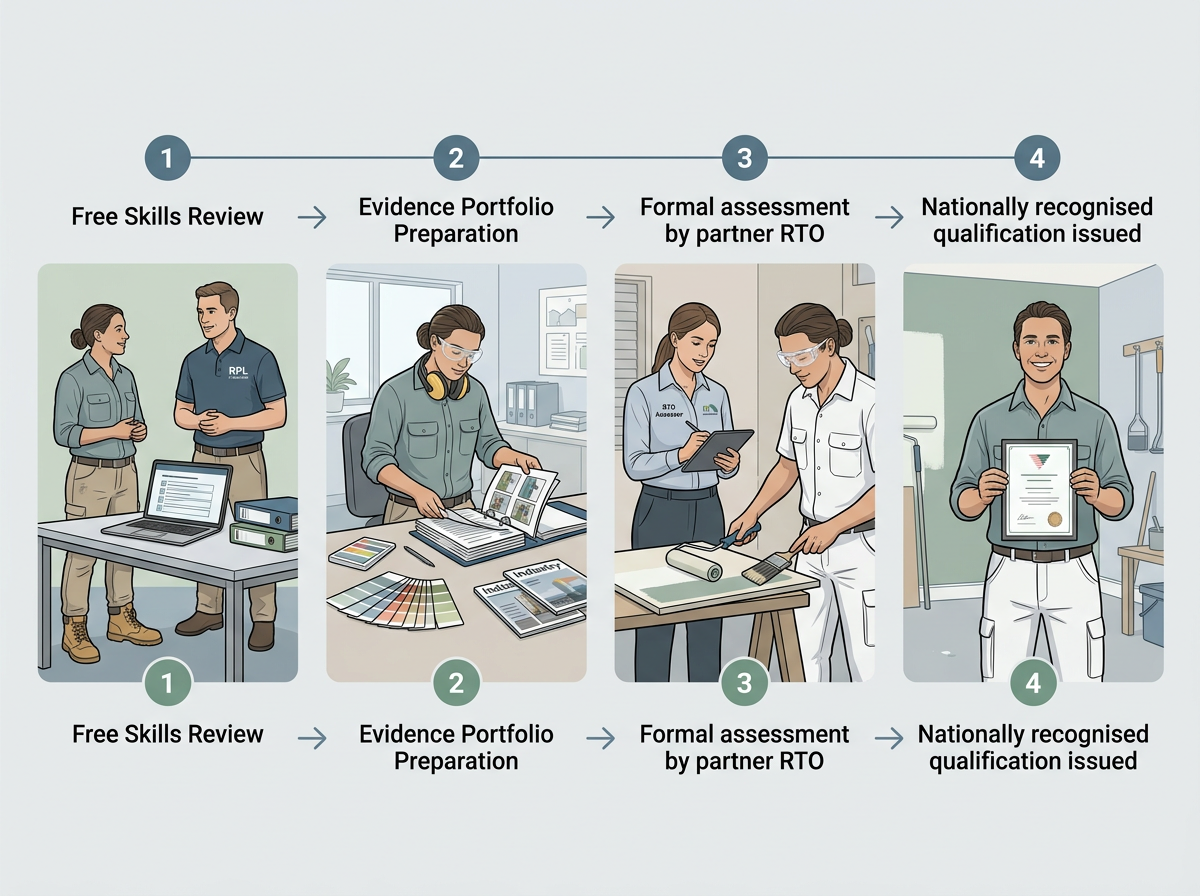
- Skills Review: An initial professional discussion to evaluate whether your practical experience supports a successful RPL application, establishing your eligibility before any formal commitment is made.
- Evidence Gathering: You compile the documentation proving your trade competence with our guidance. This is the most detailed part of the process, but you complete it around your normal work schedule without losing time on site.
- Formal Assessment: An assessor from a registered training organisation evaluates your evidence against the national units of competency. This phase includes a structured interview and may require a practical observation depending on RTO guidelines.
- Gap Training: If the assessment identifies areas where your evidence does not fully meet the required standard, you can complete targeted training in those specific units. This training focuses solely on the missing components rather than a full course.
- Qualification Issued: Once you demonstrate competence across all units, the partner registered training organisation issues your qualification. The Certificate III in Painting and Decorating (CPC30620) is nationally recognised under the Australian Qualifications Framework.
Please note that RPL it assists candidates through the preparation and submission stages. The formal assessment is conducted by independent assessors from registered training organisations who measure your skills against the national standard. The qualification is issued directly by the RTO, not by RPL it, ensuring that the process remains genuine and nationally recognised.
Completion times vary depending on how quickly you gather your evidence and the assessment schedule of the partner RTO. We do not guarantee specific timelines, but the system is built to fit around your ongoing work schedule.
Translating your experience into formal credentials
You have the trade experience. Your daily work, including surface prep, paint application, job site safety, and practical problem-solving, covers the requirements of the Certificate III in Painting and Decorating. You do not lack the necessary skills; you simply need a formal record of them.
RPL converts your practical experience into that official record. The assessment is rigorous to ensure the qualification retains its value across the industry. For a skilled painter, the work lies in compiling documentation rather than classroom study. You are showing what you already know how to do.
Gaining recognition does not require you to retrain from scratch. For experienced painters, RPL offers a practical alternative.
The choice of how you qualify is yours.
Ready to Get Recognised?
Start with a free skills review to find out if RPL is right for you.