Why 10 Years on the Brush Won't Help You Win Commercial Painting Contracts
Experienced painters keep losing commercial tenders to less-skilled operators with the right paper. Here's the cycle — and how to break it with your Certificate III.

The Tender That Goes Nowhere
You price the job competitively. Your finish work is clean. You have the references, the equipment, and the crew. The tender goes in. Then the email comes back — not a negotiation, not a request for more detail. A polite rejection, citing a qualification requirement you don't hold. The developer moves on to someone else. You go back to residential.
If that scenario is familiar, you are not alone. Experienced painters across Australia hit this wall repeatedly. It is not about skill. It is not about price. It is about a formal credential that the commercial market requires before it will even look at your submission.
The four-stage commercial exclusion cycle
There is a pattern here. Most experienced painters who have tried to break into commercial work have lived some version of it. Once you see it named, it is hard to unsee.
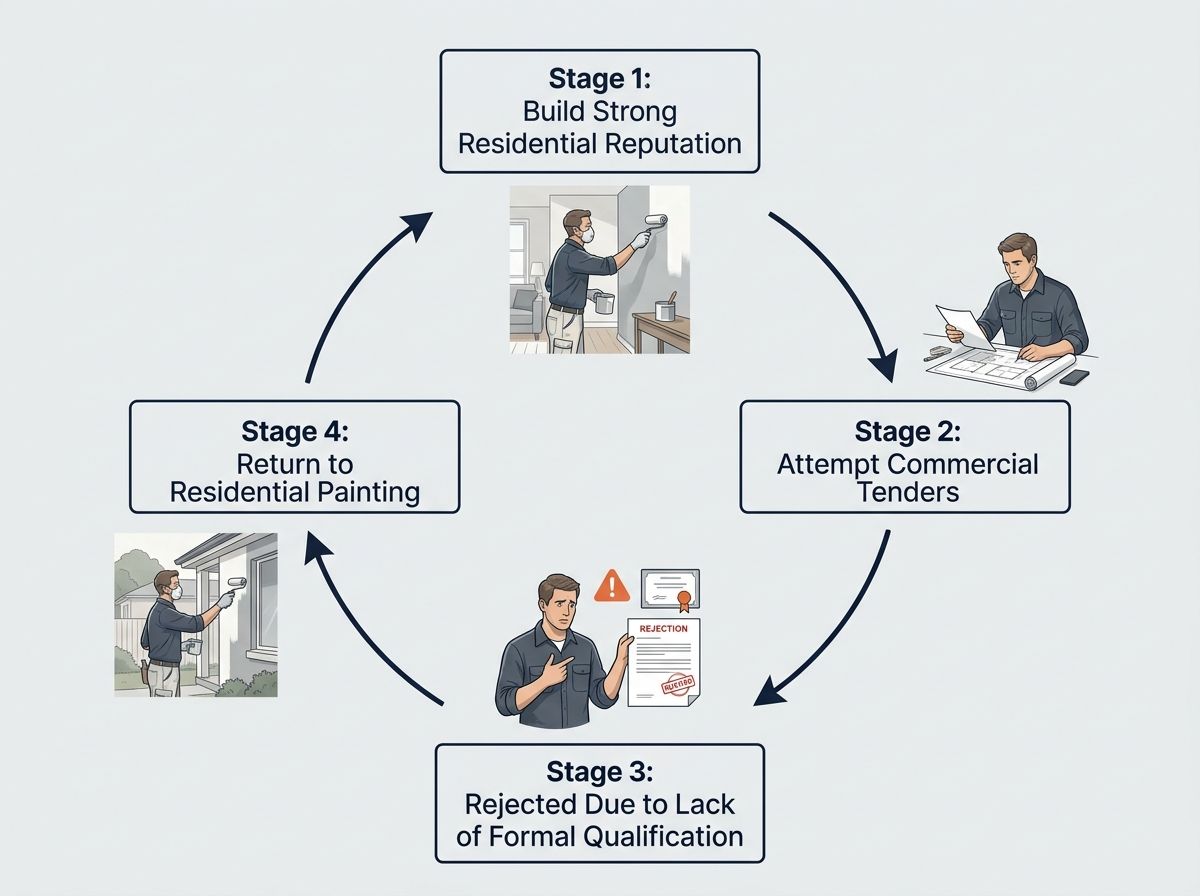
- Stage 1 — You build a strong residential reputation. Years of quality work, word-of-mouth referrals, a solid client base. You are good at what you do, and the market knows it.
- Stage 2 — You attempt to move into commercial work. The margins are better. The contracts are steadier. Multi-residential, commercial fitouts, government buildings — this is where the serious money is.
- Stage 3 — The tender or prequalification process requires a Certificate III in Painting and Decorating, or a state licence that depends on it. Your residential track record is not accepted as a substitute. The procurement system needs documented, nationally recognised evidence of competency.
- Stage 4 — You are rejected. You return to residential. The cycle repeats.
This is not a skills problem. It is a structural one. The commercial market does not assess skill directly — it assesses documented evidence of skill through a nationally recognised framework. Residential experience, however extensive, does not satisfy that requirement on its own.
If you want to understand the compliance pressures that sit alongside this qualification gap, our article on the compliance trap painting contractors face covers the administrative side of the same problem.
We have covered the compliance pressures painting contractors face in a separate article.
Why experience alone cannot break the cycle
The commercial construction market runs on procurement systems. Developers, head contractors, and government agencies cannot assess every subcontractor's skill directly — they rely on verifiable credentials as a proxy. A Certificate III in Painting and Decorating (CPC30620) is a nationally recognised qualification that signals to those systems that a painter's competency has been formally assessed against the national standard.
A painter with ten years of residential work has real, deep competency. But they have no way to make that competency visible to a procurement officer who has never seen their work. The certificate is not a test of skill — it is a translation of skill into the language procurement systems understand.
Government prequalification schemes show how this works in practice. The NSW Government's Construction Scheme for works between $1 million and $9 million — which can include painting scope for heritage building restoration — requires suppliers to meet legal, commercial, technical, and financial standards before they can tender. Prequalification determines eligibility to tender; it does not guarantee work.
The National Prequalification System for Civil Construction makes the same point: prequalification is about demonstrating verifiable capability, not just turning up with a quote. Applicants must meet registration, financial, and technical requirements.
Private head contractors and developers run their own subcontractor registration processes, and requirements vary. But the underlying logic is the same: formal documentation of competency is the entry ticket. Residential experience, however impressive, does not substitute for it.
Getting licensed is about translating your skills, not relearning them — a point we explore in more detail in a separate article.
Getting licensed is about translating your skills, not relearning them.
What the Certificate III in Painting and Decorating actually covers
The Certificate III in Painting and Decorating (CPC30620) is a nationally recognised qualification under the Construction Training Package. It comprises 29 units of competency — 26 core units and 3 elective units — covering surface preparation, application techniques, colour and finishing, workplace health and safety, and working within the construction environment.

For an experienced painter, the content of those units is not new. Surface preparation, coating application, colour theory, safety practices — these are the daily realities of the trade. What the RPL pathway does is assess whether your existing skills and experience already meet those competency standards. The process is about demonstrating what you know, not learning it from scratch.
The qualification is delivered by registered training organisations (RTOs) across Australia. RTOs conduct the assessment and issue the qualification. RPL it guides candidates through the process of preparing and presenting their evidence — but the assessment itself is conducted by a qualified assessor from the delivering RTO.
How RPL translates your experience into the qualification
Recognition of Prior Learning (RPL) is the formal process by which an RTO assesses whether a candidate's existing skills and experience meet the competency standards of a qualification. For a painter with years of hands-on work, RPL means documenting that experience — not repeating it.
The process typically involves gathering evidence of your existing work: photographs of completed projects, records of the types of surfaces and coatings you have worked with, references from employers or clients, and a skills demonstration for an assessor. The assessor maps that evidence against the units of CPC30620 and determines whether competency has been demonstrated.
If gaps are identified — units where your evidence does not yet demonstrate the required competency — gap training may be required. This is a normal part of the RPL process, not a failure. DLI Training, one RTO delivering CPC30620 RPL, states that where its assessors identify a need for gap training, it schedules a trainer to deliver the relevant components, and that this may extend the duration of the RPL process. DLI Training also states it charges no additional fee for gap training as part of its RPL process.
Everthought Education, another RTO offering CPC30620 RPL, similarly states that gap training is provided if needed as part of its RPL pathway. Policies on gap training — including any associated fees — vary between RTOs, so candidates should confirm the arrangements with their chosen provider at enrolment.
The RPL pathway is rigorous. It is not a shortcut. But for a painter who has been doing this work for years, it is a pathway that respects what you have already built.
Breaking the cycle: what changes when you hold the certificate
The Australian painting and decorating industry is substantial. IBISWorld estimates the industry's market size at around $9.6 billion in 2026, with most revenue coming from residential construction and renovation. More specialised contractors — those equipped to work on non-residential construction and maintenance projects — operate in a distinct segment of that market.
That commercial segment is where the Certificate III opens doors. Holding the qualification — or a state licence that requires it — changes your position in the market in concrete ways. You become eligible to tender for commercial and government work that requires formal qualification. You satisfy the prequalification criteria that previously excluded you. You can operate as a credentialled commercial subcontractor rather than a residential specialist.
Licensing requirements for painters vary by state and territory across Australia. In some states, a contractor licence for painting work depends on holding a Certificate III or equivalent. Requirements differ — candidates should check with the relevant licensing authority in their state before drawing conclusions about what the certificate unlocks for them specifically. What is consistent is that the Certificate III is the nationally recognised foundation qualification for the trade.
You have done the work. The certificate is the mechanism that makes that work visible to the commercial market. For the full picture of compliance requirements painting contractors face alongside this qualification question, see our related article.
For the full picture of compliance requirements painting contractors face, see our related article.
Is RPL the right pathway for you?
RPL suits painters with substantial hands-on experience who can document their work against the competency standards of CPC30620. Some RTOs indicate that candidates typically need around three or more years of relevant painting and decorating experience to be strong RPL candidates, though requirements vary between providers.
RPL is not a shortcut. It is a rigorous assessment pathway. Candidates who are early in their career, or who have worked in a narrow specialisation, may find that gap training is required to cover units their evidence does not yet demonstrate. As noted above, gap training is a normal part of the process — it means completing only the components you actually need, not repeating work you have already mastered.
The honest first step is finding out whether your experience is a strong match before making any enrolment decision. That is what the Free Skills Review is for.
You have the experience. The question is whether it is documented in the form the commercial market needs. That is what we help you find out.
Ready to Get Recognised?
Start with a free skills review to find out if RPL is right for you.