The Sub-Contractor Margin Drain: Why Outsourcing Your Split System Installs is Costing You
If your team can do 90% of the job but you're sub-contracting split system installs, you're bleeding margin. Here's what UEE20120 actually costs you.
The compliance bottleneck: a name for the margin you're losing
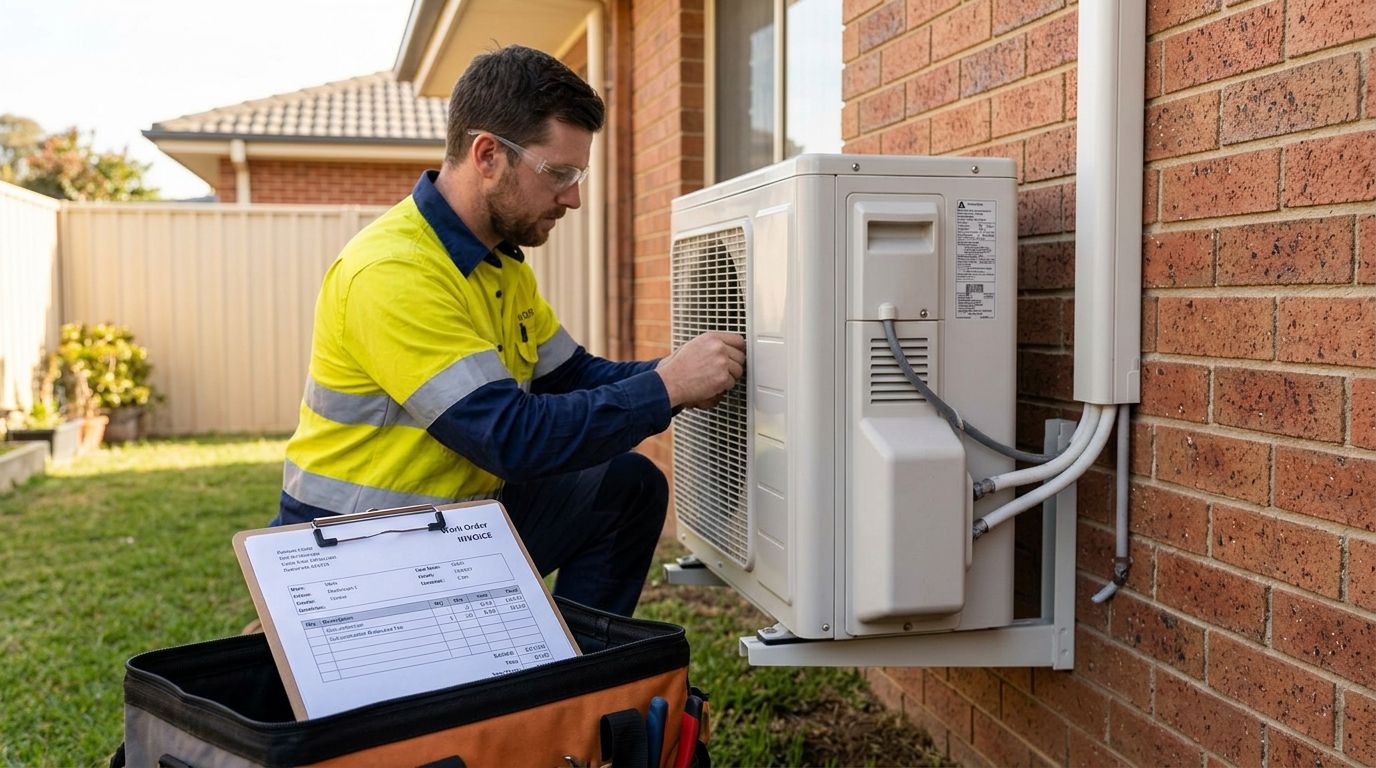
The Compliance Bottleneck is the margin lost when a business can complete 90% of a job but must sub-contract the final component due to a missing certification. It is not a skills problem. It is a paper problem. And in the split system installation space, it has a specific name: UEE20120 — the Certificate II in Split Air Conditioning and Heat Pump Systems.
Your team can run the cable. They can mount the bracket. They can commission the unit. But the moment the refrigerant circuit needs to be connected and the system signed off as a complete split system installation, the work stops — because the person doing it does not hold the right certification. So you call a sub-contractor. You hand over the final stage of the job. And with it, you hand over the margin.
This pattern plays out across electrical businesses, plumbing and services contractors, builders, and HVAC-adjacent trades all over Australia. The capability is there. The certification is not. And every time the sub-contractor's invoice arrives, the Compliance Bottleneck costs you money.
What the compliance bottleneck actually costs per job
The margin lost to sub-contracting is not a rounding error. The labour component of a residential split system installation — the work your sub-contractor is doing — typically represents a meaningful portion of the total job value. When you sub-contract that component, you are not just losing the profit on that labour. You are also absorbing the administrative overhead of coordinating the sub-contractor, managing the scheduling, and handling any follow-up if something goes wrong.
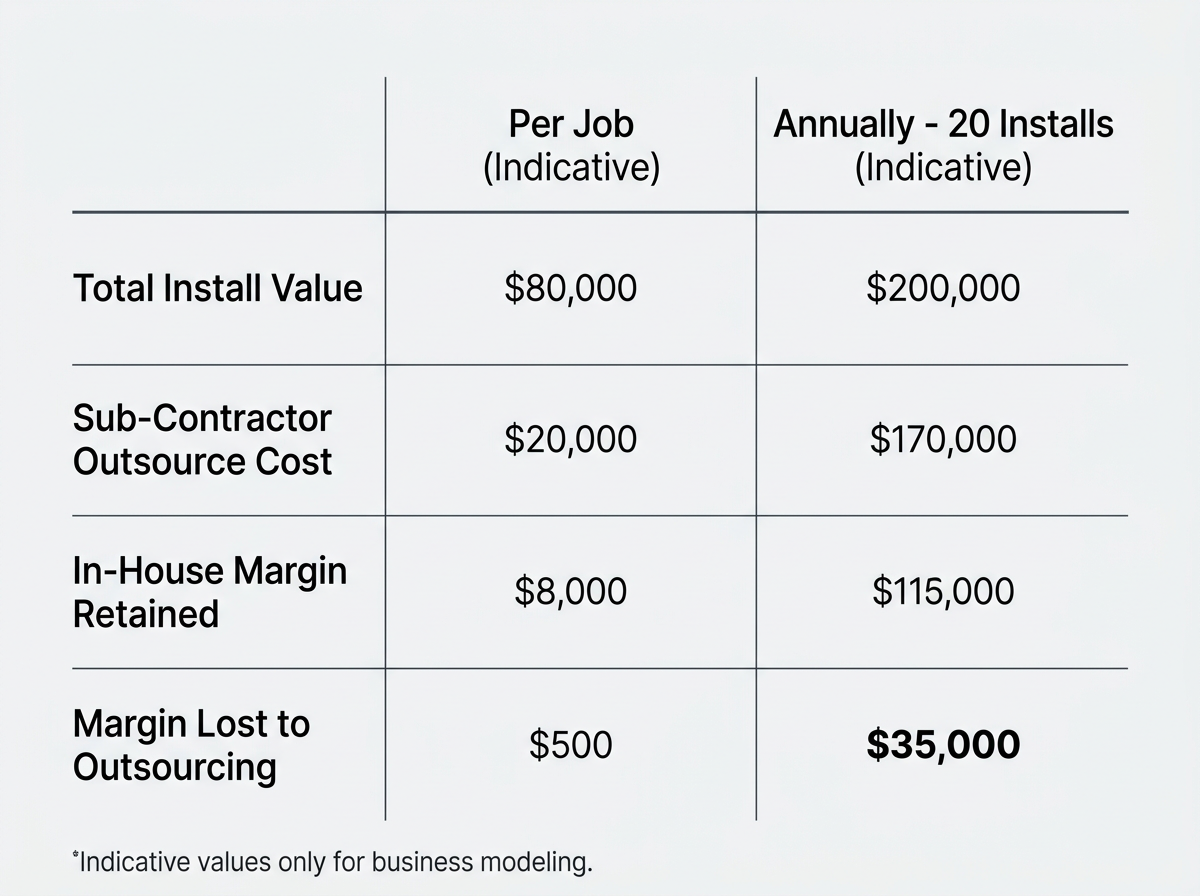
Consider what this looks like across a year. If your business sub-contracts split system installations regularly — even a modest number of jobs per month — the cumulative margin drain is significant. The exact figures will depend on your market, your pricing, and your sub-contractor arrangements. But the direction is always the same: margin out, not in.
There is also the matter of what you are not quoting. Some businesses stop offering split system installation entirely because the sub-contracting arrangement is too unreliable or too thin on margin. That is not a cost that appears on any invoice — but it is real.
The regulatory risk of unlicensed split system work is a separate but related concern — one that affects individual workers rather than business owners managing legitimate sub-contracting arrangements.
A certification gap, not a skills gap
This is the core diagnosis: your staff are not unqualified in any meaningful sense. They are uncertified for this specific work type. Those are different things.
Workers with backgrounds in electrical, refrigeration, plumbing, or general HVAC servicing often have substantial relevant experience that maps directly to what the UEE20120 qualification covers. They understand refrigerant systems. They understand electrical safety. They understand commissioning procedures. The qualification is a Certificate II — designed to formally recognise foundational to intermediate competency in split system installation and heat pump systems. For many experienced workers, the gap is not what they know. It is what they can prove.
Recognition of Prior Learning — RPL — is the formal pathway that addresses exactly this situation. Rather than requiring a worker to complete a full training program from scratch, RPL assesses whether their existing experience and knowledge meets the standard required by the qualification. If it does, the qualification is awarded on the basis of that demonstrated competency. The worker does not re-learn what they already know. They demonstrate what they already do.
Understanding how RPL works for the Certificate II in Split Air Conditioning is the starting point for any business owner considering this pathway for their staff.
The hidden costs beyond the invoice: scheduling, quality, and customer risk
The margin drain is the most visible cost of the Compliance Bottleneck. But it is not the only one.
Sub-contractor dependency creates scheduling risk. When your sub-contractor is booked out, your job stalls. The customer waits. The project timeline slips. In some cases, the customer finds another provider who can complete the whole job without the handoff. That is not a cost that appears on a spreadsheet — but it is a cost.
There is also quality control risk. Your team has your standards, your processes, your culture. A sub-contractor has their own. When the final stage of a job is completed by someone outside your business, you lose direct control over how it is done. If something goes wrong — a warranty issue, a callback, a customer complaint — you are managing it, even though you did not do the work.
And there is customer relationship risk. A seamless job, completed by your team from start to finish, is a different experience from a job where a stranger arrives to finish what your team started. For customers who value consistency and accountability, the handoff is noticeable. For businesses that compete on service quality, it is a liability.
The operational cost of turning down split system work — or handing it off — is a pattern many HVAC-adjacent businesses recognise but rarely quantify.
UEE20120 as a business investment, not a training exercise
Reframe the question. Getting a staff member certified via RPL is not a training cost. It is a margin recovery investment.
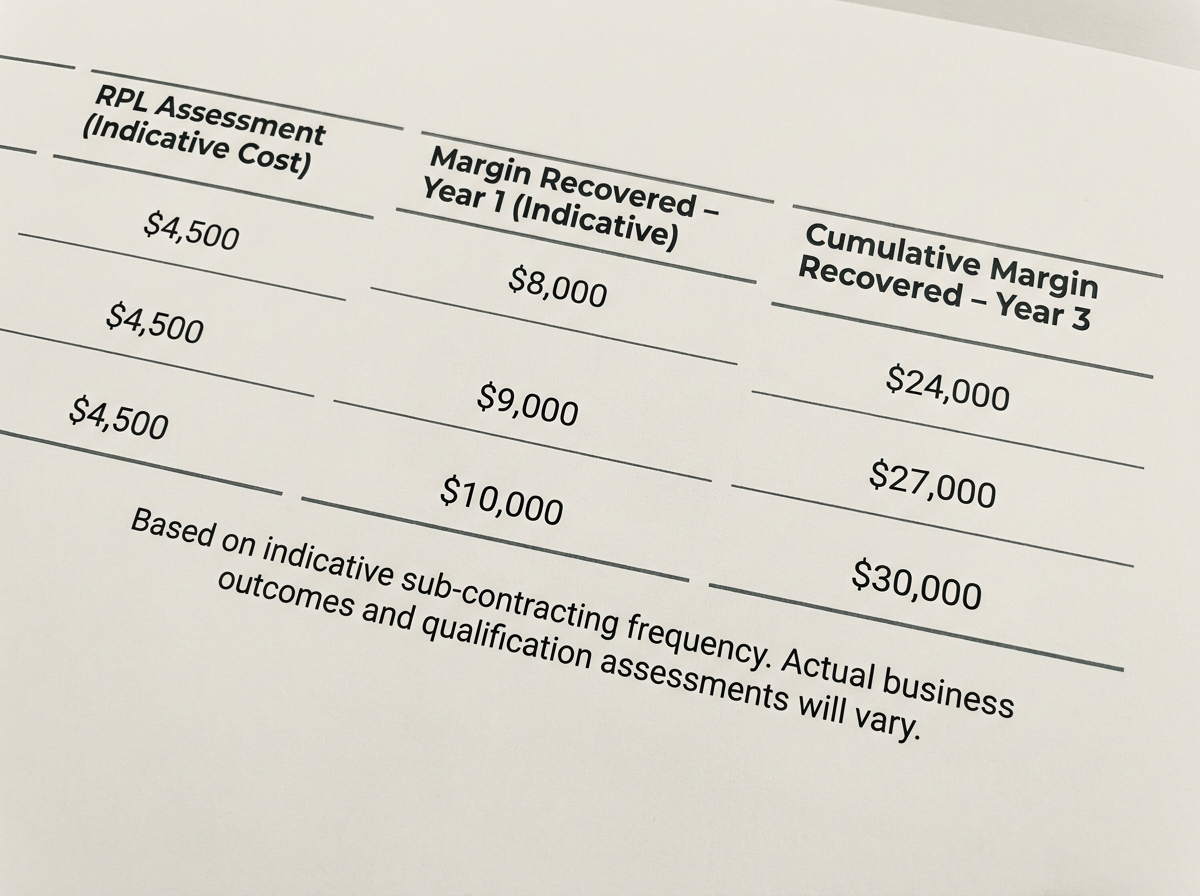
When one of your team members holds the UEE20120 certification, your business gains a new in-house capability. You can complete split system installations without a sub-contractor. You retain the full margin on that component of the job. You eliminate the scheduling dependency. You maintain quality control from start to finish. And you can quote more confidently on jobs that include split system work, knowing you can deliver the whole scope.
The investment required to get a staff member through an RPL assessment for UEE20120 will vary depending on the provider and the individual's background. It is worth getting a clear picture of that cost before making any decisions — which is exactly what the Free Skills Review is designed to help with. The payback calculation is straightforward: how many split system installs does your business sub-contract per year, and what margin are you losing on each one? In most cases, the investment in certification pays back within the first year of recovered margin — sometimes well within it. These are indicative observations, not guarantees, and your specific situation will determine the actual numbers.
There is also a compounding effect. A certified staff member does not just recover margin on one job. They recover it on every split system installation your business completes from that point forward. The certification is a one-time investment. The margin recovery is ongoing.
Understanding how employers are navigating the certification mandate — and what the RPL pathway looks like from a business perspective — is useful context before making any decisions.
How to find out if your staff are RPL-eligible
The first step does not require any commitment. It requires a conversation.
A Free Skills Review assesses whether a staff member's existing experience is likely to support an RPL application for UEE20120. It looks at their background — the type of work they have done, how long they have been doing it, and what evidence they might be able to provide. The outcome is an honest assessment of whether the RPL pathway is viable for that individual. If it is, the next steps become clear. If it is not, you have lost nothing by finding out.
This is not an enrolment. It is not a commitment. It is a starting point — a way to find out whether the investment makes sense before you make it.
Share this article with the staff member you have in mind. Have them start a Free Skills Review. Find out whether their experience qualifies. The decision about what to do next is yours — and theirs.
Ready to Get Recognised?
Start with a free skills review to find out if RPL is right for you.