Stop Thinking 'Study', Start Thinking 'Evidence': The Path to a Certificate II in Split Air Conditioning and Heat Pump Systems
Already installing split systems? The Certificate II in Split Air Conditioning (UEE20120) assesses what you know — not what you study. Here's what RPL assessors look for.
By RPL it Australia9 min read
The wrong mental model is costing you time
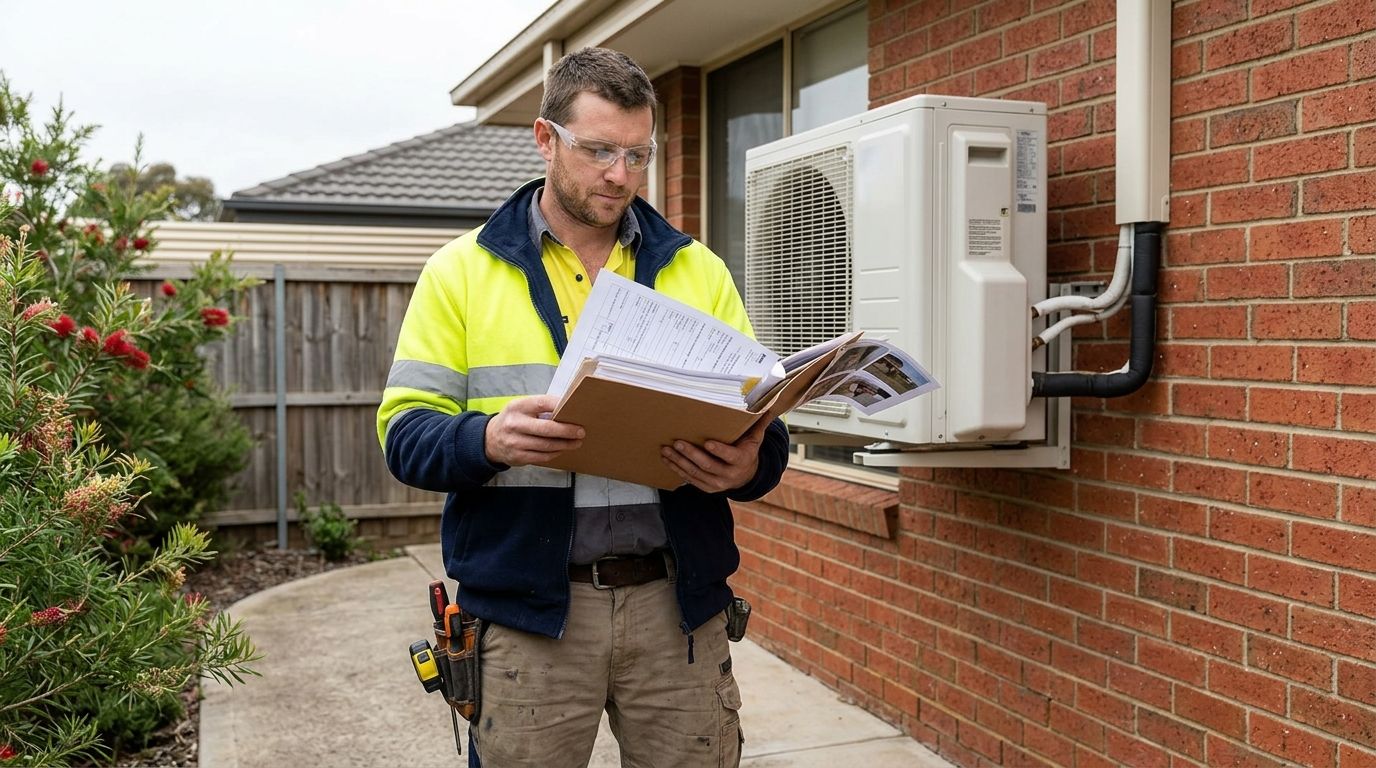
You have been installing split systems for years. Wall-hung units, cassette systems, ducted fan coil configurations — you know the work. You know how to commission a system, handle refrigerant correctly, and sign off on a job that meets Australian Standards. Then someone tells you that you need the Certificate II in Split Air Conditioning and Heat Pump Systems, and your first thought is: when am I supposed to find time to study?
That thought is understandable. It is also the wrong way to look at it — and it is why experienced technicians put this qualification off far longer than they need to.
The Certificate II in Split Air Conditioning and Heat Pump Systems (UEE20120) is not a training program. It is an assessment of competency. The question is not what you need to learn. The question is what you need to show.
If you are dealing with an employer deadline right now, it helps to understand why employers are now requiring this qualification — and what your options are.
What the Certificate II in Split Air Conditioning and Heat Pump Systems actually assesses
The UEE20120 is a nationally endorsed qualification under the UEE Electrotechnology Training Package. It is current — confirmed at release 3 as of December 2022 — and is delivered by Registered Training Organisations (RTOs) across Australia.
The full title is Certificate II in Split Air Conditioning and Heat Pump Systems. The qualification covers the installation, commissioning, and decommissioning of single-head split air conditioning and heat pump systems up to 18 kW. This includes wall-hung, floor-mounted, ceiling-suspended, cassette, and ducted fan coil split systems.
What it does not cover is equally important to understand. The qualification does not extend to service, repair, maintenance, fault diagnosis, or electrical work on commercial refrigeration, air conditioning, and heat pump equipment. It is scoped specifically to installation and commissioning of split systems.
If you have been doing this work — installing and commissioning split systems to industry standard — then the qualification is assessing what you already do. The assessor's job is to verify your competency, not to teach you new skills.
The shift: from 'what do I need to learn?' to 'what do I need to show?'
Recognition of Prior Learning — RPL — is the formal mechanism that allows a qualified assessor to evaluate your existing competency against a qualification's requirements. Under the Australian Qualifications Framework, RPL is an assessment process that evaluates an individual's non-formal and informal learning to determine the extent to which they have achieved the required learning or competency outcomes.
In plain terms: instead of completing a course, you demonstrate that you already meet the standard. The assessor reviews evidence of your existing work and makes a professional judgement about your competency.
You do not need to study air conditioning. You need to prove you already know it.
This is not a loophole or a shortcut. RPL is a rigorous assessment pathway. The standard you are assessed against is exactly the same standard that applies to someone who completed the qualification through traditional study. The difference is that your evidence comes from your working life rather than from a classroom.
What an RPL assessor actually looks for
An RPL assessor for the Certificate II in Split Air Conditioning and Heat Pump Systems is looking for evidence that is valid, authentic, current, and sufficient. These are the four rules of evidence that govern all RPL assessment in the Australian VET sector. Each piece of evidence you provide will be evaluated against these criteria.
Valid means the evidence actually demonstrates the competency being assessed — not just that you worked in the industry, but that you performed the specific tasks the qualification covers. Authentic means the evidence genuinely reflects your own work. Current means the evidence is recent enough to show that your skills are still active. Sufficient means there is enough evidence across the required competency areas to support a confident assessment decision.
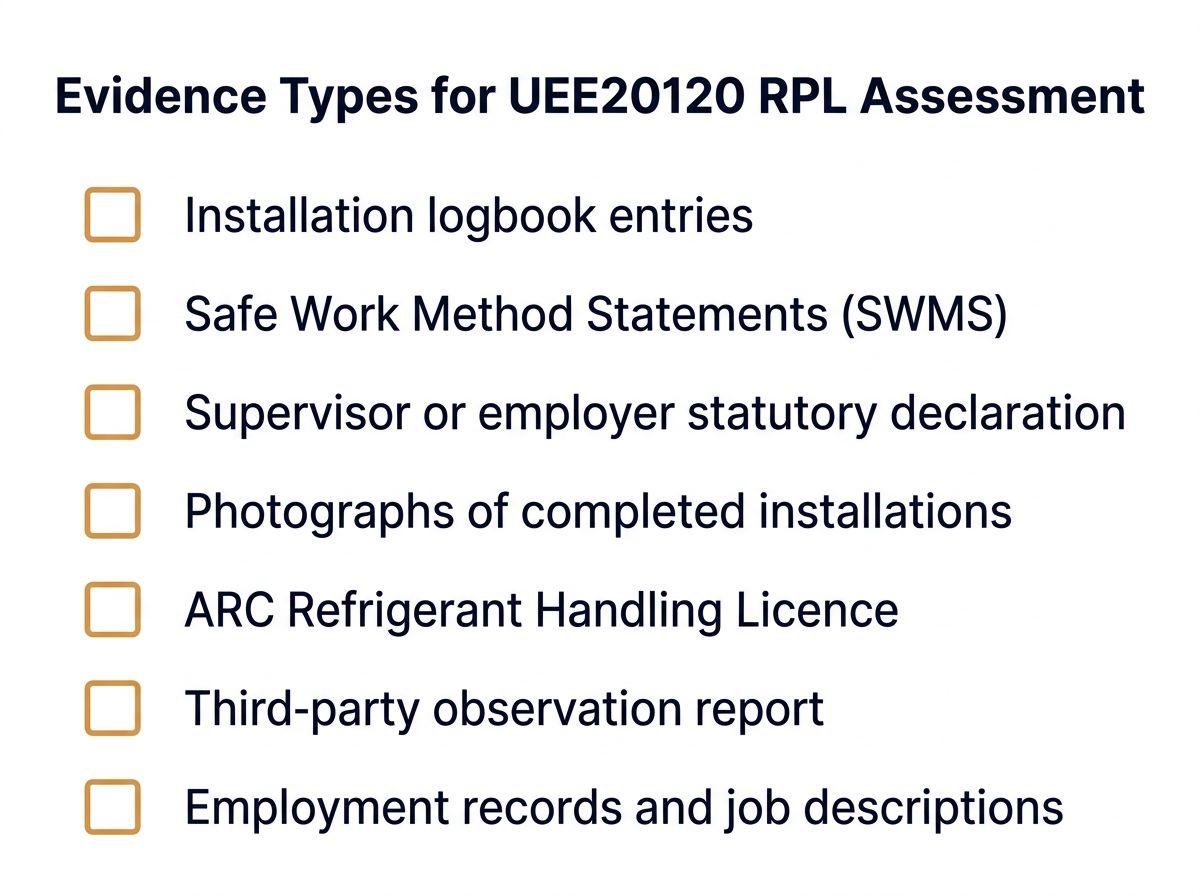
In practice, the evidence types that RTOs typically accept for trade-level RPL include:
- Installation logbook entries — records of split system installations you have completed, including system type, capacity, and date
- Safe Work Method Statements (SWMS) — safety documentation you have prepared or worked under on installation jobs
- Supervisor or employer statutory declarations — written statements from employers or supervisors confirming your role and the work you performed
- Photographs of completed installations — job site photos showing your work at various stages of installation and commissioning
- ARC Refrigerant Handling Licence documentation — your licence or registration with the Australian Refrigeration Council, which is also a prerequisite for enrolling in UEE20120
- Third-party observation reports — where an assessor or supervisor observes you performing the work directly
- Employment records and job descriptions — documentation confirming your employment history and the scope of your role
The assessor maps this evidence against the units of competency within the qualification. Where your evidence clearly demonstrates competency in a unit, that unit is credited. Where evidence is thin or absent, gap training may be required — but more on that shortly.
The evidence you probably already have (and don't realise counts)
Most experienced split system technicians have been generating RPL-eligible evidence throughout their working lives without knowing it. Your daily work has been building your qualification case all along.
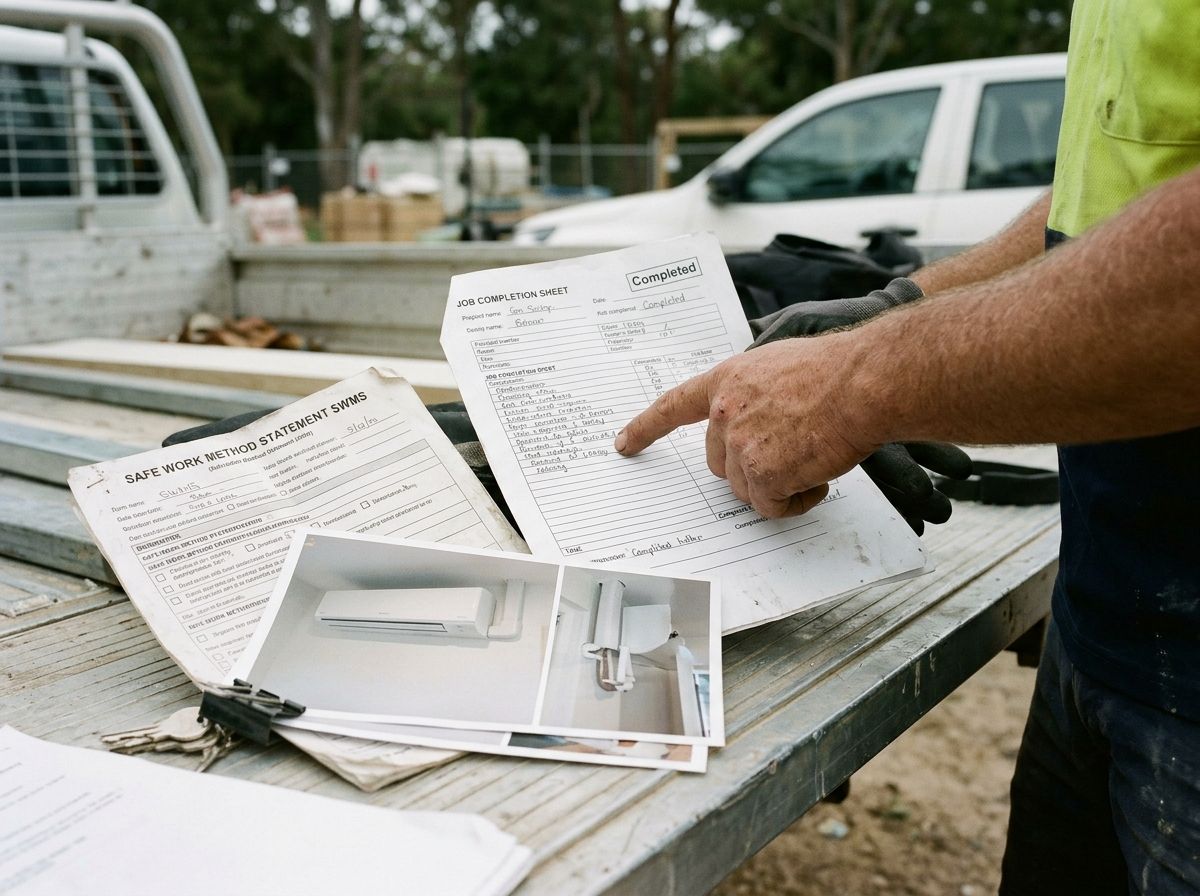
Think about the documentation that already exists from your work. Job completion records and service reports — the paperwork you fill out at the end of every installation. Warranty registration documents that confirm the system was installed and commissioned. Photographs taken for insurance purposes, quality checks, or to show a customer the completed work. SWMS documents prepared for each job site. Employer records showing your role and responsibilities.
None of this was created for an RPL application. But all of it can serve as evidence. The work you have been doing is the curriculum. The records you have been keeping are the portfolio.
One important note on the ARC Refrigerant Handling Licence: this licence is a prerequisite for enrolling in UEE20120, not something you earn through the qualification. If you already hold an ARC licence, you have already met one of the entry requirements. If you hold an electrical licence but not the Certificate III in Electrotechnology, TAFE Queensland notes that you may be able to use an RPL process to meet the entry requirements for the course.
The ARC administers the national refrigerant handling permit scheme and supports over 113,000 licensed technicians and businesses across Australia. If you are already working in the split system space, there is a reasonable chance you already have some form of ARC registration.
What happens if there are gaps?
Not every experienced technician will have complete evidence for every unit of competency. That is a normal outcome of the RPL process, and it does not mean starting the qualification from scratch.
Where gaps are identified, gap training addresses only the specific areas where evidence is insufficient. If your evidence is strong across most units but thin in one or two areas, you would complete targeted training for those areas only — not the full qualification.
Gap training requirements and costs vary by RTO. Some providers include gap training within their RPL process; others charge separately. Before enrolling, confirm with your chosen RTO exactly what their RPL process covers and what additional costs may apply if gaps are identified. This is a reasonable question to ask upfront, and any reputable provider should be able to answer it clearly.
The honest reality is that gap training is a feature of the system, not a failure. It exists because RPL is a genuine assessment — not a rubber stamp. If your evidence is strong, gaps will be minimal. If your evidence is thin in certain areas, gap training ensures the qualification you receive reflects genuine competency.
Is RPL the right pathway for you?
RPL is not suitable for everyone. It is the right pathway for workers who have genuine, demonstrable experience performing the competencies the qualification assesses.
For the Certificate II in Split Air Conditioning and Heat Pump Systems, RPL may be suitable if you:
- Hold a current electrical trade qualification (such as a Certificate III in Electrotechnology Electrician) — UEE20120 is a post-trade qualification designed for qualified electricians
- Have been actively working in split system installation for a meaningful period — general RPL guidelines for trade qualifications typically point to at least three years of relevant full-time experience, though requirements vary by RTO
- Have been working with split systems recently — evidence from the last few years carries more weight than older records
- Can document your work through records, photos, employer references, or other tangible evidence
- Hold or are eligible for an ARC Refrigerant Handling Licence
If you are an experienced electrician who has been installing split systems as part of your regular work, you are likely to be a strong candidate for RPL. The qualification was designed for exactly this situation — qualified tradespeople who need formal recognition of specialist installation skills.
If you are newer to the trade, or if your split system installation experience is limited, RPL may not be the most appropriate pathway. A Free Skills Review will give you an honest assessment of where you stand before any commitment is made.
TAFE Queensland describes UEE20120 as a post-trade qualification for qualified electricians, and notes that RPL is available for those who meet the experience requirements. Source: TAFE Queensland's course information for UEE20120.
The next step: a Free Skills Review
The mental model shift this article describes is straightforward: you do not need to study for the Certificate II in Split Air Conditioning and Heat Pump Systems. You need to demonstrate that you already meet the standard. For experienced split system technicians, that is a very different proposition.
The natural next step is finding out whether your specific experience is sufficient. That is what a Free Skills Review is for. It is a no-obligation conversation that gives you an honest picture of where your evidence is strong, where it might need strengthening, and whether RPL is the right pathway for your situation.
You can also review the qualification details directly on the product page before taking any further steps.
Review the Certificate II in Split Air Conditioning and Heat Pump Systems (UEE20120) qualification page for more detail on the qualification and the RPL pathway.
General information only, current at the date shown. Licensing rules change, so check the current requirements with the relevant regulator before you rely on them. RPL it Australia is a student support service, not a Registered Training Organisation; qualifications are assessed and issued by our partner RTOs.