Your Head of Security is doing diploma-level risk work without the diploma
Many security managers handle risk at CPP50619 level without the actual credential. Learn how RPL secures compliance and tender eligibility.
By RPL it Australia7 min read

The pattern security employers keep encountering
Your Head of Security runs the risk program. They have done so for years. They conduct threat assessments, maintain the risk register, coordinate incident response, and manage business continuity planning. When a contract requires evidence of security oversight, their name goes on the document. When an incident occurs, they lead the response.
The diploma is the only part missing.
This is not an unusual situation. Across government contracting, critical infrastructure, mining, oil and gas, and utilities, experienced security managers routinely perform work that maps directly to the Diploma of Security Risk Management (CPP50619)—without holding the formal credential. The capability is real. The qualification file is empty. This gap is the pattern this article addresses.
This gap needs to be named clearly, because the consequences of leaving it unaddressed are becoming harder to ignore.
What diploma-level security risk work actually looks like
The Diploma of Security Risk Management (CPP50619) is a nationally recognised qualification under the Australian Qualifications Framework. It covers the competencies that define professional security risk management practice: assessing and managing security risks, developing and implementing security risk management plans, managing security operations, coordinating incident responses, and contributing to business continuity planning.
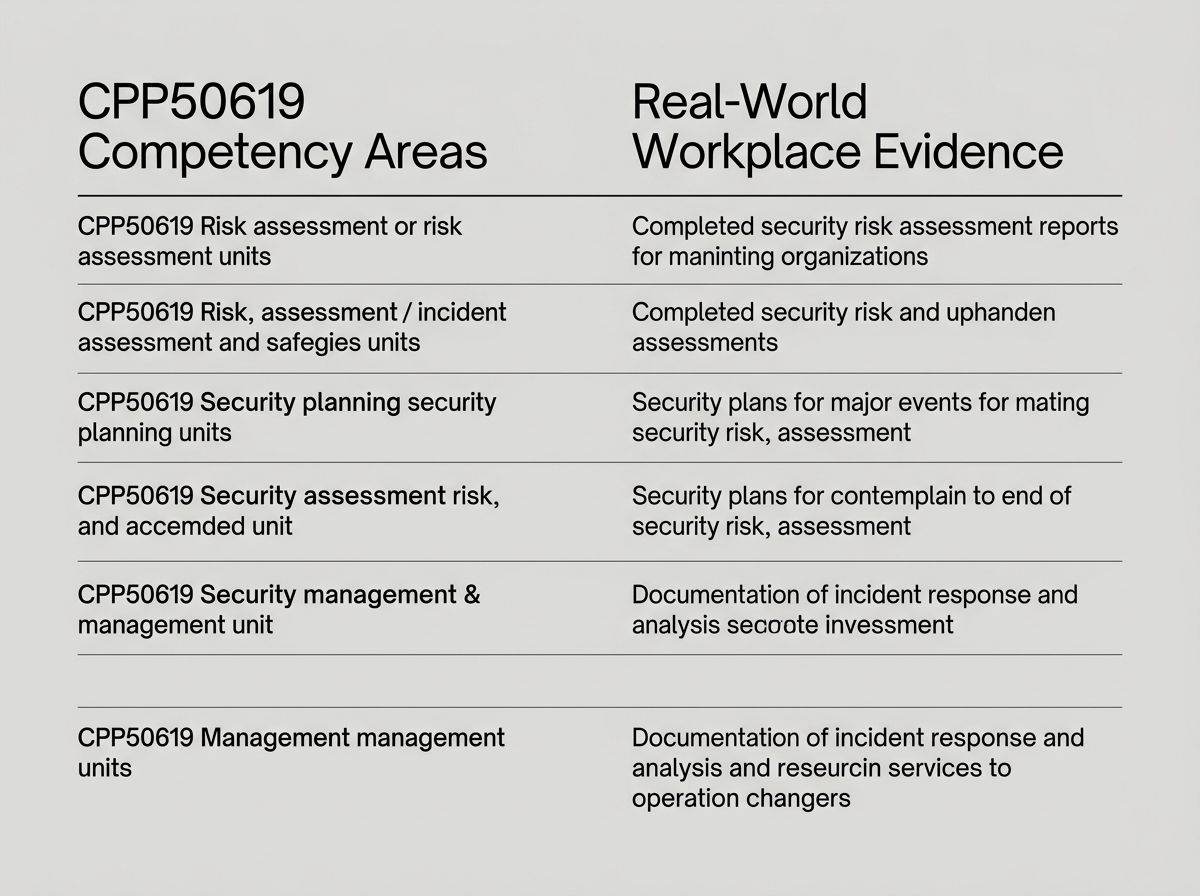
Look at that list again, then consider what your Head of Security actually does each week.
For most experienced security managers in regulated industries, the answer is that they handle all of it. They manage the risk assessment methodology, the threat and vulnerability analysis, the incident coordination, and the documentation that supports business continuity. These are not aspirational competencies—they are the operational reality of the role.
The CPP50619 qualification does not describe a higher level of work than what experienced security managers already do. It describes their current work, formally mapped to assessed competency standards.
The Diploma of Security Risk Management (CPP50619) product page outlines the qualification in full, including the RPL pathway available for candidates with demonstrated experience.
The compliance gap this creates—and why it matters now
The gap between what an experienced security manager does and what their official training record shows creates real exposure for the organisation. This risk usually surfaces in three distinct ways.
The first way is tender and contract eligibility. Government and critical infrastructure contracts increasingly specify formally qualified security personnel as a condition of engagement. When your security manager's CV lists years of experience but lacks the CPP50619, that gap can disqualify a bid—or force you to bring in an external consultant to satisfy the requirement. The capability is in-house, but the credential is not.
The second way is regulatory and compliance exposure. Regulated industries—especially those operating under security frameworks for critical infrastructure, government facilities, or resource sector sites—are subject to increasing scrutiny regarding workforce qualification standards. An experienced security manager without a formal qualification may satisfy day-to-day operational requirements, but they may not satisfy a formal audit or licensing review.
The third way is liability and incident accountability. If a security incident occurs and your organisation is asked to demonstrate that its security risk program was managed by a formally qualified practitioner, an empty credential file creates a difficult question. The experience is real, but documented competency assessment is what formal regulatory systems recognise.
None of these risks require a worst-case scenario to become relevant. They surface in tender evaluations, contract renewals, and compliance reviews—the routine business moments where the credential gap becomes visible.
The same pattern plays out in WHS roles, where experienced safety officers perform Certificate IV-level work without the formal credential, and face the compliance exposure that creates.
Why the gap persists—the cycle that keeps repeating
The credential gap in security management is not caused by negligence. It is a direct result of how the industry has historically worked.
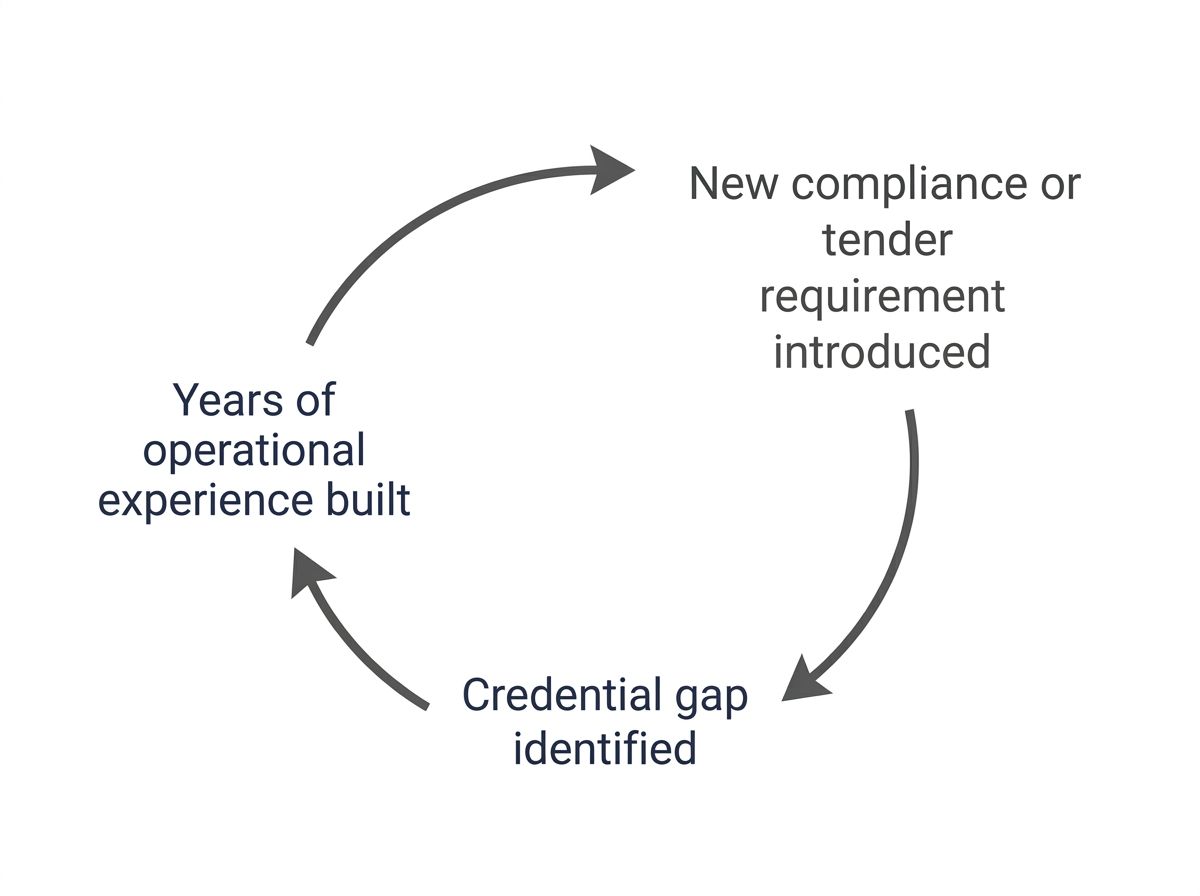
Security management capability in Australia has historically been built through operational experience, including years of working in security operations, incident response, risk program management, and threat analysis. A formal qualification was rarely the entry point into the profession, nor was it required to do the work. For most experienced security managers, the CPP50619 was simply never on their path.
Then the requirement arrived. Contracts started specifying the qualification. Procurement frameworks started referencing it. Licensing reviews started asking for it. The formal credential became a condition of engagement, not because the capability was absent, but because the system needed documented evidence of that capability.
The capability came first, the requirement came later, and the credential file never caught up.
This cycle is not unique to security management. It is the same pattern that produces experienced WHS officers without a Certificate IV, senior IT professionals without an Advanced Diploma, and site supervisors without a formal construction licence. In each case, the work preceded the formal requirement. In each case, the gap is real and closeable.
What RPL looks like for a Head of Security
Recognition of Prior Learning (RPL) is the formal assessment pathway that converts demonstrated experience into a nationally recognised qualification. For an experienced Head of Security, it is the most logical route because the evidence already exists in their daily work.
The documentation that supports a CPP50619 RPL assessment is the same documentation your security manager produces as part of their role: risk registers, threat and vulnerability assessments, incident response plans, business continuity documentation, and security program reports. These are not documents created for the assessment; they are the actual work product of the role itself.
The RPL process guides the candidate through presenting that evidence against the qualification's competency standards. A qualified assessor from a registered training organisation (RTO) reviews the evidence and determines whether the candidate has demonstrated the required competencies. If gaps are identified, gap training is provided at no additional cost to address them before the qualification is issued.
It is worth being clear about what RPL is and is not. It is a genuine assessment process, not a shortcut or a bypass of the qualification's standards. The assessor's judgement is independent, and the qualification is nationally recognised because the assessment is rigorous. What RPL does is allow that assessment to be based on demonstrated workplace competency, rather than requiring the candidate to repeat learning they have already applied in practice.
The CPP50619 RPL pathway is outlined on the Diploma of Security Risk Management product page, including what the assessment process involves and how to begin.
Is your Head of Security a candidate for CPP50619 via RPL?
Not every security manager will be suitable for RPL, as suitability depends on the depth and breadth of their documented experience across the CPP50619 competency areas. A candidate who has been conducting formal risk assessments, managing security programs, coordinating incident responses, and contributing to business continuity planning—and who has documentation to support that experience—is likely to be a strong candidate.
A candidate whose security experience is primarily operational or supervisory, without documented involvement in risk program management or formal assessment methodology, may require some gap training before the qualification can be issued. That is not a barrier; it is simply an honest starting point.
The Free Skills Review is the no-obligation way to find out. It is an honest assessment of whether your Head of Security's experience aligns with what CPP50619 requires, before any commitment is made. If RPL is the right pathway, the review will confirm it. If there are gaps, the review will identify them.
This credential gap pattern appears across many regulated industries. If you see it in your security team, it is worth checking whether it exists elsewhere in your workforce.
The same credential gap pattern in IT teams, where senior staff perform Advanced Diploma-level work without the formal qualification, is explored in detail here.
For organisations preparing for compliance reviews, understanding what auditors check for when qualifications are required is a useful resource to read alongside this article.
The credential gap is closeable
Your Head of Security has the experience, and the CPP50619 is the formal recognition of it. The gap between those two things is real, but it does not have to be permanent.
RPL exists precisely for this situation: experienced practitioners whose capability is demonstrated in their daily work, not in a classroom. The assessment is genuine, the qualification is nationally recognised, and the starting point is an honest conversation about whether the experience is there.
The decision is yours.
General information only, current at the date shown. Licensing rules change, so check the current requirements with the relevant regulator before you rely on them. RPL it Australia is a student support service, not a Registered Training Organisation; qualifications are assessed and issued by our partner RTOs.