The hospitality training package nobody explains to people already running the business
The hospitality training package explained for experienced managers, not students. See what SIT60322 covers and how your experience maps to the qualification.
By RPL it Australia7 min read

The training package was designed for students. You are not a student.
You have managed rosters, negotiated with suppliers, overseen service standards, and kept a venue profitable through seasons that would break most operations. You have done this work for years, possibly for decades. Yet now someone is asking whether you hold the right qualification.
The hospitality training package, which is the national framework governing all hospitality qualifications in Australia, was designed to outline what a qualified professional should be able to perform. It was not written to describe what you already do. This distinction is important for anyone considering Recognition of Prior Learning.
Most explanations of the training package assume you are completely new to the industry. They explain what hospitality is and describe what a manager does. You do not need those basics. What you need is to understand how the system is structured so you can see where your experience sits within it, and what is required to have that experience formally recognised.
What a training package actually is (and why it matters for RPL)
A training package is a nationally endorsed set of standards defining the competencies required for a qualification. It is not a course, nor is it a curriculum. It is a description of what a competent person in a role can do, outlining the skills, knowledge, and performance standards that define capability in that field.
This distinction is important for RPL candidates. When a registered training organisation assesses your application for Recognition of Prior Learning, they do not ask whether you completed a course. They ask whether your existing experience demonstrates the competencies described in the training package. The training package is the benchmark, your experience is the evidence, and the RPL assessment is the process that determines whether they match.
Training packages in Australia are developed by industry reference committees and endorsed by the national body. They are updated periodically to reflect updates in industry practice. The hospitality training package covers tourism, travel, and hospitality, a broad sector with qualifications ranging from entry-level certificates through to advanced diplomas for senior managers.
How the SIT training package is organised and what matters for experienced managers
The SIT Tourism, Travel and Hospitality Training Package contains qualifications at multiple levels. The Advanced Diploma of Hospitality Management, qualification code SIT60322, sits at the top of the hospitality pathway. It reflects the capabilities of someone operating at a senior management level, including overseeing operations, leading teams, managing financial performance, and directing business strategy.
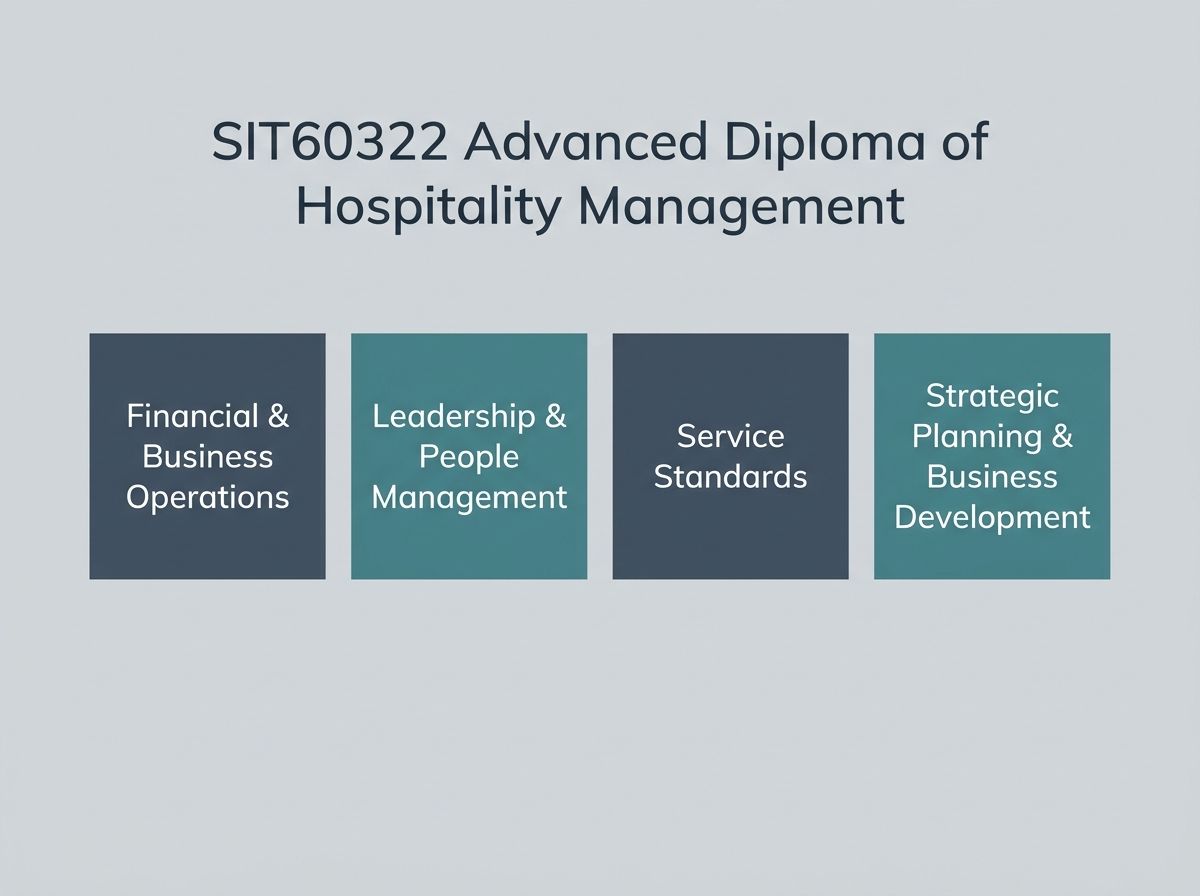
Within SIT60322, competencies are organised into units. Each unit describes a specific area of capability, such as managing financial performance, leading and managing people, developing and implementing business plans, and overseeing service quality. Some units are core requirements for the qualification, while others are electives, allowing the qualification to match the specific context of different hospitality environments, whether that is accommodation, food and beverage, events, or multi-site operations.
For an experienced manager, reading through the unit descriptions in SIT60322 can be a useful exercise. Many of the competencies described are tasks you perform routinely, such as roster management, budget oversight, supplier negotiation, staff performance reviews, and service standard development. The training package describes these as formal competencies, but you know them as your regular weekly tasks.
The important caveat: the specific unit codes, packaging rules, and total unit requirements for SIT60322 should be verified directly on training.gov.au, the official Australian training package registry. Qualification details are updated periodically, and the authoritative source is always the current version on the registry — not any secondary description, including this one.
The gap between what the training package describes and what you have actually done
The training package describes competencies in formal language, while your experience exists in operational reality. The gap between these two is not a gap in your capability; it is a gap in documentation.

RPL is the formal assessment pathway that bridges this gap. A qualified assessor from a registered training organisation reviews evidence of your actual work against the competency standards in the training package. They do not require a formal academic transcript; they require proof that you can perform what the qualification outlines.
This evidence varies by qualification and by RTO. For a senior hospitality manager, it can include position descriptions, performance reviews, financial reports you have prepared or managed, staff rosters, operational procedures you have developed, references from employers or peers, and records of projects you have led. The assessor determines whether that body of evidence demonstrates the competencies in SIT60322.
To be clear about this process, the delivering RTO's assessor makes the assessment determination. RPL it guides and supports candidates through the process, helping you understand what evidence is needed, how to compile it, and how to present it clearly. However, the assessment itself is conducted by a qualified assessor from the RTO. That rigour is what makes the resulting qualification nationally recognised.
Gap training is also a possibility. If your experience is strong in some areas of SIT60322 but lighter in others, an assessor may identify specific units where additional evidence or training is needed. This is an honest assessment rather than a failure, and it is far more efficient than repeating work you have already demonstrated.
If you are still working out whether RPL applies to your situation, this is worth reading first.
What the training package does not tell you (but experienced managers need to know)
The training package sets the standard, but it does not explain how to present your experience against it.
It does not show which of your specific roles and responsibilities map directly to which units. It does not tell you whether managing a 200-seat restaurant generates different evidence than overseeing a boutique hotel or running a catering operation. It also does not outline what an assessor will find sufficient.
Translating the formal language of the training package into the operational reality of your career is where professional guidance helps. Peak industry bodies in Australian hospitality do not publish detailed RPL guidance for individual qualifications. This translation is not standardized; it depends on your specific background, the RTO you use, and how the assessor maps your evidence to the competency standards.
This is not a reason to avoid RPL, but it is a reason to approach the process with support rather than alone. The training package gives you the destination, and guidance helps you work out the route from where you are.
Why this matters more than most RPL guides admit
Most RPL guides skip the training package entirely. They jump straight to gathering your evidence without explaining what you are gathering that evidence for. That approach works if you already understand what you are being assessed against, but for experienced managers who have never used the VET system, it leaves a major gap.
Understanding what you are being assessed against is the difference between RPL evidence that fits and evidence that misses the mark. A position description demonstrating strategic leadership maps to different units than one demonstrating operational supervision. A financial report showing P&L accountability maps differently than one showing budget tracking. The training package clarifies what the assessor is looking for, and without that understanding, you are assembling evidence without knowing the target.
This structure is not designed to exclude experienced practitioners. The rigour is there to ensure the qualification remains valuable, proving that the person who holds SIT60322 has demonstrated the competencies it describes. For someone who has spent years building those competencies through real work, that rigour is not an obstacle; it is the process that makes the recognition meaningful.
What to do with this understanding
Understanding the training package structure is the first step. The second is knowing whether your specific experience matches the units in SIT60322.
You do not have to answer that question alone. A qualified assessor should evaluate this with you, based on your background, your roles, and the evidence your career has generated. The training package outlines what the qualification requires, and a professional guide helps you see whether your experience meets that standard.
Your skills are clear. The question is whether they are documented formally, on paper, so that the next employer or opportunity can recognise them. That is the purpose of RPL, and it starts with a straightforward conversation about where you stand.
General information only, current at the date shown. Licensing rules change, so check the current requirements with the relevant regulator before you rely on them. RPL it Australia is a student support service, not a Registered Training Organisation; qualifications are assessed and issued by our partner RTOs.