Your Overseas Hospitality Experience Is Real — Here's How SIT30622 Recognises It
Worked in restaurants, cafés or hotels overseas? SIT30622 can formally recognise that experience in Australia. Here's how the RPL pathway works — and what counts as evidence.
By RPL it Australia8 min read

The gap has a name — and it's not about your skills
You've run a section in a busy restaurant. You've managed a hotel front desk through peak season. You've worked a café service from open to close, day after day, in a professional kitchen that demanded real skill. Back home, that experience meant something. Here in Australia, you're being told it doesn't count.
That moment — when an employer, a visa adviser, or a registration body tells you your overseas hospitality experience isn't formally recognised — has a name. Call it the Hospitality Recognition Gap. It's the space between what you can demonstrably do and what the Australian system can currently see.
The Hospitality Recognition Gap is not a skills problem. You have the skills. The issue is that your competency hasn't yet been assessed against Australian standards — and until it has, formal systems treat it as invisible. That's a design problem with the system, not a judgment on your capability.
This article is about closing that gap. Specifically, it's about SIT30622 — the Certificate III in Hospitality — and how Recognition of Prior Learning (RPL) uses your existing work history as the evidence base for formal Australian recognition.
What SIT30622 actually is — and why it matters for your situation
SIT30622 is the Certificate III in Hospitality — the nationally recognised qualification that covers the skills Australian employers and visa systems use as the benchmark for professional hospitality work. It sits within the Australian Qualifications Framework (AQF) and is delivered by Registered Training Organisations (RTOs) across the country.
The qualification covers the competencies expected of someone working in a professional hospitality environment — customer service, food and beverage service, responsible service of alcohol, working effectively in a hospitality context, and communication with customers and colleagues. These are not beginner skills. They are the skills of someone who has worked in a professional hospitality setting and knows how to operate within it.
If you've worked in a restaurant, café, hotel, bar, or catering environment — managing service, handling guests, working a section, or supporting kitchen operations — the competencies described in SIT30622 are likely a description of work you already do. The qualification is not above you. It is a formal description of what you already know.
Why your overseas experience doesn't automatically count — and why that's a system problem, not a skills problem
The Australian Qualifications Framework requires that competency be formally assessed against national standards before a qualification can be issued. Overseas qualifications and work history — no matter how substantial — are not automatically equivalent to an Australian qualification. This is not because the skills are inferior. It is because the formal assessment against Australian standards hasn't happened yet.
The issue is not whether your skills are real. The issue is whether they have been formally assessed against Australian standards. Those are two different things — and understanding that distinction is the first step toward closing the gap.
This matters in practice. Australian employers in hospitality increasingly require formal qualifications for certain roles. Visa points systems and skills assessment bodies reference Australian qualification codes. Without SIT30622 or an equivalent, your overseas experience — however deep — may not satisfy those requirements, regardless of what you can actually do.
RPL exists precisely to address this. It is the formal mechanism within the Australian training system that allows an assessor to evaluate your existing skills and knowledge — including skills gained through overseas work — against the units of a qualification. If your evidence demonstrates competency, the qualification can be awarded. Your experience becomes evidence. That's the pathway.
If you're unsure whether your overseas background will be recognised before committing to anything, read our guide on how to check whether your overseas experience counts.
What counts as evidence: the work history you already have
RPL assessors for SIT30622 typically accept the following types of evidence from overseas hospitality workers:
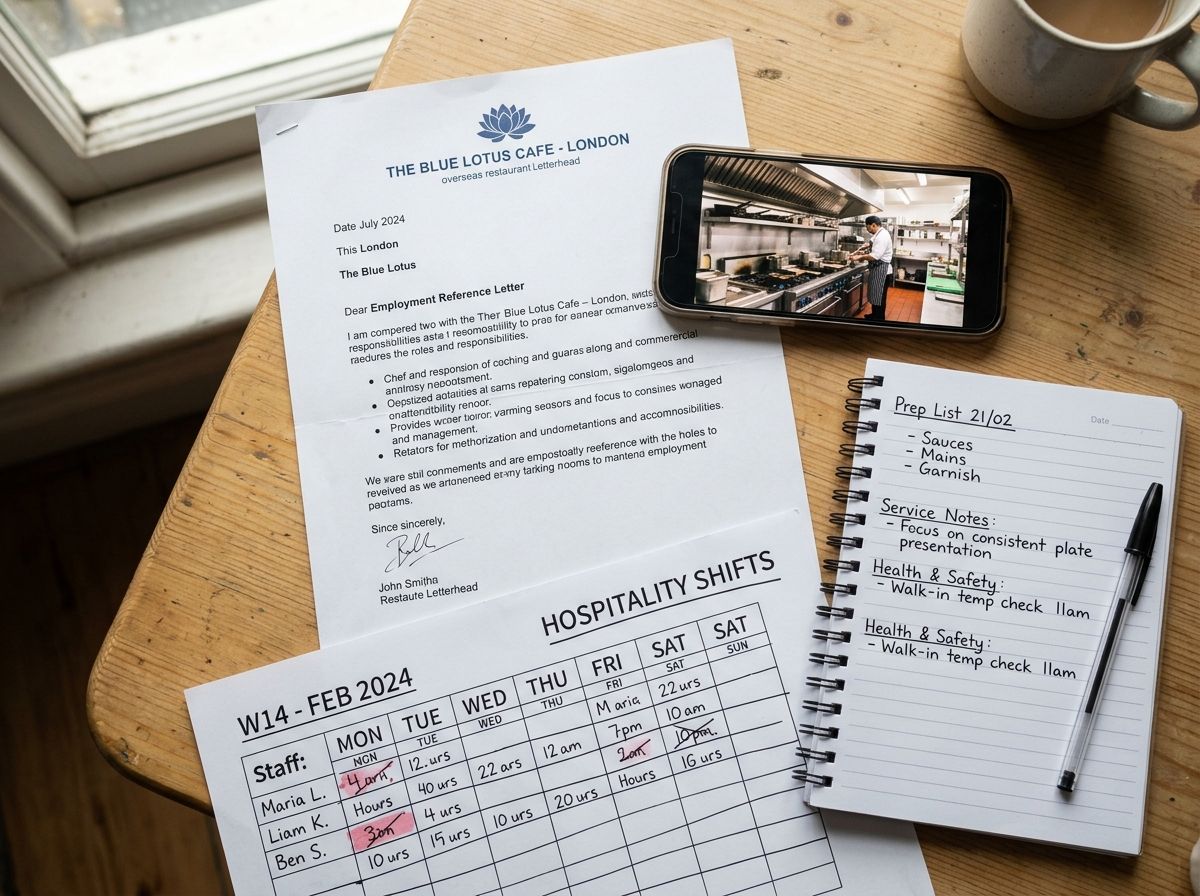
- Employment records — letters of employment, contracts, or written confirmation from previous employers stating your role, responsibilities, and duration of employment
- References from overseas managers or supervisors — written statements describing the work you performed and the standard to which you performed it
- Payslips or pay records — confirming employment in a hospitality role over a sustained period
- Photos of your work environment — images of the kitchen, service area, or hospitality setting where you worked, particularly if they show your role or responsibilities
- Menus, rosters, or operational documents — materials that show the type of establishment and the level of service you were involved in
- Training certificates or records from overseas — any formal or informal training you completed, even if not Australian-recognised
- Third-party reports — statements from colleagues, customers, or industry contacts who can speak to your competency
You likely have more evidence than you realise. Employment records, references, and photos of your work environment are the most common starting points. Documents in languages other than English may be accepted, though you should check with your RTO whether certified translation is required — requirements can vary.
The goal of evidence gathering is not to recreate your overseas career on paper. It is to give an assessor enough material to evaluate whether your skills and knowledge meet the competency standards described in SIT30622. Knowing what to collect and how to present it makes this process significantly more manageable.
How the SIT30622 RPL process works — step by step
The RPL process for SIT30622 follows a structured pathway. Here's how it typically works:
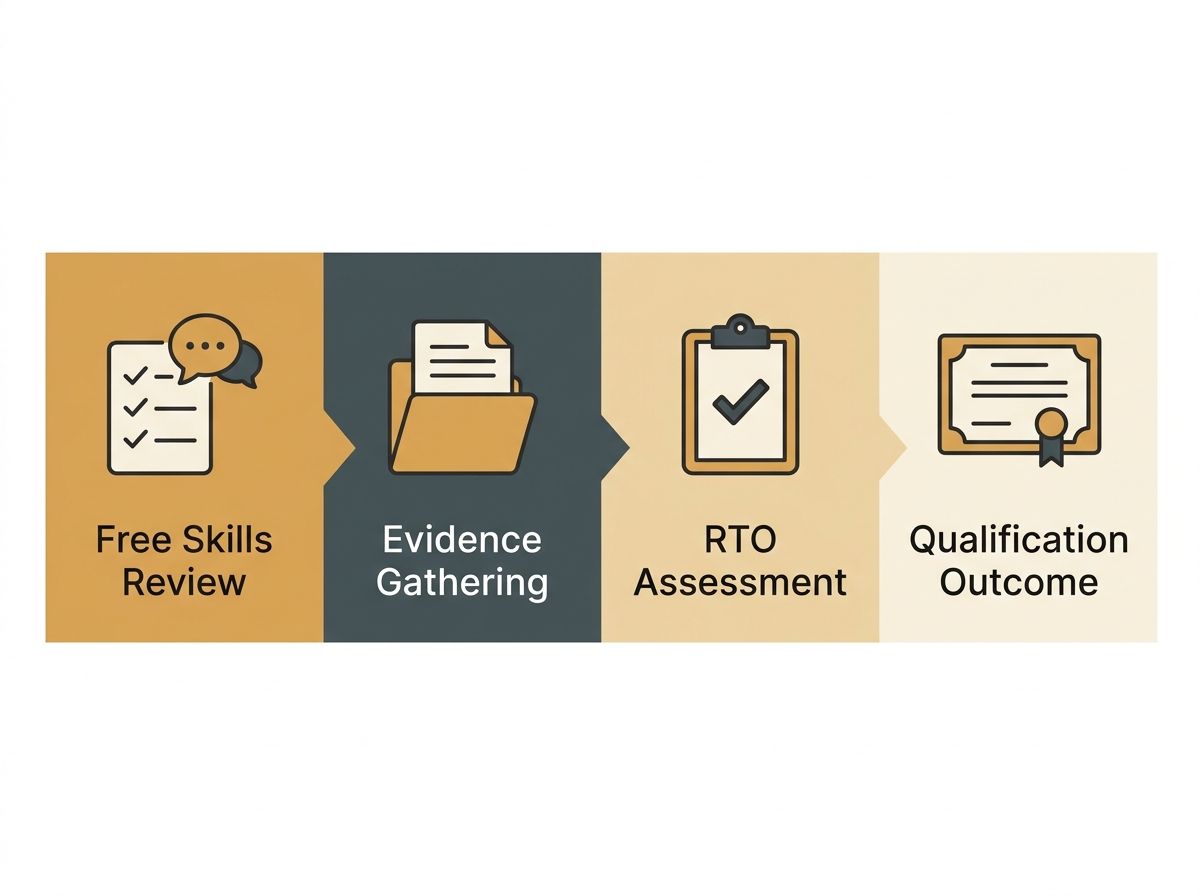
- Step 1 — Free Skills Review: You discuss your background, work history, and the types of evidence you have available. This is the starting point — a no-obligation conversation that helps identify whether RPL is likely to be suitable for your situation.
- Step 2 — Evidence gathering: With guidance, you compile the documentation that supports your application — employment records, references, photos, and any other relevant materials. RPL it guides you through this process so you know what to collect and how to present it.
- Step 3 — Assessment by a Registered Training Organisation: A qualified assessor from a registered RTO reviews your evidence against the units of SIT30622. The assessment is conducted by the RTO — not by RPL it. The assessor's professional judgement determines the outcome.
- Step 4 — Qualification outcome: If your evidence demonstrates competency across the required units, the RTO issues the SIT30622 qualification. If gaps are identified, gap training may be required — this is provided at no additional cost and covers only the areas where your evidence didn't fully demonstrate competency.
The timeline varies depending on how quickly evidence can be gathered and how the RTO schedules assessments. It is not instantaneous, and we won't pretend otherwise. What RPL does is remove the requirement to repeat learning you've already done — the process is built around your existing experience, not a classroom schedule.
SIT30622 is a nationally recognised qualification under the Australian Qualifications Framework. A qualification issued through RPL carries the same standing as one completed through traditional study.
Learn more about the SIT30622 RPL pathway and what the process involves on the qualification page.
Who this pathway is — and isn't — for
RPL for SIT30622 suits people with substantial, documented hospitality work experience. The types of roles that typically generate sufficient evidence include:
- Restaurant service staff — waitstaff, floor supervisors, section managers
- Café operations — baristas, front-of-house staff, café supervisors
- Hotel front desk and guest services — reception, concierge, guest relations
- Bar and beverage service — bartenders, bar supervisors
- Kitchen support roles — kitchen hands, commis chefs, food preparation staff
For RPL to be a realistic pathway, your experience generally needs to be sustained — not a brief stint, but a meaningful period of professional work in a hospitality environment. You also need to be able to document that experience in some form. Roles with no paper trail — no employment records, no references, no documentation of any kind — are harder to support through RPL.
RPL is not a shortcut for people with minimal experience. It is a rigorous assessment pathway that requires genuine evidence of genuine competency. If your background is specifically in patisserie rather than general hospitality, a different qualification pathway may be more appropriate — the SIT31021 Certificate III in Patisserie has its own RPL route worth exploring.
If your background is specifically in patisserie, read our guide for overseas-trained pastry chefs navigating the Australian system.
Not sure whether your specific experience and documentation are sufficient? That's exactly what the Free Skills Review is for — an honest, no-obligation assessment of whether RPL is likely to work for your situation.
The next step: find out if your experience qualifies — before you commit to anything
Your experience is real. The question is whether it has been documented in a way that works for Australian assessment — and whether the evidence you have is sufficient to support an SIT30622 RPL application.
That's what the Free Skills Review helps you find out. It costs nothing and there's no obligation — it's not an enrolment form, not a sales process. You describe your background and what documentation you have. We tell you honestly whether RPL is likely to be a suitable pathway for your situation.
Recognition shouldn't require starting over. If your overseas hospitality experience is real — and it is — the pathway to formal Australian recognition exists. The Free Skills Review is where that pathway begins.
The decision is yours.
General information only, current at the date shown. Licensing rules change, so check the current requirements with the relevant regulator before you rely on them. RPL it Australia is a student support service, not a Registered Training Organisation; qualifications are assessed and issued by our partner RTOs.