SIT30622 Certificate III in Hospitality: What counts as evidence if you trained overseas
Worked in hospitality overseas? Learn which documents count as RPL evidence for the SIT30622 Certificate III in Hospitality in Australia.
By RPL it Australia10 min read

Why your overseas hospitality experience exists in the wrong form
You have the experience. Years of it. You have worked the floor, managed a section, handled a full-service rush, and kept guests happy when things went sideways. Back home, that counted for something. Here, it can feel like it counts for nothing because it is in a format the Australian qualification system does not read.
That is the frustration. To be clear, the issue is not your capability. The issue is that your experience has not been translated into a format Australian employers and visa assessors recognise. Recognition of Prior Learning (RPL) is this translation process.
For the SIT30622 Certificate III in Hospitality, this translation happens through evidence. You need documentation showing you can perform the tasks the qualification covers to the required standard. This guide answers a practical question: if you trained and worked overseas, what documentation do you likely have, and what does each piece prove to an assessor?
What SIT30622 covers and why your work probably maps to it
The SIT30622 Certificate III in Hospitality is the national Australian qualification for front-line hospitality workers. It covers the skills and knowledge expected of someone working in food and beverage service, accommodation, or a related hospitality role. This is not management level, but competent, professional operational work.
In practical terms, the qualification addresses core operational tasks like serving food and beverages to guests, working safely in a busy environment, communicating effectively with customers and colleagues, handling cash and payments, preparing and presenting drinks, and working as part of a service team. If you have worked as a waiter, bartender, café attendant, or hotel front desk officer in any country, the tasks you performed day-to-day will likely map closely to what SIT30622 assesses.
The qualification does not require you to have worked in Australia. It requires you to show that you can perform the relevant tasks to the required standard. This happens through evidence, and that evidence can come from overseas employment.
Review the full SIT30622 qualification details on the RPL it qualification page.
Note: qualification codes in the Australian VET system are periodically updated. Before proceeding with an RPL application, confirm the current status of SIT30622 with your registered training organisation (RTO). If the qualification has been superseded, your assessor will advise on the current code and how your evidence applies.
What Australian RPL assessors look for
RPL assessors are not looking specifically for Australian documents. They look for evidence of competency. They need proof that you can perform the required tasks to the standard, regardless of where or how you learned to do them.
In the Australian VET system, RPL assessment is a formal process conducted by a qualified assessor from an RTO. The assessor's role is to gather enough evidence to make a professional judgement about whether you are competent in the units that make up the qualification. That evidence can take many forms, including overseas employment, overseas training, or a combination of both.
Generally, RPL evidence falls into two broad categories. Primary evidence is direct proof of competency, such as a practical assessment where you perform tasks in front of an assessor, or a portfolio of work. Secondary evidence consists of supporting documents that back up your claims, such as employment records, references, and prior qualifications. For overseas-trained applicants, secondary evidence is often the starting point, which the assessor may supplement with questions or practical tasks to address any gaps.
The main principle is that overseas documentation is not automatically disqualified. What matters is whether it is specific, verifiable, and relevant to the units being assessed. A payslip from a restaurant in the Philippines, a reference letter from a hotel manager in India, or a food safety certificate from a training provider in Vietnam can all form part of an RPL evidence package, provided they are clear and authentic.
Requirements vary between RTOs. The guidance below reflects general RPL practice in the Australian VET sector. Your assessor will advise on what they need from you.
Payslips: What they prove and what they do not
Payslips from overseas employers are useful supporting evidence. They confirm specific, verifiable facts: your employer's name, contact details, employment dates, job title, and pay rate. These facts establish that you worked in a hospitality role for a defined period at a real business.
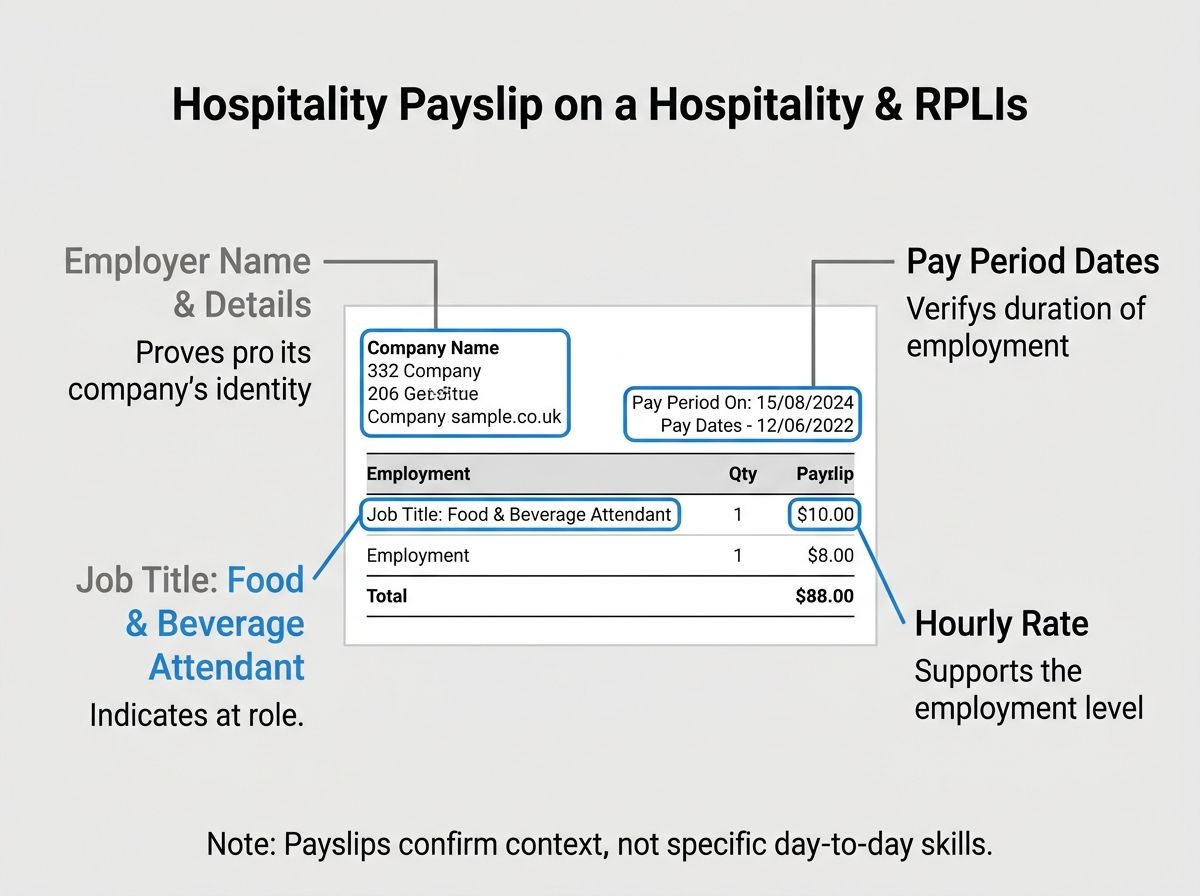
What payslips do not confirm on their own is what you actually did in that role. A payslip listing your title as 'Food and Beverage Attendant' tells an assessor you held that position. It does not show whether you served tables, handled complaints, prepared drinks, or worked in a high-volume environment. That detail must come from other documents.
This is not a reason to discount your payslips. They act as corroborating evidence by verifying the employment context described in your other documents. Gather as many payslips as you have, covering as much of your employment history as possible.
If your payslips are not in English, you will likely need them translated. Requirements vary between RTOs. Some accept informal translations, while others require certified translation by a NAATI-accredited translator. Check with your RTO before submitting. Do not assume untranslated documents are acceptable, but do not assume they are useless either. It is best to ask.
Employer letters: The most useful document you might not have requested
A detailed employer letter is often the most useful document in an overseas RPL application for SIT30622. Unlike a payslip, an employer letter describes your specific work, the tasks you performed, your level of responsibility, your work environments, and your duration of service.
What makes an employer letter useful is detail. A letter stating 'Priya worked for us from 2018 to 2022 as a waitress' is less helpful than one stating 'Priya worked as a senior food and beverage attendant from 2018 to 2022. Her responsibilities included taking orders, serving tables, handling customer complaints, training new staff, and operating the point-of-sale system during peak service periods.' The second letter gives an assessor clear evidence to work with.
If you are in contact with a former employer or supervisor, it is worth requesting a letter even if your employment ended years ago. Many employers are willing to provide retrospective letters. When you contact them, explain what the letter is for and ask them to describe your specific duties and responsibilities, rather than just listing your job title and dates.
If the letter is written in a language other than English, the translation rules are the same as for payslips. Check with your RTO about their specific requirements. Some RTOs accept a translated letter accompanied by the original, while others have different policies.
If you cannot get a formal letter because the employer has closed or contact has been lost, a written statement from a colleague who observed your work can help. This is not identical to an official employer letter, but it still has value. Discuss these options with your assessor.
References: How third-party confirmation strengthens your evidence
You can submit professional references from overseas supervisors, managers, or colleagues who observed your work as part of your SIT30622 RPL evidence. These work differently from employer letters. Rather than just confirming employment dates, they describe your actual performance. A reference from someone who observed your work adds an independent perspective that an assessor cannot get from your personal documents.
A practical reference for RPL describes what the referee observed, such as how you handled service, interacted with customers, performed under pressure, and demonstrated your skills. Generic phrases like 'Priya was a pleasure to work with' are less useful than specific statements like 'Priya consistently managed a section of twelve tables independently during busy dinner services and was trusted to train new staff.'
Overseas referees can present practical challenges, such as different time zones, language barriers, and the passage of time. These are real obstacles, but RPL assessors working with overseas-trained applicants are familiar with them. If a referee is not comfortable writing in English, a translated reference accompanied by the original is often acceptable. Confirm this with your RTO.
Some RTOs contact referees directly by phone or email to verify details. If this is likely, let your referees know in advance so they are prepared for contact from an Australian organisation.
If you are looking at overseas evidence across other industries, our article on what counts as evidence when you trained overseas in security and real estate covers similar principles in a different context.
Other documents that can support your application
Beyond payslips, employer letters, and references, other documents can strengthen your RPL application. Check your records for any additional proof from your overseas employment and training history.
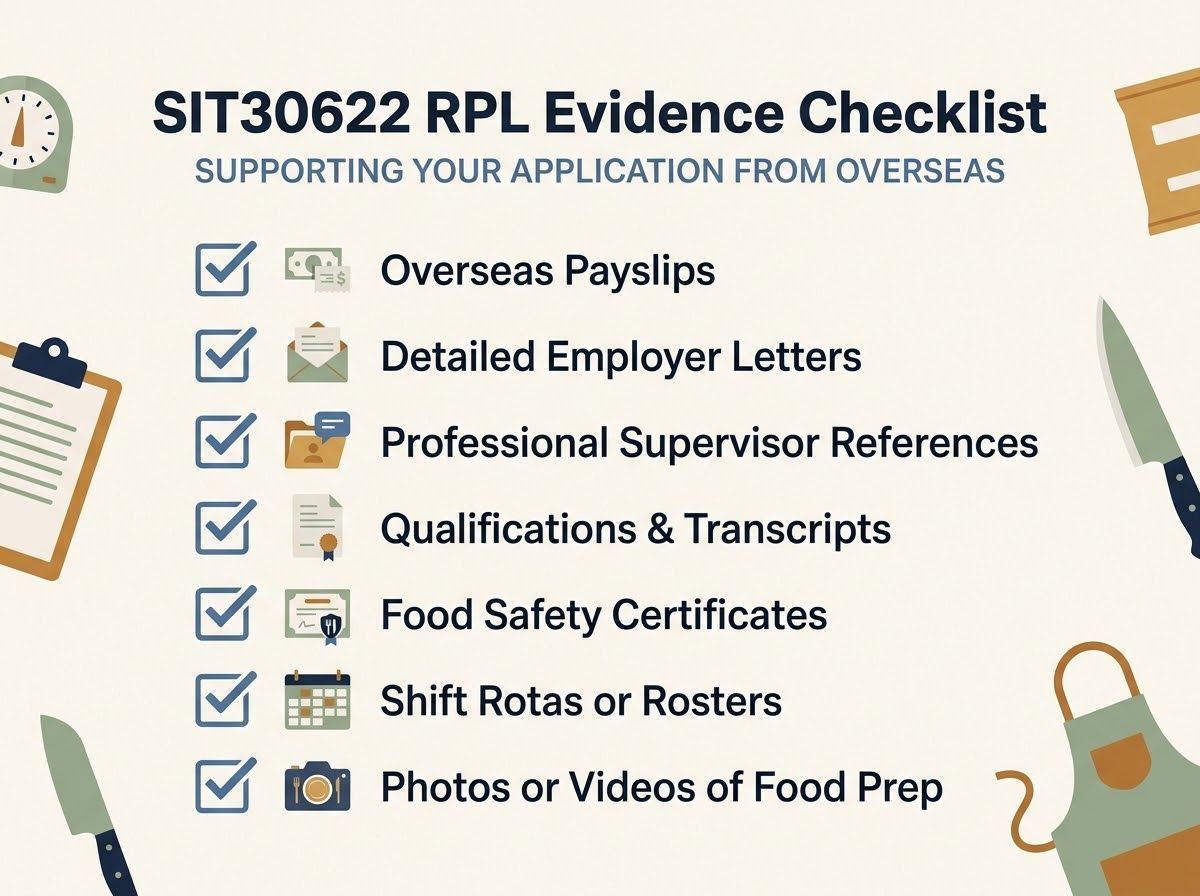
- Overseas qualifications and transcripts: A hospitality diploma, certificate, or apprenticeship completion from your home country may be accepted as supporting evidence, even if it is not formally recognised by Australian authorities. It demonstrates that you received structured training in the relevant skills.
- Food safety or hygiene certifications: If you completed food handling, HACCP, or similar training in your home country, the certificate demonstrates relevant knowledge. Translation may be required.
- Training records or course completion documents: Any documented training relevant to hospitality service, customer interaction, or workplace safety can support your application.
- Awards, commendations, or performance reviews: Formal recognition of your work from a previous employer can corroborate the quality of your performance, not just its existence.
- Photographs of your work environment: Some RTOs accept photographs as supplementary evidence, particularly where they illustrate the scale or complexity of the environment you worked in. Check with your assessor before relying on these.
- Contracts of employment: An employment contract that specifies your duties and responsibilities can serve a similar function to an employer letter, particularly if a retrospective letter is not obtainable.
The goal is to build a clear, corroborated account of your hospitality experience that an assessor can use to make a professional judgement about your competency. No single document is likely to be sufficient on its own. The strength of your RPL application comes from combining various evidence types, with each confirming a different dimension of your working history.
What happens if you do not have everything: Gap training
Many overseas-trained applicants will not have a complete set of documents. Some evidence might be missing. A former employer may be unreachable, old payslips might be lost, or a certificate may have been misplaced. This is a normal reality and does not disqualify you from the process.
An RPL assessment identifies both what you can demonstrate and what you cannot. When an assessor finds that your evidence does not fully establish competency in a particular unit, they will identify a gap. Gap training addresses that specific area. It is targeted, focusing only on the units where evidence is insufficient, so you do not have to repeat learning you have already proven.
Gap training is a standard part of the RPL process for many applicants. It does not mean your experience is invalid. It simply means the available evidence does not fully cover every unit, and some additional learning or assessment is required. The extent of gap training varies depending on the units involved, your documents, and the assessor's professional judgement.
What gap training involves, including its format, duration, and cost, varies between RTOs. Ask your RTO to explain their approach to gap training before you enrol. Understanding this upfront helps you make an informed decision about whether this pathway is right for you.
The decision to proceed is yours, but you do not have to make it without knowing where you stand.
The first step: Finding out where you stand before committing
You have read through the evidence types and have a sense of what documents you hold or might be missing. The next practical question is whether what you have is sufficient for an SIT30622 RPL application.
That question deserves an honest answer based on your specific situation, not a generic checklist. A Free Skills Review is the way to get that answer. It is a no-obligation assessment of your background and documentation, designed to give you a clear picture of where your overseas experience stands before you spend money.
You can also review the full SIT30622 Certificate III in Hospitality RPL pathway before taking the next step.
General information only, current at the date shown. Licensing rules change, so check the current requirements with the relevant regulator before you rely on them. RPL it Australia is a student support service, not a Registered Training Organisation; qualifications are assessed and issued by our partner RTOs.