The 'Start From the Bottom' Myth: Why Cross-Industry Experience Gets Lost in Translation
Told to start junior despite years of experience? Your competence isn't the issue. Here is why skills get lost, and how RPL in Australia fixes it.

The moment that stops you cold
You have been managing professional teams for a decade. You have run operational budgets, negotiated directly with suppliers, handled complex compliance, and solved problems that would stump most university graduates. You know this work inside out because you have spent years doing it. Yet, when you apply for a role in a different industry—one that uses the exact same skills under a different title—you are told you must start as a junior.
This happens every day to hospitality managers trying to move into event management. It happens to logistics coordinators moving into construction project management, and to healthcare administrators moving into community services. The core skills are identical, but the vocabulary is completely different. The recruitment system, it turns out, is simply not built to tell the difference.
That frustrating moment—being told to 'do your time' when you have already spent years doing it—does not reflect your actual competence. It is a symptom of a systemic translation failure in how companies hire. It deserves to be recognized as exactly that.
You are not the problem. The translation system is.
When a hiring manager tells a cross-industry candidate to start at the bottom, they are rarely making a personal judgment about that applicant's capability. They are simply doing what the recruitment system has trained them to do: screen for credentials rather than evaluate actual competence. Australian hiring processes, from job descriptions and interview structures to automated software, are built entirely around industry-specific qualification codes. They are simply not designed to map adjacent skills from other sectors.
Applicant tracking systems filter resumes against rigid keyword lists and qualification codes. If your application does not contain the expected credential identifier, the software filters you out automatically, regardless of how relevant your actual experience is. Furthermore, interview panels are typically made up of industry insiders who are fluent in their own terminology but lack any formal framework to evaluate equivalent skills expressed in a different industry's language. This is not a fair assessment of capability; it is a translation failure.
Your competence is real, but the recruitment system cannot read it. Those are two entirely different problems, and only one of them is yours to solve.
This structural gap is what we call the experience exchange rate problem—the invisible barrier that discounts your years of experience the moment you cross an industry line.
Why your experience speaks fluent competence with a foreign accent
Consider a hospitality manager who has spent a decade running a busy, high-volume restaurant. They have managed a team of twenty staff, run six-figure operational budgets, negotiated supplier contracts, maintained strict food safety compliance, and resolved customer complaints under heavy pressure. These are not vague soft skills. They are direct, measurable operational capabilities that keep a business profitable.
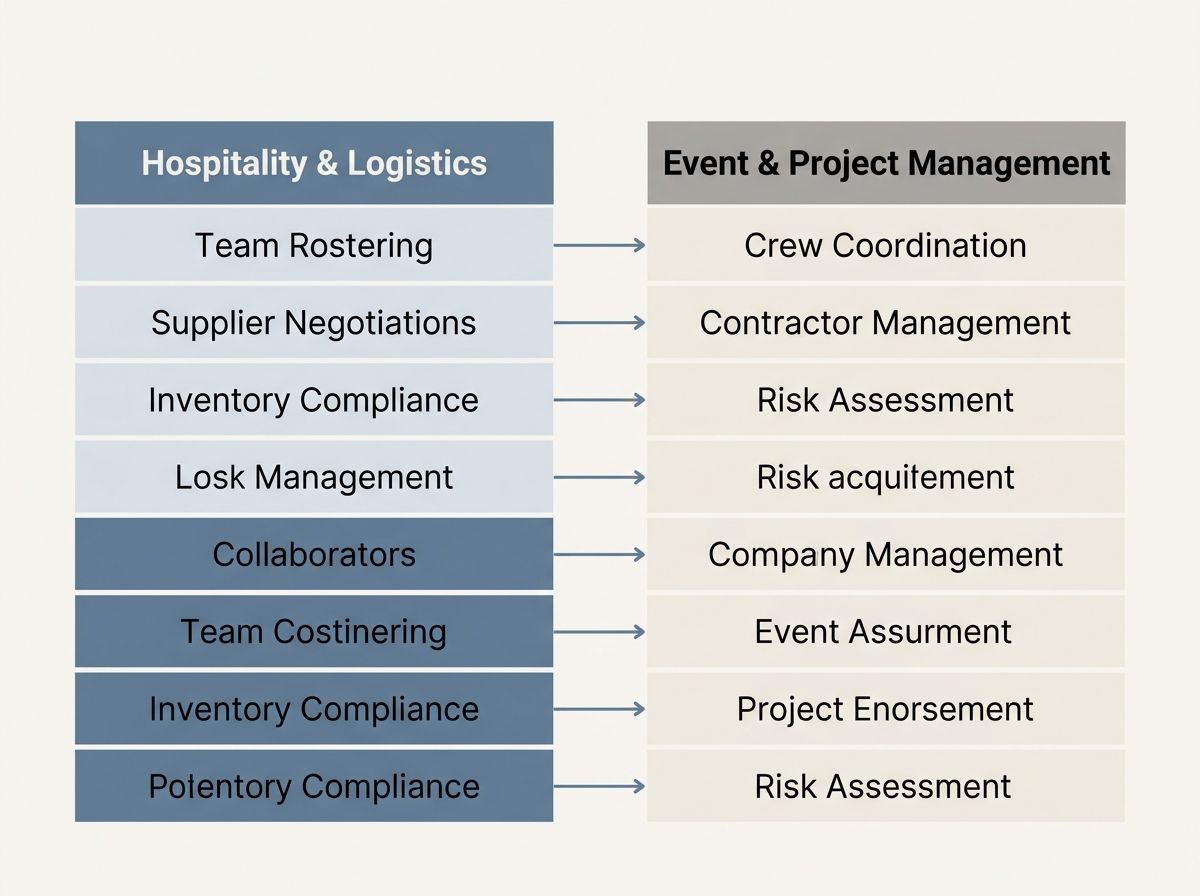
Now look at how those same capabilities are described in event management terms. Team management becomes crew coordination and contractor briefing. Budget control becomes event cost management and budget reconciliation. Supplier negotiation becomes vendor contract management. Food safety compliance becomes venue and catering compliance. Customer complaint resolution becomes delegate experience management. The actual work is identical, but the vocabulary makes it look completely foreign.
This translation gap exists across dozens of common cross-industry transitions. A logistics coordinator moving into construction project management brings scheduling, subcontractor coordination, compliance documentation, and risk management. These skills map directly to construction roles, but are written in freight and supply chain terms instead of building industry language. Similarly, a manufacturing quality controller moving into mining operations brings process auditing and safety management, but describes them through manufacturing standards instead of resources sector frameworks.
You speak fluent competence, but you speak it with an accent the new industry does not yet recognize. Without a formal translation mechanism, hiring managers cannot hear what you are actually saying.
This is why reframing RPL as a professional translation service, rather than an academic test, changes everything for experienced professionals.
Five ways cross-industry experience gets lost in translation
This translation failure is not random. It happens at specific, predictable points in the recruitment process. Understanding where these break downs occur is the first step to fixing them.
- Automated screening filters target qualification codes instead of skill descriptions. Applicant tracking systems look for specific credential numbers. If your resume lacks the exact code for the target industry, the system filters it out before a human recruiter ever sees your relevant experience.
- Job descriptions list industry-specific credentials as mandatory when they should be preferred. If a role requires a Diploma of Events rather than accepting equivalent management experience, it shuts out highly capable candidates. The credential becomes a shortcut for sorting applications, not a true test of capability.
- Interview panels lack the framework to evaluate adjacent competence. Panels composed of industry insiders speak their own terminology. They rarely have the tools or the mandate to assess whether an applicant's leadership in another sector meets the operational demands of the role.
- Reference checks use industry-specific questions that referees cannot answer in the new terminology. A hospitality manager's referees can verify their leadership, budget control, and operational skills, but cannot speak to event-specific outcomes. The standard reference process fails to bridge this gap.
- Onboarding structures are often designed for entry-level graduates rather than lateral hires. When an experienced professional enters a standard onboarding program, the process treats them as if they are starting from scratch. The system fails to recognise the management capabilities they already bring to the business.
Each of these barriers represents a system failure, not a lack of capability on your part.
What RPL in Australia actually does
Recognition of Prior Learning (RPL) is the formal pathway within Australia's vocational education and training system to assess your existing skills against national standards. It does not require classroom study. It does not ask you to relearn what you already do daily. Instead, it allows you to demonstrate through practical evidence that you meet the standards of a specific qualification.
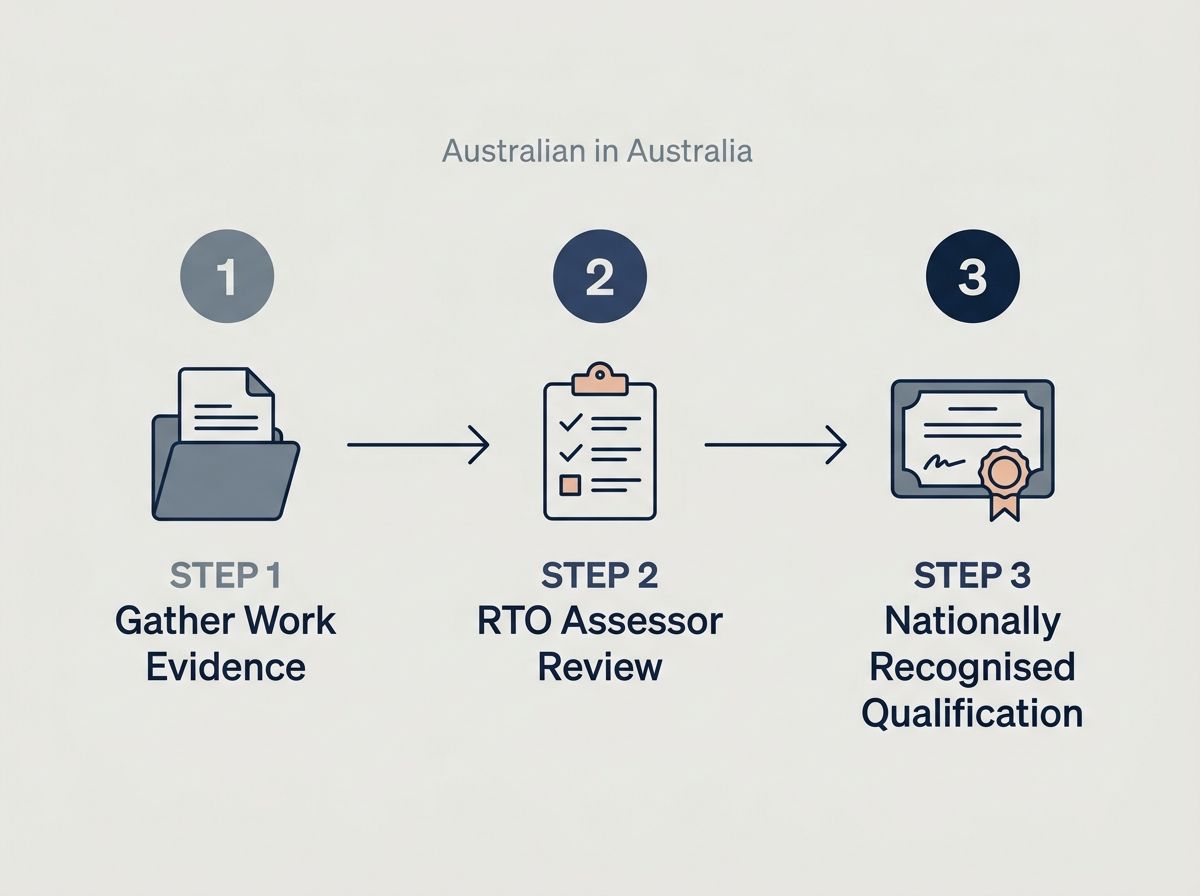
For experienced professionals, this process changes the transition completely. RPL allows your hospitality management background to be formally assessed against the units of a Diploma of Events. Your logistics work can be assessed against a Certificate IV in Building and Construction, and your manufacturing quality control experience can translate to resources sector qualifications. A qualified assessor from a registered training organisation (RTO) reviews your evidence. If you meet the criteria, you receive a nationally recognised qualification built on the same standards as those held by industry veterans.
This is the real value of RPL: it translates your actual skills into a credential that recruitment systems recognize. It does not alter your capabilities; it simply makes them visible to the systems and managers screening your applications.
It is important to understand what RPL does not do. It does not guarantee a qualification; that decision rests with the RTO assessor based on the evidence you submit. It does not guarantee a job offer. It is also not an automated process, as it requires you to gather clear proof of your skills. If an assessor finds gaps in your documentation, you may need to complete targeted gap training to meet the full requirements.
Understanding how an RPL certificate translates seniority across industries, rather than simply adding a credential, is the key insight for experienced professionals.
The professional level you have already reached
The demand to 'start from the bottom' assumes you are entry-level. You are not. You operate at a level earned through years of hard work. The issue is not your capability; the issue is that the hiring systems in your target industry cannot recognize your experience without the correct qualification codes.
RPL acts as that code. It does not change what you can do; it simply makes your existing value visible to employers.
Pursuing RPL is not a concession to a flawed hiring process. It is a practical strategy to claim the formal recognition you have earned. You are not returning to school or starting your career over. You are presenting your documented skills in a format that assessors can measure, leading to a credential that reflects your true professional level.
What happens when your experience is formally recognised
Once you secure a nationally recognised qualification through RPL, the translation issue is solved. Your new credential speaks the target industry's language because it is built on identical training frameworks. Hiring managers understand it, applicant tracking systems process it, and interview panels can measure your background directly against their vacancy requirements.
Your competence remains exactly the same. The only change is how clearly the target industry sees it. The management, financial, and operational skills you have always used are now presented in a standard format that recruiters can formally verify.
We should be realistic about what formal recognition achieves. It removes the credential gap that prevents employers from seeing your competence, but it does not solve every hiring challenge or guarantee a job. What it does is place you on equal footing with industry-trained applicants, giving you the added advantage of actual, proven workplace experience behind your qualification.
Find out if your cross-industry experience qualifies
Your first step is not to enrol in a program. It is to have a realistic conversation about whether your experience matches the evidence requirements for the qualification you need.
This is the purpose of a Free Skills Review. It is a practical assessment of your background, not a sales pitch. An experienced advisor looks at your work history to determine if an RPL pathway is viable. If it is, you will learn exactly what evidence you need to collect and how the process works. If it is not, we will tell you directly so you do not waste time or money on an unsuitable path.
Your skills are valuable. We help make them visible to employers. The choice of how to proceed is entirely yours.
Ready to Get Recognised?
Start with a free skills review to find out if RPL is right for you.