Your overseas security or real estate licence does not transfer to Australia — but your experience can
An overseas security or real estate licence does not transfer to Australia automatically, but you can assess your practical experience through RPL.
By RPL it Australia9 min read

The credential transfer wall: What you are experiencing
You have years of experience. Your licence was hard-earned, professionally respected, and legally valid in the country where you built your career. Yet when you arrived in Australia, the licensing system did not recognise it.
This is the credential transfer wall. It is the specific frustration thousands of skilled migrants face when they find that their overseas security or real estate licence does not automatically translate into Australian recognition. Your licence is valid and your experience is real. However, the Australian regulatory system is designed to verify local compliance rather than evaluate overseas credentials.
This distinction matters because it shows the barrier is structural rather than personal. It is not a verdict on your capability, but a feature of how Australian licensing operates. Once you understand this structure, the pathway forward becomes clear.
If you have been told your overseas licence does not count here, you are not alone. You are also not starting from scratch. Your practical experience is your foundation. The main task is to present this experience in a format that the Australian system can formally evaluate.
Why Australian licensing systems do not recognise overseas credentials automatically
Australia does not use a single national security licence or real estate licence. Licensing in both sectors is managed at the state and territory level. Each jurisdiction operates under its own legislation, runs its own licensing authority, and sets its own eligibility requirements.
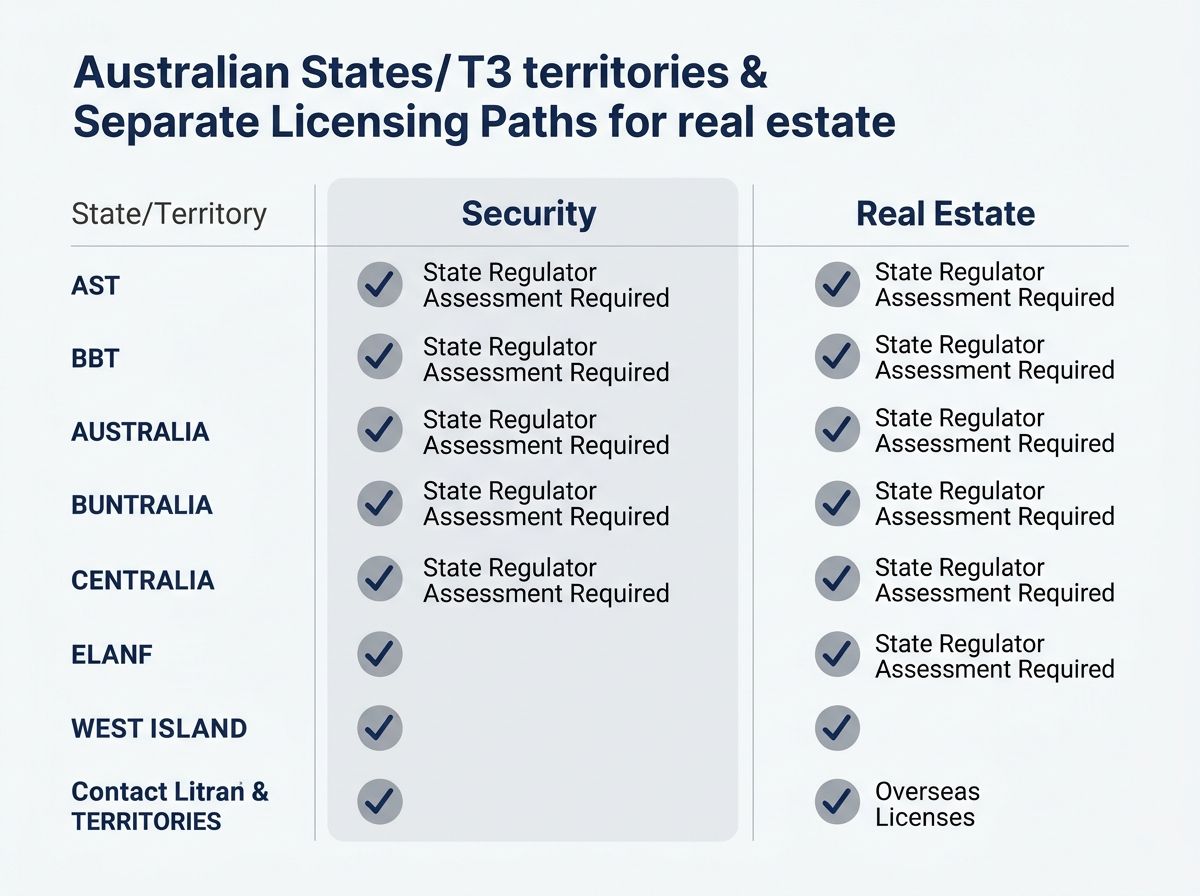
For security professionals, this structure results in eight separate licensing regimes across Australia. The same rule applies to real estate professionals, as each state manages its own property services legislation and regulatory body. The specific requirements you must meet depend entirely on where you intend to work.
Mutual recognition arrangements exist between Australian states and territories. For example, a licensed security professional from Victoria can apply for an equivalent licence in Western Australia. However, these arrangements generally cover licences issued within Australia or New Zealand. Western Australia's published mutual recognition pathway for security licences lists credentials from other Australian states, territories, and New Zealand as eligible, but it does not include other overseas licences.
The situation is similar in the real estate sector. Consumer Affairs Victoria has a dedicated application pathway to evaluate overseas estate agents' licences. This pathway indicates that overseas credentials must be assessed rather than simply accepted. Applicants must satisfy the Business Licensing Authority that they have sufficient knowledge of Victorian property law, practice, procedures, and trust accounting. In contrast, Victoria's mutual recognition route is strictly reserved for interstate or New Zealand licence holders.
The system does not assess where you acquired your skills. Instead, it evaluates what you can demonstrate and whether your performance meets Australian standards. This is the central point where Recognition of Prior Learning becomes relevant.
What security and real estate professionals bring from overseas
Before looking at the pathway, it is useful to outline the specific skills you bring to the table.
If you worked in security overseas, you likely have experience in crowd management, access control, surveillance, risk assessment, and emergency procedures. You may have worked in busy environments such as large events, corporate facilities, government offices, or critical infrastructure. Your previous licence probably required formal training, background checks, and ongoing compliance.
If you worked in real estate overseas, your practical background likely includes property sales, property management, client advisory, contract negotiation, and compliance with local property laws. You may have managed large portfolios, maintained client relationships over several years, and worked within a regulated professional framework.
These achievements do not disappear when you move to a new country. What changes is the format required for formal recognition. A parliamentary committee report on skilled migration noted that some migrants experience occupational downgrading by working in roles below their skill level. Correctly recognising migrant skills and qualifications benefits both the individual and the broader Australian workforce.
Your professional experience deserves recognition. The main challenge is presenting your history in a format that the Australian system can formally evaluate.
How your security or real estate experience becomes evidence for RPL
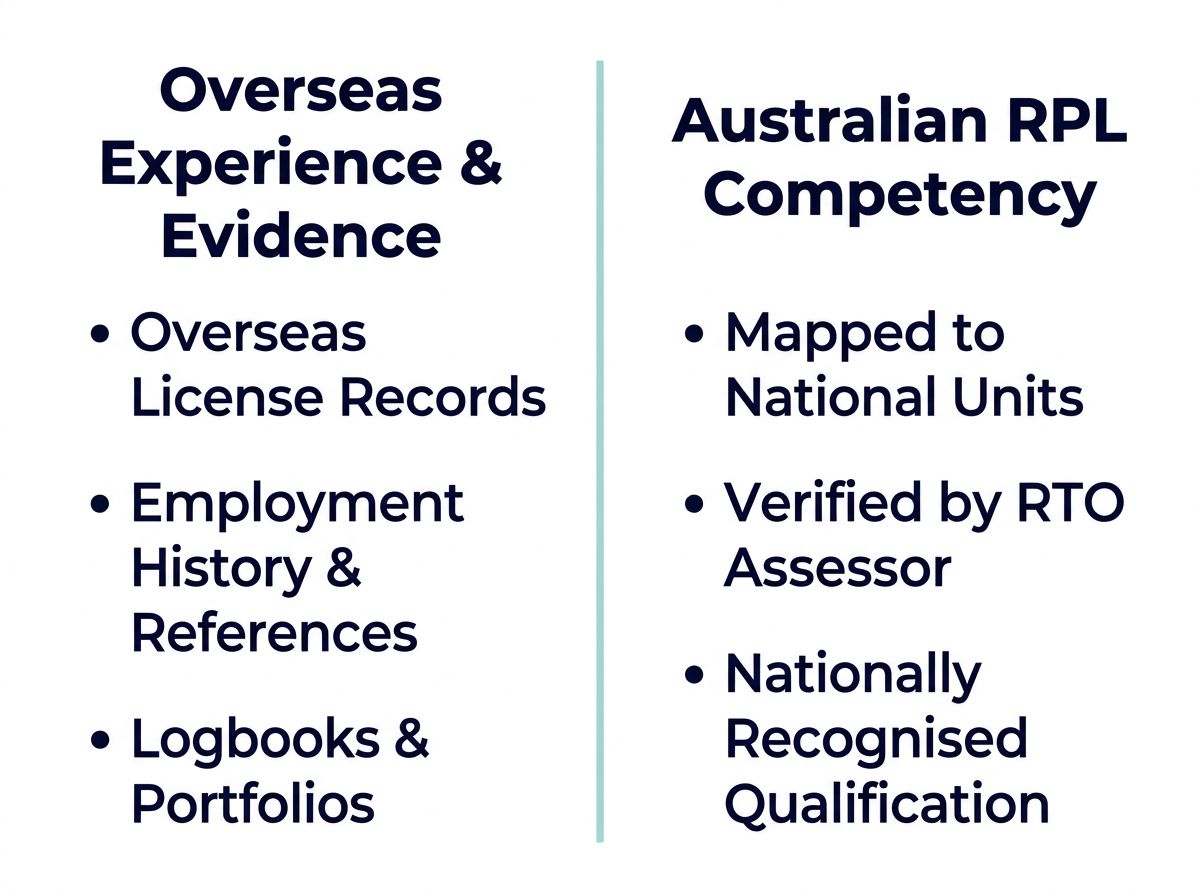
Recognition of Prior Learning (RPL) is the formal Australian process for evaluating your practical experience against the units of competency in a nationally recognised qualification. It is not a shortcut. Instead, it is a thorough assessment pathway that recognises your existing knowledge and skills, saving you from repeating training you have already completed.
Australia's national training register, training.gov.au, maintains the qualifications relevant to security and real estate work. Qualification codes and titles change periodically as training packages are updated, so you should verify current codes on the register when exploring your options.
For security professionals, relevant qualifications have historically included the Certificate II in Security Operations, Certificate III in Security Operations, and Certificate IV in Security Risk Analysis. For real estate professionals, qualifications include the Certificate IV in Real Estate Practice and the Diploma of Property (Agency Management). The RPL it Real Estate Security page lists the qualifications currently available through this pathway.
In an RPL assessment, your overseas experience is your evidence base. According to ASQA, Australia's national regulator for vocational education and training, a quality RPL process must be clear, fair, flexible, and valid, with assessments based on course requirements and applied consistently. Evidence required by a provider can include work samples, portfolios, training records, certificates, and employer declarations or references.
For real estate professionals, evidence may include property listings, sales agreements, property management records, client correspondence, and references from employers or licensees who can confirm your competence. The specific evidence required depends on the units of competency being assessed.
You must understand the distinction between a qualification and a licence. The training provider, which must be a registered training organisation (RTO), conducts the RPL assessment and issues the qualification. The relevant state or territory licensing authority issues the actual licence. RPL applies strictly to the qualification. You must still confirm licensing requirements with the state regulator.
The training.gov.au national register is the official source for verifying current qualification codes, titles, and approved training organisations.
The RPL process for security and real estate professionals
The RPL process is structured and involves a formal assessment by a qualified assessor from a registered training organisation. The process typically follows these steps:
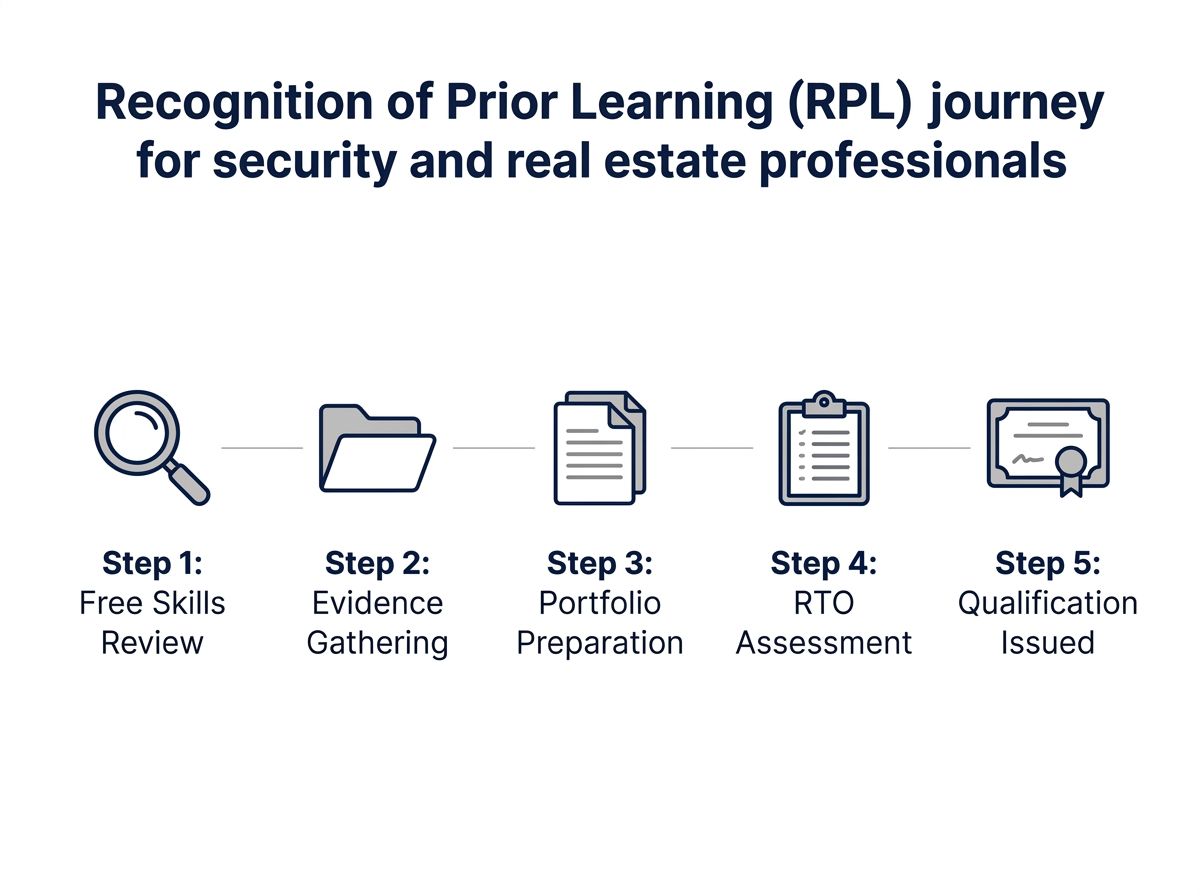
- Step 1: Free Skills Review. An honest review to see if your experience matches the qualification you want. This step assesses your suitability before you make any commitment.
- Step 2: Evidence Gathering. With guidance, you compile documents showing your competence, such as employment records, references, work samples, and prior training certificates.
- Step 3: Portfolio Preparation. Your evidence is organised into a structured portfolio aligned to the units of competency in the qualification.
- Step 4: RTO Assessment. A qualified assessor from the RTO reviews your portfolio and makes a professional assessment of your competency against each unit.
- Step 5: Qualification Issued. If the assessor determines you have met the requirements across all units, the RTO issues your nationally recognised qualification.
If the assessor identifies gaps in your evidence, the provider may offer training or support to complete the remaining units. This is provided at no additional cost.
How long does this take? Timeframes vary depending on the provider. One RTO publishes an indicative range of two to eight weeks, depending on evidence readiness and the qualification. Another provider notes that applicants with complete evidence portfolios can receive their qualification within roughly 14 days of enrolling, with reviews taking three to seven business days. These are examples rather than guarantees. The actual duration depends on the RTO, the qualification, your situation, and whether you need gap training.
For security professionals, standard RPL is restricted for certain licensing courses in some jurisdictions. In New South Wales, for example, Asset College states that the Security Licensing and Enforcement Directorate (SLED) does not permit standard RPL for security courses delivered in NSW. An assessment-only pathway may be available for experienced applicants, though it requires attending assessment days and completing all mandated tasks. Because requirements vary by state, territory, and qualification, a personalised suitability check is necessary.
Is RPL the right pathway for your situation?
RPL is a rigorous assessment pathway rather than a shortcut. It is highly effective if you have substantial, documented experience that maps directly to the units of competency in the qualification you want.
This pathway is suitable if you have years of hands-on security or real estate experience, employment records and references to verify your background, and prior training documents from overseas that demonstrate relevant learning.
The process is less straightforward if your overseas experience is in a specialised area that does not map cleanly to Australian qualifications. For example, your security work might have focused on armed roles while the local qualification covers unarmed operations. Similarly, your real estate experience may have occurred in a legal environment that differs significantly from Australian property law. These factors do not automatically disqualify you, but a qualified assessor must evaluate them.
ASQA has noted concerning assessment practices in the real estate sector among some providers, which highlights the need to choose your RTO carefully. A legitimate RPL process requires genuine assessment by a qualified assessor rather than a simple rubber stamp.
The answer to whether RPL is right for you depends on your specific experience, the qualification you want, and the state or territory where you plan to work. A Free Skills Review is designed to evaluate these exact factors.
The Consumer Affairs Victoria overseas licence recognition page outlines what applicants must show to satisfy the Business Licensing Authority, illustrating how state regulators evaluate overseas credentials.
Your experience is real. The question is whether it has been formally recognised.
You have the practical experience, years of work, professional judgment, and client history. These assets do not disappear simply because a licensing system in a new country is not set up to automatically recognise them.
Your experience can serve as evidence. RPL is the formal mechanism that allows a qualified assessor to evaluate what you can demonstrate. The focus is on what you know and can do, rather than where you trained or which country issued your original licence.
The pathway is structured and the assessment is genuine. The final outcome is a nationally recognised Australian qualification that is issued by an RTO, evaluated by a qualified assessor, and recognised across the country.
The decision to proceed is yours, but you can make that choice with clear information.
General information only, current at the date shown. Licensing rules change, so check the current requirements with the relevant regulator before you rely on them. RPL it Australia is a student support service, not a Registered Training Organisation; qualifications are assessed and issued by our partner RTOs.