Security and real estate licensing in Australia: What evidence counts when you trained overseas
Trained overseas in security or real estate? Find out what evidence Australian RPL assessors accept, from employment records to previous licences.
By RPL it Australia9 min read

The evidence challenge that many overseas professionals face without realising it
You have years of professional experience managing security operations, handling real estate transactions, supervising teams, and working with clients under pressure. In your home country, this experience defined your professional identity. However, when arriving in Australia, you might find that employers and licensing bodies do not automatically recognise your background.
This is a challenging position to be in. However, the core issue for overseas-trained security and real estate professionals is rarely the actual quality of their experience. Instead, the obstacle is how that experience is presented. Recognition of Prior Learning (RPL) is a formal Australian assessment pathway where a qualified assessor maps your existing documents to specific local units of competency. The assessor does not require you to hold a local qualification from the start; they require objective proof that you can perform the work. Most overseas professionals already have this proof in their work history, but they simply do not know how to format it.
The Queensland Government states that non-recognition of overseas qualifications, alongside employer preferences for local experience, represent major barriers that prevent skilled migrants and refugees from securing suitable employment. Consequently, professionals from migrant and refugee backgrounds are often underemployed within the Australian workforce despite holding appropriate technical skills and a strong willingness to work.
The Queensland Government's data on migrant employment barriers shows the scale of this challenge, confirming that non-recognition of overseas qualifications remains a primary obstacle for skilled professionals.
This guide outlines how to overcome these barriers. We explain the four primary categories of evidence that Australian RPL assessors accept, discuss how your overseas licensing documentation fits into the process, and show you exactly what to gather before you start your application.
Why Australian licensing bodies require local evidence despite your overseas record
Australian security and real estate licensing operates under strict state-based regulatory frameworks. Each state and territory manages its own licensing authority. For example, security licensing in New South Wales is overseen by the Security Licensing and Enforcement Directorate (SLED), while Queensland real estate licensing is managed by the Office of Fair Trading. These regulators require demonstrated competency against current Australian qualification standards. This is a compliance requirement rather than a criticism of your overseas training.
Understanding this regulatory context clarifies the process. Instead of repeating your education, you focus on translation. You present your current skills in a format that Australian assessors and licensing bodies can evaluate against national standards. Security licensing in Australia typically requires a qualification from a registered training organisation (RTO). Completing an RPL assessment through an RTO is one pathway to obtain this. However, earning a qualification does not guarantee licence approval, as final licensing decisions rest with state regulators, who also evaluate criminal history, identity checks, and other eligibility criteria.
RPL it works with registered training organisations across the security and real estate sectors. You can view the full range of security and real estate RPL qualifications available.
You should always check qualification codes for security and real estate pathways on training.gov.au, as national codes and their currency can change. The training.gov.au register allows you to search by code or title, and the status field indicates whether a qualification is active or superseded.
You can check the status of any qualification code on the national training register to see if it is current, superseded, or replaced.
The four primary categories of evidence RPL assessors look for
RPL assessors evaluate your history across four main areas. They require evidence of your practical ability to perform the work, rather than a specific foreign certificate. The Australian Skills Quality Authority (ASQA), which regulates training providers, advises that a quality RPL process should remain flexible and accept a diverse range of evidence types.
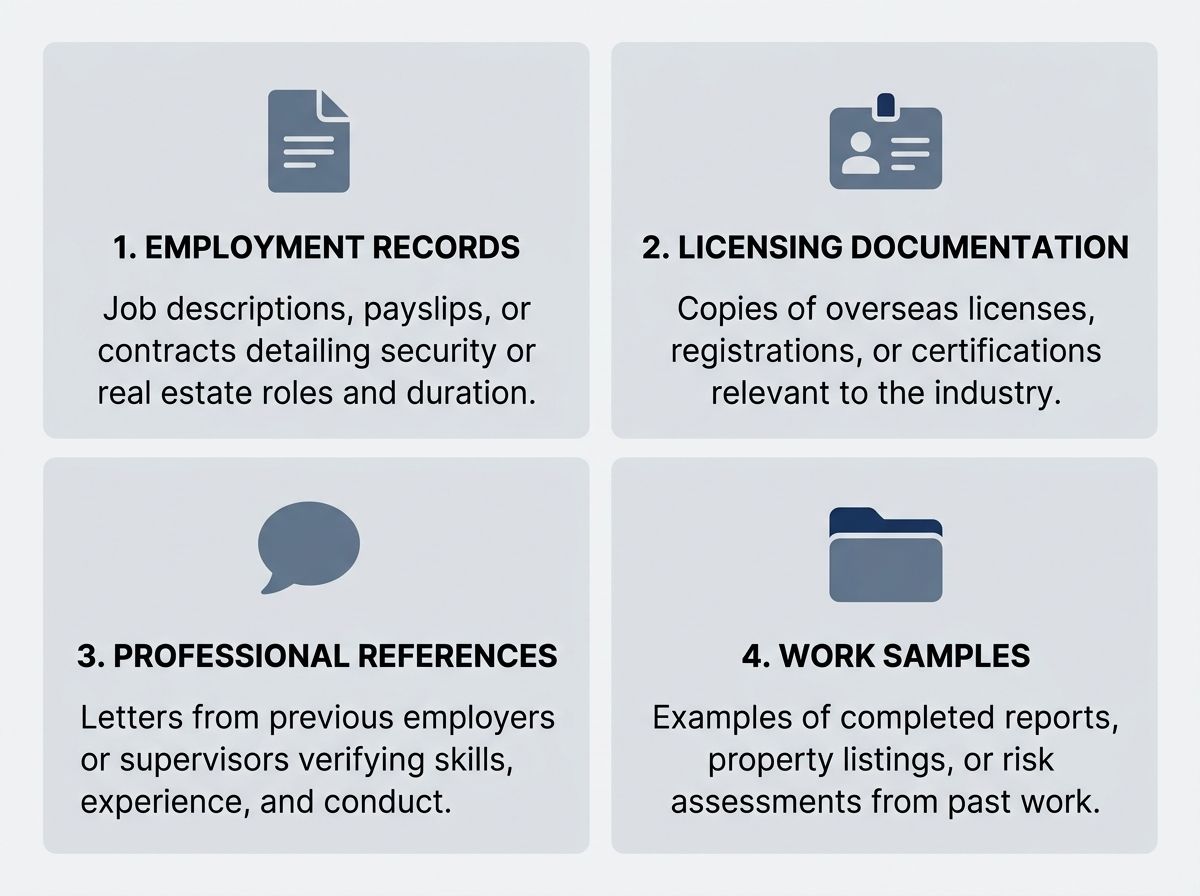
- Employment records, including payslips, employment contracts, position descriptions, and official letters of service.
- Overseas licensing documentation, such as foreign licences, professional registrations, and regulatory credentials.
- Professional references, including signed statements from supervisors, employers, or clients addressing specific competency units.
- Work samples, such as incident reports, property management portfolios, sales contracts, patrol logs, and professional correspondence.
Most overseas professionals already possess documentation across all four of these categories. The primary challenge is identifying which documents to gather, how to organize them, and what the assessor needs to see in each folder. The following sections explain each category in practical detail.
Employment records: using your work history as evidence
Payslips, employment contracts, position descriptions, and letters of service from overseas employers are key evidence in an RPL assessment. These documents establish your length of service, your scope of work, and your level of responsibility. For security professionals, this includes shift rosters, patrol logs, and incident management records. For real estate professionals, it covers property portfolios, sales volumes, client databases, and leasing agreements.
Collecting overseas records can feel like an administrative hurdle, but the objective is straightforward. The assessor must verify what tasks you performed, your employment duration, and your level of authority. A position description showing you supervised a team of security guards, or a letter of service confirming you managed a portfolio of 150 properties, directly supports the competency units under assessment.
If original overseas employer documents are unavailable, some providers suggest that statutory declarations explaining the situation and offering alternative evidence can assist. Because requirements vary between RTOs, you should confirm which alternative evidence types are accepted during your initial skills review.
If your employment records are not written in English, some RPL providers require them to be translated, with some specifically requesting NAATI-certified translations. Because translation policies vary by RTO, you should confirm these requirements with your provider before submitting your application.
Overseas licensing documentation: your foreign licence holds value
A security licence from the UK, a real estate registration from India, or a property management credential from the Middle East holds real value in Australia. These documents provide independent proof that a regulatory body in another jurisdiction assessed and approved your skills. This carries significant weight during an RPL assessment.
ASQA guidelines state that overseas qualifications or competencies can be used as RPL evidence, provided RTOs map them to Australian legislative requirements. Assessors must evaluate this evidence for currency, authenticity, and sufficiency against the relevant training package. This means your overseas licence is not automatically equivalent to an Australian qualification, but it serves as valuable corroborating evidence.
ASQA also advises against automatically granting RPL based on a higher qualification in the same field. Do not assume overseas credentials will automatically result in RPL. The assessor must evaluate your evidence against specific Australian standards rather than simply verifying a foreign qualification.
ASQA's RPL and Credit Transfer Practice Guide outlines how RTOs should evaluate overseas qualifications and competencies as part of an RPL assessment.
You should include your overseas licensing documentation in your application. If the documents are not in English, ask your RTO if they require a certified translation. Even an expired overseas licence can support your application, as it shows you met a regulatory standard in the past. Discuss this option with your assessor.
Professional references: choosing who can verify your skills
A professional reference from a former employer, supervisor, or client who can verify your technical skills is highly valuable in an RPL assessment. For overseas-trained professionals, this involves contacting former managers, security supervisors, real estate principals, or property management directors, regardless of where they are currently located.
The reference must be specific. A generic character reference stating that you were a reliable employee is not sufficient. The statement must cover the exact competency areas under assessment. For instance, a reference from a security manager describing how you coordinated patrol teams and managed incidents directly helps an assessor evaluate security units. Similarly, a reference from a real estate principal detailing your property management portfolio and leasing activities directly supports real estate units.
Before contacting your referee, ask your RTO if they provide a reference template or a list of specific competency areas. This simplifies the process for your referee and makes the document more effective. Verification requirements, such as notarisation or video references, vary depending on the RTO.
Work samples and portfolio evidence: what you produced on the job
Work samples provide direct proof of your competence by showing assessors what you actually did on the job. For security roles, this includes incident reports, risk assessments, and patrol logs. For real estate roles, this covers lease agreements, sales contracts, and professional client correspondence.
Many professionals assume their overseas work samples are irrelevant because they were produced in a different market or language. However, the assessor evaluates the skills demonstrated rather than the jurisdiction where you worked. A well-written incident report from a security role in South Asia demonstrates the same analytical and operational skills as one written in Australia.
If your work samples are not in English, confirm whether translation is required and what format is accepted. Some providers require certified translations, but rules vary. You should also check for confidentiality constraints, as security logs or property records can contain sensitive information. Discuss how to handle confidential documents with your RTO before submission.
What to do if your evidence has gaps
It is normal if you do not have complete evidence for every unit in a qualification. When gaps exist, the RTO can provide gap training, which is targeted supplementary training for specific units. ASQA guidelines state that if your evidence does not fully meet the requirements, the provider can offer additional training or support to help you complete the remaining units.
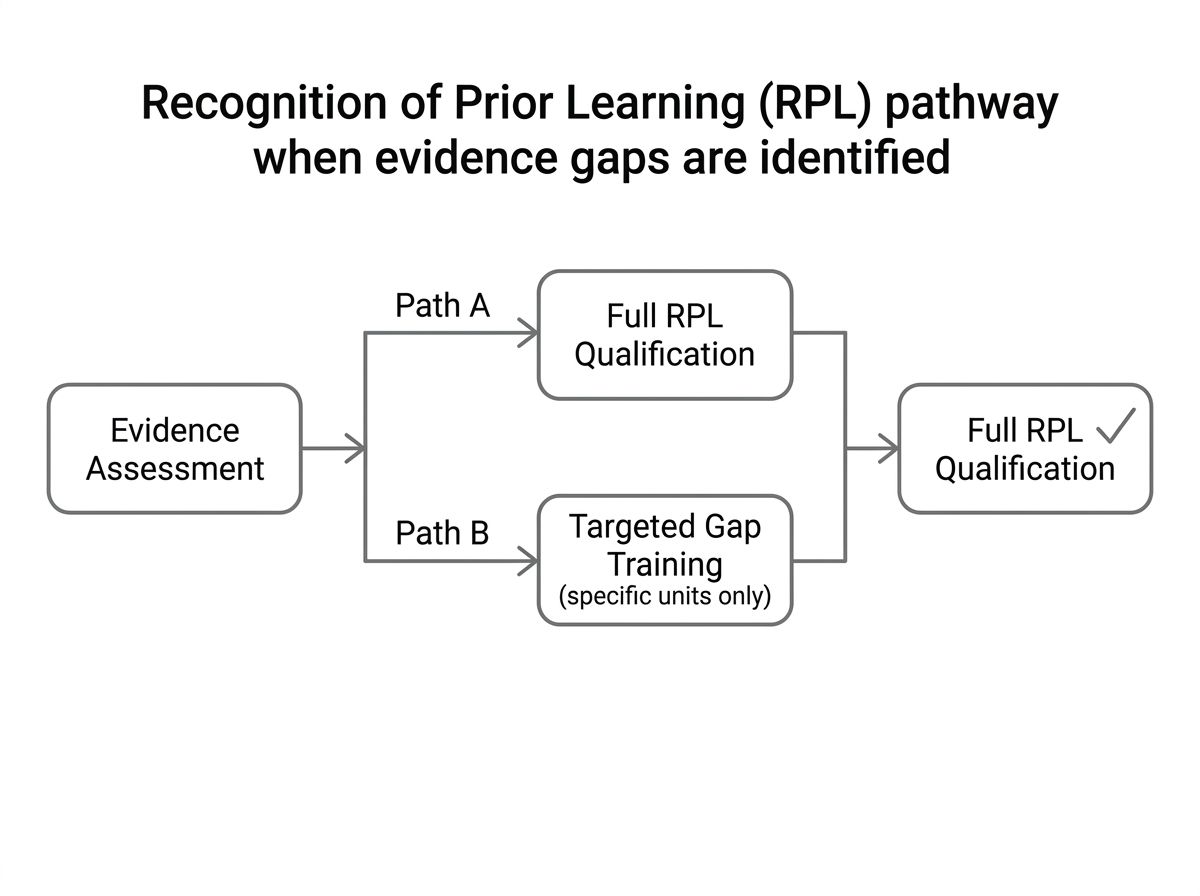
Gap training does not mean starting your studies from the beginning. It simply fills specific gaps in your existing portfolio, allowing you to earn your qualification through a mix of RPL and targeted assessment. ASQA guidelines state that RPL assessments must meet the standards required for high-risk licensing, meaning the gap training process for regulated roles like security is designed to meet these exact requirements.
RPL outcomes depend on your individual work history. Some candidates prove full competency across all units, while others require targeted gap training. A Free Skills Review is the best way to understand your options before you commit to a pathway.
The first step: a Free Skills Review before you commit
Before you gather documents or spend any money, starting with a Free Skills Review is highly recommended. This no-obligation assessment checks how your overseas background maps to the Australian qualification you need, identifying your current evidence, potential gaps, and whether RPL is the right pathway.
RPL it helps you navigate the recognition process by organizing your experience as evidence for assessment by a registered training organisation. The RTO evaluates your file and issues the qualification. You remain in control of the process at every stage.
Your overseas experience in security or real estate represents valuable professional capability. The next step is organizing your documents into a format that Australian assessors can evaluate, which begins with auditing your current files.
General information only, current at the date shown. Licensing rules change, so check the current requirements with the relevant regulator before you rely on them. RPL it Australia is a student support service, not a Registered Training Organisation; qualifications are assessed and issued by our partner RTOs.