Stop Treating RPL Like a Test (And Start Treating It Like a Translator)
RPL qualifications are not an exam you can fail. They function as a translation service, converting your existing skills into recognised industry terms.
By RPL it Australia8 min read

The Mental Model That Blocks Progress
You have the experience. You know you do. You have spent ten years managing teams, running projects, and solving problems that your new industry simply calls by different names. Yet when someone mentions RPL qualifications, you might feel a moment of hesitation. A quiet voice asks: what if I am not good enough? What if I sit down with an assessor and they find gaps in my knowledge?
That hesitation does not mean you lack competence. It means you are using the wrong mental model.
Most people approach Recognition of Prior Learning the same way they approach a formal exam, treating it as a test they could fail. They imagine an assessor with a checklist, looking for reasons to reject their application. They delay. They second-guess. They decide they need to study before they are ready. Consequently, the credential that could formally recognise a decade of practical competence remains on the to-do list.
This article is about replacing that mental model with one that accurately reflects how RPL works, and why this shift changes the entire process.
What a Test Measures (And Why RPL Is Different)
A test starts with what you do not know. It assumes a knowledge gap and measures whether recent instruction has filled that gap. You study, sit the exam, and face the possibility of failure. The starting assumption is a deficit.
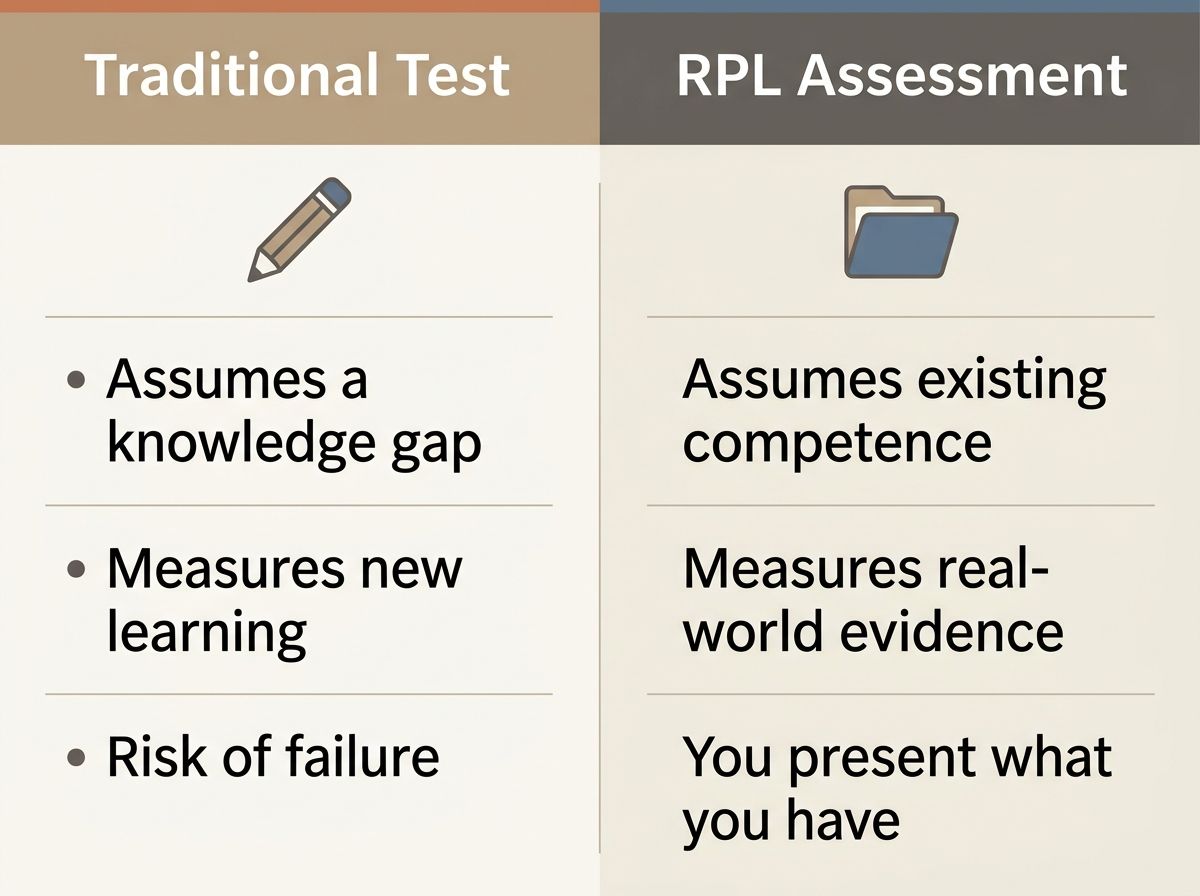
RPL starts with what you already know. It is an assessment process that evaluates your existing skills and knowledge, gained through work experience, informal learning, and life experience, against the formal requirements of a qualification. The starting assumption is competence.
According to the Western Australian Government's fact sheet on Recognition of Prior Learning, RPL is formally defined as an assessment process, not a training process. It is distinct from credit transfer, which recognises prior formal study, and from formal enrolment in a course. You are not being taught. You are being assessed on the skills you already possess.
The Australian Government's education profile describes RPL as assessing prior learning from formal and informal study, work experience, industry-based learning, and life experience. The outcome can lead to admission to a course, credit within a course, or the awarding of a full qualification.
That distinction is important. When you understand that RPL is an assessment of existing competence rather than a test of newly acquired knowledge, your focus shifts. You stop asking whether you are good enough and start looking at how to present what you already have.
The Translation Frame: Your Skills in a New Language
Here is the perspective that changes how RPL qualifications feel: RPL is not a test of whether you are capable enough. It is a translation service that converts your existing knowledge into the language your new industry recognises.
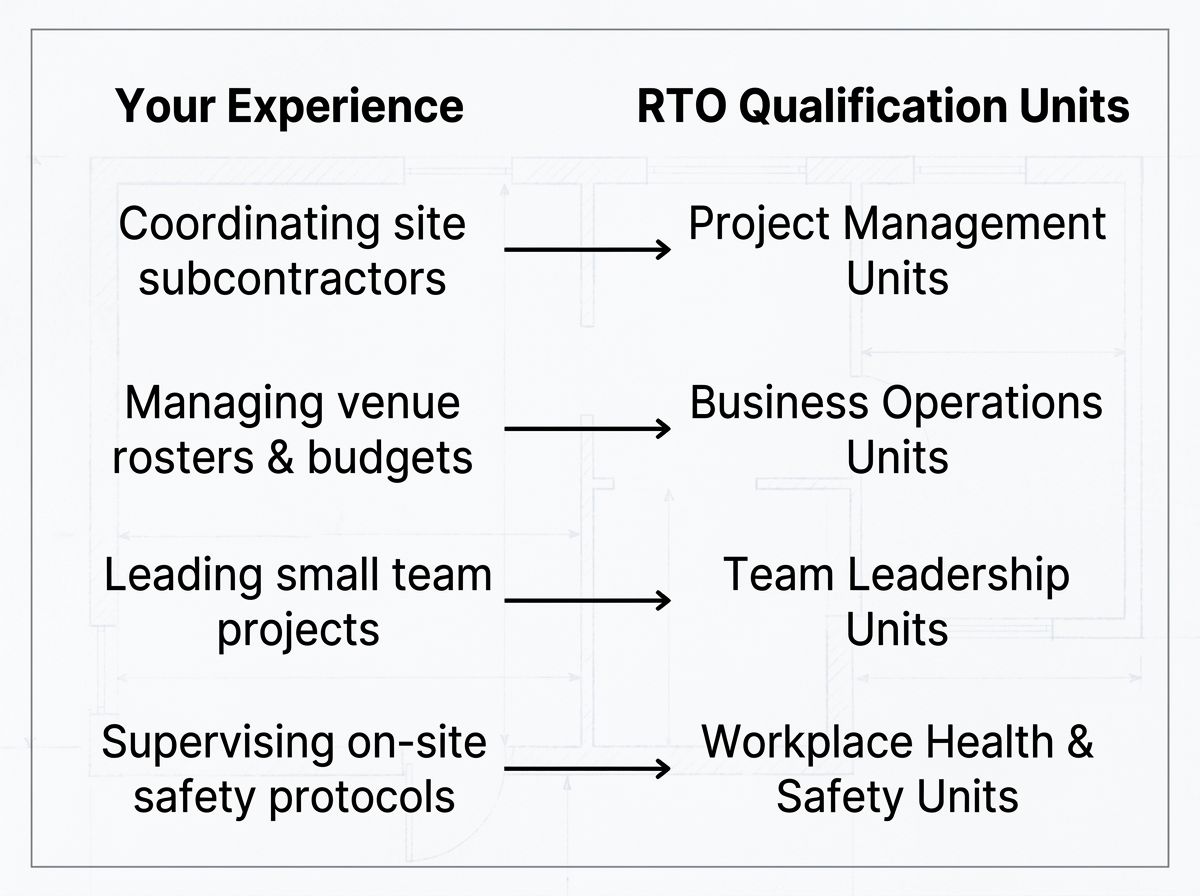
Every industry uses its own vocabulary for competence. The underlying skills are often identical, but the terminology is different.
Consider a hospitality manager with ten years of experience running a venue. They coordinate suppliers, manage time-critical logistics, lead a team under pressure, maintain quality standards, and handle client relationships. When they transition into event management, they find that the Diploma of Events requires competencies in project coordination, stakeholder communication, risk management, and operational planning. The industry is different, but the skills are the same.
Or consider a construction site supervisor moving into project management. They have spent years managing subcontractors, reading plans, tracking budgets, and ensuring compliance with safety standards. A Certificate IV in Project Management Practice requires competencies in scope management, resource coordination, risk identification, and stakeholder reporting. The supervisor performs these tasks daily; they simply have not described them in those terms.
RPL is the mechanism that maps your current activities onto the framework the new industry uses to recognise competence. The assessor is not looking for gaps to fail you on. They are looking for evidence to map your experience against the qualification's standards. You are not learning new skills; you are presenting existing skills in a new language.
The Australian Government's education profile confirms that RPL draws on prior learning from work experience, industry-based learning, and life experience — not just formal study.
VET qualifications are designed with transferability in mind. The Health Training Package, for example, explicitly acknowledges transferable skills and cross-sectoral learning as part of how qualifications are structured, recognising that competence gained in one context remains relevant across different roles and industries.
The same translation principle applies across industries — from hospitality to construction, from administration to community services.
Why the Test Frame Causes Hesitation
The test frame asks if you are good enough. The translator frame asks how you can present what you already have.
These are different questions. The first is personal, while the second is practical. The mental model you carry into the RPL process determines which question you try to answer.
When experienced professionals treat RPL as an exam, they often experience imposter syndrome. They compare their informal, on-the-job learning to the formal study of those who followed a traditional pathway. They worry the assessor will find them lacking and delay the process until they feel ready, which often means they never start.
Professional commentary from the Australian Cyber Workforce Playbook notes that certifications can help validate skills and knowledge, boost morale, and combat imposter syndrome, particularly for career switchers and new entrants to a field. Having your competence formally recognised changes how you see your own skills and how others perceive them.
The ANZCA Bulletin similarly notes that mentoring, coaching, and education can build confidence and combat imposter syndrome, which can lead to higher job satisfaction and a stronger sense of professional purpose.
The translator frame addresses this directly. When you understand that RPL is about presenting evidence of what you already know, rather than proving you are identical to someone who studied formally, the process shifts. You move from defending your background to demonstrating your capability.
This is why excellence alone doesn't open doors without formal recognition — and why the recognition pathway matters.
What the Translation Process Looks Like in Practice
In practice, RPL assessment involves gathering evidence that your existing experience meets the competency standards of the qualification. This is not an exam, and there is no study guide.
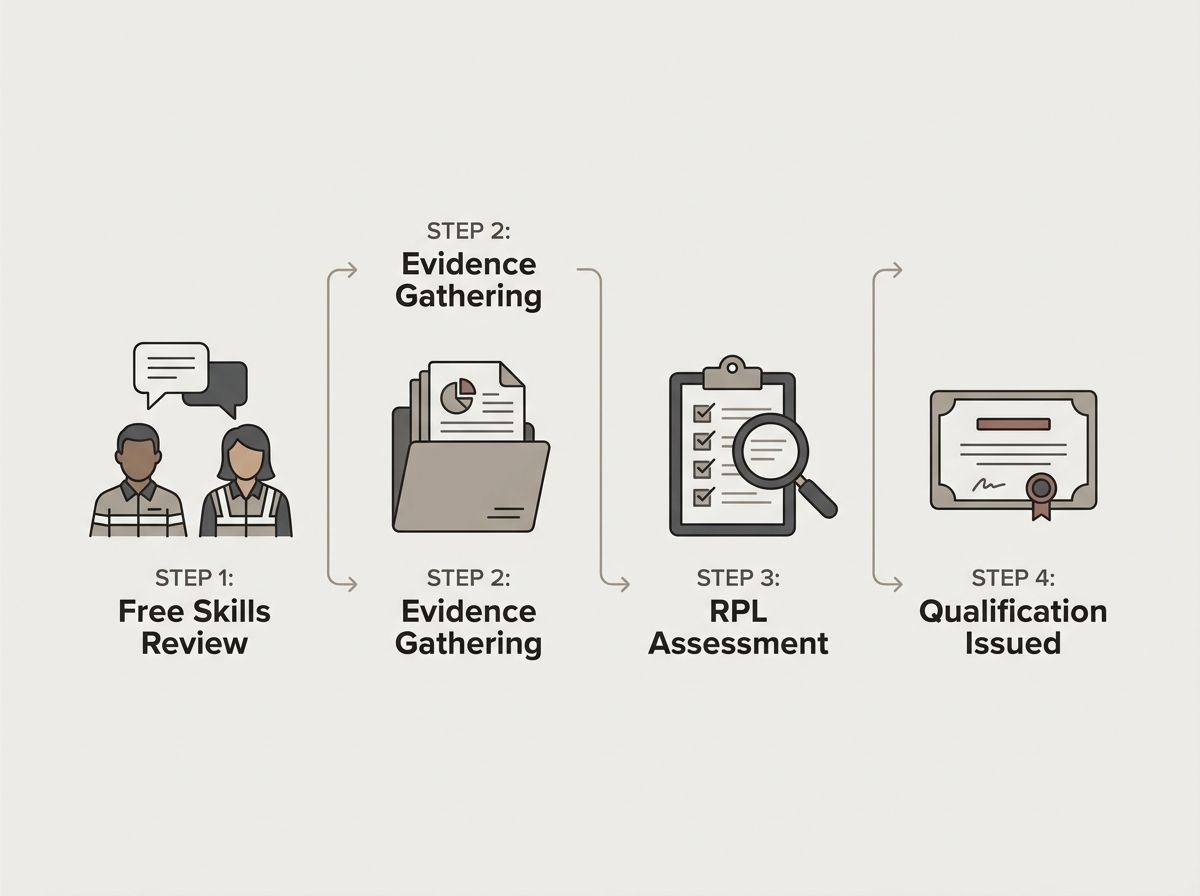
According to ASQA guidance, acceptable RPL evidence may include records of completed training, assessment items, assessment records, employer declarations, and student records. Typically, this translates to employment history documents, supervisor or employer statements, work samples, portfolios, and a structured interview with the assessor.
The assessor's job is to map your evidence against the competency standards of the qualification, not to find reasons to reject your application. They look for alignment between your experience and the qualification requirements. Where alignment exists, it is recognised. If any gaps are identified, gap training is provided, which is typically included as part of the RPL process at no extra cost.
It is important to understand that RPL assessments are conducted by qualified assessors from registered training organisations (RTOs), not by RPL it. RTOs issue the qualifications. This is why the qualification is nationally recognised: the assessment is genuine, conducted to national standards, and independently verified. The rigour of the process ensures the value of the credential.
The WA Government's fact sheet on Recognition of Prior Learning confirms that RPL must meet the Principles of Assessment and the Rules of Evidence — the same standards that apply to all formal assessment in the Australian VET system.
Understanding how experienced workers present their skills as formal evidence is the practical heart of the RPL process.
The Sectors Where This Translation Occurs
RPL qualifications are available across a wide range of Australian industries, including construction, engineering, community services, health, hospitality, tourism, business, finance, and information technology. The pathway is not limited to trades or to any single sector.
Research from NCVER suggests that some industries, including construction and gas, show higher RPL uptake. This is likely because on-the-job experience pathways are well established and the competency frameworks map closely to daily work practices.
Career changers are not the only people who use this pathway. Experienced workers seeking formal recognition within their own industry, such as those who have been doing the job for years without the credential to match, use RPL regularly. Sometimes the translation is between different industries, and other times it is between informal practice and formal recognition in the same field.
Across all of these contexts, the underlying logic remains: your experience is real. The focus is simply on whether it has been formally presented in the language the qualification framework requires.
The First Step Is a Conversation
The translation process begins with an honest assessment of whether your experience matches the qualification you want. This is a diagnostic step, not a financial commitment.
The Free Skills Review from RPL it is designed for this step. Before you invest time or money, you deserve a clear answer to the question of whether your experience translates. The review is a guided conversation, not a sales pitch, designed to show whether your background maps to the qualification you have in mind.
We prefer to guide candidates to the correct pathway rather than enrol them in an unsuitable one. That means being clear when the fit is strong, and equally direct when it is not, or when a different qualification might match your experience better.
Your skills are valuable. We help make them visible. The choice is yours.
General information only, current at the date shown. Licensing rules change, so check the current requirements with the relevant regulator before you rely on them. RPL it Australia is a student support service, not a Registered Training Organisation; qualifications are assessed and issued by our partner RTOs.