The Paperwork Penalty: How Unqualified Chippies Are Losing Commercial Contracts
Experienced carpenters are being locked out of commercial work — not because of skill, but because of missing paperwork. Here's what RPL carpentry can do about it.

The job goes to the younger chippy with the cert
You have the experience. Fifteen years of it. Framing, fit-out, formwork, commercial joinery — you have done it all. And yet the contract goes to someone with half your time on the tools. Not because they are better. Because they have a piece of paper you do not.
This is not a hypothetical. It is happening across commercial construction sites in Australia. Principal contractors are tightening their subcontractor requirements. Compliance checks that barely existed a decade ago are now standard. And experienced carpenters who have never needed a formal qualification to prove their worth are finding that the rules have changed — without anyone telling them.
The frustration is real. The financial cost is real. And the solution — RPL carpentry, or recognition of prior learning — is more accessible than most experienced chippies realise.
Why commercial sites are getting stricter about carpentry qualifications
The compliance pressure on Australian construction sites has been building for years. At the federal level, government procurement frameworks increasingly require contractors to demonstrate capability against Australian Standards, with agencies expected to make reasonable inquiries before awarding contracts.
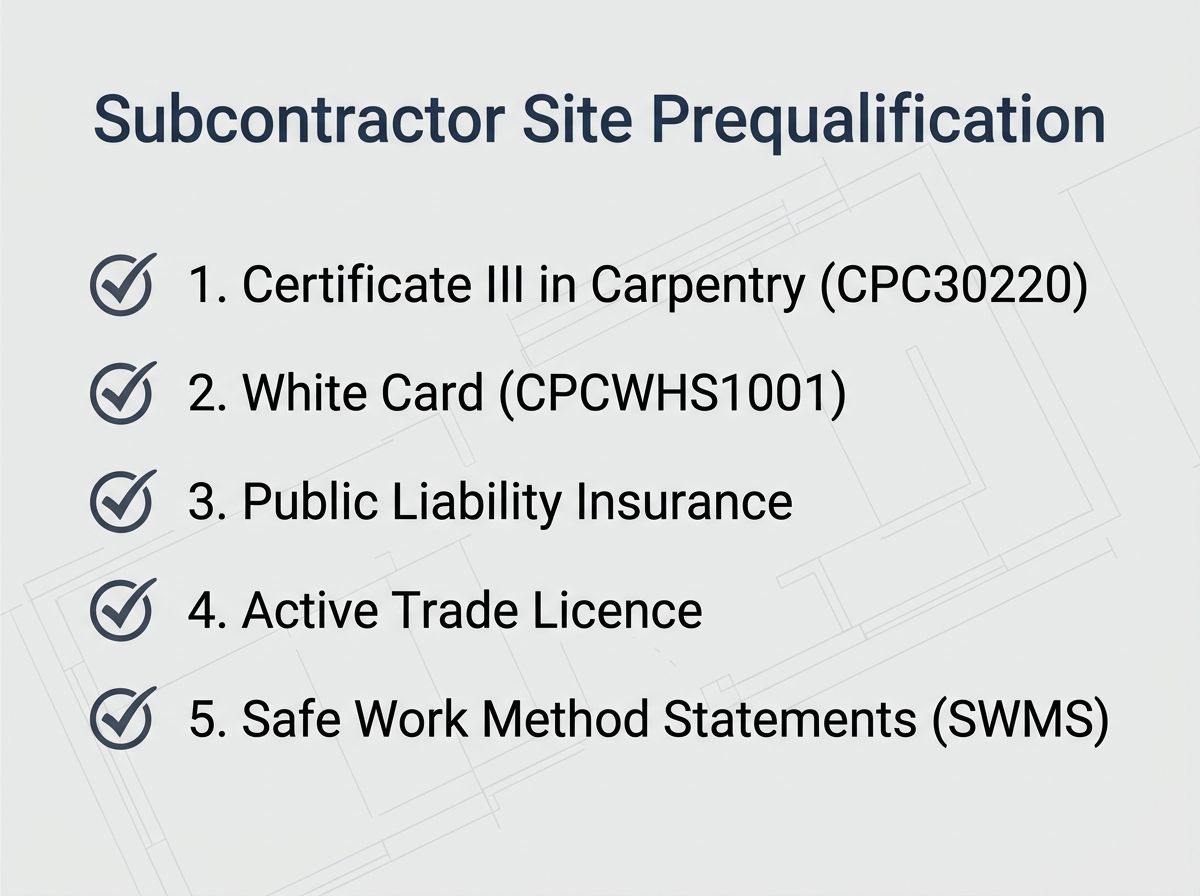
At the state level, formal prequalification systems are now a standard feature of government-funded construction. In Queensland, for example, the government's Prequalification (PQC) System requires that all building contractors directly engaged on government projects above $1 million be prequalified — and that prequalification applications demonstrate appropriate experience and qualifications.
Queensland's PQC System is a whole-of-government register used by departments to identify prequalified suppliers based on project size, type, location, and the supplier's licence and capabilities.
Key trade and specialist contractors — including those in demolition, fire protection, and security systems — must also be prequalified if their work exceeds $1 million, and ongoing compliance includes subcontractor management obligations.
Beyond government projects, standard commercial contracts increasingly include provisions that allow principals to require superintendent approval of subcontractors, or to draw on approved supplier registers. The practical effect: if you cannot demonstrate formal qualifications, you may not make the list.
And then there is the baseline. Every person working on a construction site in Australia must hold a White Card (CPCWHS1001). That is the floor. For carpenters seeking commercial subcontracts, the floor has risen considerably.
What experienced carpenters are actually losing
The stakes are not abstract. When a commercial fit-out contract goes to a qualified competitor, that is real income walking out the door. When a Tier 1 builder's subcontractor compliance check excludes you from their approved list, that is an entire category of work you cannot access — regardless of how good you are on the tools.
The losses compound. Without formal recognition, you may be unable to take on apprentices. In NSW, for example, the supervisor of an apprentice must be trade-qualified in the relevant vocation — meaning they hold a Certificate of Proficiency for that trade, or have qualifications and experience that would entitle them to one. An experienced carpenter without formal recognition may not meet that threshold.
NSW Government guidance confirms that supervisors of apprentices must be trade qualified in the vocation of the apprenticeship — requirements that vary by state and trade.
There is also the licensing dimension. In NSW, a licence or certificate is required to carry out residential building work — including general building work valued at more than $5,000 in labour and materials. Applicants must complete an approved qualification and demonstrate at least two years of relevant industry experience. Unlicensed work can attract fines of $22,000 for an individual.
NSW licensing requirements for general building work set out the qualifications and experience needed — and the penalties for working without the appropriate licence.
The work is the same. The site is the same. The only difference is a certificate. And that difference is costing experienced carpenters contracts, income, and career progression — every week.
The qualification wall is not about skill — it is about evidence
Here is the thing worth understanding clearly. The problem is not that experienced carpenters lack competence. It is that their competence exists in the wrong form for formal systems to recognise.
Years of framing walls, installing flooring systems, fitting doors and windows, finishing joinery — that is real skill. The Certificate III in Carpentry (CPC30220) covers 34 units of competency, combining core and elective units across the full range of carpentry work. If you have been doing commercial carpentry for a decade, the odds are strong that your daily work already maps to much of what the qualification requires.
Experience is not less than education. It is a different form of evidence. The question is not whether you have the skills. The question is whether you can demonstrate them in a form the formal system accepts.
That is precisely what recognition of prior learning — carpentry RPL — is designed to address.
The same principle applies across construction trades: your on-site experience is already evidence. The challenge is presenting it in a form assessors can evaluate.
What RPL carpentry actually involves
Recognition of prior learning (RPL) is a formal assessment pathway — not a shortcut, and not a loophole. It is a rigorous process through which a qualified assessor from a registered training organisation (RTO) evaluates your existing skills and experience against the national standard for the Certificate III in Carpentry (CPC30220). If your competency is demonstrated, the RTO issues the qualification. If gaps are identified, gap training is provided.
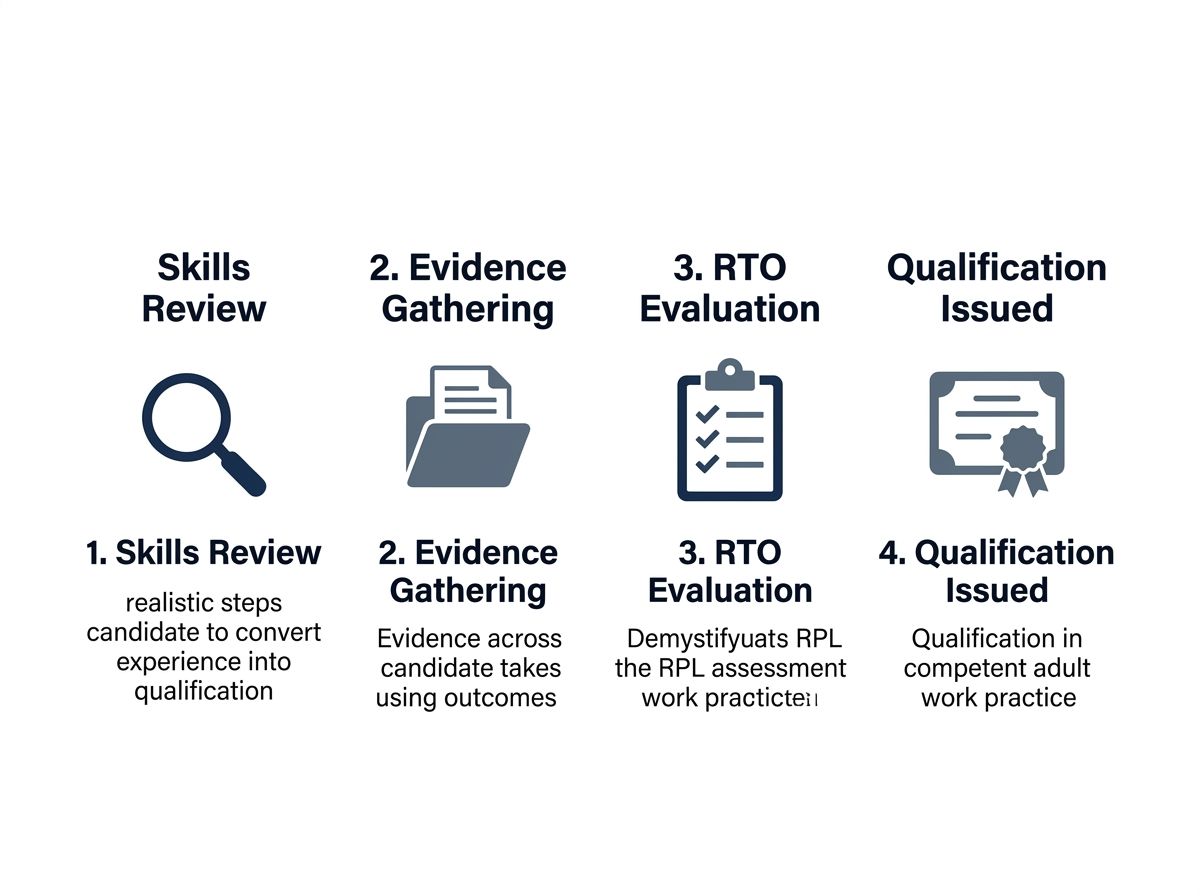
The process typically involves four stages. First, a skills review — an honest assessment of whether your experience is likely to align with the qualification requirements. Second, evidence gathering — compiling documentation that demonstrates your competency. Third, formal assessment by a qualified assessor from the delivering RTO. Fourth, qualification issuance, where the RTO awards the Certificate III in Carpentry if competency is confirmed.
RTOs commonly accept a range of evidence types in an RPL application: resumes, employer references, photos or videos of completed work, job descriptions, work samples, and certificates from prior training.
For carpentry specifically, evidence may include photos of completed projects — framing, flooring systems, roofing structures, doors, windows, finishing tasks — along with employment or client references and a detailed work history.
Some RPL providers also ask for a referee testimonial, a White Card, and identity documentation as part of their eligibility requirements. Requirements vary between RTOs and states, so it is worth confirming what your chosen provider needs.
Assessment may involve interviews, portfolio reviews, practical demonstrations, and written assessments. The assessor evaluates how well your evidence aligns with the required units of competency — not whether you can pass a classroom test.
Evidence is mapped to specific units of competency under the guidance of the RTO assessor. The assessor's role is to help you understand what evidence is needed and how to present it effectively.
As for timeframes: carpentry RPL can generally take a few weeks to a couple of months, depending on how quickly you can gather your evidence and the RTO's assessment scheduling.
The length of an RPL assessment also depends on how much RPL you are applying for. Your RTO assessor is the right person to give you an individual time estimate based on your specific situation.
Learn more about the Certificate III in Carpentry via RPL and what the pathway involves.
Who is likely to be eligible for RPL carpentry
RPL is not suitable for everyone, and honest guidance matters here. Some providers indicate that strong RPL candidates typically have substantial carpentry experience — at least two years of relevant industry work across a wide range of carpentry tasks, ideally undertaken with a licensed carpenter or builder.
If your experience covers a broad range of carpentry work — framing, fixing, fit-out, roofing, or commercial joinery — you are likely to have strong coverage of the CPC30220 units. If your work has been highly specialised in one narrow area, you may find that some units require gap training to fill. That is not a barrier; it is part of the process, and gap training is provided as part of the RPL pathway.
The assessor determines competency — not the RPL provider, and not this article. What a free skills review can do is give you an honest, no-obligation indication of whether your experience is likely to align with the qualification requirements before you commit to anything.
The decision is yours — but the window is narrowing
You have the experience. The pathway exists. The decision to pursue carpentry RPL is yours to make.
But the commercial reality is not standing still. Compliance requirements in Australian construction are tightening. More contracts are specifying formal qualifications. More prequalification systems are checking credentials. The cost of waiting is measured in contracts you do not win, sites you cannot access, and roles you cannot step into.
Recognition of prior learning for carpentry is not about going back to school. It is about presenting what you already know in a form the formal system can assess and acknowledge. Your skills speak. We help them be heard.
Experienced tradespeople being passed over because of missing credentials is a pattern playing out across Australian construction — not just in carpentry.
Ready to Get Recognised?
Start with a free skills review to find out if RPL is right for you.