You Don't Need to Return to the Classroom to Prove You Can Run a Site
Think getting the Cert IV means sitting in a classroom? It doesn't. Your site diaries, SWMS, and toolbox talks are already RPL evidence. Here's how it works.

The Misconception Keeping Experienced Site Workers Out of Compliance
You have been running building sites for years. You know how to coordinate subcontractors, interpret building plans, handle active WHS requirements, and keep a project moving. When you are told you need the Certificate IV in Building and Construction, your first thought is likely a classroom. Sitting with apprentices, losing valuable days of income, and starting from scratch on tasks you mastered years ago.
That picture is incorrect. It is also the reason many qualified site managers delay getting their paperwork sorted.
The Certificate IV in Building and Construction (CPC40120) is fully accessible through Recognition of Prior Learning (RPL). This formal pathway assesses your current skills and knowledge instead of retraining you from scratch. The documentation you produce on-site every week is more than administrative paperwork; for most experienced managers, these files form the basis of a solid RPL evidence portfolio.
What RPL Is and What It Is Not
RPL, or Recognition of Prior Learning, is a formal assessment pathway. A qualified assessor from a registered training organisation (RTO) evaluates your existing skills and experience against the national standard. You are not being retrained; you are being assessed on skills you already use on the job.
RPL is neither a shortcut nor a loophole. It is a rigorous, nationally recognised assessment process. The vocational system recognises that competence is built through hands-on industry experience, rather than solely through classroom study.
The CPC40120 Certificate IV in Building and Construction contains 19 units of competency, including 11 core units and 8 electives. These cover critical areas such as WHS management, site supervision, building codes, plan interpretation, subcontractor coordination, and project administration.
The packaging rules for CPC40120 depend on your target occupational outcome. The Builder pathway and the Site Manager pathway require different elective units, which explains why unit lists vary between training providers while still meeting the same national standard.
Please note that RTOs conduct the actual assessments and issue qualifications. RPL it guides candidates through this process, helping you identify required evidence, compile your portfolio, and understand what to expect. The assessor's decision remains entirely independent.
The Evidence You Already Have: A Site Manager's Portfolio
This is where the mental model shifts. Most experienced site managers generate RPL-eligible evidence every working day. You have built your portfolio without realising it.
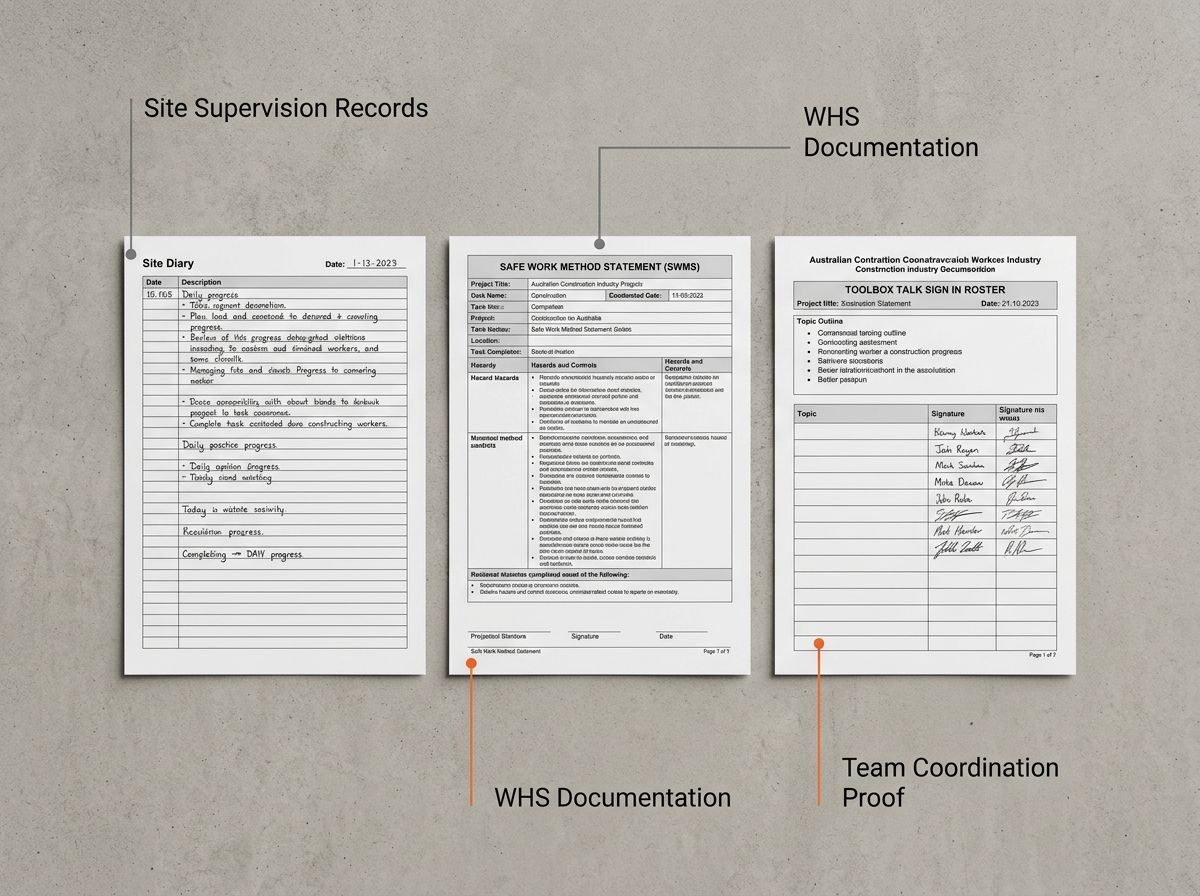
RPL evidence for CPC40120 consists of work-based documents. RTOs typically accept the following evidence, though exact requirements vary depending on the provider:
- Site diaries and daily logs: These records show ongoing site supervision, trade coordination, and management of daily activities, mapping directly to units covering site communication and project administration.
- Safe Work Method Statements (SWMS): Writing, reviewing, or implementing SWMS on site provides direct evidence of safety management. The CPC40120 core units require proven capability in managing work health and safety in building and construction.
- Toolbox talk records: Sign-in sheets and notes from meetings you facilitated confirm your active role in safety communication and daily site coordination responsibilities.
- Subcontractor coordination records: Emails, meeting minutes, and scheduling documents showing how you actively managed trades and subcontractors on site.
- Project documentation: Contracts, variation logs, progress claims, and handover documents proving your direct involvement in project administration.
- Inspection and quality logs: Completed checklists, defect lists, and inspection reports showing your role in maintaining quality standards.
- References from licensed builders or site managers: Formal employer references confirming your job role, specific responsibilities, and years of experience.
- Prior training certificates: This includes your White Card (CPCCWHS1001), which satisfies the general construction induction requirement referenced in the qualification rules.
Possessing these files does not automatically prove competency. An assessor must verify that your evidence is valid, sufficient, authentic, and current, ensuring it matches the standards of each unit. However, for an experienced site manager who has run jobs for years, the necessary evidence is usually already compiled.
The RPL Assessment Process Explained Step-by-Step
The RPL process for CPC40120 follows a logical sequence. It typically involves these stages:
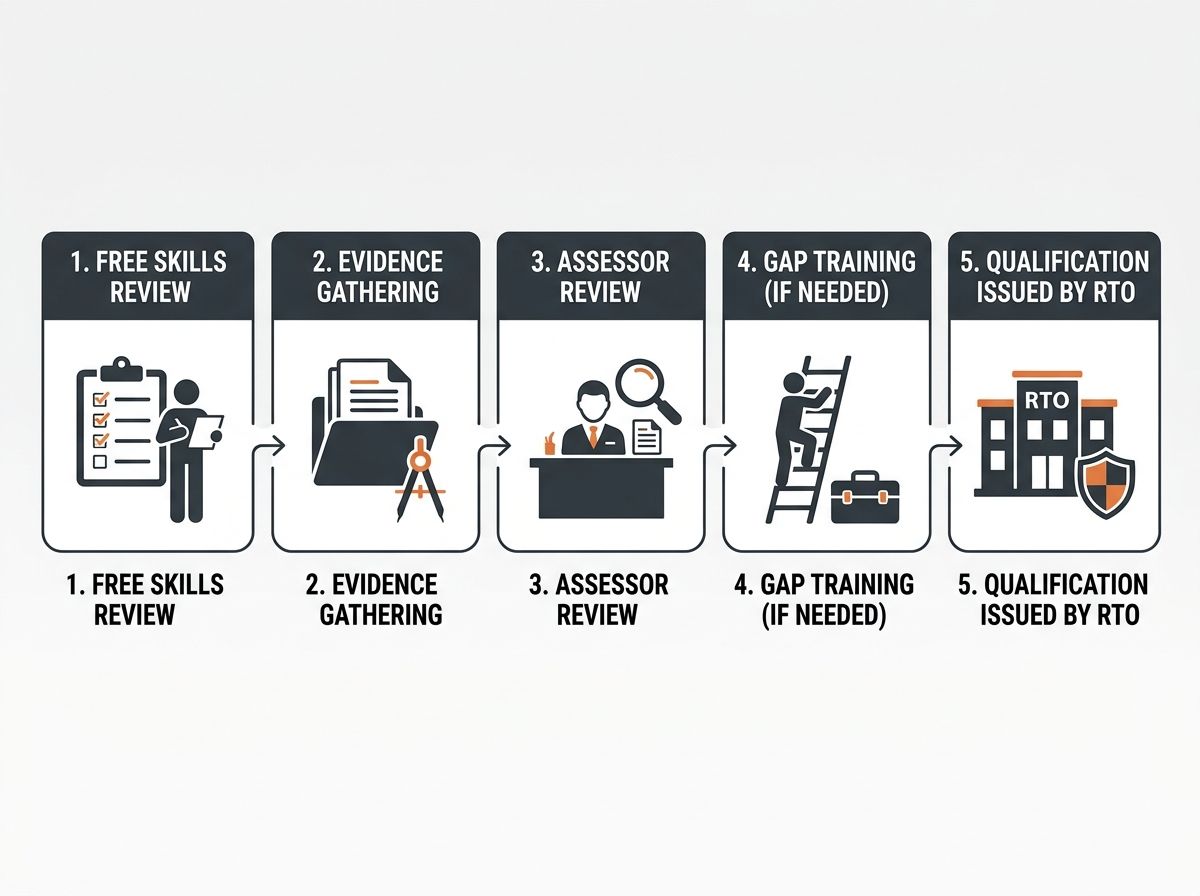
- Step 1: Skills Review. Before formal assessment begins, a skills review determines if RPL is your best path. We evaluate your background, daily duties, and paperwork against the standard qualification rules. RPL it provides a Free Skills Review at no cost and with no commitment to enrol.
- Step 2: Evidence Gathering. With support from your assessor or RPL support team, you compile your evidence portfolio. This means organising your current site documents and, when necessary, getting references or statutory declarations from licensed builders who can confirm your practical experience.
- Step 3: Assessor Review. A qualified assessor from the delivering RTO reviews your portfolio against each unit of competency. They often hold a professional conversation, which is a structured technical interview, to clarify details or supplement your written files.
- Step 4: Gap Training (if required). If your evidence does not fully demonstrate competence in a specific area, you will complete targeted gap training for that unit. This covers only what you cannot prove, rather than making you repeat the whole course.
- Step 5: Qualification Issuance. Once the assessor is satisfied that you have demonstrated competency across all units, the RTO issues your Certificate IV in Building and Construction. This qualification is nationally recognised under the Australian Qualifications Framework.
How long does the process take? Timeframes vary. One industry association RTO structures its CPC40120 RPL program to conclude within six months, requiring knowledge assessments within two months and all evidence files within five months. Another provider offers an assessor-supported program averaging four to eight weeks.
The actual duration depends on how complete your evidence is, your assessor's schedule, and the RTO you choose. Because RPL relies on evidence, the currency of your documents (how recent and relevant they are) also impacts the final timeline.
You should not expect to spend months in a classroom. This pathway is built around the skills you currently possess, not teaching you things you already do.
Why the Certificate IV Matters Beyond Your Current Project
Your employer might have set an immediate compliance deadline. However, the Certificate IV in Building and Construction is a national credential under the Australian Qualifications Framework. Once you hold it, it belongs to you and remains valid across different employers, projects, and states.
CPC40120 also acts as the educational foundation for getting a builder or site supervisor licence in Australian states and territories. Licensing criteria vary by state, and regulators usually require additional practical experience beyond holding the qualification.
The current compliance deadline is simply the trigger. The qualification is your permanent asset. Once earned, you never have to repeat this process for this standard. It is formal recognition of what you already do.
Is RPL Right for You? How Suitability Is Determined
Not all candidates qualify for RPL, and honest advice is more important than a fast enrolment. RPL it aims to guide you to the correct training pathway rather than signing you up for a process that does not fit.
RPL suitability for CPC40120 does not rely on a single national experience limit; individual RTOs set their own entry rules. For example, one RTO accepts candidates with at least two years of industry experience. Another requires a minimum of three years, current employment as a site supervisor, construction supervisor, or builder, and proven management experience across at least one residential and two commercial low-rise projects.
Beyond your years on site, eligibility depends on providing solid paperwork, including project documents, employer references, and a current White Card. In some instances, basic computer skills are also necessary to compile and upload your evidence files.
If your background is strictly in a trade role without leadership tasks, or if you cannot obtain records from past jobs, RPL might not be the right path for you today. A skills review will clarify your position before you spend any money.
Find Out Where You Stand Today
You have the on-site experience. The key is confirming that your documentation matches what an assessor needs, and identifying whether any knowledge gaps can be easily addressed.
A Free Skills Review is the simplest way to check your eligibility. It is entirely free and carries no obligation to enrol. It provides a clear assessment of whether RPL fits your background and lists the exact files you will need.
This qualification is not about learning new content. It is about proving your existing capability. The choice is yours.
The CPC40120 qualification is registered on training.gov.au, where you can inspect the official structure, packaging rules, and unit guidelines.
Ready to Get Recognised?
Start with a free skills review to find out if RPL is right for you.