You're Not an Apprentice: Rethinking How You Get Your Carpentry Ticket
Need to get qualified? Recognition of prior learning lets you prove what you already know without sitting in a classroom with first-year apprentices.

The compliance call nobody wanted
You have the experience. You've been framing walls, pitching roofs, and reading plans for years. Then your employer calls you in. A new contract requires everyone to hold a formal qualification: the Certificate III in Carpentry (CPC30220) by a set date.
It feels frustrating. You've been doing this work longer than some of your crew have been out of school. But the mandate isn't about your skill. It's about a document. That distinction matters.
Construction is one of Australia's largest employing industries, and carpenters are among its largest occupations. Many experienced tradespeople built their careers on the job rather than through formal training. Today, a lot of them face this exact scenario.
This is not a skills issue. It is an administrative requirement, and there is a pathway built specifically for it.
Why the apprenticeship model is the wrong frame
When experienced carpenters hear they need to get qualified, they usually picture a classroom. They think of first-year apprentices, modules on things they mastered a decade ago, lost weekends, and disrupted income. That picture is wrong if you already have the experience.
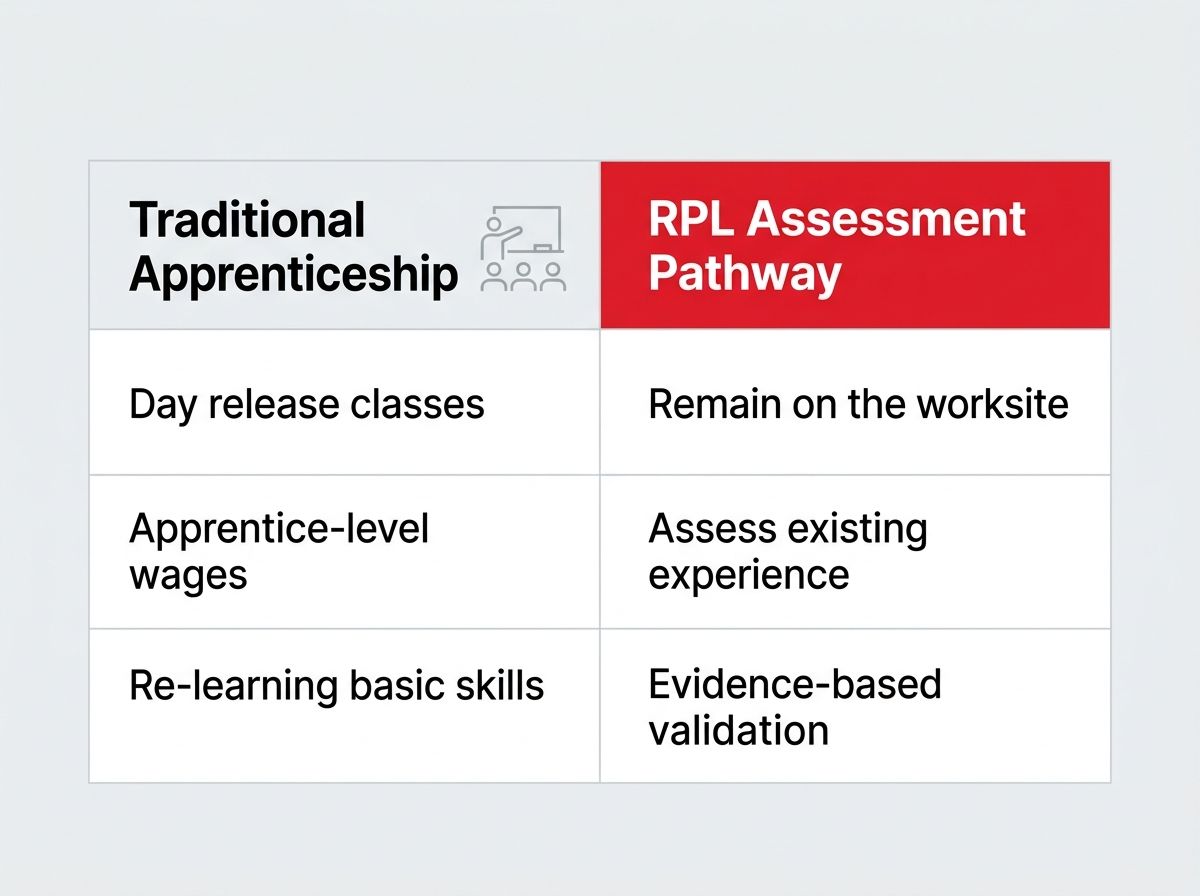
Recognition of prior learning carpentry is not a training pathway. It is an assessment pathway. This is an important distinction.
The Australian Skills Quality Authority (ASQA) defines recognition of prior learning as a process that assesses your formal, non-formal, and informal learning to see how well you meet the training package requirements. It is an assessment of what you already know, not instruction in what you do not.
An NCVER study on RPL in Australian vocational education reinforces this point. RPL is different from credit transfer. It allows people with existing skills to gain formal recognition without going through traditional training. You are not re-learning carpentry; you are demonstrating that you can already do it.
You know the work and you do the work. Now you just need to prove it.
The same principle applies across the construction trades. Experienced workers across building and construction are navigating this same shift.
What the employer mandate actually requires
Your employer is not asking you to get better at your job. They need a document showing your existing skills meet the national standard. This is a compliance requirement, not a gap in your ability.
The reasons behind these mandates vary. Principal contractor requirements, insurance terms, state licensing rules, and site access policies all play a part depending on your state and line of work. They are business and legal requirements, not judgements about how well you do your job.
Understanding this changes how you look at the process. Instead of dreading a return to school, you are solving a paperwork issue. The task is simply to secure the document that proves what you already do every day.
How recognition of prior learning carpentry actually works
The RPL process for the CPC30220 qualification involves four main stages. None of them require you to step into a classroom.
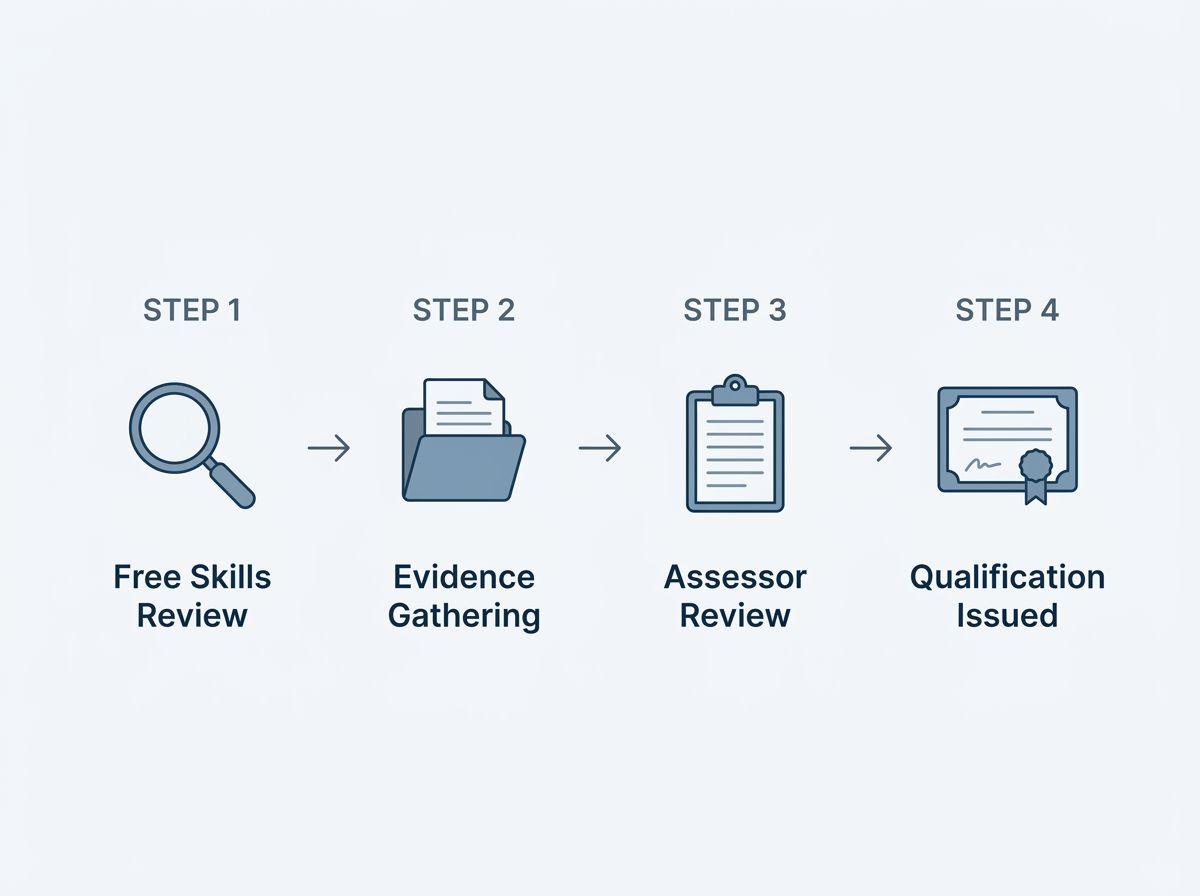
First is the skills review. Before you commit, your experience is checked against the requirements of the Certificate III in Carpentry. This stage confirms if RPL is the right path for you. This is also where RPL it assists you, helping you understand what evidence you need and showing you how to compile it.
Second is evidence gathering. You put together documents that demonstrate your skills across the units of CPC30220. You are not creating new work; you are organizing proof from your years on the tools.
Third is the assessment itself. A qualified assessor from a registered training organisation (RTO) reviews your proof against national standards. Under ASQA guidelines, if your evidence is acceptable, you may receive full or partial credit. If the assessor finds gaps, the provider can offer top-up training to address them.
Fourth, the qualification is issued. The RTO awards the CPC30220 Certificate III in Carpentry, not RPL it. We guide you through the process, while the RTO handles the formal assessment and issues the certificate.
This is a genuine, rigorous assessment. Because it is designed for people who already have the trade skills, the evidence you need is likely stuff you already have.
What counts as evidence for a carpentry RPL assessment
You are not starting from scratch here. The goal is simply to organize the proof you already have from your day-to-day work.
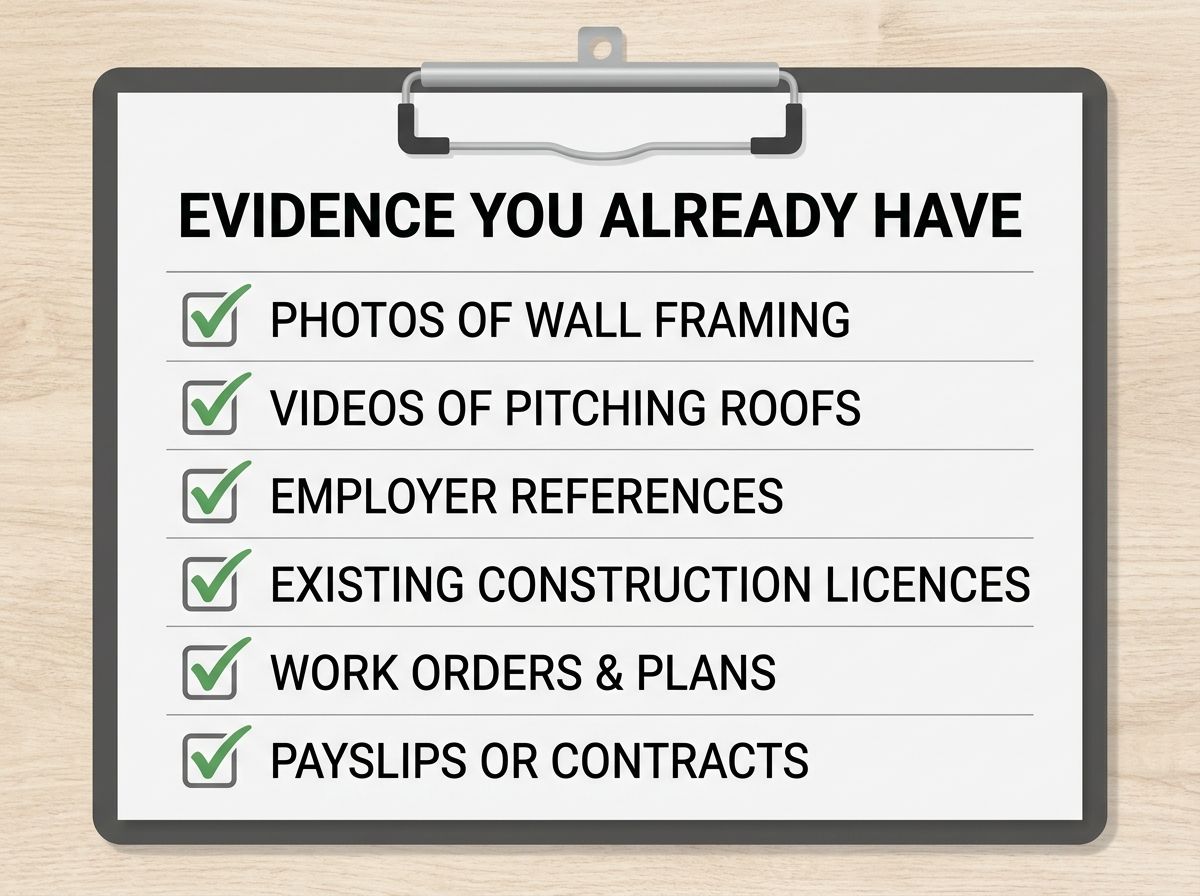
RPL evidence for the CPC30220 qualification falls into three main categories. Direct evidence shows your skills first-hand, like photos or video of your completed carpentry work, practical demonstrations, or site observations. Indirect evidence supports your claim through paperwork like construction plans, job sheets, employer references, and invoices. Supplementary evidence provides extra context, including payslips, contracts, your current White Card, and other relevant licenses.
To show you how this looks in practice, Master Builders NSW, an industry body offering CPC30220 RPL, lists several tasks that your evidence might need to cover. These include:
- Constructing wall frames and partitions
- Erecting timber and steel frames
- Setting out and installing ceiling frames
- Pitching a roof, including scotch valley, broken hip and valley, and gable
- Framing and fitting wet areas
- Installing and replacing windows and doors
- Setting out site, basic formwork, and concreting
- Demonstrating use of explosive power tools and levelling devices
- Installing flooring systems
- Installing exterior fibrous cement weatherboards
- Basic demolition and site clean up
This list is from one provider, and requirements can vary by RTO. For most experienced carpenters, though, these points describe a standard week on the job. The evidence is not unusual. It is just the work you already do.
Some training organisations structure their RPL assessment around a kit. This usually combines knowledge questions, practical projects or site observations, and a portfolio of documents. For example, one provider requires candidates to build at least two full-size structures, showing evidence through photos, videos, and paperwork. Requirements depend on the RTO, and your RPL guide will help you understand exactly what you need.
The honest truth about RPL: what it is and what it isn't
RPL is not a shortcut or a loophole. It is a rigorous assessment process that respects your existing trade experience. That level of rigor is exactly why the qualification is valuable.
The CPC30220 Certificate III in Carpentry issued through RPL is identical to the qualification earned through a traditional apprenticeship. As RTOs explain, it carries the same AQF accreditation, comes under the same national training system, and is recognized identically by employers, licensing boards, and government agencies nationwide.
This equivalence holds because the assessment is real. Assessors review your evidence against the same national standards that apply to every CPC30220 candidate. If they identify gaps during your assessment, you can complete gap training. Your qualification reflects genuine competency, which is why it is widely recognized.
RPL does not guarantee a qualification. The assessor makes an independent decision, and the RTO issues the certificate, not RPL it. State licensing bodies may also have separate requirements beyond the qualification itself, depending on where you work. These details are not reasons to avoid RPL; they are just reasons to start the process with clear expectations.
Starting without commitment: the free skills review
Before taking any other steps, find out if RPL is the right path for you. The process starts with a free skills review. This is an honest check of your trade experience against the CPC30220 requirements. There is no obligation to proceed and no commitment required.
We offer this review because RPL is not suitable for everyone, and signing up for a pathway that does not fit your background wastes your time and money. The review gives you a clear picture of where you stand before you make any commitments.
Your skills speak for themselves. We just help them be recognized. The next step is up to you.
ASQA's guidance for students explains that in an RPL assessment, a qualified assessor compares your evidence against course requirements. If your evidence is acceptable, you may receive full or partial credit toward your qualification.
According to Jobs and Skills Australia, carpenters and joiners are among the largest employing occupations in the Australian construction industry, a sector that employs around 1.37 million people and accounts for roughly 9.3% of the national workforce.
A BITRE analysis of ABS Census data found that in a major construction sub-sector, certificate-level qualifications were the main post-school qualification, held by 38% of workers compared with 24% of the general workforce. This shows that while formal credentials are common, they are far from universal in the trades.
Master Builders NSW, an industry body delivering CPC30220 RPL, outlines the types of evidence and tasks a carpentry assessment might cover, including framing, roofing, and fixing work documented through photos, videos, and project records.
Ready to Get Recognised?
Start with a free skills review to find out if RPL is right for you.