Why 15 Years of Framing Experience Can Cost You Work
Experienced framers are being filtered off major sites, not for lack of skill, but because they lack qualifications. Learn how RPL carpentry changes this.

You have the experience. Fifteen years of it. Wall frames, roof trusses, top plates, structural plans: you have read them, set them out, and built to tolerance on site after site. And yet, recognition of prior learning carpentry is a phrase you have probably only recently heard. This is because a shift in the industry is costing experienced framers contracts they should easily win.
How site managers filter subcontractors has changed
Australian construction runs on subcontractors. According to a submission to a Senate Economics Committee inquiry into insolvency in the construction industry, subcontractors perform between 80 and 85 per cent of all construction work in Australia, which is described in that inquiry as the highest rate of subcontracting in the world. The same Senate committee report outlines the industry as a pyramid of contractual relationships, placing head contractors at the top with multiple layers of specialist subcontractors working underneath them.
That basic structure is unchanged. What has shifted is how head contractors and site managers handle the compliance risk. Across many major residential and commercial sites, the pre-qualification process for subcontractors now requires proof of formal credentials. They are checking more than just your ABN, insurance, and White Card; they want to see trade qualifications. For carpenters and framers, that means holding a nationally recognised Certificate III in Carpentry.
Licensing requirements vary between states and territories, and not every role on every site requires a formal builder's licence. An employee working under a licensed builder might not need a personal licence. However, for subcontractors working directly, meaning they quote their own jobs, deal directly with builders, and run their own crews on site, the question about trade credentials is bound to come up eventually.
The White Card is the simplest example of how credential verification operates on Australian sites. Every worker, regardless of their experience, role, or seniority, must hold a Construction Induction Card before stepping foot on a site. That is not a skills assessment; it is a document check. This same administration-first logic is now being applied to trade qualifications.
Why more experience can mean more exposure
Here is what most experienced framers do not expect: the more capable you are, the more obvious your lack of paperwork becomes. Junior carpenters work under direct supervision without quoting jobs, managing crews, or dealing with builders. But a framer with 15 years on the tools is exactly the person asked to step up to run a framing crew, quote on a residential development, or deal directly with the head contractor.
These are exactly the roles where the lack of a formal qualification gets exposed. This is not because your trade skills are in question. It is because the administrative systems, including pre-qualification checklists, insurance policies, and subcontractor agreements, do not have a blank space for 'years of experience.' They have a mandatory field for your qualification.
Operating without formal recognition makes the credential gap more obvious as you take on larger projects. The more senior the role, the harder it is to work around.
What site managers are actually checking
The qualification check is an administrative filter, not a skills assessment. Site managers and compliance officers do not watch you frame a wall. They look at a list. On that compliance list, the required document for a carpenter or framer is the nationally recognised Certificate III in Carpentry, which has the qualification code CPC30220.
Construction managers oversee subcontractors and maintain quality standards, while also managing schedules, safety, budgets, and client relations. This responsibility drives their compliance demands. When an issue occurs on site, the paper trail is what matters. A qualified subcontractor represents a verified credential, whereas a subcontractor with 15 years of experience but no paperwork represents an unmanaged compliance risk.
The Certificate III in Carpentry (CPC30220) is the national qualification that satisfies this administrative check. It is the document that gets you past the compliance filter and into the jobs you want.
What recognition of prior learning actually means
Recognition of prior learning for carpentry is a formal assessment pathway conducted by a registered training organisation (RTO). It evaluates whether your practical skills and experience meet the national standards for CPC30220. If the assessment shows you do, you receive the exact same Certificate III in Carpentry as someone who finished a traditional apprenticeship. The qualification itself is identical; only the assessment pathway is different.
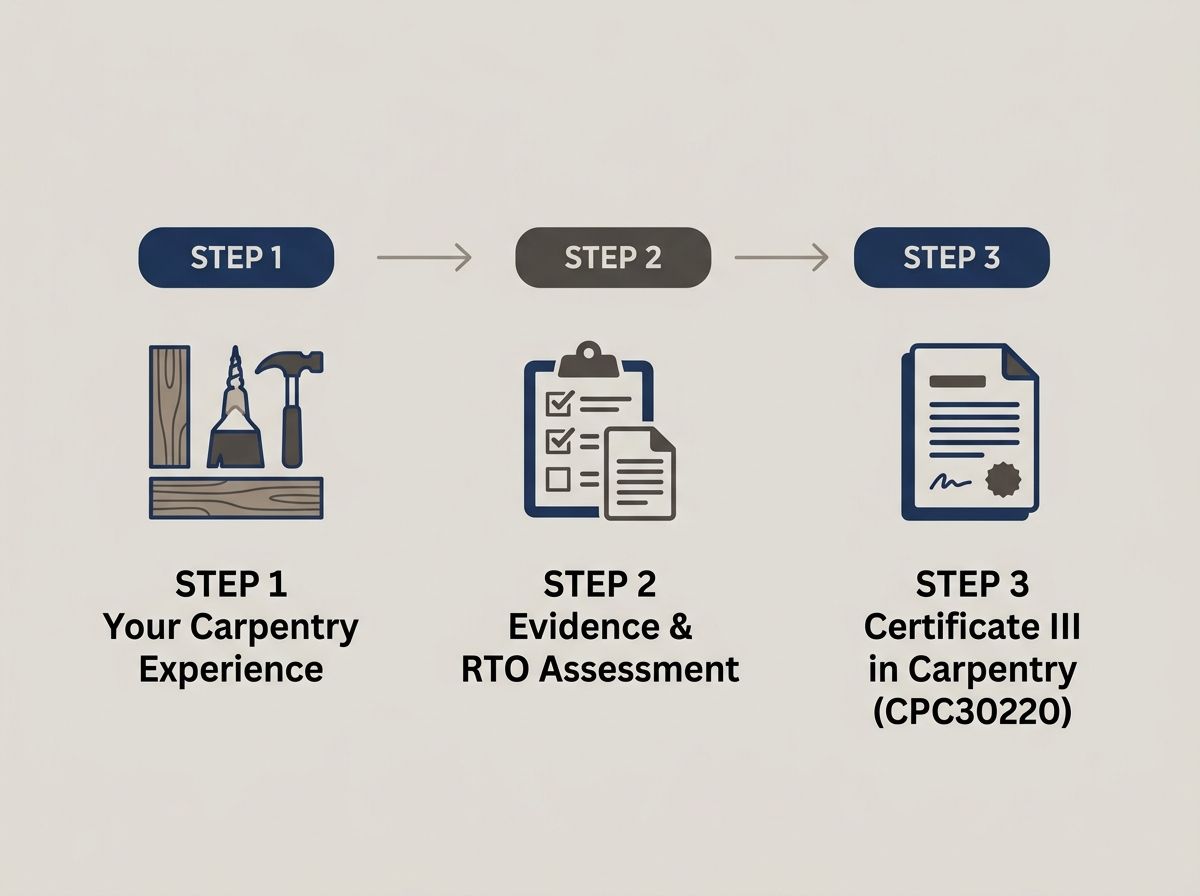
This is not a shortcut. The assessment is a thorough process, which is why the resulting qualification holds genuine value. An RTO assessor evaluates your evidence against specific competency units. They do not hand out passes as a favour; they conduct a structured review against the national training standard.
RPL it does not assess your skills or issue qualifications; RTOs do. Instead, we guide you through the entire preparation process. We help you identify the evidence you need, show you how to gather it, and organize your work history into a format that the RTO assessor can easily review.
How framing experience translates to evidence
The work a framer does every day maps directly to the competency units within CPC30220. The qualification's core units include CPCCCA3004 Construct and erect wall frames, CPCCCA3005 Construct ceiling frames, CPCCCA3006 Erect roof trusses, and CPCCCA3007 Construct pitched roofs. Specialist elective units include CPCCCA3008 Construct eaves and CPCCCA3009 Construct advanced roofs, with elective availability varying by RTO.

The complete unit list for CPC30220 is on the national training register, the official source for qualification requirements.
If you have spent years setting out wall frames, erecting roof trusses, and reading structural plans on site, you already do the work these units cover. The issue is not your ability to do the job. The issue is showing your competence in a format that the assessment process can formally review.
Evidence for a carpentry RPL assessment relies on things you likely already have: photos of your work, references from builders you have worked with, records of projects you have contributed to, and proof of your methods. The main task is not learning new skills. It is organizing your existing history into a clean portfolio that meets the assessment guidelines.
RPL is an assessment, not a guaranteed pass
Recognition of prior learning is a strict process. Not every applicant has enough evidence to prove competency in every single unit. Where gaps appear, gap training is the standard solution. Some RTOs include this training within their overall RPL package at no extra cost to you.
For example, DLI Training states that if gap training and assessment is required during its Certificate III in Carpentry RPL process, it is completed online as part of the program with no extra fee. Some government-subsidised initiatives, like the NSW Government's Trade Pathways for Experienced Workers program delivered by CTI, cover both the RPL assessment and any necessary gap training at no cost for eligible participants.
RTO policies vary, so verify the gap training arrangements with your provider before starting. Remember that gap training is a standard and expected part of the RPL process. It is not a sign of failure, and it should not hold you back from starting.
The assessment outcome depends entirely on your evidence. That is why getting clear advice on your suitability before you make any commitments is so important. We prefer to help you confirm whether RPL makes sense for your situation rather than see you start a process that does not fit your background.
Start with a free skills review
Before making any commitments, you should confirm if your experience fits the requirements. A Free Skills Review is a straightforward conversation that maps your practical background against the CPC30220 standards, letting you know exactly where you stand before you take any further steps.
This situation, where experienced, capable tradespeople are filtered out by credential requirements, is common across Australian construction. It is not unique to carpentry; it is how the modern industry manages its compliance risks.
You have the practical experience. Find out if it qualifies. The choice is yours.
Ready to Get Recognised?
Start with a free skills review to find out if RPL is right for you.