The engineering tender trap: why better skills are losing to better paperwork
Are you losing tenders to candidates with formal credentials? Learn how engineering RPL turns your proven experience into recognised qualifications.

The tender that should have been yours
You have done this work for years. You know the site, the specs, and the tolerances. You have managed the complexity, solved the problems, and delivered on time. Then the tender result comes back and you did not get it. The contract went to a team with less experience on the tools, but they listed a formal qualification on their submission.
This is not an isolated event. It is a structural feature of how government and commercial procurement works in Australia. Procurement frameworks are designed to manage risk and ensure value for money. When a procurement officer cannot directly assess technical capability, they rely on formal qualifications as shorthand. Most of them cannot judge your trade skills directly. Your years of demonstrated competence exist in the wrong form for the system to recognise them.
Your skills are real. The system just cannot read them yet.
How the procurement system became a credential filter
Australian government procurement is governed by the Commonwealth Procurement Rules, which are designed to ensure value for money and transparent, accountable decision-making.
Under this framework, agencies are required to publish contract information on AusTender and to make reasonable inquiries about a tenderer's capability to deliver. For construction and engineering projects, that capability assessment often includes references to compliance with relevant Australian Standards and formal demonstration of technical competency.
According to Infrastructure Australia's 2025 Infrastructure Market Capacity Report, most government procurement specifications in Australia reference compliance with relevant Australian Standards, though the report notes that compliance is not universally mandated and enforcement varies across the country.
The practical effect is this: procurement officers are not engineers. They cannot evaluate your site judgement, your problem-solving under pressure, or the quality of your previous work. What they can evaluate is a checklist. Formal qualifications sit on that checklist. If yours is missing, the risk assessment defaults against you, regardless of your actual capability.
The Commonwealth Procurement Rules framework is published by the Department of Finance and governs how federal agencies assess and award contracts.
The invisible practitioner: when experience exists in the wrong form
There is a distinct frustration in knowing you can do the job, only to be told by a form that you cannot prove it.
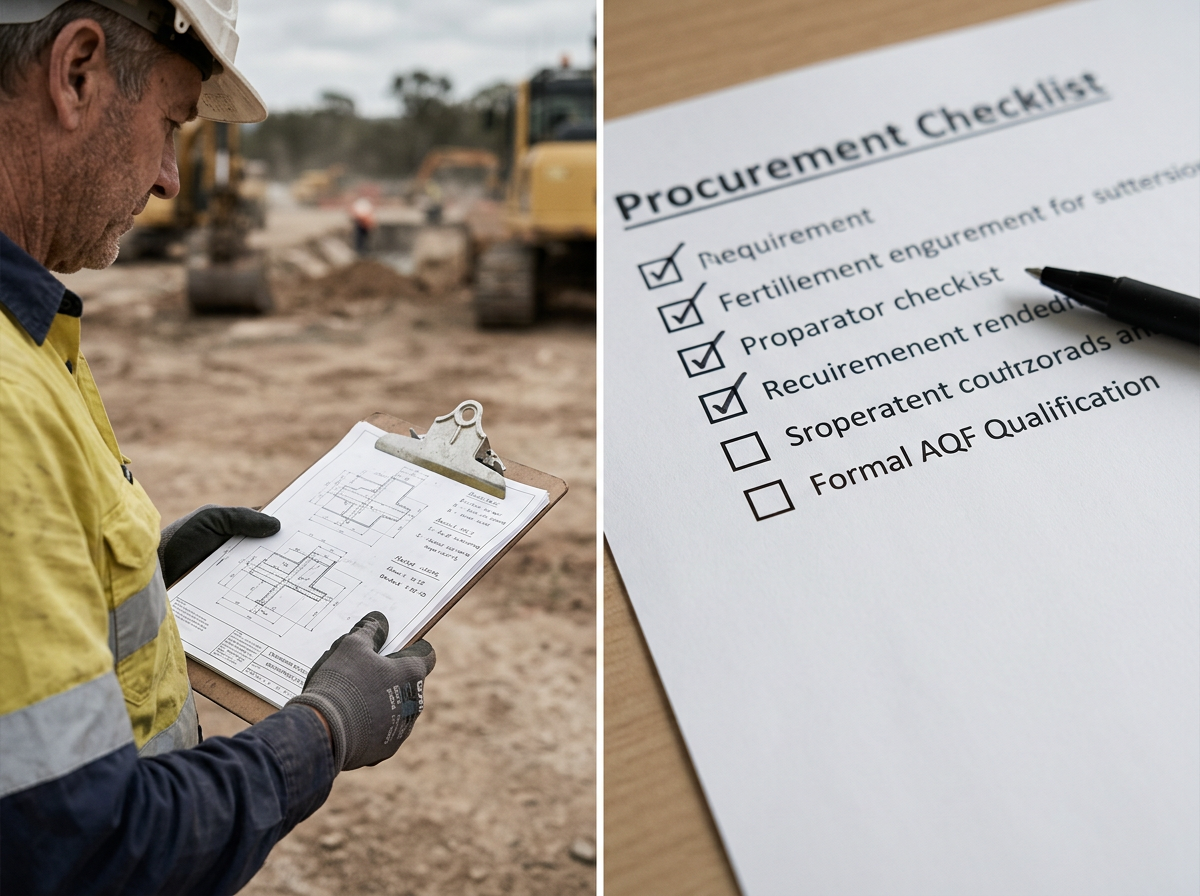
In engineering and construction, this plays out in concrete ways. For example, you cannot bid on certain government infrastructure tenders because the procurement document mandates a formal qualification you do not hold. You are passed over for supervisory or management roles because HR requires a Diploma or Certificate IV on the application. You might be working under someone else's licence or qualification, doing the actual technical work while they sign off on it. You cannot act as a Nominated Supervisor or Principal Contractor because those roles require formal credentials.
Your experience is genuine. Your competence is real. But it exists in a form the formal system cannot process. It was learned on the job and built through years of practice, but never translated into the language of nationally recognised qualifications.
Infrastructure Australia has identified worker shortages and stagnating productivity across the construction sector as a major challenge to project delivery. This workforce challenge involves both numbers and professional recognition. Experienced practitioners who cannot access the roles their skills warrant represent a form of unused capacity.
Why this problem is getting worse, not better
Australia's infrastructure investment pipeline has reached historically high levels. According to Infrastructure Australia's 2025 Infrastructure Market Capacity Report, the five-year Major Public Infrastructure Pipeline increased by $29 billion to reach $242 billion, which is the highest level since Infrastructure Australia began tracking nationwide government infrastructure investment in 2021.
Transport infrastructure alone accounts for $129 billion of that pipeline, or 53 per cent of the total, representing a $3 billion increase on the previous year's outlook.
Growth in the pipeline is largely driven by government investment in energy transmission and housing projects, as governments pursue housing and net zero targets.
Infrastructure Australia's 2025 Infrastructure Market Capacity Report provides the most comprehensive publicly available data on Australia's infrastructure investment pipeline and workforce pressures.
More investment means more tenders. More tenders means more qualification requirements. And Infrastructure Australia has recommended the development of consistent nationwide training programs to upskill workers in productivity-enhancing innovations, confirming that the workforce development challenge is real and growing.
The credential gap is not resolving itself. If anything, the scale of Australia's infrastructure ambition makes it more acute. Experienced practitioners without formal qualifications face a procurement environment that is becoming more credential-dependent, not less.
What engineering RPL actually is (and what it isn't)
Recognition of Prior Learning (RPL) is a formal assessment process conducted by a registered training organisation (RTO) that evaluates whether your existing skills and experience meet the competency standards of a nationally recognised qualification under the Australian Qualifications Framework. It is not a shortcut or a workaround; it is a legitimate and rigorous assessment pathway.
Churchill Education, an Australian RTO, describes RPL as a formal assessment process under the AQF in which a full RPL qualification is identical to a qualification earned through conventional study, carrying the same AQF level, the same issuing RTO, and the same unit codes.
The regulatory framework is consistent nationally. The AQF provides the national standard for qualification levels, and ASQA, the Australian Skills Quality Authority, regulates registered training organisations and maintains quality standards across the VET sector.
For engineering and construction practitioners, RPL is available across a range of nationally recognised qualifications, from Certificate III in Engineering through to Diploma of Engineering and Certificate IV in Building and Construction. The specific qualifications available depend on the RTO's scope of registration. An RTO can only conduct RPL for a training product that is on its approved scope.
An important point of clarification is that RPL qualifications are nationally recognised because the assessment process is genuine. The qualification carries weight with employers, licensing bodies, and government agencies because it has been formally assessed against national competency standards, rather than a certificate being issued without scrutiny. RPL outcomes are not lesser than training-based outcomes; units awarded through RPL meet the exact same standards as units awarded through formal training.
Regarding peak bodies such as Engineers Australia: Skills Recognition International, an Australian RTO, states that its RPL-awarded qualifications are accepted as evidence by authorities that recognise Australian VET qualifications, including Engineers Australia for engineering, with each authority applying its own assessment process and evidence requirements. Readers should confirm current requirements directly with Engineers Australia or their relevant state regulator, as each authority has its own criteria.
RPL it works with engineering and construction practitioners across a range of qualifications. See the full range of engineering and construction RPL qualifications available.
The evidence you already have (and might not know about)
One of the most common misconceptions about RPL is that it requires you to prove yourself from scratch. It does not. It requires you to organise what you already have.
Experienced engineering and construction practitioners typically hold more potential evidence than they realise. This includes project records, site diaries, and photos of completed work. It also includes employer references, letters of verification, safety documentation, incident reports, training certificates, licences, job descriptions, position statements, and professional memberships.
According to METS Training Services, evidence commonly used to support an RPL application includes resumes, employer references, photos or videos of work, job descriptions, work samples, and prior certificates. Assessors use this evidence to map the applicant's experience directly against specific competency requirements.
The assessment is evidence-based, not exam-based. You are not being asked to demonstrate that you can learn something new. You are being asked to demonstrate that you already know it, and that your work history shows it.
RPL can suit people who have learned on the job but do not hold a formal certificate, because skills and knowledge can be gained through work, volunteering, informal training, or life experience.
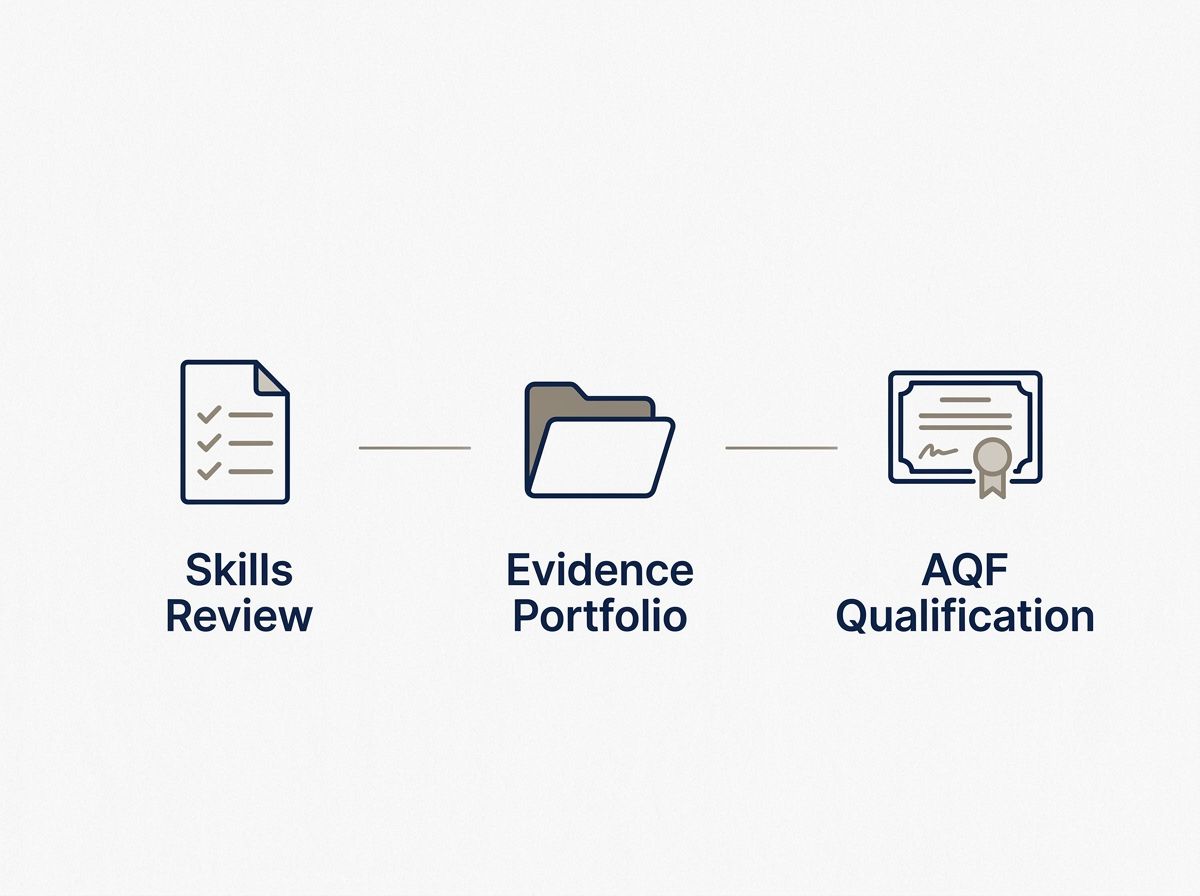
The guided process of gathering and presenting that evidence is where RPL it supports candidates. This involves helping you identify the evidence you already have, organising it into a coherent portfolio, and presenting it in the specific format an assessor can evaluate.
From invisible to competitive: what changes after engineering RPL
When the formal record matches your actual capability, the credential barrier disappears. This is not a guarantee of a specific commercial outcome, but rather a description of what removing that barrier makes possible.
For engineering and construction practitioners, a nationally recognised qualification opens access to tenders that previously excluded you on credential grounds. It satisfies the formal requirements for supervisory and management roles. It enables you to operate as a Nominated Supervisor or Principal Contractor, and removes the need to work under someone else's qualification.
Your skills are real. Your experience counts. What changes is that the formal system can now see both.
Getting licensed or credentialled through RPL is not about relearning your trade. It is about presenting what you already know in a form the system can recognise.
Is engineering RPL right for you?
RPL is not suitable for everyone, and honest suitability guidance matters more than a sales pitch.
Under Australian RPL requirements, applicants are assessed against the requirements of the specific training product, and evidence must be current, authentic, valid, and sufficient. Suitability is not based simply on years of experience; it depends on whether your experience covers the breadth of competencies required by the qualification.
As a general indicator, one engineering RTO's published eligibility criteria include a minimum of three years of full-time work experience in a relevant engineering role. However, these are provider-specific criteria and requirements may vary across RTOs and qualifications.
RPL is most likely to suit you if you have substantial hands-on experience working at or near the level of the target qualification, your experience covers a broad range of the relevant competencies rather than a narrow specialisation, you can provide current evidence of your skills instead of just historical records, and you have been working in the field consistently rather than sporadically.
If gaps exist between your experience and the qualification's requirements, gap training may be required. This is a normal part of the RPL process, not a failure. Reputable RTOs provide gap training as part of the assessment pathway.
The decision about whether RPL is the right pathway for you starts with an honest assessment of where you stand, not a sales conversation.
The first step: a free skills review
Your experience can be evidence. The question is whether it is the right evidence, organised in the right way, for the qualification you are targeting.
A Free Skills Review is the honest starting point. It is not a commitment to enrol. It is not a sales call. It is an assessment of whether your experience aligns with the RPL pathway, so you can make an informed decision before you commit to anything.
Your skills are real. Your experience counts. Find out where you stand.
Ready to Get Recognised?
Start with a free skills review to find out if RPL is right for you.