You're not a beginner anymore: Why getting your plumber licence doesn't mean going back to TAFE
Think getting your plumber licence means sitting in a classroom with apprentices? It doesn't. Here is how experienced plumbers use RPL to get licensed.
The dread that stops experienced plumbers from getting licensed
You have been doing this for years. You know the trade inside and out: the rough-ins, the drainage calculations, the gas work, and the hot water systems. You have trained apprentices. You have fixed other people's mistakes. Yet the idea of sitting in a classroom with 18-year-old apprentices, working through content you mastered a decade ago, makes you want to put this off for another year.
That dread is real. It is the main reason experienced plumbers delay getting licensed, rather than the cost, the time, or the paperwork. It is frustrating to have to prove yourself to a system that does not yet recognise what you already know how to do.
Most experienced plumbers do not realise that this dread is based on a misunderstanding of what the licensing process actually involves. Getting your plumber licence does not require you to go back to TAFE or start from scratch. You do not have to sit through lessons on how to do the work you have already been doing for years.
What getting a plumber licence actually requires
In NSW, plumbing work is regulated, and licensing is administered by NSW Fair Trading. To work as a licensed plumber, especially if you want to operate as a contractor who can take on jobs independently, pull permits, and run a business, you must hold the relevant licence class and meet the underlying qualification prerequisites.
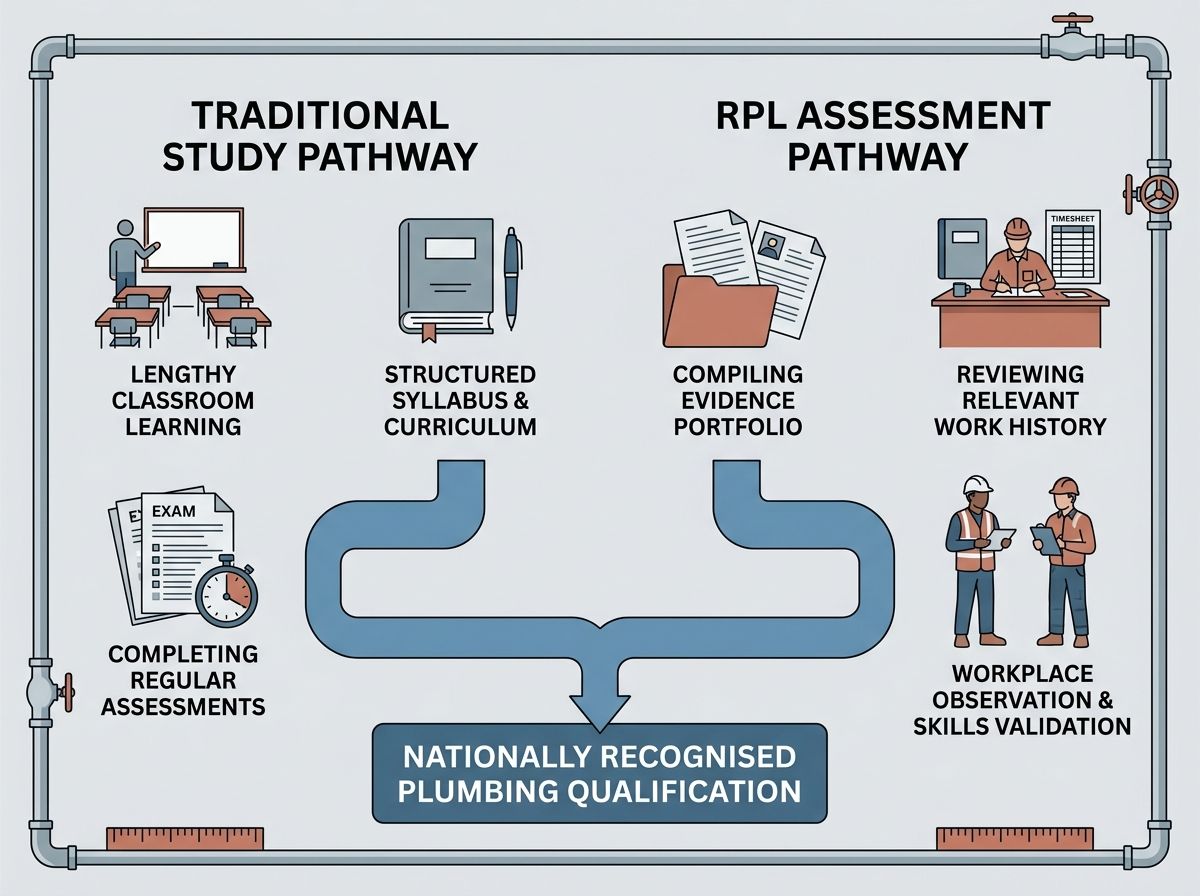
These qualification prerequisites require formal recognition of your skills against national standards. The qualifications are part of the Construction, Plumbing and Services Training Package, and the competency units align directly with the work experienced plumbers perform every day.
The main point is that the qualification requirement is about demonstrating competency, not about completing a course. Recognition of Prior Learning (RPL) is a nationally recognised assessment pathway under the Australian Qualifications Framework. It is designed to allow experienced workers to have their existing skills formally assessed and recognised, without repeating training they have already completed.
The licensing body needs to see that you meet the competency standard. How you demonstrate that skill, whether through traditional study or through RPL, is a separate question. Both pathways lead to the same recognised qualification, and both qualifications satisfy the same licensing prerequisite.
The difference between learning a trade and proving you already know it
This is the core distinction.
A TAFE course is designed for someone who does not yet know how to do the work. The content, assessments, and structured delivery are all built on the assumption that the student is learning new skills. If you are an experienced plumber, that assumption does not apply to you. You are not learning new skills; you are being asked to prove the skills you already use daily.
RPL is built for people who already do the work. It is the process of presenting your existing skills as evidence, structured and assessed against the same national standards that a TAFE course covers. The assessor is not asking you to learn anything new. They are asking you to show what you already know how to do.
Look at it from this perspective. The qualification standard outlines a set of skills a qualified plumber must have. A TAFE course teaches those skills to someone who is new to the industry. RPL asks you to prove that you already possess them. The final qualification is the same, but your starting point is different.
Your experience is real. The real challenge is showing it in the format the training system requires. That is exactly what the RPL process does.
What gathering evidence actually looks like for a plumber
The RPL process is not a single exam or a classroom test. It is a systematic way of gathering and presenting proof of your current skills. For an experienced plumber, that evidence already exists in the work you complete every week.
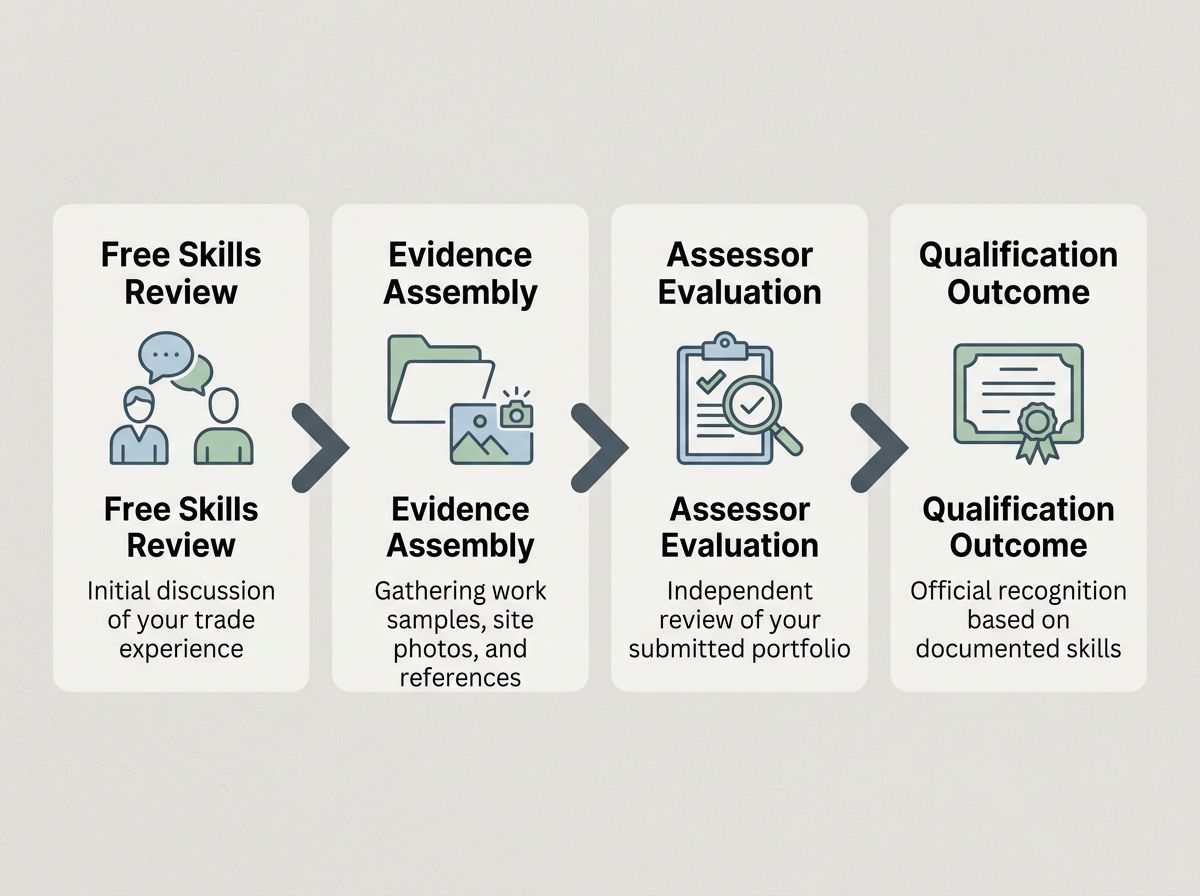
Evidence in an RPL assessment includes records of completed jobs, photographs of your work, references from supervisors or clients who can verify your skills, and logbooks or job sheets. In some cases, it may also require a practical demonstration or a technical interview with an assessor. The exact evidence needed depends on the qualification and the registered training organisation (RTO) conducting the assessment.
The process follows a straightforward sequence. It begins with a skills review, which is a straightforward discussion about your experience and how it aligns with the course requirements. This is followed by guided evidence gathering, where you identify what documents you have and how to present them. Next, a qualified assessor from the RTO conducts a formal assessment. Finally, if you demonstrate the required skills, your qualification is issued.
If the assessment identifies any gaps where your documented experience does not fully meet a competency unit, targeted training can fill those specific areas. This is not a failure. It is a normal part of the process to ensure your final qualification is complete and compliant.
The process is fully guided. You do not have to navigate it alone, and you are not starting from scratch. You are simply showing what you have already built.
Why the classroom fear is costing you more than you think
There is a clear irony here: the fear of going back to study, which keeps many experienced plumbers from taking action, actually causes the exact disruption they are trying to avoid.
Operating without the correct plumber licence in NSW carries major risks. Unlicensed plumbing work attracts significant penalties under state legislation, and NSW Fair Trading actively enforces these rules. Beyond regulatory fines, you face practical limitations. You cannot tender for certain contracts, you cannot legally supervise commercial jobs, and you face serious insurance complications if you are not the licence holder on record.
Every month you work without your licence adds to your professional risk. Your exposure continues as long as you delay, and the long-term impact on your business growth compounds over time.
The reality is that the process is far more straightforward than most people assume. The main barrier is not months of study, but simply taking the first step to understand the pathway and find out whether your experience qualifies you.
Is RPL the right pathway for you? Honest guidance
RPL is not suitable for everyone. The assessment is thorough, and the qualification is nationally recognised because the process is rigorous. Not every applicant has enough documented experience to meet all the required competency standards. Some will have gaps that require top-up training before a qualification can be issued.
The right question to ask is whether your current experience aligns with the national competency standards. An experienced assessor can answer this honestly, which is exactly what a Free Skills Review resolves before you make any commitment.
RPL is best suited to plumbers who have worked in the trade for several years, have performed diverse plumbing work across different sectors, and can verify that work. If your experience is narrow, very recent, or undocumented, a skills review will state that clearly and guide you toward a more suitable training pathway.
The objective is not to enrol every applicant in RPL, but to find the right training pathway for your specific situation. This starts with a clear assessment of where you stand.
The next step: Find out where you stand before you commit
You already have the experience. The main question is whether that experience is in a format ready for formal recognition, and you can get an answer to that before you spend any money.
A Free Skills Review is the starting point. It is a straightforward, no-obligation conversation about your work history, the qualification requirements, and whether the RPL pathway fits your needs. It is not a sales call; it is a practical assessment of your current standing.
If RPL is the correct option, you will learn exactly what evidence you need to pull together. If it is not the right fit, you will find out immediately so you can make an informed decision about your next steps.
The decision is yours, but you cannot make an informed choice without knowing how your current skills stack up.
Ready to Get Recognised?
Start with a free skills review to find out if RPL is right for you.