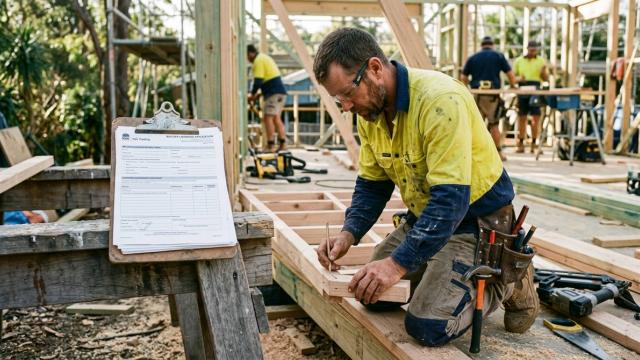
NSW Carpenters: The Licensing Rule Nobody Explains Until You're Already Working Illegally
NSW carpentry work over $5,000 requires a contractor licence. Many find out too late. Here is what the law requires and how RPL helps you get licensed.
By RPL it Australia7 min read
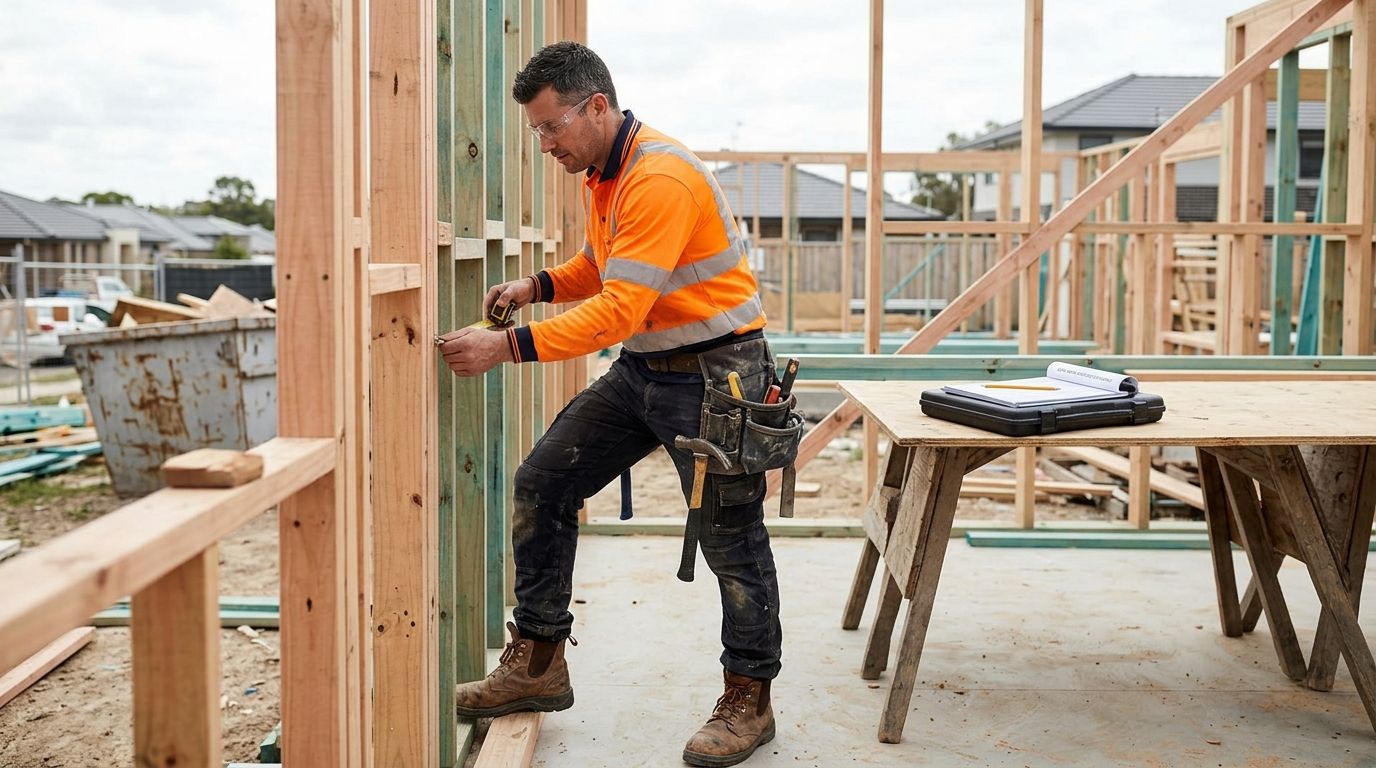
The $5,000 threshold for NSW carpentry work
In NSW, you need a contractor licence to do, advertise, or contract for residential building or trade work, including carpentry, if the total value is over $5,000 in labour and materials (including GST). This is the legal threshold. It is not an industry guideline or a suggestion; it is a strict requirement under the Home Building Act 1989.
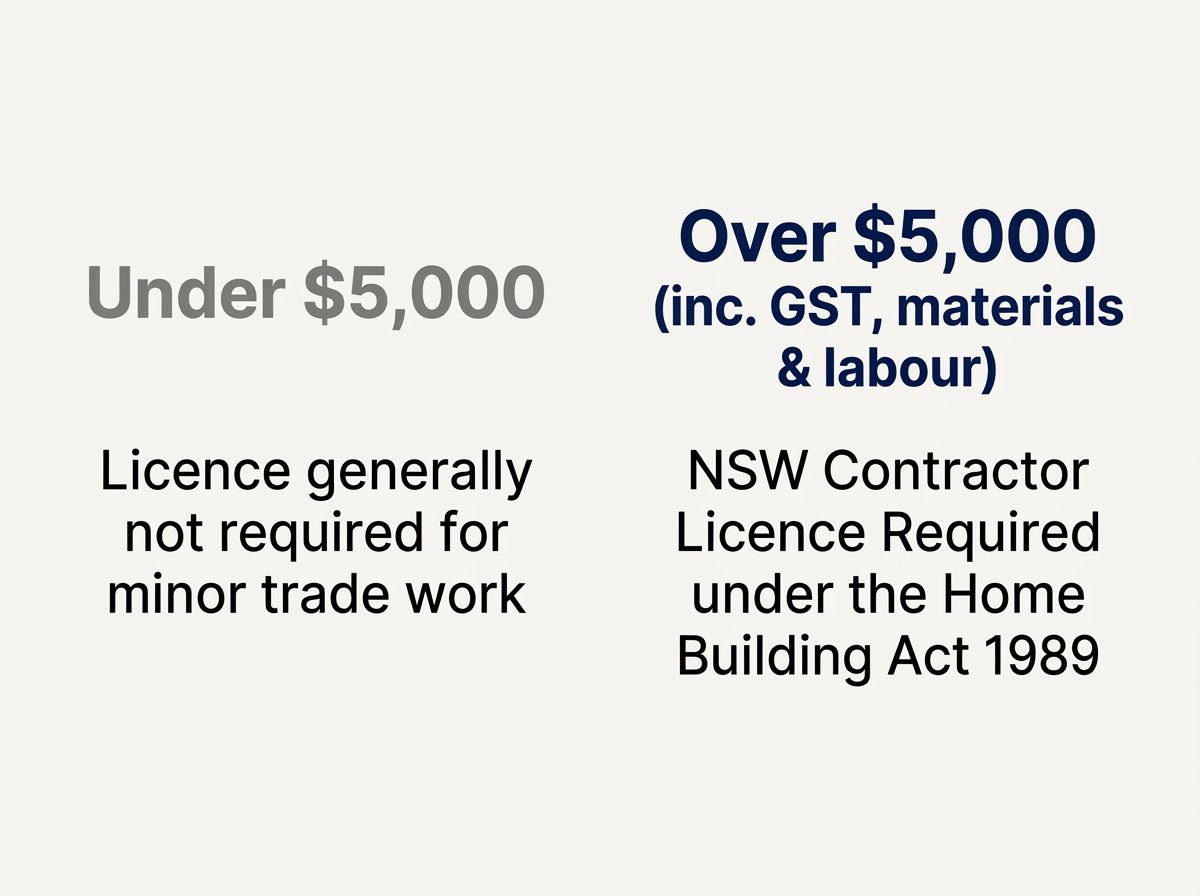
Most experienced carpenters were never told this rule exists. They learned the trade on site, not in a compliance seminar. By the time they learn about the threshold, they are often already working on projects that exceed it, sometimes by a significant margin.
The NSW Government's carpentry licensing page states this requirement clearly: you must hold a contractor licence for residential building or trade work, including carpentry, valued at more than $5,000 in labour and materials including GST.
Why most experienced carpenters do not know this rule
This licence requirement is rarely explained when you learn the trade. Apprenticeships teach carpentry skills, such as framing, roofing, joinery, and fit-out. They do not cover licensing regulations. Most carpenters only discover the rule when a problem occurs, like a contract falling through, a client asking for a licence number, or a site manager raising the issue.
There is also a widespread belief among carpenters subcontracting under a licensed builder that the builder's licence covers their work. This is a misunderstanding. Under NSW Government guidelines, licensing requirements apply to subcontractors as well. If you are subcontracting for trade work that is part of a larger project valued at more than $5,000, you will typically need your own contractor licence for your trade category.
The NSW Government highlights this with a practical example: a subcontractor doing $3,000 of dry plastering within a $30,000 kitchen renovation run by a main contractor still needs their own dry plastering licence. The $5,000 threshold applies to the entire contract, not just the value of your individual subcontract.
This is not a minor detail. It is a core part of how NSW home building licensing is structured, and it frequently catches out highly experienced, competent tradespeople who work to a high standard but have never formalised their qualifications.
What unlicensed carpentry work means in practice
Carrying out, advertising, or contracting for residential building or trade work without the proper licence is a serious offence in NSW. Under the Home Building Act 1989, unlicensed work can lead to fines of up to $22,000 for an individual or $110,000 for a corporation, as outlined in NSW Government guidance.
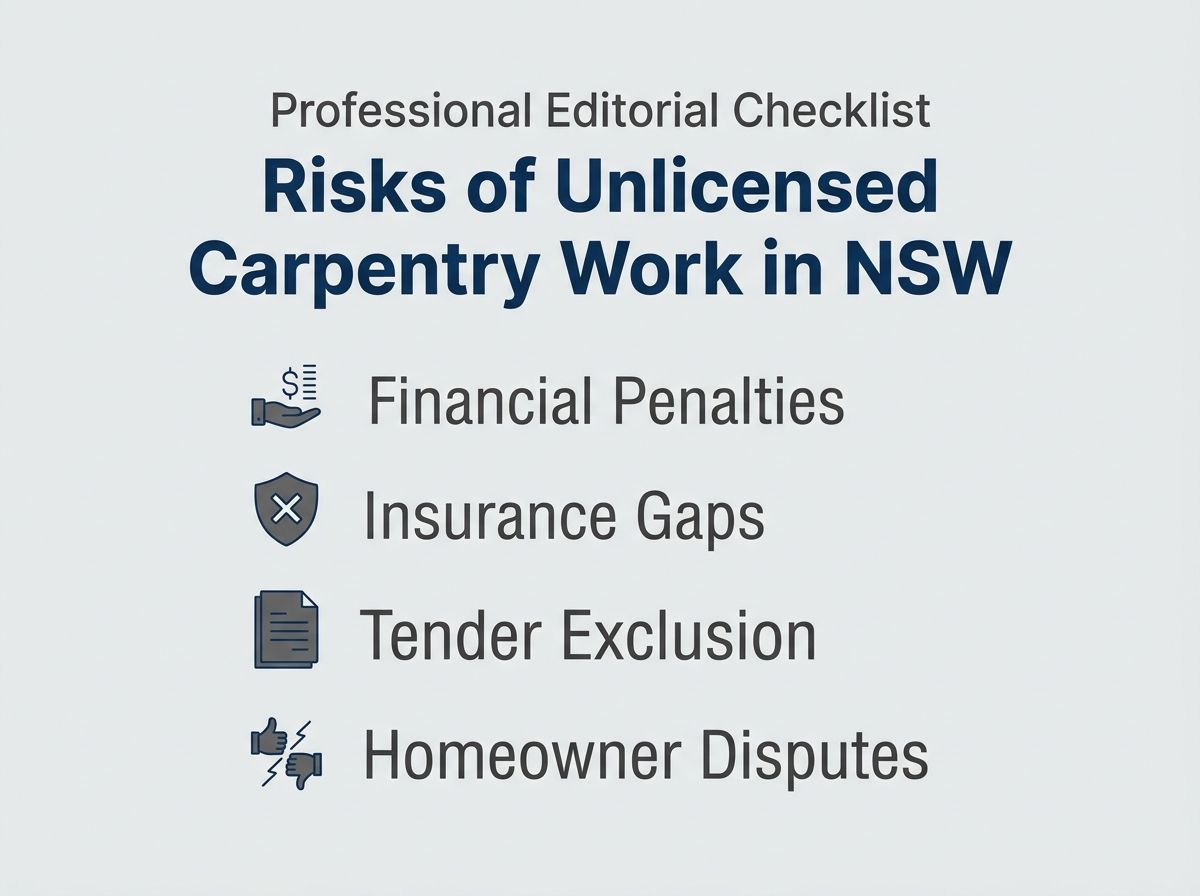
The NSW Government's general building work licensing page details the consequences of working unlicensed, including the specific penalties under the Home Building Act 1989.
Beyond fines, operating without a licence creates ongoing business problems that build up over time. Without a valid licence, you cannot legally contract directly with clients for work above the $5,000 threshold. You may be locked out of commercial tenders that require proof of licensing. Securing appropriate insurance is also highly complex, and if a site dispute or defect arises, your position is much weaker without formal credentials.
The Home Building Act 1989 forms the regulatory framework for residential construction in NSW. Under this act, the Building Commission NSW has the power to investigate disputes and issue rectification orders. While these laws protect licensed contractors, working without a licence leaves you outside this system and exposed to direct liability.
The gap between trade experience and licensing paperwork
Most carpenters in this position do high-quality work, meet project deadlines, and run professional operations. Their workmanship is not the issue. The challenge is that their practical skills are not documented in a way the regulatory system recognises.
Years of practical experience on residential builds—including framing walls, erecting roof structures, installing flooring, and fitting windows and doors—proves your trade competence. However, the NSW licensing system requires this practical competence to be presented in a specific format. You must show a recognised qualification and documented experience. Without this formal proof, the licensing system has no way to verify your skills.
This situation is simply a gap between your hands-on trade experience and the formal paperwork the state requires. Fortunately, you can bridge this gap without returning to a classroom or starting your training from scratch.
Requirements for a NSW carpentry contractor licence
To apply for a NSW contractor licence in the carpentry trade, you must hold a recognised qualification and demonstrate your practical experience. NSW Fair Trading accepts several pathways for this, including the CPC30220 Certificate III in Carpentry, alongside equivalent older or superseded qualifications.
NSW also issues different licences and certificates depending on your exact role, whether you are contracting to do the work, supervising other tradespeople, performing the physical carpentry, or a combination of these. The right licence type for your business depends on your setup. Because regulations can change, it is best to verify your specific situation with NSW Fair Trading or Service NSW before applying.
How RPL converts your carpentry experience into a qualification
Recognition of Prior Learning (RPL) is a formal assessment process that measures your existing trade experience against the requirements of a national qualification. It is not a shortcut. It is a nationally recognised assessment pathway under the Australian Qualifications Framework, delivered by Registered Training Organisations (RTOs) listed on the official training.gov.au register.
The Master Builders Association of NSW explains that RPL is an assessment-only process that translates practical experience into a nationally recognised Certificate III qualification. They identify applying for a contractor licence as a primary reason experienced tradespeople choose this pathway.
In a carpentry RPL assessment, an assessor from the partner RTO compares your industry experience against the units of competency in the qualification. Your evidence portfolio typically includes site photographs, work diaries, client references, and records of completed projects. You may also need to demonstrate specific practical skills or answer questions about building codes and methods.
The qualification you receive through RPL is the exact same certificate earned through a traditional apprenticeship. It carries full national recognition because the assessment is thorough and mapped to the same rigorous standards. If your experience does not cover every required unit of competency, the RTO will identify these gaps early so you can complete short, targeted training.
RPL it helps you navigate this process by assisting with your evidence portfolio, helping you understand the assessment criteria, and connecting you with a suitable partner RTO. The RTO conducts the formal assessment and issues the qualification. RPL it provides guidance and support throughout, but we do not assess your work or issue certificates directly.
Is RPL the right path for your situation?
RPL works best for carpenters who have broad, demonstrable experience across a range of residential work. The Certificate III in Carpentry (CPC30220) contains 34 units of competency. These core units cover the complete scope of carpentry, including setting out, constructing wall and ceiling frames, building roof structures, laying flooring, fitting windows and doors, installing stairs, applying external cladding, and fixing lining and moulding.
If your experience is broad—covering different project types, building elements, and stages of construction—you will have a very strong foundation for RPL. However, if your work has been highly specialised in one narrow area, there may be some competency units where your evidence is thin, and you may need to complete targeted gap training.
Whether RPL will work for you depends entirely on the scope of your practical history. A Free Skills Review is designed to evaluate your background and give you a clear answer before you spend any money or make any commitments.
Step-by-step: From trade experience to a contractor licence
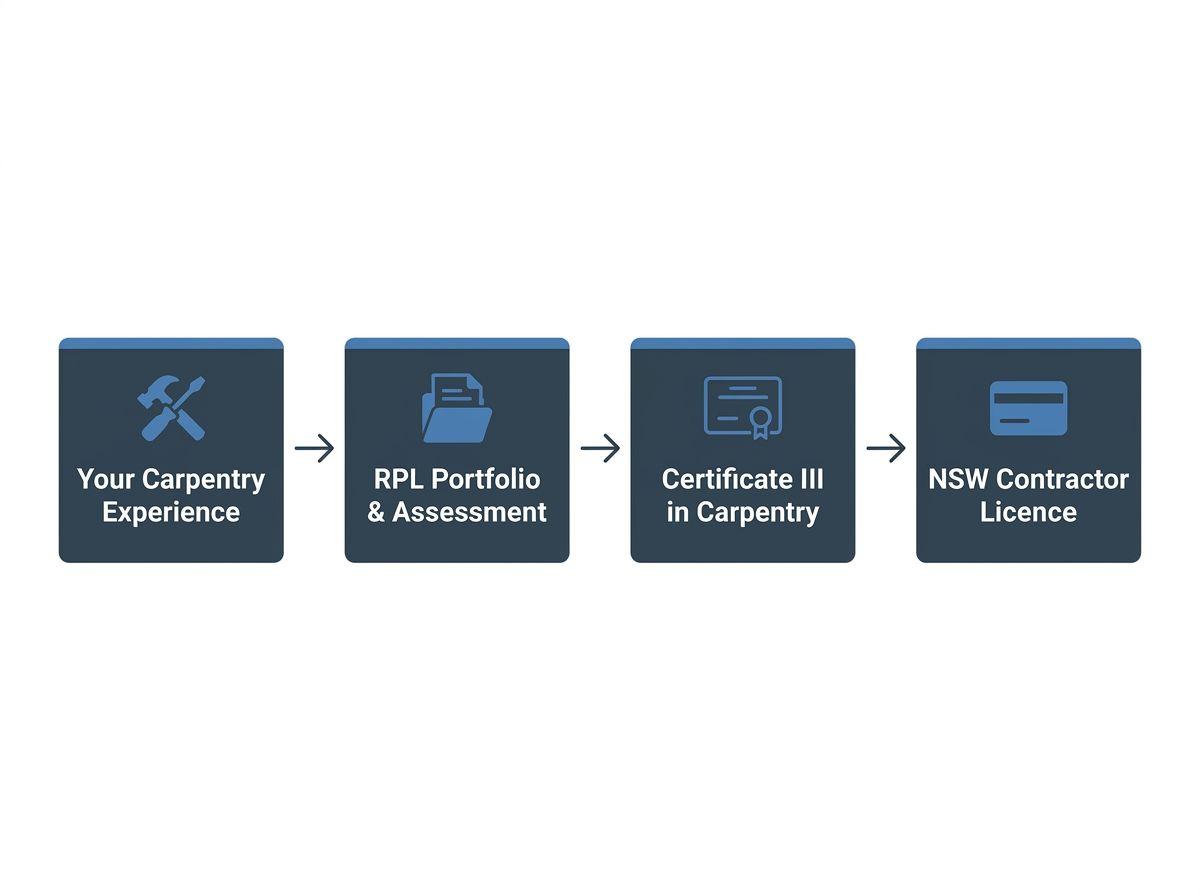
For a NSW carpenter who needs a contractor licence and wants to use the RPL pathway, the process follows a practical sequence. First, you undergo a skills review to see if your experience maps to the qualification. Next, a qualified assessor from an RTO conducts the formal RPL assessment. Once successful, the RTO issues your Certificate III in Carpentry, which you then use to apply for your licence with NSW Fair Trading.
It is important to remember that the qualification and the licence are entirely separate things. An RPL qualification is an educational credential, whereas a trade licence is a legal permit to operate. NSW Fair Trading requires you to hold the necessary qualifications before they will assess your application and grant a contractor licence.
You already have the hands-on skills. The licensing system simply requires those skills to be presented in a standardized format. RPL bridges this gap by evaluating your actual on-site competence against national benchmarks, rather than forcing you to retake training you do not need.
The choice is yours to make. However, if you are currently doing carpentry work in NSW that exceeds the $5,000 threshold without a licence, understanding your options now is much safer than waiting for a compliance audit, a fine, or a lost contract.
General information only, current at the date shown. Licensing rules change, so check the current requirements with the relevant regulator before you rely on them. RPL it Australia is a student support service, not a Registered Training Organisation; qualifications are assessed and issued by our partner RTOs.