The sign-off tax: how much you pay another plumber to stamp your work
Every job you hand over for sign-off costs you money. Calculate your annual sign-off tax and see why getting your NSW plumbing licence through RPL ends it.

You do the work. Someone else signs it off. And you pay for the privilege.
You know exactly what you are doing on site. You have been doing it for years. The rough-in is clean, the pressure test passes, and the customer is happy. Then you hand over the paperwork, the compliance certificate, and the formal record of a job well done to someone who may not have set foot on site. And you pay them for it.
That arrangement has a name. Call it the sign-off tax.
It is not a formal charge. It is not on any invoice template. But it is real, it is recurring, and for many experienced plumbers working in NSW without their own contractor licence, it is one of the most consistent costs in the business. This is not a one-off. It occurs on every job, every week, year after year.
If you have been operating this way, you already know the feeling. This article puts a number on it and explains why holding your own NSW plumbing licence is the only way to make it stop.
What the sign-off tax actually costs you per year
Sign-off arrangements vary. Some plumbers pay a flat fee per job. Some pay a percentage of the invoice value. Some have an ongoing retainer with a licensed contractor who makes themselves available for certification. The structure differs, but the cost does not go away.
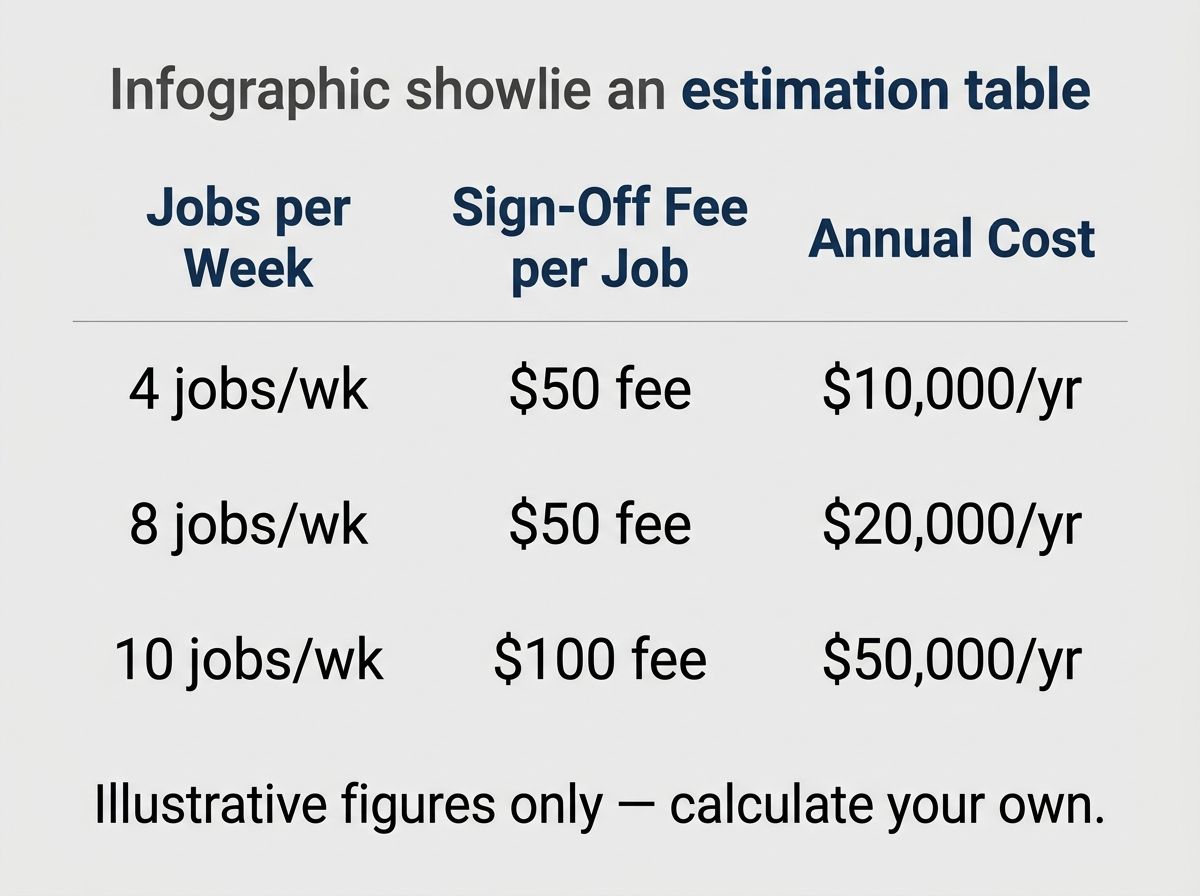
To make this concrete, consider a few illustrative scenarios. These are not industry averages; they are worked examples. Run your own numbers.
- If you complete 8 jobs per week and pay a flat $50 per sign-off, that is $400 per week, which is roughly $20,000 per year.
- If you work on higher-value commercial jobs and the arrangement is percentage-based at 3% of invoice value, on $5,000 average jobs at 3 per week, that is $450 per week, which is over $23,000 per year.
- If you have a retainer arrangement at $500 per month, the base cost is $6,000 per year, but that typically does not cover the per-job fees on top.
None of these figures are made-up statistics. They are illustrative calculations designed to prompt one question: what does your arrangement actually cost you? Most plumbers in this situation have never sat down and added it up. The sign-off tax tends to feel like a cost of doing business until you calculate it.
There is also the tax deductibility question. Fees paid to a licensed contractor for sign-off services may be deductible as a business expense, but that does not make them free. A deduction reduces your taxable income; it does not return the money. The net cost is still real.
The part nobody talks about: you are building their business name, not yours
The sign-off tax is not only financial. There is a second cost that does not show up in your bank account, but it compounds just as steadily.
When work is certified under another plumber's licence, the formal record of that work belongs to them. The compliance certificate carries their name. The permit history sits in their file. The client who calls back for the next job may call the name on the paperwork, not yours.
You are the labour. They are the business.
That is not an accusation directed at the licensed plumber in your arrangement. Most of these arrangements are practical and mutually convenient. But the structural reality is clear: every job you complete under someone else's licence is a job that builds their compliance history, their professional record, and their business reputation. Your work deserves to be counted under your own name.
This is the deeper issue beneath the sign-off fee. The fee is the visible cost. The invisible cost is the business you are building for someone else, one job at a time.
The credential gap that limits independent operation is the same gap that keeps experienced plumbers from tendering for the jobs they are more than capable of completing.
Why experienced plumbers stay stuck in the sign-off arrangement
If the sign-off tax is this costly, why do so many skilled plumbers keep paying it? The honest answer is that the barriers feel real, because some of them are.
The most common barrier is the assumption that getting your NSW plumbing contractor licence means going back to study. That you would need to sit in a classroom, work through a course, and essentially repeat training for skills you have been applying on site for years. That assumption stops a lot of experienced plumbers from even looking into it.
There is also the time pressure. If you are running a full workload, the idea of carving out time for formal study feels impossible. The sign-off arrangement, frustrating as it is, at least keeps the work moving.
And there is uncertainty about the process itself. What qualifications does the NSW contractor licence actually require? What does the application involve? Who do you even call?
These are legitimate questions. But the most common barrier, the belief that you would have to study your way to a licence, is based on a misunderstanding of how the pathway actually works for experienced practitioners.
Recognition of Prior Learning exists precisely for this situation. It is not a shortcut. It is not a workaround. It is a formal assessment pathway that evaluates what you already know and can already do, and recognises it as the qualification it represents.
Getting your licence is a documentation exercise, not a study program, and that distinction changes everything for experienced plumbers who have been putting it off.
How recognition of prior learning ends the sign-off tax
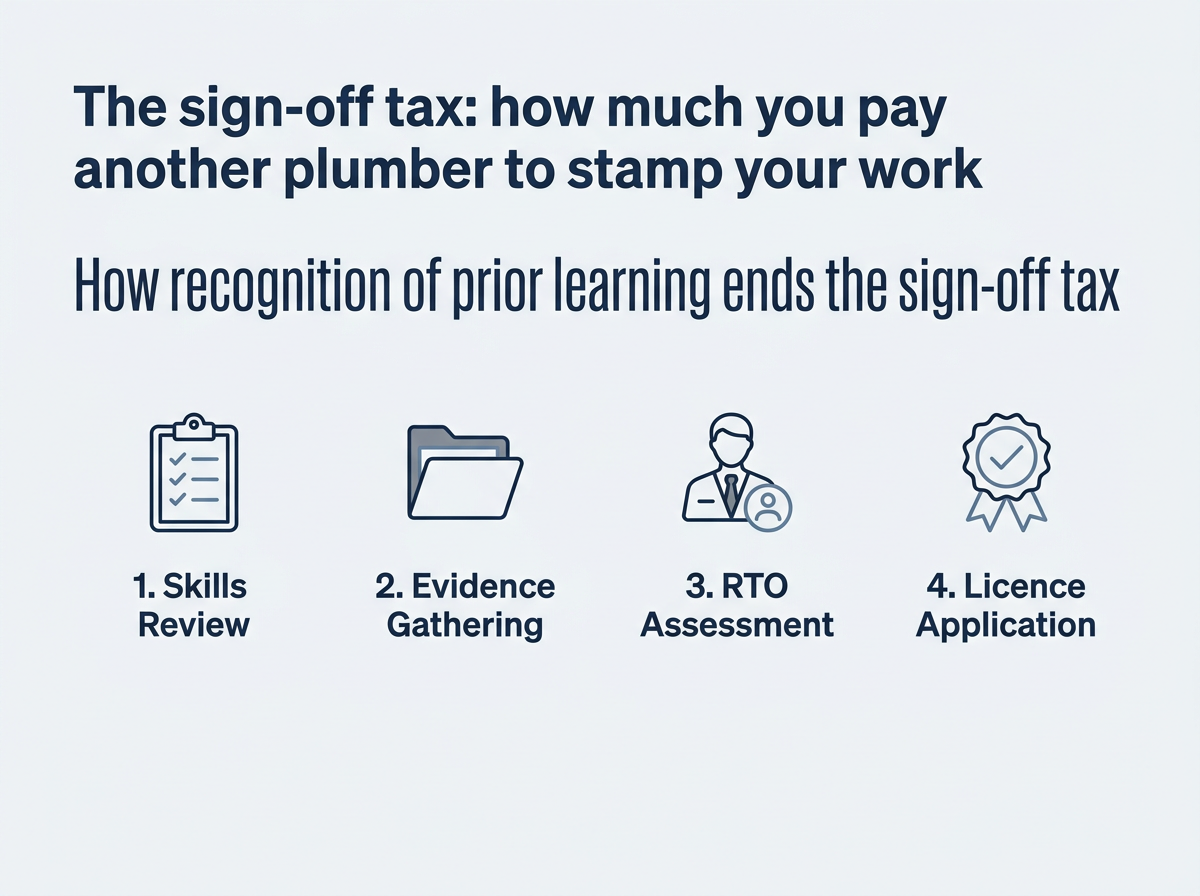
Recognition of Prior Learning, or RPL, is a formal assessment process conducted by a registered training organisation (RTO). It evaluates your existing skills and knowledge against the competency standards of a nationally recognised qualification. If your experience meets those standards, the qualification is awarded. If there are gaps, gap training addresses them.
For plumbers working towards an NSW plumbing contractor licence, the relevant qualification pathway typically involves a Certificate IV in Plumbing and Services. RPL is an accepted pathway to that qualification for experienced practitioners; it is not a different qualification, but rather a different route to the same outcome.
What does the RPL process actually involve? In general terms, it typically includes:
- A skills review, which is an honest assessment of your experience against the qualification's competency requirements.
- Evidence gathering, which involves compiling documentation of your work history. This may include job records, site photos, references from supervisors or clients, and records of work you have completed.
- Assessment by a qualified assessor from the delivering RTO, who evaluates your evidence against the national standards.
- Gap training, if required. If any competency areas are not fully evidenced, targeted training addresses those gaps. This is provided at no additional tuition cost by the RTO.
The qualification issued through this process is nationally recognised. It carries the same standing as a qualification earned through any other pathway because the assessment is genuine, conducted by a qualified assessor, and held to the same standards.
RPL it guides candidates through this process. We do not conduct the assessment ourselves, as that is the RTO's role. We help you understand whether your experience is likely to meet the requirements, prepare your evidence, and navigate the process. We provide honest guidance before any commitment.
Getting licensed through RPL is about presenting your experience, not repeating it, and that is a meaningful distinction for anyone who has spent years developing real competence on the job.
The calculation changes when you hold your own licence
Return to the number you calculated earlier. Your annual sign-off tax. Whatever that figure is, whether it is $6,000, $15,000, or $23,000, it disappears when you hold your own NSW plumbing contractor licence.
The jobs you complete are certified under your name. The compliance records belong to your business. The client who calls back calls you. The permits, the certificates, and the formal history of your professional work all accumulate in your file, not someone else's.
There is also the access question. Some contracts, such as commercial work, government projects, or larger residential developments, require the principal contractor to hold their own licence. Operating under another plumber's licence closes those doors entirely. Your own licence opens them.
None of this is guaranteed. Holding a licence does not guarantee contracts, income, or business growth. What it does is remove the structural barrier that has been extracting value from your work every week. The sign-off tax is a choice you can stop making once you hold the credential that makes it unnecessary.
The choice is yours.
Understanding the risk of continuing to operate without your own licence is the other side of this calculation, and it is worth reading before you decide.
Find out more about the NSW plumbing licence pathway and what it involves.
Ready to Get Recognised?
Start with a free skills review to find out if RPL is right for you.