Why Delaying Your NSW Plumbing Registration Is Costing You More Than the Fines
Think getting your NSW plumbing licence is expensive? The real cost is what you're losing every week without it — direct quotes, emergency rates, and full margins.
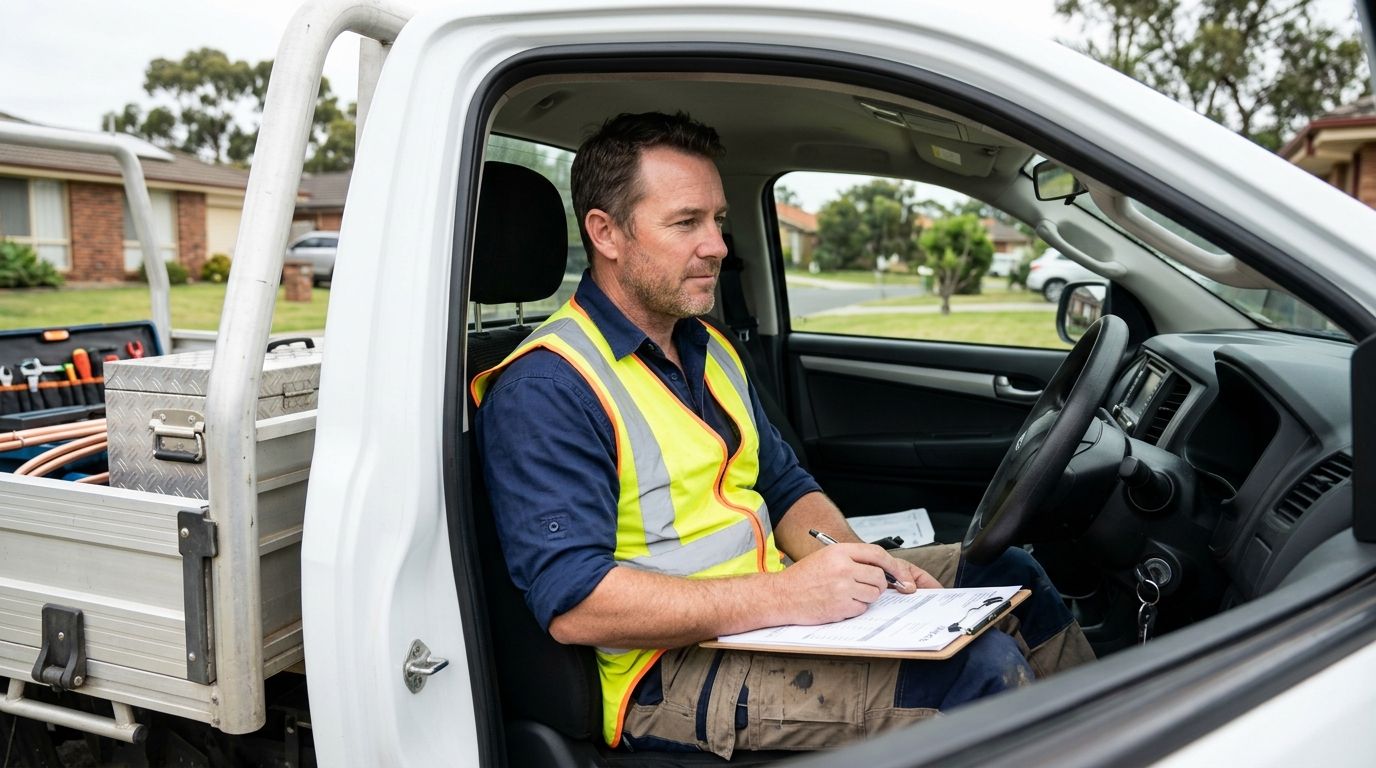
The assumption keeping you stuck
You have the experience. You know the trade. You've been doing this work for years — probably better than some of the licensed operators you've worked alongside. The NSW plumbing licence feels like an expensive formality standing between you and a piece of paper you already deserve.
So the calculation goes something like this: getting licensed costs money and time, and the chance of being caught working unlicensed is probably low. You weigh the cost of registration against the risk of a fine, decide the odds are in your favour, and keep going.
That calculation is wrong. Not because the fine risk is higher than you think — but because you're comparing the wrong two things. The real comparison isn't the cost of getting licensed versus the risk of a fine. It's the cost of getting licensed versus the income you are permanently forfeiting every single week you stay unlicensed.
That's the number most unlicensed plumbers have never actually worked out. This article does it for you.
What a NSW plumbing licence actually lets you do
In NSW, any plumbing, draining, or gasfitting work requires a licence or certificate — regardless of the cost of the job, whether it's residential, commercial, or industrial. There are no thresholds below which unlicensed work is permitted.
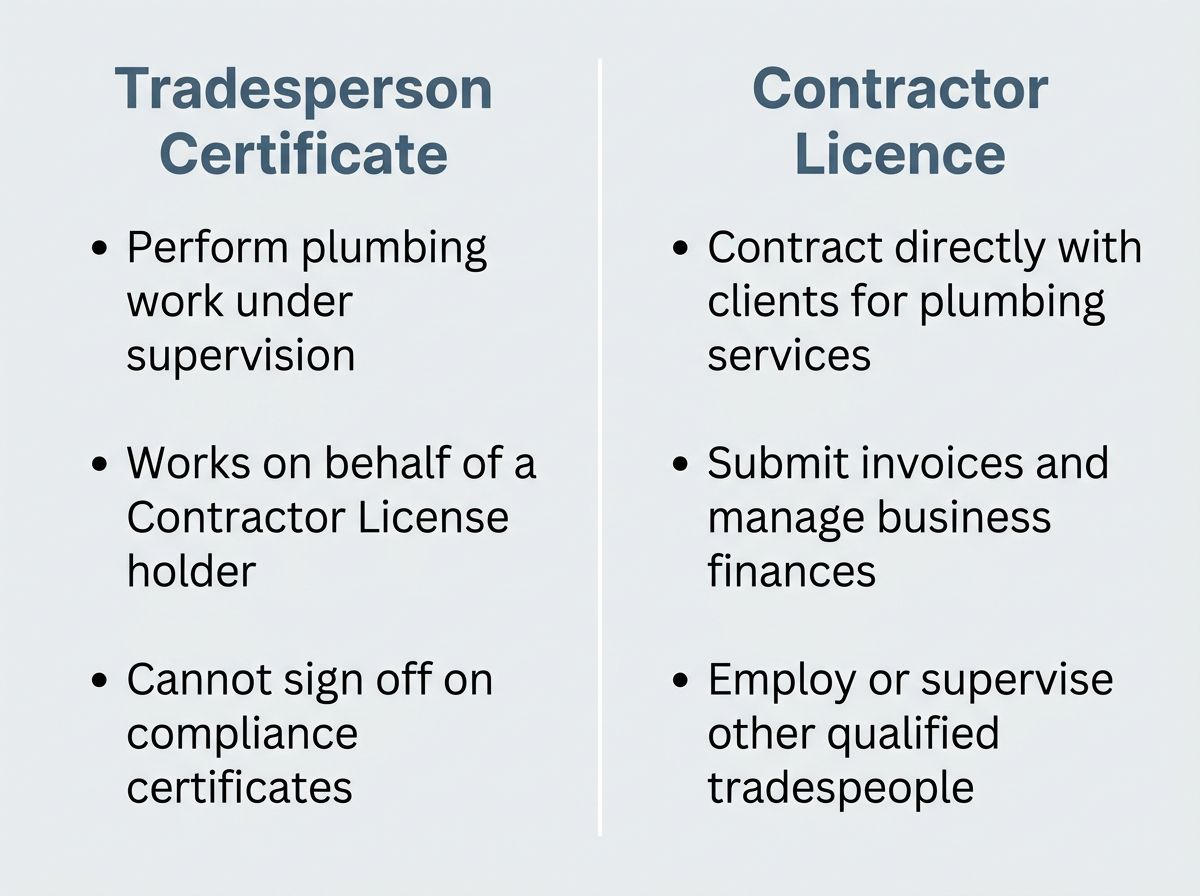
The critical distinction is between a tradesperson certificate and a contractor licence. A tradesperson certificate allows you to carry out plumbing work, but only under the general supervision of someone who holds a contractor licence or qualified supervisor certificate. The work must also be signed off by that person. You cannot quote directly to clients, pull permits in your own name, or operate as a principal contractor.
A contractor licence changes that entirely. It is the legal prerequisite for quoting and contracting directly with clients, issuing invoices as the responsible party, and operating as a principal contractor on a job. Without it, every piece of work you do flows through someone else's licence — and that has a direct financial consequence.
The sub-contracting margin you're giving away every week
When you work under a licensed contractor's name, that contractor carries the legal and insurance risk for the work. In exchange, they take a margin. This is not a bureaucratic technicality — it is a direct reduction in what you earn from every job.
The specific margin varies by arrangement and is not regulated or published by any government body. What is clear from the regulatory structure is that the licensed contractor's involvement is mandatory for tradesperson certificate holders: they must supervise and sign off the work. That obligation has a commercial value, and contractors price it accordingly.
The official cost of a NSW contractor licence itself is modest. According to the NSW Government's Building Commission fee schedule, a new individual trade or specialist contractor licence costs $403 for a one-year term, $803 for three years, or $1,235 for five years. A tradesperson certificate costs $142 to $329 depending on term. These are the government application fees — they do not include any commercial margin a contractor might charge for acting as principal contractor on your behalf.
The point is this: the licensed contractor's margin is not a one-off cost. It is a permanent weekly income reduction. Every job you complete under someone else's licence is a job where a portion of the revenue leaves your pocket and enters theirs. The longer you delay registration, the more total income you surrender — not as a fine, not as a penalty, but as a structural feature of the arrangement you're in.
The jobs you can't quote on — and the ones that pay the most
Beyond the margin question, there is a category of work you are structurally excluded from entirely: jobs where the client or site requires the quoting entity to hold a contractor licence.
Emergency call-outs are the clearest example. A licensed plumbing contractor can respond to an emergency call, quote the job, and invoice the client directly. An unlicensed tradesperson cannot — at least not legally without routing through a licensed contractor. Emergency work typically commands premium rates, and the ability to respond independently and invoice directly is what captures that premium.
The same applies to direct residential contracts, commercial sub-contracting as a principal, and any work where the client requires proof of contractor licence before engaging. These are not niche categories. They represent a significant portion of the higher-margin work available in the NSW plumbing market.
The income ceiling imposed by operating without a contractor licence is not theoretical. It is structural. You can be the most skilled plumber on a site and still be legally prohibited from quoting the jobs that pay the most.
What the fine risk actually costs — and why it's the smaller number
The penalties for unlicensed plumbing contracting in NSW are significant. Under the Home Building Act 1989, carrying out unlicensed plumbing, draining, or gasfitting work can attract fines of up to $22,000 for an individual or $110,000 for a company. Supervision breaches carry additional penalties.
NSW Fair Trading is an active regulator. In 2023–24, the NSW Department of Customer Service reported 263 charges laid, 60 defendants convicted, and fines and penalties totalling over $832,000, alongside 908 Penalty Infringement Notices with fines totalling over $1.3 million. These figures cover NSW Fair Trading's regulatory functions broadly — they are not isolated to unlicensed plumbing — but they show that enforcement is real and ongoing.
The NSW Department of Customer Service Annual Report 2023–24 provides the full enforcement context for NSW Fair Trading's regulatory activity.
Here is the honest framing: the fine is a probabilistic risk. It requires an inspector, a complaint, or a competitor dob-in to trigger. The income you're losing through sub-contracting margins and excluded work categories requires nothing — it happens automatically, every week, whether you're caught or not.
The fine is the smaller number. The income suppression is the larger one. Most unlicensed plumbers have been calculating the wrong risk.
The RPL pathway: what getting your NSW plumbing licence actually involves
For experienced plumbers, the pathway to a NSW contractor licence typically requires a formal qualification as a prerequisite — specifically, a Certificate IV in Plumbing and Services (CPC40920). This is the qualification that demonstrates the advanced competencies required for contractor-level work.
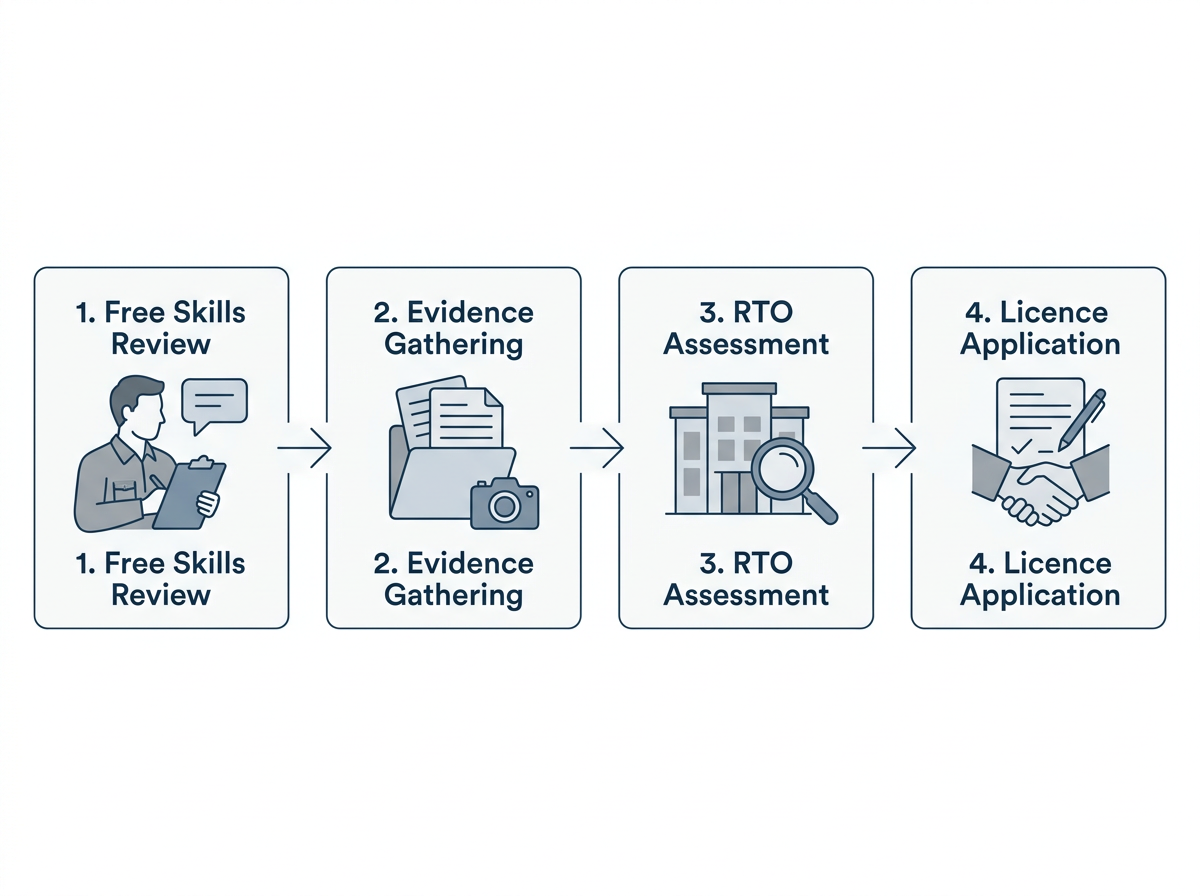
Recognition of Prior Learning (RPL) is an assessment pathway that allows experienced tradespeople to have their existing skills and knowledge assessed against the qualification's competency standards — without repeating trade school. As Charles Darwin University describes it, RPL is an assessment of skills and knowledge acquired through prior training, work, or life experience. It is not time-referenced, but the skills must be current and must match the elements and performance criteria of the individual units being assessed.
RPL is not a shortcut. It is a rigorous assessment process. A qualified assessor from a registered training organisation (RTO) evaluates your evidence — your documented work history, job records, references, and demonstrated competencies — against the national standard. The RTO conducts the assessment and issues the qualification. Gap training may be required if evidence gaps are identified, and suitability varies by individual.
One RTO, Career Skills Australia (RTO 45254), publishes an indicative RPL fee for CPC40920 of from $2,500 to $4,500, noting that fees vary depending on individual circumstances. This is one provider's published range — fees vary across RTOs and depend on the evidence you bring to the assessment. It is not RPL it's own fee, and it is not a fixed or guaranteed price.
For context, the full-course delivery fees for CPC40920 at Charles Darwin University range from approximately $2,400 for government-supported NT residents to over $10,700 for full-fee places — these are full course delivery costs, not RPL pathway fees, and the supported rate applies only to eligible NT residents.
Career Skills Australia's published information on the CPC40920 RPL pathway provides one indicative reference point for RPL costs and timeframes.
The maths of waiting versus acting
Consider the financial position of two experienced NSW plumbers with identical skills. One holds a contractor licence. One does not.
According to a national plumbing salary guide published by Builders Academy, the reported median plumber salary in Australia is around $77,000 per year, with the top 10 per cent earning $120,000 or more. Award minimums for fully qualified plumbing employees range from approximately $59,679 per year for a Tradesperson Level 1 (not registered) to approximately $70,040 per year for an Advanced Tradesperson Level 2 (registered). These are national figures and may not reflect NSW specifically — but they show the wage floor difference that registration creates even at the employee level.
The guide also notes that newly licensed plumbers may start around $55,000 to $65,000 per year, while experienced tradespeople with around 10 years' experience can exceed $100,000. Self-employed plumbers and contractors may earn more than employees, though they carry business overhead costs and variable income.
The Builders Academy plumbing salary guide provides indicative national earnings data across qualification and experience levels.
The break-even calculation on getting licensed depends on your individual situation — how much work you're doing, what margin your current arrangement involves, and what new work categories become accessible once you hold the contractor licence. What is clear is that the cost of the RPL pathway and the licence application fee are fixed, one-time costs. The income difference between operating with and without a contractor licence is ongoing.
For many experienced plumbers, the break-even point is measured in weeks of recovered margin — not years. The longer the delay, the more that calculation moves against you.
Where to start if you've been putting this off
The most common reason experienced plumbers delay registration is uncertainty — not about whether they can do the work, but about whether their experience maps to the qualification, what the process involves, and whether it's worth starting.
The Free Skills Review exists to answer those questions honestly, before you commit to anything. It's a no-obligation assessment of whether your existing experience is likely to support an RPL pathway — so you can make an informed decision, not a pressured one.
You have the experience. The question is whether it maps to the qualification in the form the assessor needs to see it. That's what the review is for.
Ready to Get Recognised?
Start with a free skills review to find out if RPL is right for you.