Why 10 Years of HR Experience Beats a Textbook (And How to Prove It)
Experienced HR leaders are built on the ground, not in classrooms. Learn how to translate your real-world experience into a formal HR diploma through RPL.

The HR manager who couldn't get the job she was already doing
Consider this scenario. You have twelve years of experience working in human resources. You have managed a major redundancy round that directly affected sixty people. You have personally conducted complex misconduct investigations that went all the way to the Fair Work Commission. You have sat across the negotiation table from union delegates late into the night during enterprise bargaining, keeping the room together when the business was ready to walk away. You know this work because you live it every day.
Then an ideal role becomes available: HR Director. It is, in every practical sense, the exact job you are already doing. You submit your application. The automated recruitment filter removes your application before a human ever reads it. The reason is simple: the position requires a Diploma of Human Resource Management.
Experienced HR leaders understand that you cannot teach crisis management in a classroom. Yet recruitment systems still rely heavily on formal paper credentials.
This is the paper ceiling. It is not an issue of your competence, but rather the format that your competence takes. Your experience is real, but it remains entirely invisible to the automated systems making decisions about your career progression.
What a classroom cannot teach you about HR
Formal HR education teaches theoretical frameworks. It covers employment law theory, performance management models, and workforce planning principles. While these provide useful foundations, they are not the same as day-to-day workplace competence.
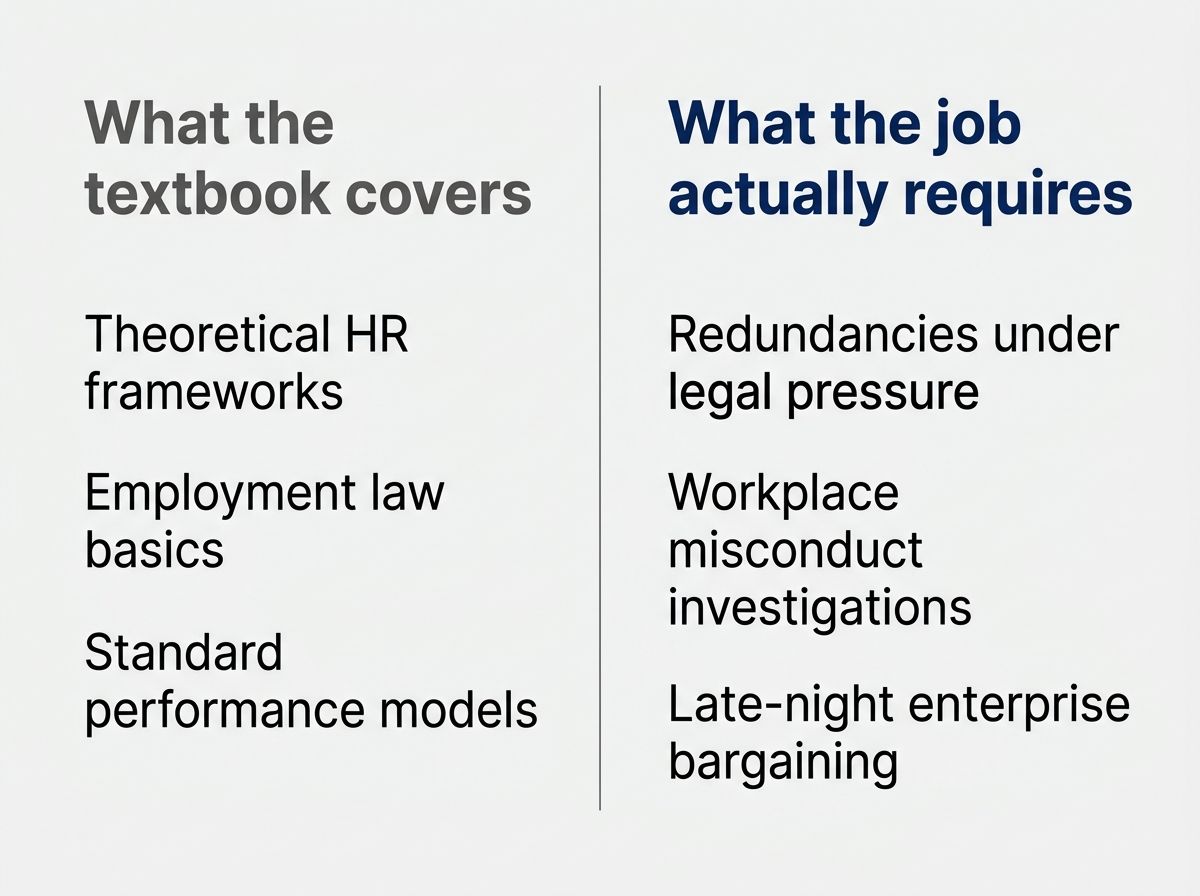
True HR competence is built in the practical moments that theoretical frameworks cannot anticipate.
You have managed redundancies. This means the actual process, not the simplified textbook version, where an employee breaks down in your office and you must maintain legal compliance while managing human distress. You balance the business's demand for rapid change with the procedural fairness required by the Fair Work Act, often as the only person in the room who understands both sides.
You have run workplace investigations. These are scenarios where the evidence is highly ambiguous, both the complainant and the respondent present credible accounts, and senior leadership is watching to see if you manage the process correctly. The outcome directly affects people's careers and the company's legal liability, and there is no textbook answer to guide you.
You have held negotiations together late into the night during enterprise bargaining. When the union delegates are pushing hard and the executive team is completely exhausted, the negotiation continues only because you can read the room and find a practical path forward.
These are the complex scenarios that build genuine HR capability. No classroom lecture covers them adequately, and no university assignment can replicate them. They are learned by doing the work under pressure with real-world consequences.
The reality is that highly competent HR leaders are not produced by classrooms. They develop their skills through years of hands-on work.
Three critical scenarios that build practical competence
Three practical scenarios separate experienced HR professionals from those who have only studied the theory. Each area develops skills that a Diploma of Human Resource Management is designed to recognise, and each maps directly to the evidence required for an RPL assessment.
1. Managing a large-scale redundancy
Managing redundancies requires you to handle multiple complex priorities simultaneously: the strict legal obligations under Australian employment law, genuine care for the individuals affected, communication strategies for the remaining staff, and the operational continuity of the business. You are actively working across workforce planning, employee relations, and organisational change, often under significant time pressure.
The competence this develops is highly practical. It is the ability to navigate complex, legally sensitive situations with precision and professional care. This is a senior HR skill, and it can be documented as evidence.
2. Conducting a workplace misconduct investigation
A rigorous misconduct investigation requires procedural fairness, objective evidence gathering, absolute impartiality under organisational pressure, and the ability to draft clear findings that will withstand external scrutiny from a tribunal or commission. You are applying complex employment law principles, managing sensitive stakeholder relationships, and making judgements that directly affect people's professional lives.
This is senior HR practice rather than basic administrative work. Every investigation you have managed serves as a body of evidence that demonstrates this level of responsibility.
3. Navigating enterprise bargaining
Enterprise bargaining combines deep industrial relations knowledge, negotiation skill, and stakeholder management. You must understand the legislative framework, protect the organisation's commercial interests, manage relationships with union representatives, and secure sustainable outcomes for both sides. It is one of the most complex tasks an HR professional performs, and it is almost entirely learned through practical experience.
These scenarios align with the competency areas covered by a Diploma of Human Resource Management, which includes workforce planning, employee relations, performance management, and HR strategy. The qualification is designed to recognise this level of work. The challenge is not whether you have performed these duties, but how you document them.
The issue is not your competence, but the form your evidence takes
This is where the approach changes.

The HR professional in our opening scenario does not lack competence. Instead, she lacks evidence in the format that formal education systems recognise. Her expertise is real, but it is currently captured in the wrong medium.
Experience can be evidence.
This is the fundamental principle of Recognition of Prior Learning (RPL). RPL is the formal process where a registered training organisation (RTO) assesses your existing skills and knowledge against the competency standards of a qualification. If your experience meets these standards, you are awarded the qualification based on your demonstrated work rather than classroom attendance.
For an HR professional, RPL evidence typically consists of documents you already possess. This includes position descriptions showing your operational scope, performance reviews, project records from redundancies or investigations, policies you have developed or implemented, and formal statements from managers or colleagues who can verify your practice.
You do not need to create this evidence from scratch. It is gathered directly from your past work. The assessment process involves compiling these records so a qualified assessor can evaluate them against the official qualification standards.
The challenge has never been your competence; it is simply the format.
What the RPL process actually looks like for an HR professional
HR professionals are naturally process-oriented. Before starting, you need to understand the operational steps. Here is a practical overview of what the RPL process involves.
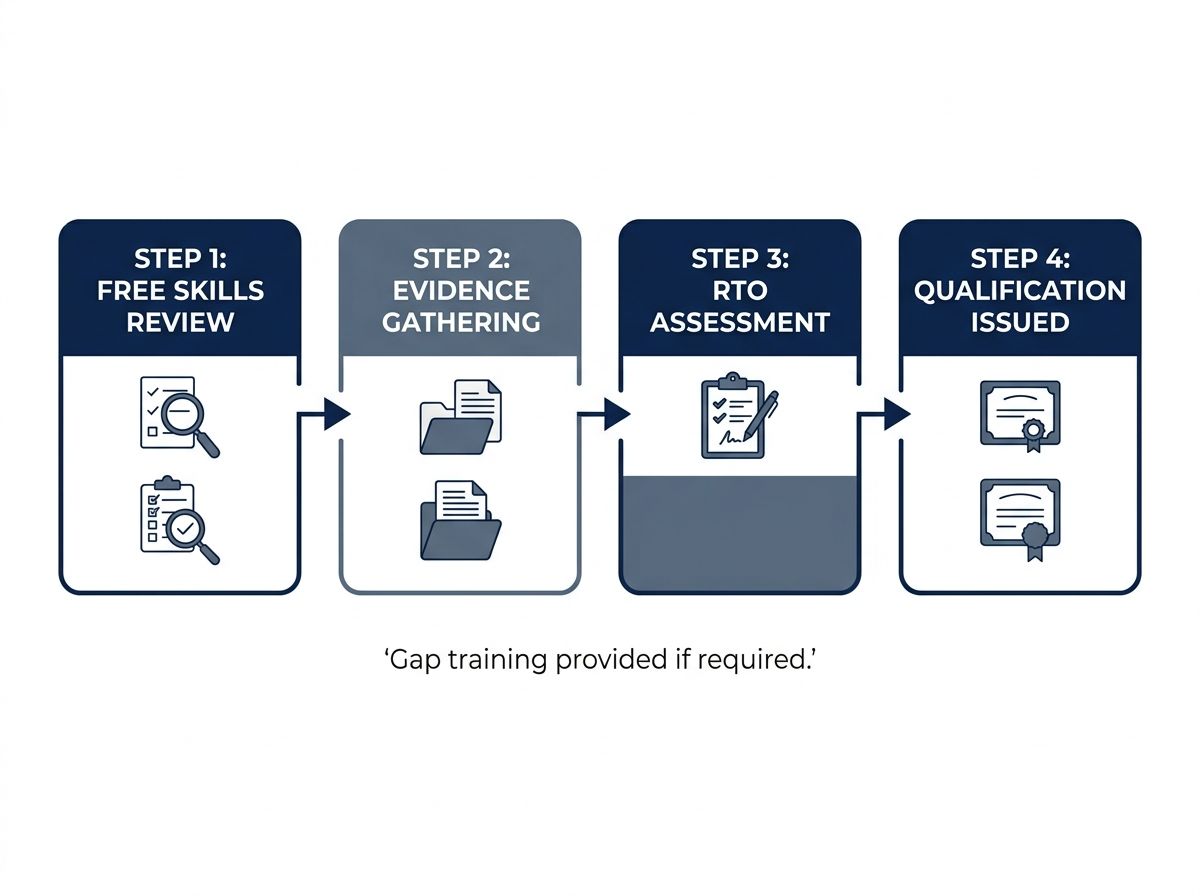
- Step 1: Free Skills Review. An honest assessment of whether your current HR experience aligns with the competency requirements of the Diploma of Human Resource Management. This is the starting point, with no commitment to proceed, designed to determine if RPL is a suitable option for you.
- Step 2: Evidence Gathering. You will compile the workplace documents, records, and professional references that demonstrate your competency. This is the most substantial part of the process, as the quality of your documented evidence directly determines the final assessment outcome.
- Step 3: RTO Assessment. A qualified assessor from a registered training organisation reviews your compiled evidence against the national standards of the BSB50320 qualification. The assessor is independent and makes their determination based entirely on what your records demonstrate.
- Step 4: Outcome. If the assessor confirms your evidence meets the national standards, the RTO issues the qualification. If any gaps are identified during the assessment process, targeted gap training is provided at no extra cost to address those specific areas before the diploma is awarded.
To be clear, RTOs conduct the formal assessment and issue the qualification, not RPL it. The processing timeframe depends on your available evidence and the RTO's review schedule, so it cannot be guaranteed upfront. Gap training is a standard part of the pathway rather than a failure. It ensures the assessment remains rigorous and the resulting qualification carries real value.
This is not a shortcut, but rather a formal assessment pathway that evaluates and recognises your established career achievements.
Is your HR experience sufficient? What the assessment actually evaluates
Not every applicant is a suitable candidate for RPL, and it is best to establish this before beginning. The assessment evaluates evidence of competence across all qualification requirements. Suitable candidates for an HR diploma RPL pathway generally share several characteristics.
Breadth of experience is important. The Diploma of Human Resource Management covers several key functions, including workforce planning, employee relations, performance management, and HR strategy. If your background is limited to a single specialist area like recruitment or payroll, you may struggle to provide evidence for all units. A generalist background or experience across multiple roles usually provides a closer match.
Depth of experience is also critical. This qualification is at the Diploma level, representing senior performance. Administrative HR tasks like scheduling and data entry do not meet the strategic criteria of this course. The assessment focuses on roles involving genuine operational decision-making, stakeholder management, and the resolution of complex workplace issues.
Documentation is essential because the assessment is entirely evidence-based. If you have been working in HR for a decade but lack position descriptions, project records, or professional references to verify your practice, the process becomes significantly more challenging. Having an established paper trail of your work history over time makes for a much stronger RPL application.
If you are unsure whether your experience meets the criteria, the Free Skills Review provides a practical answer. It is a straightforward evaluation, not a sales pitch, to determine if RPL is the right pathway for your career.
An HR diploma that recognises your existing knowledge
The Diploma of Human Resource Management (BSB50320) is a nationally recognised qualification within the Australian Qualifications Framework. It is the credential that many Australian employers, particularly larger organisations with dedicated HR departments, list as a requirement for senior roles.
At a high level, the qualification covers the core components of senior HR practice: workforce planning, industrial relations management, performance systems implementation, strategic HR design, and organisational development. These are advanced operational standards rather than entry-level tasks, reflecting the work of an experienced professional who has operated at a meaningful level.
This program is not intended to teach you basic HR principles from scratch. Instead, it recognises your existing knowledge when backed by practical evidence. This is the exact function of the RPL process.
For an HR professional with a decade of experience, the BSB50320 is not a learning curve. It is formal proof of your current professional standing.
Recognition, not repetition
Consider again the HR professional described at the start of this article. With twelve years of experience covering redundancies, investigation management, and late-night bargaining, she does not need to sit in a classroom studying basic theory. She requires a structured process to convert her real-world competence into formal evidence and a qualification that reflects her actual achievements.
If you have the experience and the evidence, the qualification is simply the next step in your career.
Gaining a credential should not mean starting your education over. It requires a practical method to present your existing achievements in a format that formal recruitment systems recognise.
This is the purpose of RPL. Achieving an HR diploma through Recognition of Prior Learning is not a shortcut or a workaround. It is a rigorous, legally compliant process that formally acknowledges the professional history you have already built.
The choice is yours.
Ready to Get Recognised?
Start with a free skills review to find out if RPL is right for you.