Passed over again? The silent filter blocking your HR career
You run the department and train new managers. But without the BSB50320, promotions go to others. Here is what is actually happening.

The pattern nobody talks about in HR
You know the onboarding process better than anyone because you wrote half of it yourself. You manage the performance review cycle, handle the sensitive staff conversations, advise the line managers, and maintain the complex workforce planning spreadsheet that nobody else understands. When a new HR manager starts, you brief them, answer their questions, and often train them on the basics.
Then the next manager role opens up, and it goes to an external candidate who holds a BSB50320.
This is not an unusual story. It is a quiet, structural pattern that is rarely named in the office. The day-to-day work is identical. The job title is different. The only real variable is the piece of paper.
What the BSB50320 actually is, and why it keeps appearing in job ads
The BSB50320 is the qualification code for the Diploma of Human Resource Management. This nationally recognised qualification is delivered through registered training organisations (RTOs) under Australia's vocational education and training framework. It sits at Diploma level within the Australian Qualifications Framework and is the standard credential for HR management roles across Australian industry.
When employers list the BSB50320, the Diploma of Human Resource Management, or an equivalent qualification in a job ad, they are using it as a convenient proxy signal. It tells them quickly that a candidate has been formally assessed against a national standard for HR management competency. Whether or not that signal accurately reflects real capability is a separate question. The point is that it functions as an early filter, applied before a hiring manager reads your actual experience.
To learn more about the BSB50320 and what it covers, view the qualification page:
Diploma of Human Resource Management (BSB50320)
The invisible filter: How a qualification becomes a career ceiling
Here is what happens in practice. An HR manager role is advertised. The job description lists the BSB50320, or a tertiary qualification in HR or equivalent, as a mandatory requirement. Applications are screened by an applicant tracking system or a recruiter working from a basic checklist. Candidates without the formal qualification are filtered out before anyone reads their resume.
An HR coordinator with eight years of solid experience, who has managed enterprise bargaining support, led the graduate recruitment programme, and built the performance framework from scratch, does not make it past the first screen. Meanwhile, an external candidate with a BSB50320 and only two years of generalist experience does.
This is not a reflection of your capability. It is a reflection of how formal corporate systems process information. Qualifications are easily verified. Experience, without formal recognition, is not. The system is not designed to be unfair; it is built to be efficient. The cost of that efficiency is borne by professionals whose expertise exists in the wrong form.
What HR coordinators actually do every day that maps to BSB50320 competency areas
The BSB50320 Diploma of Human Resource Management covers operational areas that are immediately recognisable to anyone working as an HR coordinator or senior HR officer. The qualification addresses core areas including workforce planning, recruitment, performance management, employee relations, HR strategy, and organisational development.
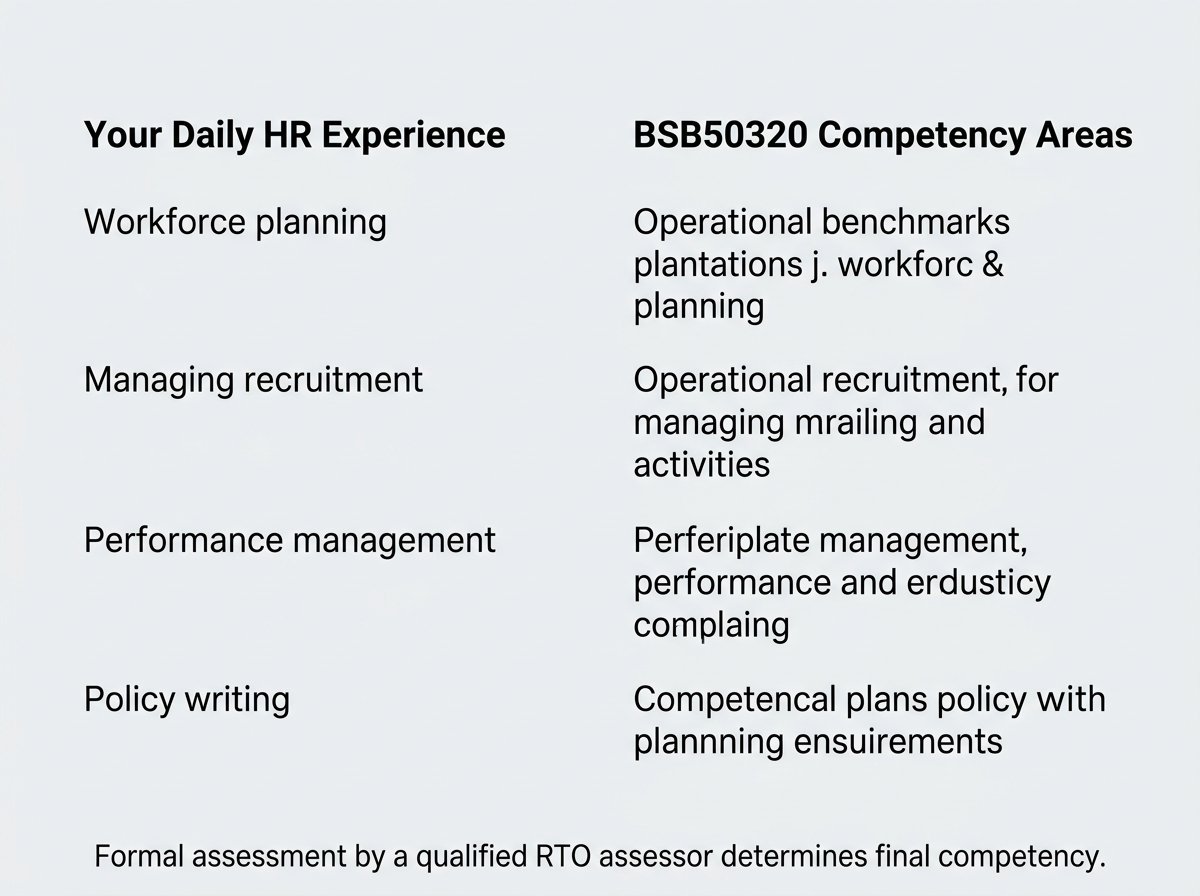
Consider what a typical week looks like for an experienced HR coordinator. You spend your days advising managers on performance improvement processes, reviewing position descriptions, and supporting recruitment panels. You maintain compliance with enterprise agreements and modern awards, contribute directly to workforce planning discussions, draft policy updates, manage sensitive employee matters, and coordinate training programmes.
These are not peripheral activities; they are the core of HR management practice. They correspond directly to the competency areas that the BSB50320 assesses.
The gap is not in the work itself. The gap is in the formal record of it. Your daily practice has not been assessed against a nationally recognised standard, not because it does not meet that standard, but because it has never been formally compiled and presented as evidence.
Why going back to study is not your only option
Recognition of Prior Learning (RPL) is a nationally recognised assessment pathway within Australia's vocational education and training system. It exists precisely for this situation: experienced professionals who already hold the competencies that a qualification assesses, but who have not yet had those skills formally recognised.
RPL is not a shortcut or a way to bypass assessment. It is a rigorous, legitimate pathway through which a qualified assessor from a registered training organisation evaluates your existing experience against the competency standards of the qualification. If your experience demonstrates competency, the qualification is issued. If gaps are identified, targeted gap training is provided to address them.
The distinction matters. RPL does not award qualifications based on years of service or seniority alone. It awards qualifications based on demonstrated competency, which is the same standard applied to any other candidate. The difference is that your evidence comes from your professional history rather than from a classroom.
Assessments are conducted by qualified assessors from the delivering RTO. RPL it guides you through the process, helping you identify, gather, and present your evidence, but the qualification is issued directly by the RTO, not by us.
If you assumed that returning to study was your only option, that assumption is worth revisiting.
What the RPL process looks like for an HR professional
The RPL process involves several straightforward stages, and understanding them in advance makes the pathway clear.
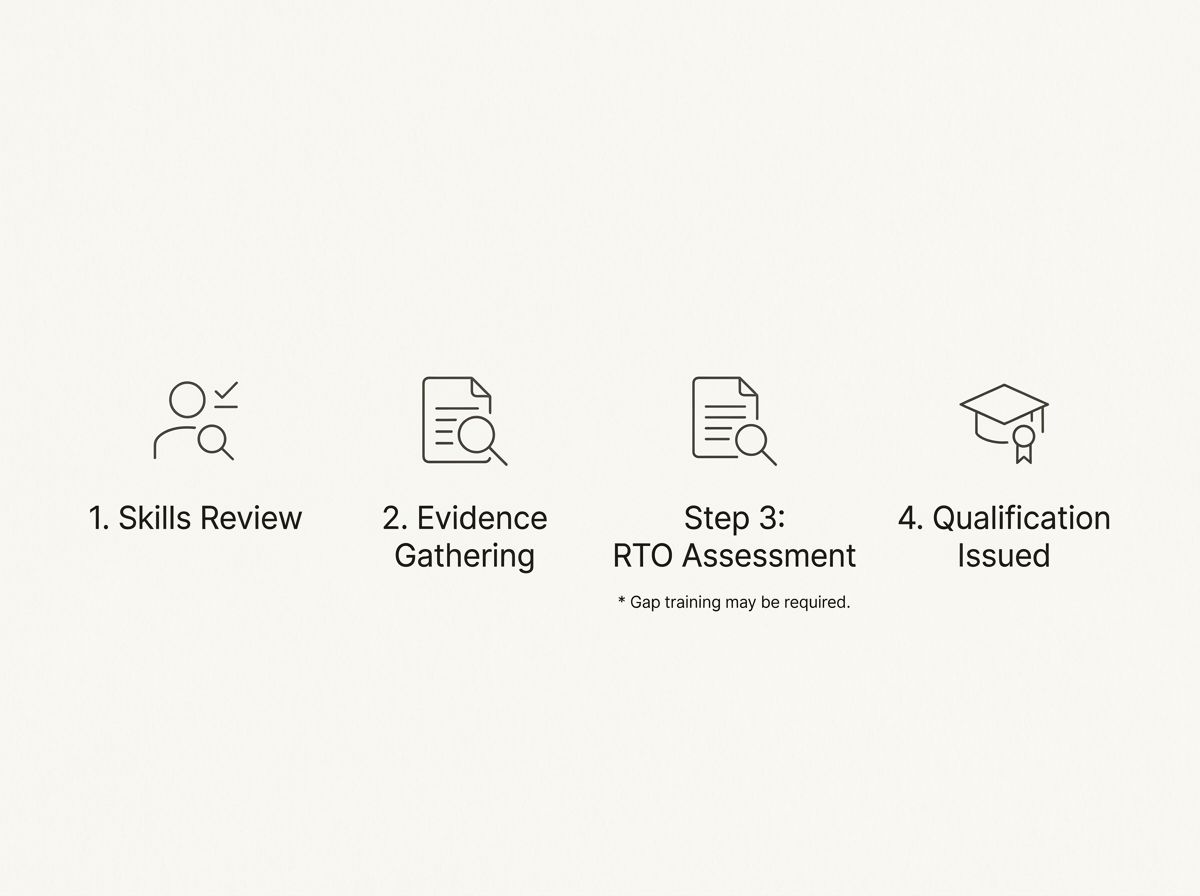
- A skills review: An initial consultation to map your experience against the BSB50320 competency areas and identify whether RPL is suitable for your situation.
- Evidence gathering: Compiling documentation that demonstrates your competency. For HR professionals, this typically includes position descriptions, work samples such as policies, reports, or project documentation, references from managers, and professional development records.
- Assessment: A qualified RTO assessor reviews your evidence portfolio and may conduct a structured interview or practical demonstration to confirm competency.
- Outcome: If competency is demonstrated across all required areas, the qualification is issued. If gaps are identified, targeted gap training is provided to address them before the qualification is awarded.
Timeframes vary depending on the RTO, the complexity of your experience, and how quickly you can gather evidence. They are indicative only and should be confirmed with your chosen RTO. What does not vary is the standard: the BSB50320 issued through RPL is the same nationally recognised qualification as one issued through traditional study.
Is RPL the right path for you?
RPL is not suitable for everyone, and honest guidance matters here. To be a strong candidate for BSB50320 RPL, you generally need substantial, relevant experience in HR roles that cover the qualification's core competency areas. This typically means several years working directly in HR, rather than just in adjacent roles, with clear involvement in workforce planning, performance management, employee relations, recruitment, and HR strategy.
If your experience has been primarily administrative or transactional, RPL may not be the right fit, or gap training may be a more significant component of your pathway than you expect. A Free Skills Review is the honest way to find out where you actually stand, without committing to anything.
The review is a genuine assessment of your experience against the BSB50320 competency areas. It is not a sales conversation. If RPL is not suitable for your situation, we will tell you that directly, and we will explain why.
Your experience is already your evidence
The work you have been doing, including the policies you have written, the managers you have advised, the workforce plans you have supported, and the employee matters you have navigated, is not invisible. It is evidence. It has simply not yet been formally presented as such.
The BSB50320 is not a measure of what you know. It is a formal record of it. RPL is the mechanism that translates what you have already demonstrated in practice into what formal systems can recognise and act on.
You have the experience and the evidence. The pathway is ready.
The next step is yours.
Ready to Get Recognised?
Start with a free skills review to find out if RPL is right for you.