When you are the one training the team, but you are passed over for the official role
You run onboarding and mentor new hires, but the L&D role went to someone with a certificate. Learn how your training becomes TAE40122 RPL evidence.

You already do the job. The title just went to someone else.
You ran the induction for the last three new hires. You built the onboarding checklist that the whole team now uses. When someone does not understand a process, they come to you instead of their manager or HR. They come to you. You have been the unofficial trainer for years, and everyone in the building knows it.
Then the Learning and Development Coordinator role opened up. You applied, and you were the obvious choice. However, the position went to someone who had never set foot on your work floor, simply because they held a Certificate IV in Training and Assessment.
Being overlooked is a frustrating experience, but watching someone with a new qualification step into a role that you have already been performing for years without the official title, the pay grade, or the recognition is a unique professional challenge.
Your training experience is real. The gap is not your capability. The gap is documentation, and that is a gap you can close.
The qualification wall in corporate training is real, and it is not about your capability
The TAE40122, known as the Certificate IV in Training and Assessment, is the nationally recognised qualification for trainers and assessors in Australia's vocational education and training sector. In many contexts, this is a regulatory requirement rather than a preference. Registered training organisations must ensure their trainers hold appropriate qualifications, and the TAE40122 is the benchmark that satisfies this requirement.
Beyond the vocational education sector, the TAE40122 is a standard requirement in corporate training departments. When an organisation lists it as a requirement for an internal training coordinator or coordinator role, they are often managing compliance risk as much as assessing capability. The qualification signals to auditors, insurers, and regulators that the person delivering training meets a recognised standard.
This does not reflect your ability to train. It reflects how formal systems manage risk. The barrier is structural rather than personal. Understanding this distinction matters, because it means the solution to this hurdle is structural as well.
How informal training works as evidence for an RPL application
Recognition of Prior Learning, or RPL, is a formal assessment pathway that lets you demonstrate your existing competency against the units of a qualification, instead of completing the full course from scratch. For the TAE40122, this means your current training work can be presented as evidence to be evaluated by a qualified assessor from a registered training organisation.
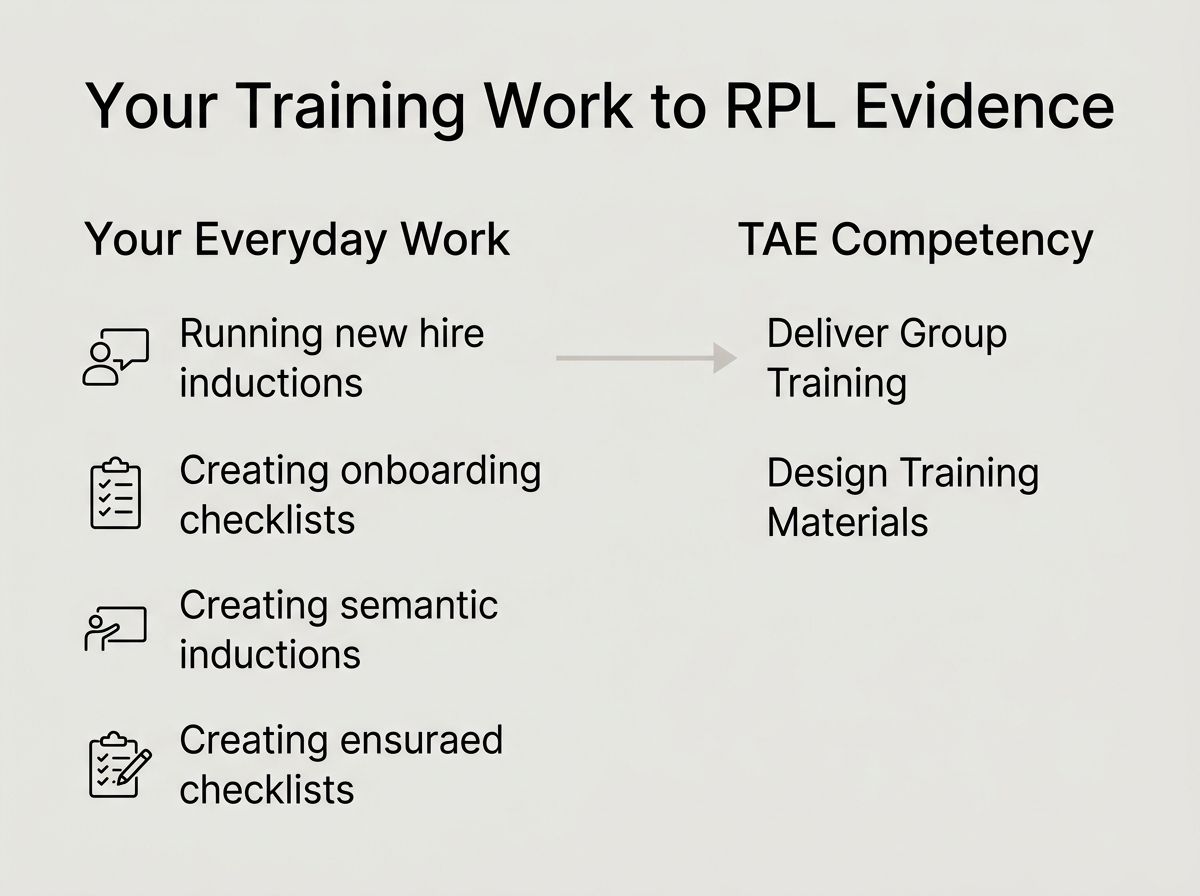
The main question at this stage is whether your day-to-day work counts. Here is how common informal training activities align directly with the competencies covered in the TAE40122 qualification:
- Running new hire inductions and structured onboarding sessions, which maps directly to planning and delivering group-based learning
- Creating training materials, guides, checklists, or procedure documents, which maps to competencies in designing structured learning resources
- Mentoring junior staff one-on-one through workplace tasks and processes, which maps to competencies in facilitating individual learning
- Checking whether someone is ready to work independently, or identifying when they need support, which maps to assessment and feedback
- Identifying skill gaps in your team and adjusting your delivery, which maps to competencies in evaluating and improving training practices
The TAE40122 covers several units across training design, delivery, and assessment. The specific units in your RPL application depend on your experience profile and the elective options offered by the delivering RTO. What matters now is recognising that the training work you have done informally has a formal name, and that name is evidence.
The evidence supporting an RPL application typically includes workplace documents you have created, such as induction plans, training schedules, and assessment checklists. It also includes records of training sessions you delivered, written statements from supervisors or colleagues who observed your work, and sometimes a structured interview or observed demonstration. These requirements vary by RTO and unit, and your guide will clarify what applies to your situation.
The documentation gap: why your experience is invisible to the system
The core of the issue is simple: your training experience exists and is real. It has been seen by colleagues and managers, but it exists in a format that formal systems do not recognize.
Formal systems, including HR departments, qualification frameworks, and regulatory bodies, require evidence in a specific format. They must see documented proof that competency has been demonstrated against defined standards. Your years of onboarding new hires, mentoring colleagues, and building training materials are not invisible because they did not happen. They are invisible because they were never recorded in the format these systems understand.
RPL translates your experience into that formal format. It does not create skills you lack; it makes your existing competencies visible. The difference between being unqualified and being undocumented is substantial, and for many experienced workplace trainers, it is the only difference that matters.
How RPL works for the TAE40122: what the process involves
RPL for the Certificate IV in Training and Assessment is a thorough assessment process. It is not a shortcut or a mere formality. A qualified assessor from a registered training organisation evaluates your evidence against the units of competency in the qualification. The qualification carries weight because the assessment process is rigorous.
The process involves several stages. First is a suitability conversation, which is an assessment of whether your background supports an RPL application before you commit. Second is a self-assessment against the qualification units to find where your evidence is strong and where gaps exist. Third is evidence gathering, which means compiling workplace documents, records, and written statements. Fourth is the assessor review, where a qualified assessor evaluates your files, conducts an interview, or asks for a demonstration.
Be aware that gap training may be required. If your evidence does not fully cover specific units, especially those requiring observed training delivery or assessment, the RTO will identify these areas and provide gap training to address them. This gap training is provided at no additional cost as part of the RPL process.
The qualification is issued by the registered training organisation that conducts your assessment. While RPL it guides you through the process, the RTO assessor makes the final determination of competency. This independent assessment ensures the qualification remains meaningful.
Is your training experience enough to start an RPL application?
This is a direct question that deserves a direct answer. Not everyone with an informal training background will qualify for a complete RPL pathway for the TAE40122. The strength of your application depends on the nature of your training experience, the evidence you can collect, and the units required by the RTO.
Your experience is likely to support RPL if you regularly deliver structured training or inductions, rather than just showing someone a task once. It also helps if you have created training guides or resources that others use, or if you evaluate whether someone has learned the material and adjust your approach accordingly. Finally, you should have colleagues or supervisors who can provide written statements confirming your training work.
Your experience may have gaps if your training has been entirely informal and undocumented, leaving no record of what you delivered or to whom. Gaps may also exist if you have never assessed someone in a structured way, or if you have no colleagues who can provide a third-party report of your training work.
The only way to find out is to have your specific experience reviewed before you make any commitment.
Your work deserves to be recognised
You have been training staff, building capacity in your organisation, and doing the work that the L&D title represents. That work is real.
The system did not recognize your work because it was not in the format required. This is a documentation issue, not a capability issue, and documentation issues can be solved.
Your training experience is real, and your skills deserve recognition.
The next step is finding out if your experience supports an RPL application for the Certificate IV in Training and Assessment. This initial review is free and involves no commitment.
Explore the Certificate IV in Training and Assessment (TAE40122) and what an RPL pathway looks like for this qualification.
Ready to Get Recognised?
Start with a free skills review to find out if RPL is right for you.