BSB40420 is not about learning HR from scratch: it is about proving you already do the work
The Certificate IV in Human Resource Management is not a beginner's course. If you are already doing the work, BSB40420 is how you prove it.
By RPL it Australia8 min read

Most people searching this qualification are already doing the work
You have been doing HR work for years: recruitment, onboarding, performance conversations, and workforce planning. This is the daily work that keeps an organisation's people function running. Then a job ad appears. It is a role you are ready for, with a salary band that reflects your actual contribution. But somewhere in the requirements, you see it: the Certificate IV in Human Resource Management (BSB40420) or equivalent.
That gap is not about capability. You know that, and the hiring manager probably does too. But the recruitment process requires formal proof, and you do not currently have it.
The common response is to assume you must go back to study. You imagine sitting through classes, online or in person, covering basic material that describes your current job. That assumption is understandable, but for experienced HR practitioners, it is incorrect.
What BSB40420 actually measures (and it is not what most people think)
BSB40420 is a competency standard. It defines what a qualified HR practitioner can do, rather than how they learned to do it.
This distinction is highly practical. A competency standard outlines the skills and knowledge required to perform a role to a set level of proficiency. It is not a course syllabus, nor is it a list of topics to be taught in a classroom. Instead, it is a benchmark used to assess your current capability.
The Certificate IV in Human Resource Management is part of Australia's national vocational education and training framework. Like all qualifications in this system, it specifies what a qualified person can do, regardless of how they gained those skills. The assessment asks whether you can demonstrate these competencies, not whether you attended a specific class.
For an experienced HR professional, this is a very different question. The competency standard describes your daily work. The real task is simply to show how your current practice can be mapped as evidence against that standard.
The work BSB40420 describes is probably already in your job description
The competencies covered by the Certificate IV in Human Resource Management align with the work of HR coordinators, generalists, and people and culture advisors in Australian organisations. Consider what the qualification actually addresses:
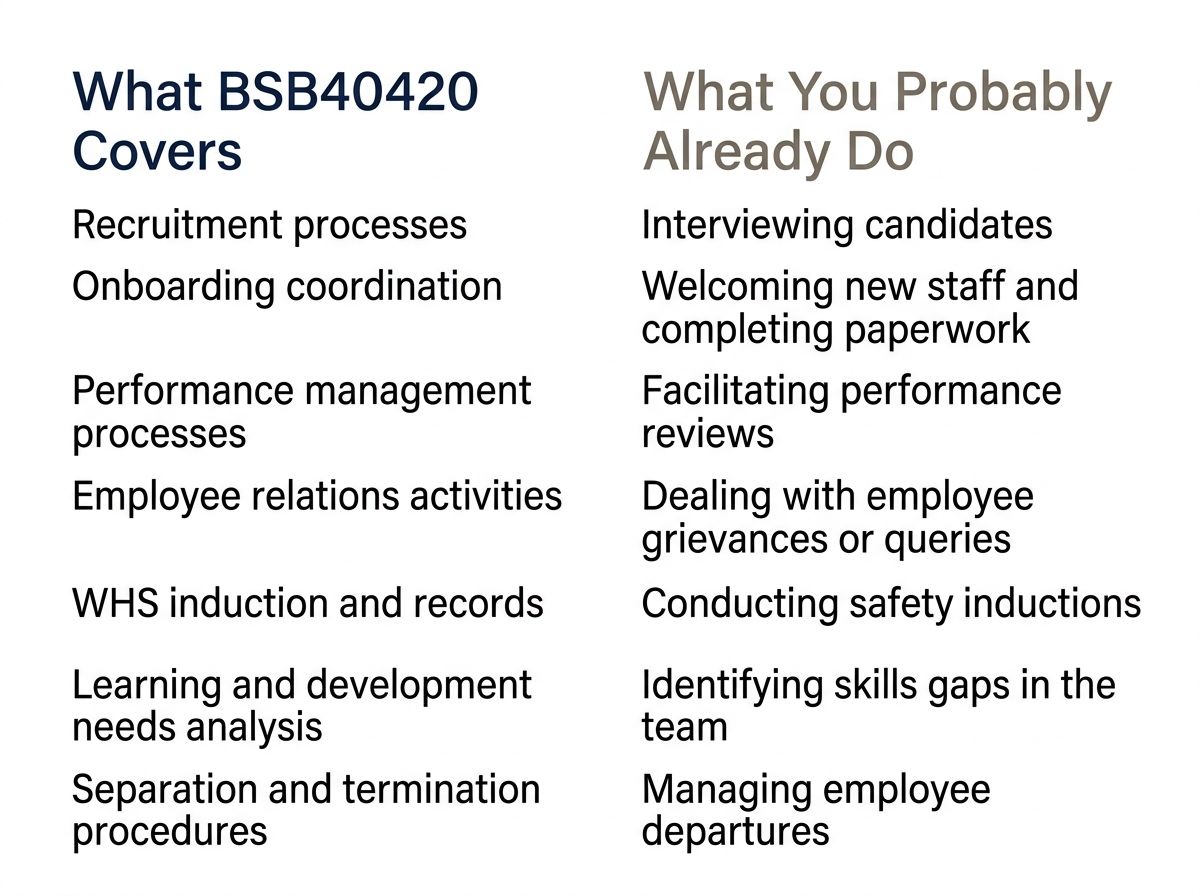
- Recruitment and selection: sourcing candidates, managing interview processes, and coordinating employment offers
- Onboarding and workforce planning: welcoming new staff members and contributing to workforce planning analyses
- Performance management: managing employee reviews and supporting formal performance improvement plans
- Workplace relations: applying relevant legislation and advising managers on industrial relations matters
- Work health and safety obligations: maintaining WHS compliance and coordinating incident management procedures
- HR administration and reporting: managing records, producing workforce data, and helping implement organisational policies
If you have been in HR for several years, this list does not describe skills you need to learn. It describes the work you did last week.
The qualification does not ask you to learn these tasks. It asks you to show that you already perform them consistently, to the required industry standard, with the professional knowledge your role demands.
Why experienced HR practitioners hesitate, and why that hesitation is unnecessary
The common assumption is that getting BSB40420 requires enrolling in a course. For an experienced professional, that assumption is incorrect.
Recognition of Prior Learning (RPL) is a formal assessment pathway within Australia's vocational education and training system. It is designed specifically for situations where a professional has gained the required skills and knowledge through years of work experience rather than formal study. Through RPL, a registered training organisation (RTO) assesses whether you can demonstrate these competencies using evidence from your current work.
RPL is not a shortcut or a loophole. It is a legitimate, nationally recognised assessment pathway that has been part of the Australian qualifications system for decades. The assessment is rigorous, and the qualification you receive is exactly the same as one earned through study. The only difference is the form of evidence used to prove your skills.
For an experienced HR professional, RPL means that instead of sitting through a course covering material you already know, you work with an assessor to document and prove that your current practice meets the competency standard. Your employment history, work samples, and daily responsibilities serve as the primary evidence base for your assessment.
The hesitation most experienced HR professionals feel has nothing to do with capability. It usually comes from not knowing how the assessment process works. Once you understand the RPL pathway, the process becomes much more straightforward.
What proving your experience actually looks like
The necessary evidence already exists in your daily files: your position descriptions, performance reviews you have conducted, recruitment campaigns you have run, and workplace relations matters you have managed. The goal is not to produce new work, but to compile your existing documents so an assessor can evaluate them against the official standard.

In practice, evidence for a BSB40420 RPL application typically draws on several different sources. Employment records establish the context, showing how long you have worked in HR and your level of responsibility. Position descriptions and performance reviews outline the scope of your daily tasks. Work samples, such as de-identified documents, process templates, or correspondence, show how you apply HR knowledge to real workplace situations. Finally, referee statements from managers or colleagues confirm your practical skills.
An assessor will also guide you through a professional discussion. During this conversation, you will talk about your daily practice and demonstrate your understanding of employment laws and policies, showing that your knowledge is current and practical rather than theoretical.
This process requires time and active participation. It is a genuine assessment, not a rubber stamp. However, if you have years of experience, you already have the evidence. The process is simply about organizing and presenting your work, not creating new materials.
It is important to be realistic: if an assessor finds areas where your experience does not fully cover the competency standard, you may need to complete targeted gap training. A professional RTO will identify these areas early and help you address them. This is a standard part of the process, not a setback.
The difference between studying for a qualification and demonstrating your skills
There are two pathways to the same qualification. One requires formal study: enrolling in a course, completing assignments, and learning the concepts step-by-step. The other requires demonstrating your existing competency through real-world work. Both options lead to the same nationally recognised qualification and are assessed against the same standard.
The final qualification does not show how you acquired your skills; it only states that you have them. The assessor applies the exact same standards to your work evidence as they would to classroom exams.
This distinction has practical benefits. A BSB40420 obtained via RPL has the same national recognition as one earned through a standard course. It meets the same recruitment requirements, opens the same career paths, and awards the identical certificate.
The difference between these options is not where you end up, but where you begin. Study-based courses are designed for people who need to learn HR concepts from scratch. Assessment-based pathways are built for professionals who already perform this work every day. Choosing RPL is not about finding a shortcut; it is about choosing a path that respects your current professional standing.
Is BSB40420 via RPL the right option for you?
RPL is not the right choice for everyone, and it is important to be clear about that.
If you are new to HR, or if your experience is limited to a single area, such as recruitment or basic admin, RPL may not be suitable. The qualification covers a broad spectrum of HR functions, and you must show evidence across all these areas rather than specializing in just one.
The RPL pathway is highly effective if you have worked in an HR role for a substantial period, across a broad range of responsibilities that match the qualification guidelines. If your daily work includes managing recruitment, guiding performance reviews, handling WHS requirements, and contributing to workforce planning—and has done so for some time—you are highly likely to have a solid evidence base.
An article cannot give you a definitive answer on whether RPL is right for you. It depends entirely on your specific work history and how your daily tasks align with the national standard. This is exactly what the Free Skills Review evaluates, giving you a clear answer before you commit to the process.
The next step: a free, no-obligation skills review
If you have been working in HR for years and need a BSB40420 to take your next career step, your capability is not in question. The only task is to package your existing experience as evidence against the competency standard.
This is a straightforward technical question, and you do not have to guess the answer.
The Certificate IV in Human Resource Management (BSB40420) course page provides detailed information on how the RPL pathway works and what the assessment entails.
The Free Skills Review is a practical way to find out where you stand. There is no commitment and no obligation, just an honest assessment of whether your current experience matches the qualification requirements.
General information only, current at the date shown. Licensing rules change, so check the current requirements with the relevant regulator before you rely on them. RPL it Australia is a student support service, not a Registered Training Organisation; qualifications are assessed and issued by our partner RTOs.