BSB80120 explained: What the Graduate Diploma of Management (Learning) covers
BSB80120 is the Graduate Diploma of Management (Learning). Read about what it covers, how it works in practice, and how to map your senior L&D experience.
By RPL it Australia9 min read

What BSB80120 actually is
BSB80120 is the Graduate Diploma of Management (Learning), a nationally recognised qualification for senior learning and development professionals in Australia. If you have seen this code in a job advertisement, a tender requirement, or a conversation with a manager, this is what it means.
The qualification is positioned at a postgraduate-equivalent level within Australia's vocational education and training system. It is designed for practitioners who already have substantial professional experience, rather than those entering the field. The code itself does not show that, but the qualification requirements do.
BSB80120 formally recognises strategic capability in learning design, organisational capability development, and the management of learning functions. It is the kind of credential that appears in senior L&D role requirements, organisational capability frameworks, and government procurement specifications, often without context. This article provides that explanation.
Note: Qualification codes and their currency can change over time. Before making decisions based on this article, we recommend verifying the current status of BSB80120 directly on the national training register at training.gov.au.
Who this qualification is designed for
BSB80120 is not an entry-level credential. It is designed for professionals already operating at a senior level in learning and development, organisational capability, or people-development roles.
If your work involves any of the following, this qualification was written with your role in mind:
- Designing or overseeing learning strategy for a team, department, or organisation
- Managing an L&D function, team, or budget
- Advising senior leaders on capability gaps and development priorities
- Leading the design and implementation of organisational development programs
- Evaluating the impact of learning initiatives on business performance
- Consulting internally or externally on workforce capability
Common role titles that align with this qualification's scope include L&D Manager, Capability Development Lead, Head of Learning, Organisational Development Consultant, and Senior Learning Designer with strategic responsibilities. The specific titles vary by organisation and sector. The key factor is the level and nature of the work, not the label on the business card.
The qualification is relevant across a wide range of industries. Corporate, government, healthcare, education, and the not-for-profit sectors all employ senior L&D professionals whose work maps to BSB80120's scope. If you have been doing this work for years without a formal credential to match, that is the gap this qualification addresses.
The core domains BSB80120 covers
Rather than listing unit codes, it is more useful to describe what BSB80120 actually asks you to demonstrate. The qualification spans several interconnected practice domains, with each mapping to a recognisable dimension of senior L&D work.
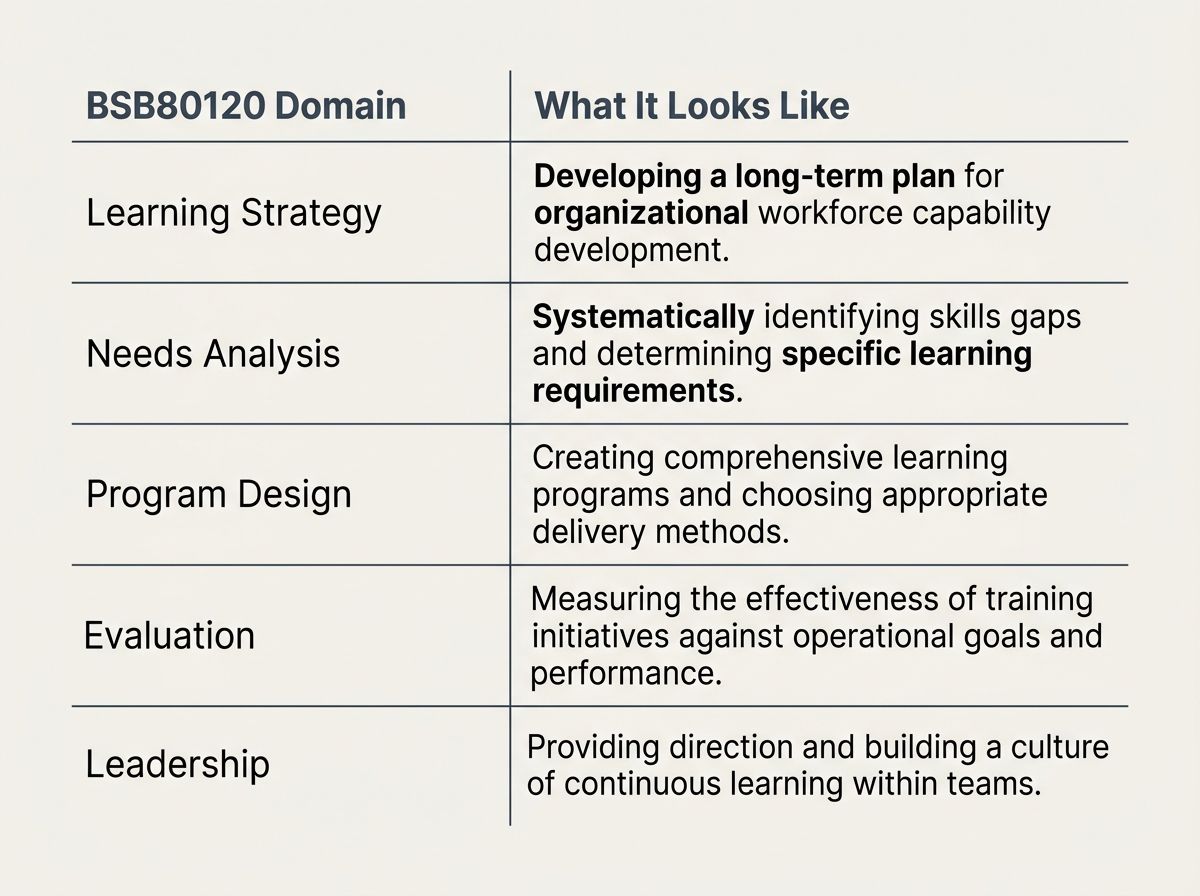
Because all research queries to the national training register were unavailable at the time of writing, the domain descriptions below are drawn from general knowledge of the BSB80120 qualification scope. Specific unit titles and performance criteria should be verified at training.gov.au before any assessment decisions are made.
Learning strategy and organisational alignment
This domain covers the ability to translate organisational goals into learning strategy. It asks how you identify what capability an organisation needs, and how you design a learning response that actually addresses it. This is not about individual training programs; it is about the strategic layer above them.
Needs analysis and capability assessment
This domain covers the systematic identification of capability gaps. It includes the methods you use to diagnose learning needs, whether through performance data, stakeholder consultation, skills audits, or workforce planning analysis. The emphasis is on rigour and evidence, not intuition.
Learning design and program development
This domain covers the design of learning solutions, from instructional design principles to the selection of delivery modalities, the development of learning resources, and the sequencing of content for different audiences. It spans both formal and informal learning approaches.
Evaluation and impact measurement
This domain covers the ability to assess whether learning has worked. It includes evaluation frameworks, measurement approaches, and the capacity to report on learning outcomes in terms that are meaningful to organisational stakeholders, rather than simply presenting completion rates.
Stakeholder engagement and influence
This domain covers the relational and consultative dimensions of senior L&D work, including building credibility with business leaders, managing competing priorities, communicating the value of learning investment, and influencing decisions about capability development at an organisational level.
Leadership and management of learning functions
This domain covers the management responsibilities that come with senior L&D roles, such as leading teams, managing vendors and external providers, overseeing budgets, and building a learning culture within an organisation. The extent to which this domain applies will depend on the specific units selected and your individual role.
These domains are not siloed. Senior L&D work is inherently integrative. Strategy informs design, design informs evaluation, and evaluation informs strategy. BSB80120 reflects that integration.
What 'demonstrating competency' actually means at this level
At this qualification level, competency is not demonstrated by completing coursework. It is demonstrated by showing that you already apply the relevant knowledge and skills autonomously, at a sophisticated level, in a real professional context.
That distinction matters. It means the standard is not about what you can learn in a classroom. It is about what you already do at work. The assessment asks: can you show evidence that you have applied these capabilities, made professional judgements, and taken responsibility for outcomes?
For experienced L&D professionals, this is often a more achievable standard than it first appears. The work exists. The question is whether it has been documented in a form that an assessor can evaluate.
The types of evidence that are typically relevant for RPL at this level include:
- Work samples, including learning strategies, needs analysis reports, program designs, and evaluation frameworks
- Project documentation, such as scoping documents, stakeholder briefs, implementation plans, and post-implementation reviews
- Professional development records showing evidence of ongoing learning and reflective practice
- Third-party reports, including references or statements from managers, clients, or colleagues who can speak to your professional practice
- Portfolio evidence consisting of a structured collection of work that demonstrates competency across the qualification's domains
Specific evidence requirements vary by registered training organisation (RTO). The assessment is conducted by a qualified assessor from the delivering RTO, not by RPL it. RPL it's role is to guide you through the evidence-gathering and preparation process.
The standard is high, but so is your level of experience. These two realities are not in conflict; they are the premise of Recognition of Prior Learning.
How to read your own work against the BSB80120 framework
If your work includes any of the following, your experience may already map to BSB80120 competency requirements. Work through this list with your own career in mind.
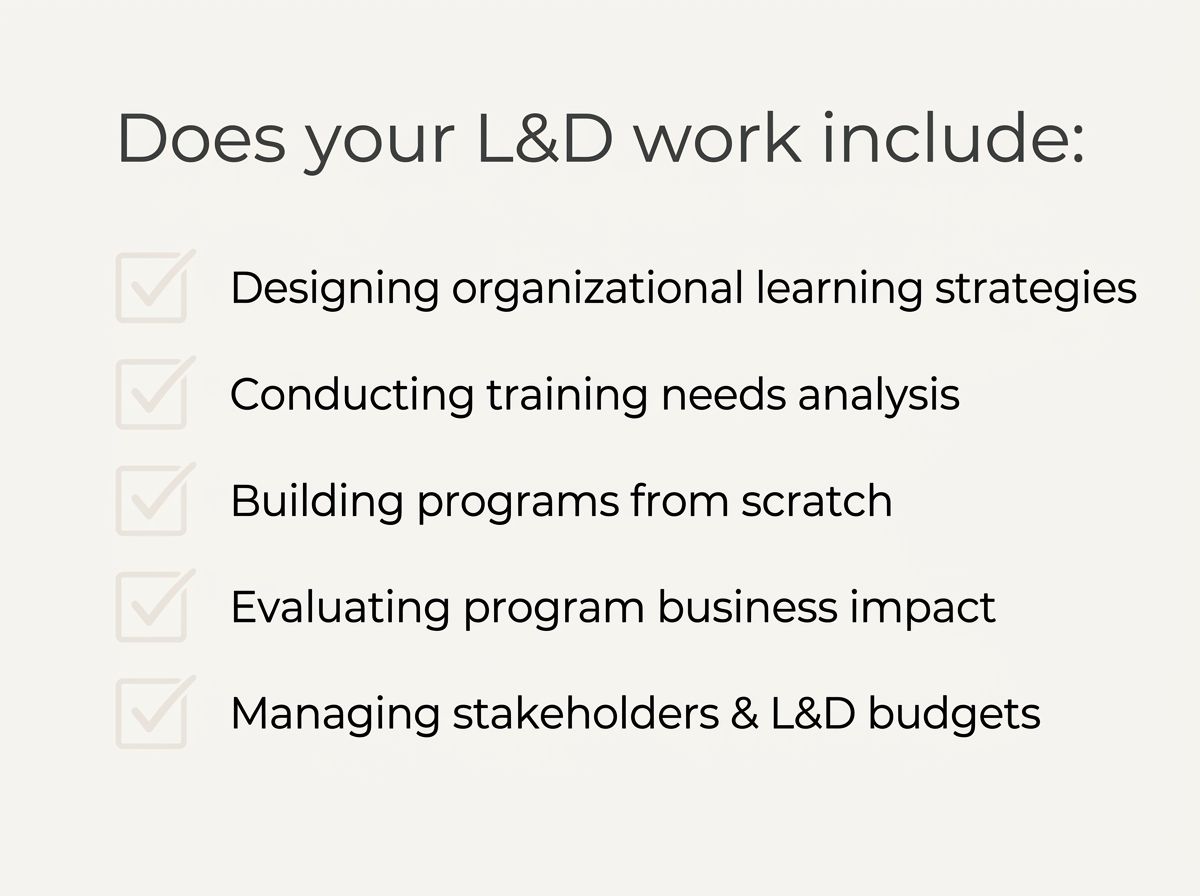
- You have designed a learning strategy for a team, department, or organisation, representing a considered approach to capability development over time rather than just individual programs.
- You have conducted a training needs analysis, systematically identifying what capability gaps exist and why, using data or structured consultation rather than assumption.
- You have designed learning programs or resources from scratch, applying instructional design principles to create something that did not exist before you built it.
- You have evaluated the impact of learning, going beyond completion rates to assess whether the training actually changed behaviour, performance, or organisational outcomes.
- You have managed relationships with senior stakeholders around learning, including presenting business cases, influencing decisions, or advising leaders on capability strategy.
- You have managed an L&D function, team, or budget, taking operational or strategic responsibility for how learning is delivered in your organisation.
- You have led or contributed to organisational development initiatives, such as change management, culture programs, leadership development, or workforce planning.
- You have consulted on capability development, either internally as an advisor to business units, or externally as a consultant or contractor.
If you recognised your own work in several of those descriptions, the BSB80120 framework may already reflect what you do. The question is not whether you are capable, but whether your experience has been documented in a way that an assessor can evaluate.
Whether people management experience is required will depend on the specific units selected for your assessment. Some units within the qualification have a stronger management focus than others. This is one of the questions a Free Skills Review can help clarify, before you commit to anything.
What BSB80120 is not
Honest guidance is essential. BSB80120 is not the right qualification for every L&D professional.
If you are early in your L&D career, primarily delivering training designed by others, supporting programs rather than leading them, or building foundational facilitation skills, this is not the right qualification yet. The level of autonomous, strategic practice it requires takes time to develop.
If your work has been primarily operational rather than strategic, such as administering an LMS, coordinating logistics, or facilitating programs without involvement in their design or evaluation, there may be a better-fit qualification at a different level. The Certificate IV in Training and Assessment (TAE40122) or the Diploma of Vocational Education and Training (TAE50122) may be more appropriate starting points.
If you work as a senior instructional designer or learning consultant without formal management responsibilities, your suitability will depend on the specific units selected for your assessment. Some pathways through BSB80120 are more accessible to strategic individual contributors than others. This is worth exploring before assuming the qualification either does or does not apply to you.
The qualification is rigorous. That rigour is what makes it meaningful. It is also why an honest suitability assessment, conducted before enrolment, is the right starting point.
BSB80120 and the RPL pathway: What happens next
Recognition of Prior Learning (RPL) is a formal assessment process. It is not a shortcut or a workaround; it is a legitimate pathway through which demonstrated experience is assessed against the same competency standards as any other candidate.
Here is what the process looks like in broad terms:
- A suitability assessment, representing an honest review of whether your experience is likely to meet the qualification's requirements. This is where RPL it's guidance begins.
- Evidence gathering, which involves working through the qualification's competency domains and identifying the work samples, documentation, and professional records that demonstrate your capability. RPL it guides this process.
- Formal assessment, conducted by a qualified assessor from a registered training organisation (RTO). The RTO determines competency. RPL it does not assess or award qualifications.
- Gap training, where if the assessment identifies areas where your evidence is insufficient, gap training is provided to address those gaps. This is included as part of the process.
- Qualification issuance, meaning if competency is demonstrated across all required units, the RTO issues the nationally recognised BSB80120 qualification.
The duration of the process varies depending on the candidate, the RTO, and the complexity of the evidence required. We do not publish indicative timeframes because they vary too significantly to be useful, and because we choose not to overpromise on timelines.
We can state that the process is designed to honour the work you have already done, rather than asking you to repeat it.
For full details on the BSB80120 qualification and the RPL pathway, visit the qualification page.
General information only, current at the date shown. Licensing rules change, so check the current requirements with the relevant regulator before you rely on them. RPL it Australia is a student support service, not a Registered Training Organisation; qualifications are assessed and issued by our partner RTOs.