How to get a Queensland landscaping licence if you already do the work
Already doing landscaping work in QLD? Learn how to get the formal licence that recognises your trade experience without going back to classroom study.
By RPL it Australia9 min read
The wrong question — and the right one
You already know how to become a landscaper. You did it. Somewhere between the first retaining wall you built and the hundredth project you delivered, you stopped learning the trade and started running it. The question you are actually asking — the one behind the search query that brought you here — is not about starting out. It is about getting formal recognition for the work you already do every day.
Most articles about how to become a landscaper assume you are starting from scratch. They offer career guides, TAFE course listings, and apprenticeship pathways. All of that is written for people who have never held a line trimmer on a professional site. If you are already running projects, managing crews, quoting jobs, and building structures that last, those guides are not meant for you.
This article is.
In Queensland, the path to qualification for experienced landscapers does not require a full-time course. It is a straightforward assessment of what you already know. Before looking at how that works, it helps to understand what the state actually requires — and why so many experienced tradespeople only discover these licensing rules later than they should have.
What Queensland actually requires — and why it catches experienced operators off guard
Queensland's building and construction licensing framework, run by the Queensland Building and Construction Commission (QBCC), covers a wide range of trade and construction activities, including several categories of landscaping. Not all landscaping requires a licence. Basic mowing, garden maintenance, and soft landscaping generally fall outside these rules. However, structural landscaping work — such as retaining walls, earthworks, drainage, and hard landscaping — is a different matter.
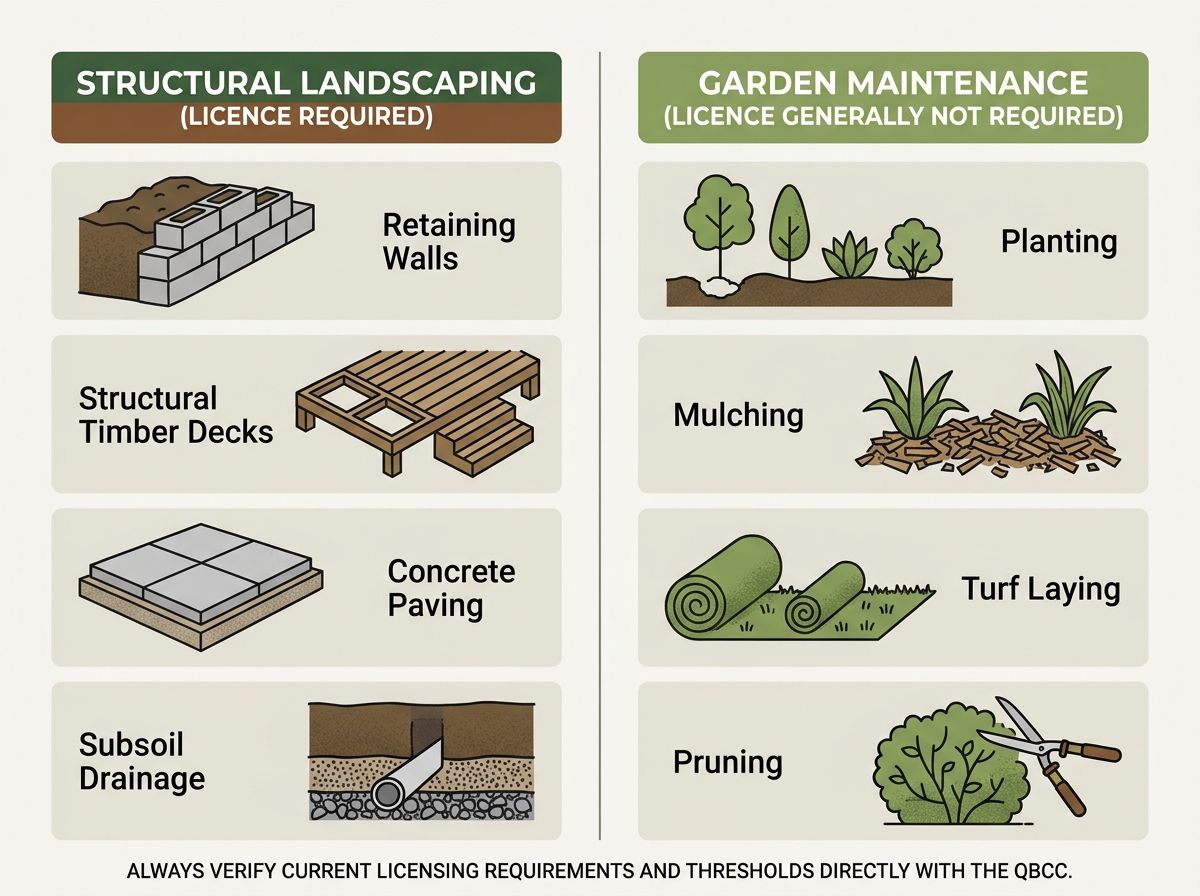
The QBCC manages licence classes that cover structural landscaping work in Queensland. Whether a specific project needs a licensed operator depends on the type of work and the contract value. The QBCC website at qbc.qld.gov.au is the source for current licence classes, work scopes, and the financial thresholds that apply to your business. Licensing requirements can change and the details are specific, so you should always verify directly with the QBCC rather than relying on secondhand summaries.
Experienced operators are rarely caught off guard by a lack of skill. Instead, they often assume that their practical experience is enough on its own. In the eyes of the licensing framework, it is not. A landscaper who has been building sound retaining walls for ten years is not automatically licensed to do so. The regulator requires formal evidence of that competence, not just the practical ability to do the work.
This matters for your business. Unlicensed work in regulated categories can affect your ability to recover payments through courts, complicate your insurance cover, and expose you to compliance action. The QBCC's enforcement policies outline these consequences, and the QBCC website at qbcc.qld.gov.au is where you can check the rules that apply to your current situation.
This is not about catching you out. It is about identifying the gap: you have the practical skill, but the system does not recognise it yet. That is a solvable problem.
The pathway that does not require starting over
Recognition of Prior Learning (RPL) is an assessment pathway under the Australian Qualifications Framework. It exists specifically for tradespeople in your position: skilled workers who developed their competencies on the job rather than in a classroom.
RPL is not a shortcut. It is a structured assessment process where an assessor reviews evidence of your practical skills and knowledge against the standard units of a national qualification. If your evidence meets the required standards, you receive the qualification. The credential holds weight because the assessment is thorough, verifying your actual ability on the job.
For experienced landscapers in Queensland, the qualification pathway connects to QBCC licence eligibility. You should confirm the exact qualification you need directly with the QBCC, as requirements depend on the specific licence class you want. The QBCC maintains the official list of approved qualifications. Landscape construction qualifications at Certificate III or Certificate IV level are usually the correct pathway, but you must check your specific class with the regulator before starting.
In practice, RPL means that if you have spent years doing the work, you likely already have the skills the qualification requires. The assessment process simply documents and confirms those skills. You do not have to go back to school to sit in a classroom. Instead, you present evidence of what you already know how to do.
What experience actually means to an RPL assessor
The most common concern landscapers raise about RPL is that their experience will not count because it was self-employed, informal, or not documented in a neat folder. This concern is understandable, but in most cases, it is misplaced.
Assessors do not need a spotless employment history with official job titles and HR records. They want to see proof of your skills. The Australian Skills Quality Authority (ASQA) sets the standards that registered training organisations must follow, and these rules require assessors to accept different types of evidence rather than just formal employment contracts.
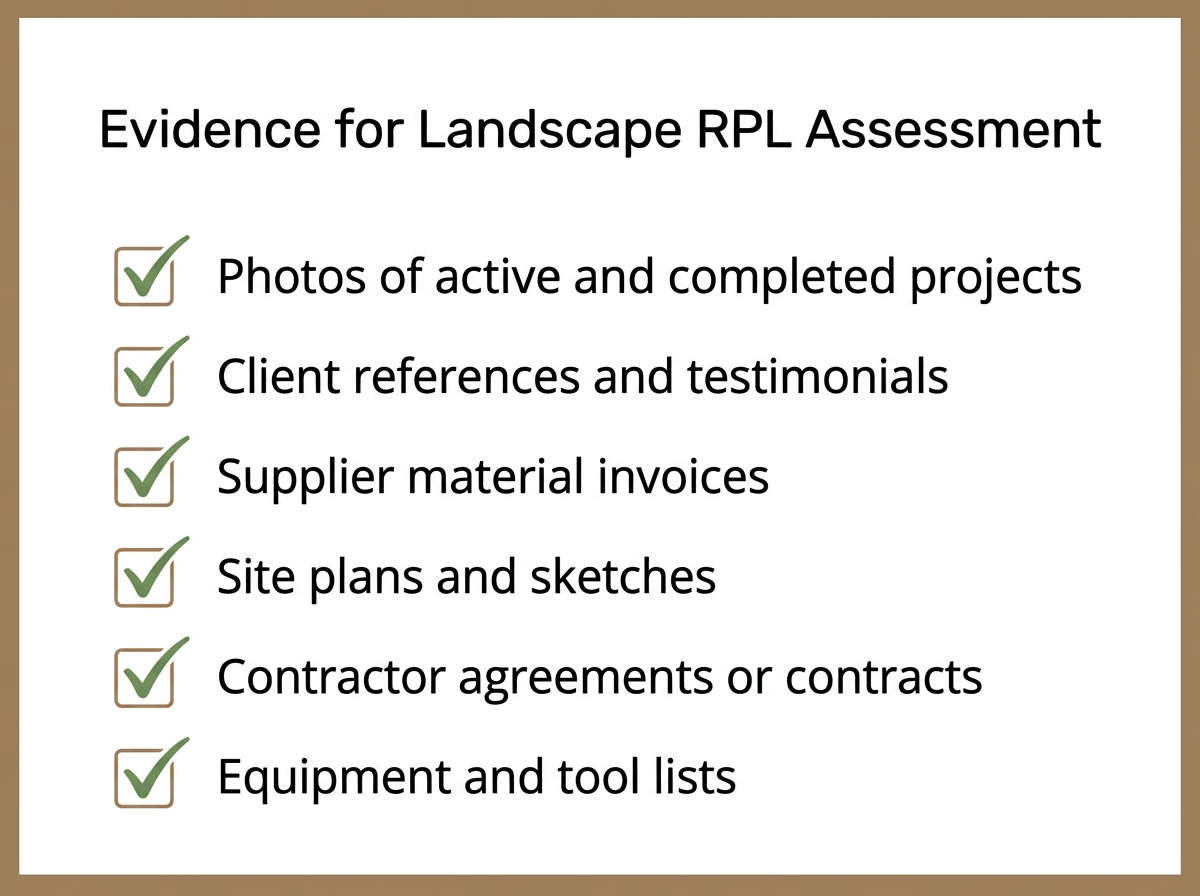
What kinds of evidence are relevant for a landscape construction RPL assessment? The exact requirements depend on the qualification and your training provider, but the main categories include: photos of your completed projects, client references, supplier invoices, purchase records, site plans, project layouts, contracts, and lists of the tools and machinery you operate. If you have been running a landscaping business — even as an unregistered sole trader — you probably have more usable evidence on your phone and in your records than you realise.
Self-employment and sole trader work count. You do not need a past employer to verify your hours. The core question is whether you can show you have the skills the qualification requires. A retaining wall you built as a sole trader is valid evidence. A drainage system you put in for a private client is valid evidence. The work itself proves your capability.
If you are unsure what experience counts for RPL, our article on what counts as experience in an RPL assessment covers the details in depth.
Is RPL the right pathway for you? An honest assessment
RPL is not for everyone. It is the correct path if you have substantial, hands-on experience in landscape construction. It is not designed for people who are new to the trade or who have only worked in adjacent roles without doing the actual construction work.
If you have done structural landscaping work — like retaining walls, earthworks, and drainage — for a reasonable period, and you can point to finished jobs and gather photos or invoices, RPL is worth looking into. The assessment will determine whether your evidence meets the national standard. The assessment itself gives the final answer, not a generic guide.
If you are new to the trade, or if your experience is mostly in soft landscaping and garden maintenance rather than structural work, RPL is likely not the right pathway. Speaking with a training provider about your background will give you a clearer picture than any online guide.
If your assessment shows gaps where your evidence does not fully meet the standard, you can usually complete gap training for those specific units. You do not have to repeat training for areas where you are already skilled. The process is designed to recognise your existing knowledge and only train you on what is missing.
We want to help you find the right path rather than sign you up for something that does not fit. That is not sales talk — it is how the trade assessment system works best.
What the process looks like: from skills review to formal recognition
The RPL pathway for experienced landscapers wanting a Queensland licence follows a clear sequence. Here is how the process works.
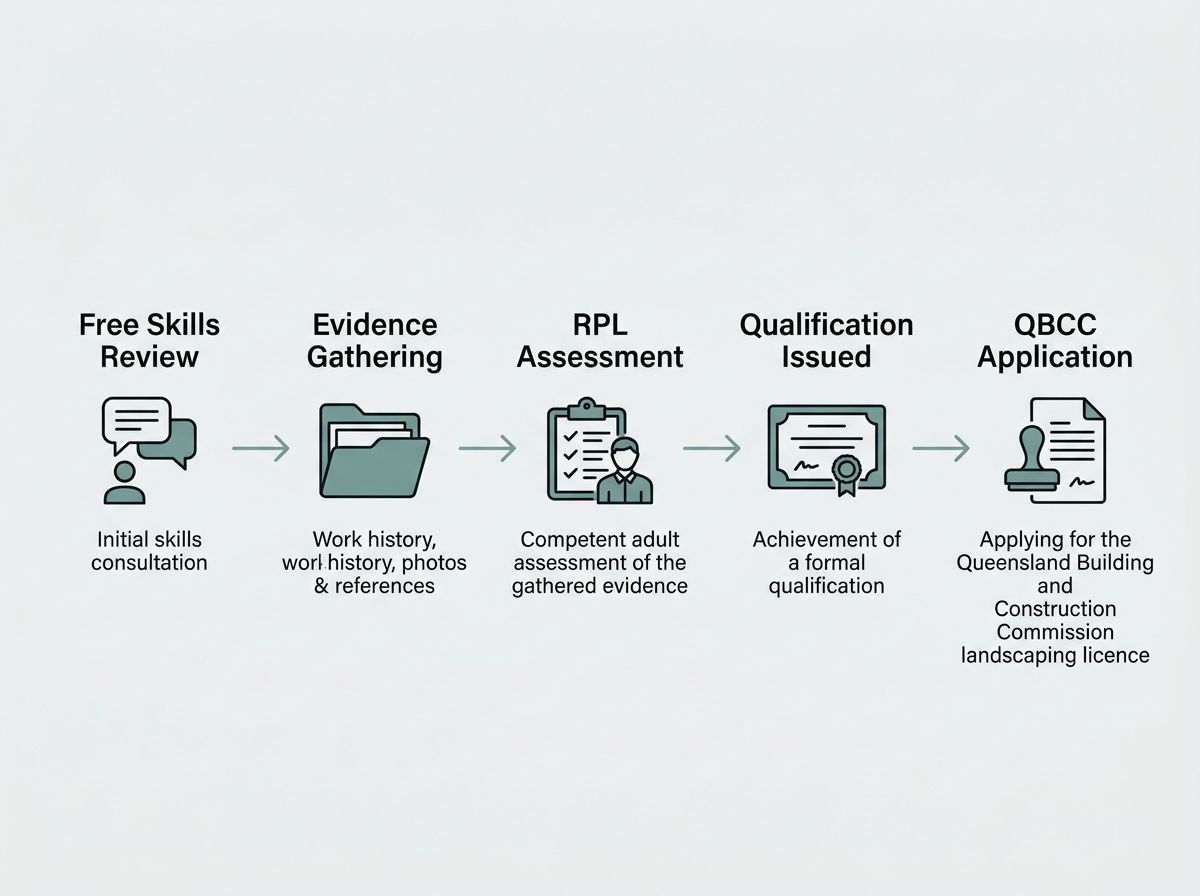
- Free Skills Review: Your start point is a direct conversation about your trade background. It is not an assessment or a test, but a quick review to see if RPL is viable for your situation. The goal is to give you an honest picture of your chances before you spend any money or make any commitment. If it is not the right fit, we will tell you directly.
- Evidence Gathering: If the initial review looks promising, you will begin collecting proof of your trade skills. This is where your project photos, client references, supplier invoices, and job documents come together. The training provider will guide you through exactly what is needed for your file.
- Formal RPL Assessment: An assessor compares your compiled evidence against the units of the qualification. This process may include a practical demonstration or a technical interview to verify your skills if the paperwork needs backing up. This review is thorough, which is why the finished qualification carries real weight.
- Qualification Award: Once the assessor confirms your evidence meets all the training standards, the registered training organisation issues your trade certificate. This is a nationally recognised qualification under the Australian Qualifications Framework.
- QBCC Licence Application: You can then use your new qualification to apply for your licence through the QBCC. The QBCC website outlines the application process, the fees, and any other paperwork you need to submit. Processing times are managed entirely by the QBCC, so check their current turnarounds directly.
The time required for the assessment depends on how fast you can gather your evidence and the training provider's schedule. It does not happen overnight, and no reputable provider will promise a guaranteed turnaround date. What the process does offer is a pathway that respects your trade experience instead of asking you to start over.
Our QLD landscaper trade licence RPL pathway page has more detail on what the process involves for Queensland applicants.
The question you should have been asked years ago
Searching for how to become a landscaper assumes you are just starting out. You are not. You are in the middle of a trade career built on practical work, completed projects, and real skills. The question you should be asking is different: how do you get formal recognition for what you already know how to do?
Your experience counts as evidence. That is the core principle behind Recognition of Prior Learning. The trade work you have done is not invisible, and your years on the tools have not been wasted. Your past projects are the direct basis of an assessment that leads to a national qualification, helping you secure the Queensland trade licence that reflects your actual skills.
Getting qualified should not mean starting over. For experienced Queensland landscapers, it does not have to.
If you want to know how licensing works in other states, our article on whether landscapers need a licence covers the rules elsewhere.
General information only, current at the date shown. Licensing rules change, so check the current requirements with the relevant regulator before you rely on them. RPL it Australia is a student support service, not a Registered Training Organisation; qualifications are assessed and issued by our partner RTOs.