What counts as experience when you have never held the title 'horticulturist'?
Never held the title 'horticulturist' but spent years growing and maintaining plants? Learn what RPL assessors look for when evaluating your experience.
By RPL it Australia8 min read
The title problem: why 'horticulturist' is the wrong thing to look for
You have the experience. The question is whether you can see it.
Most people who have spent years working with plants, soil, and land never call themselves a horticulturist. They are the person who runs the community garden, the one who does weekend landscaping jobs, or the volunteer who turns up every Saturday for landcare. Others are home growers who sell at the farmers' market. None of these roles come with a formal title, which is why so many people assume they do not qualify for a horticulture credential.
They are wrong, and the reason they are wrong matters.
Recognition of Prior Learning (RPL) is a formal assessment pathway within Australia's national vocational education and training system. It assesses demonstrated competency. It does not look at your job title, your employer's name, or whether you studied at TAFE. It evaluates what you can actually do and whether you can show evidence of doing it.
If you have dismissed your experience because it does not look professional on paper, this article is for you. We will explain exactly what RPL assessors look for and provide a checklist to help you see if your experience qualifies.
If you are still exploring whether horticulture is the right direction, read our article on the horticulture qualification pathway built for career-changers first.
What RPL assessors actually look for (it is not a job title)
RPL assessment is evidence-based. An assessor determines whether you can demonstrate the competencies required by a qualification, unit by unit. They do not check your employment history or verify your job title. They simply ask whether you can do the work.
In the VET sector, evidence for RPL typically falls into three categories:
- Direct evidence, such as performing a task. This includes observed assessments, work samples, or practical demonstrations.
- Indirect evidence, consisting of records that show you have done the work. This includes photos, logbooks, invoices, plant diaries, project records, or certificates of participation.
- Supplementary evidence, which means third-party confirmation. This includes references from employers, community group coordinators, landcare supervisors, or clients who can verify your skills.
None of these categories require a formal job title. A volunteer coordinator's reference is supplementary evidence. A folder of photos from your market garden is indirect evidence. A practical demonstration of pruning technique is direct evidence. The system is designed to assess what you know and what you can do, not what you have been called.
This principle makes RPL accessible to anyone who has built genuine horticultural skills outside of formal employment. Your experience is real. The question is whether you can present it as evidence. For most people who have been working with plants for years, the answer is yes.
The checklist: eight types of horticultural experience that count
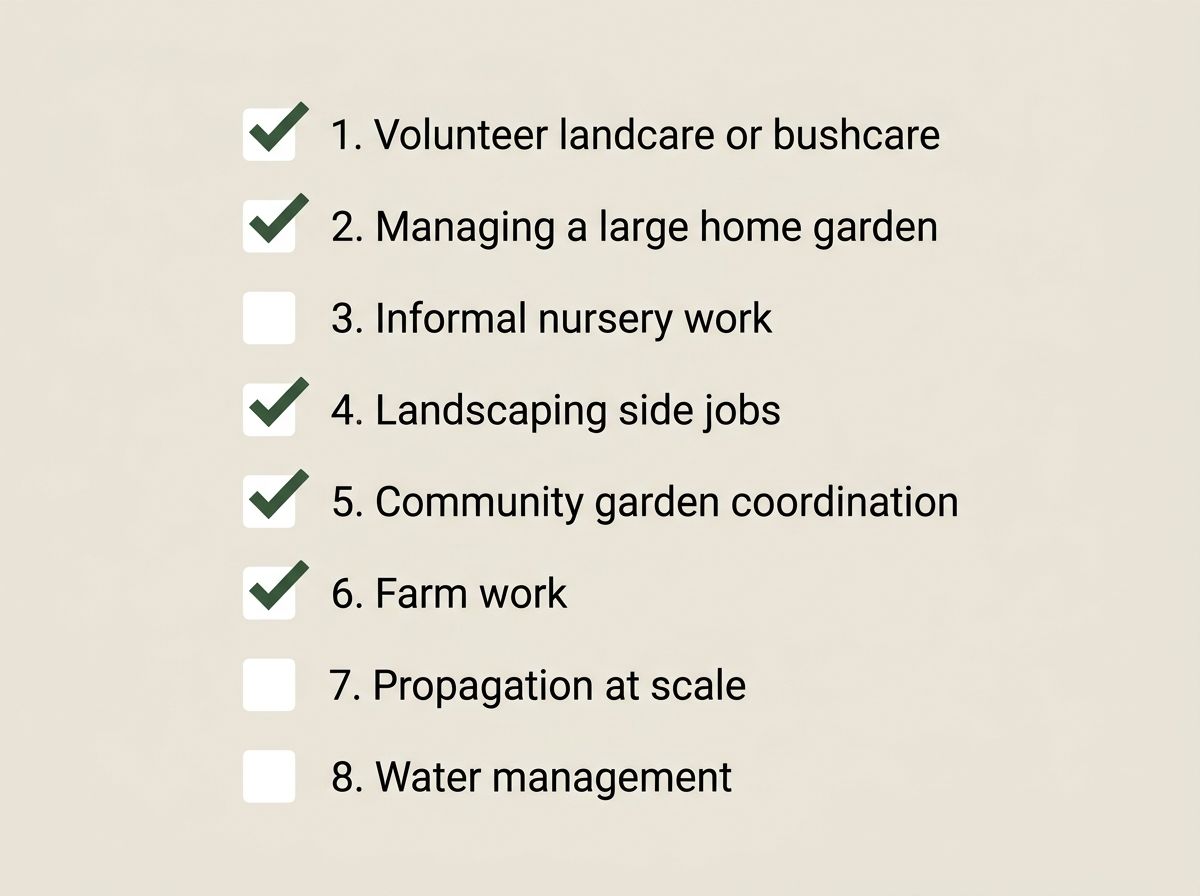
If you have done any of the following, your experience is likely assessable for a horticulture qualification. Work through each item and note which ones apply to you. We will explain what your results mean below.
1. Volunteer landcare or bushcare work
If you have volunteered with a landcare, bushcare, or Landcare Australia-affiliated group, you have done structured environmental horticulture work. Weed removal, revegetation planting, soil preparation, plant identification, and site monitoring are all competency areas relevant to horticulture qualifications. Evidence can include volunteer records from the group, coordinator references, photos from working bees, and attendance logs.
2. Managing a large home garden or market garden
If you have managed a productive garden at scale, such as growing vegetables, herbs, or fruit for household use, sale at a farmers' market, or supply to a local business, you have applied plant production and management skills. Soil preparation, irrigation management, pest and disease identification, harvesting, and seasonal planning are all relevant. Evidence can include photos, sales records, social media posts documenting your growing, and customer references.
3. Informal nursery work
Helping at a family nursery, working casually at a garden centre, or assisting with propagation and plant care in an informal capacity all count. Potting, propagation, plant identification, customer advice, and stock management are assessable competencies. Evidence can include references from the nursery owner, photos of your work, and any records of hours or tasks.
4. Landscaping side jobs or cash-in-hand garden maintenance
If you have done garden maintenance, lawn care, pruning, mulching, or planting for neighbours, friends, or small clients, even informally, you have applied practical horticulture skills. The work counts regardless of whether you were formally employed. Evidence can include client references, before-and-after photos, and any invoices or payment records you kept.
5. Community garden coordination
Coordinating or managing a community garden involves plant selection, soil management, composting, irrigation, pest management, and volunteer supervision. These tasks directly align with horticulture qualification units. Evidence can include references from the community organisation, photos, and any planning documents or garden records you have kept.
6. Farm work with plant-related tasks
If you have worked on a farm, even in a general capacity, and your work included planting, harvesting, irrigation, crop monitoring, or pest management, those tasks are assessable. This includes seasonal work, working holiday visa farm placements, and family farm contributions. Evidence can include employer references, payslips, photos, and any farm records you can access.
7. Propagation or seed-saving at scale
If you have propagated plants from cuttings, grown from seed, or maintained a seed-saving practice at a meaningful scale, rather than just keeping a few pots on a windowsill, you have applied plant propagation skills. Evidence can include photos of your propagation setup, records of varieties grown, and references from community seed-saving groups or gardening clubs.
8. Irrigation or water management on a property
Designing, installing, or maintaining an irrigation system, even a simple drip system for a home garden or small property, demonstrates water management competency relevant to horticulture qualifications. Evidence can include photos of the system, design sketches or plans, and references from property owners if you did this work for others.
The evidence you probably already have (and do not realise counts)
Most people do not realise they have already been documenting their experience without knowing it.
Consider what you already have. This might include photos on your phone of a garden you built over several years, social media posts showing your propagation setup, or invoices for plants purchased for a client's garden. You might also have emails from a community garden committee or a reference from a landcare group coordinator who has seen your work over several years.
While none of this matches the formality of a payslip, it acts as valid evidence for an RPL assessment. The VET sector recognises that you can demonstrate competency in many ways, and informal records are a legitimate part of your application.
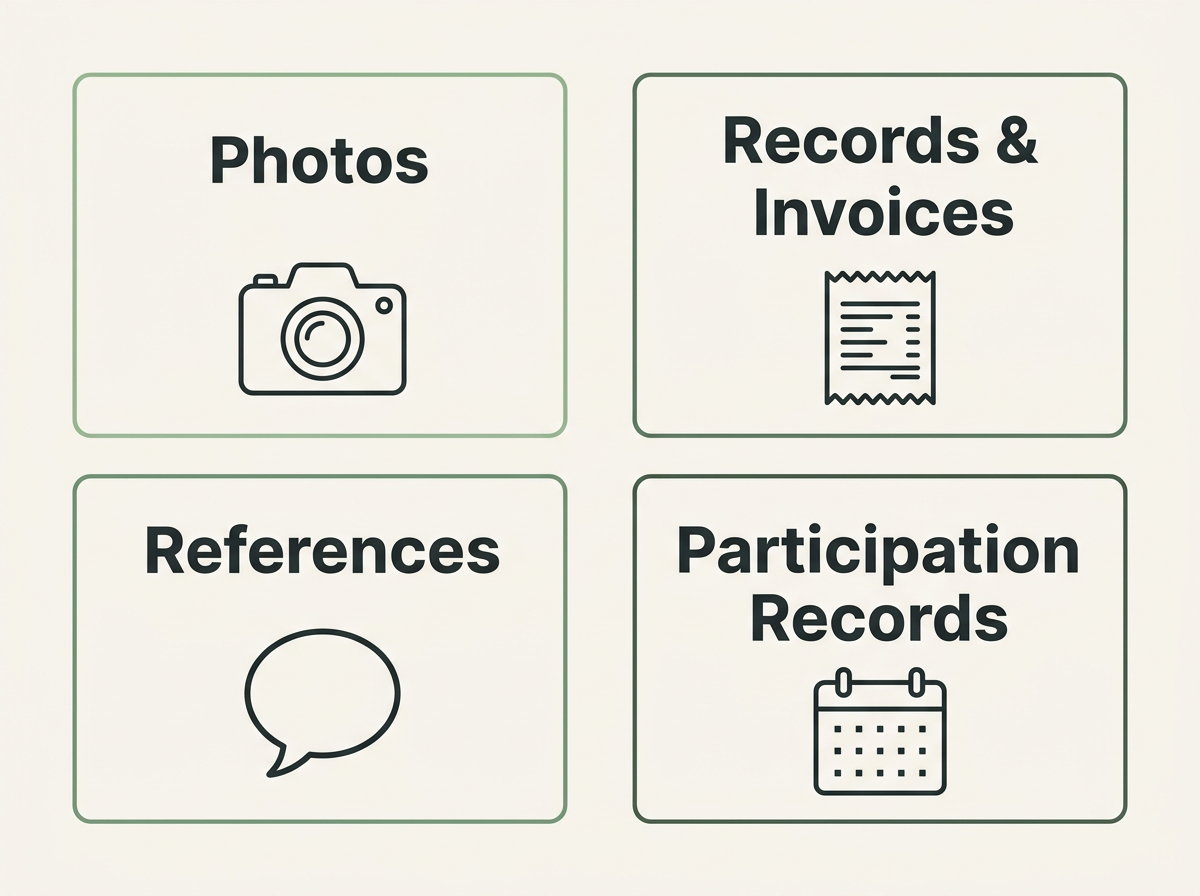
The four most useful types of informal evidence for horticulture RPL are:
- Photos: before-and-after shots of gardens you have worked on, propagation setups, planting projects, and irrigation systems. Dated photos are especially helpful.
- Records: invoices, receipts for plants and materials, garden diaries or logbooks, community garden planning documents, and seed-saving records.
- References: written statements from people who have seen you work, such as a landcare coordinator, community garden committee member, neighbour, or nursery owner. These do not need to be formal employment references.
- Participation records: volunteer attendance logs, community group membership records, workshop certificates, or any documentation showing your regular involvement with plants.
If you have some of this evidence but not all of it, that is completely normal. RPL assessment does not require a perfect portfolio from day one. Gathering and organising your files is part of the structured process, and you do not need everything prepared before taking the first step.
What happens if you have gaps in your evidence?
Not everyone will have evidence for every single competency area required by a qualification. This is not a disqualifier, but rather a normal part of the RPL process.
When an RPL assessment identifies areas where you cannot fully demonstrate competency through existing evidence, you can complete gap training. This is targeted, unit-specific training addressing only those missing areas, rather than a full course starting from scratch. You still earn the qualification through a combination of recognised prior learning and specific gap training.
This distinction is important to understand before you evaluate your skills. Many people look at a checklist, find they cannot tick every box, and assume RPL is not an option for them. That conclusion is premature. The key question is whether you have enough experience to make RPL a viable pathway. A Free Skills Review is designed to answer this question honestly before you commit to the process.
Getting credit for your skills should not mean starting your education from scratch, and it does not have to.
Your score: what your checklist results mean
Look back at the eight checklist items. How many of them apply to you?
- Six to eight items: You are likely a strong candidate for RPL assessment, as you possess broad horticultural experience across multiple competency areas. A Free Skills Review will help map your experience to the relevant qualification units.
- Three to five items: You are a moderate candidate. RPL is likely still the right pathway, though some gap training may be required. The Free Skills Review will clarify which skills are assessable and what you might need to address.
- Fewer than three items: RPL may not be the most suitable pathway for you right now. This does not mean your experience is invalid, but a different qualification level, an alternative entry point, or gaining more experience first might suit you better. The Free Skills Review will provide an honest assessment.
These ranges are indicative rather than absolute. The only way to know for certain is to have your experience evaluated by someone who understands the qualification requirements. That is what the Free Skills Review is designed to do.
The next step: find out what your experience is actually worth
Your experience is real. The years you have spent working with plants, soil, and land are valuable, even if they have not been formally recognised yet. RPL is designed to change that.
The Free Skills Review is a direct, no-obligation discussion about your background and whether it aligns with a horticulture qualification. The review is completely free, and there is no commitment to proceed. It is an honest assessment, and if RPL is not the right fit for your goals, we will let you know.
You can also explore the full range of horticulture RPL qualifications available through RPL it.
General information only, current at the date shown. Licensing rules change, so check the current requirements with the relevant regulator before you rely on them. RPL it Australia is a student support service, not a Registered Training Organisation; qualifications are assessed and issued by our partner RTOs.