Glazing Certificate vs Experience: Why QLD Treats Them as Two Different Things
Experienced Queensland glaziers often assume practical skills are enough. Here is why the regulator disagrees and how RPL bridges the gap.
By RPL it Australia7 min read

You Know the Trade. QLD Still Wants the Certificate.
You have the experience. Years of it. Glass cut to tolerance, frames fitted without a gap, and clients who call you back because you do the job right. You have worked on residential installs, commercial shopfronts, and frameless systems. This is the kind of work that takes real skill to execute properly.
Yet in Queensland, that experience does not automatically give you the right to operate as a licensed glazing contractor. The regulator does not evaluate how long you have worked or how highly your clients rate your work. Instead, it looks for one specific marker: a formal glazing qualification.
The gap between your hands-on knowledge and what the system recognises is real, and it can be frustrating. It is worth understanding this division clearly, because the way you choose to close it determines how quickly you can get licensed.
What a glazing certificate is (and what it is not)
A glazing certificate is not a record of your work history, nor is it a reference letter from a builder who trusts you. It is not a measure of how many jobs you have finished or how many decades you have spent on the tools.
To be precise, a glazing certificate refers to the Certificate III in Glass and Glazing (MSF30422). This is a nationally recognised trade qualification. A registered training organisation (RTO) issues this credential only after assessing your competence against national industry standards. The qualification sits within Australia’s training framework and is the baseline requirement for obtaining a glazing contractor licence in Queensland.
This distinction is critical to understand. The certificate is not a long-service award. It is a formal verification that your skills have been assessed against a national benchmark and found to comply with it. Practical capability and formal assessment are treated as two distinct concepts by the Queensland licensing regulator.
Why QLD regulators do not rely on your years in the trade
This reality often catches experienced glass and glazing professionals off guard. It is a logical assumption: if you have worked in the trade for years and maintained high standards, the system should acknowledge that capability. Most tradespeople naturally believe their practical experience should be enough to satisfy the authorities.
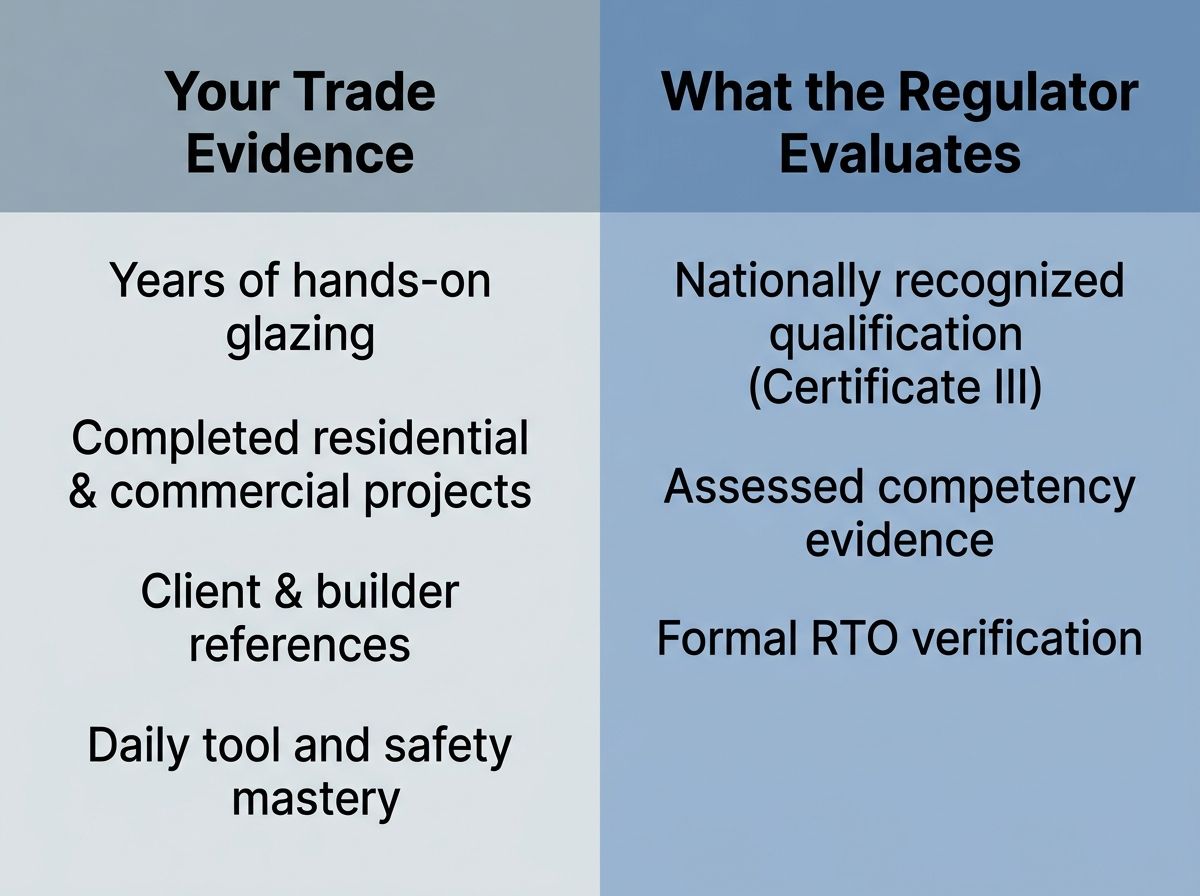
Your experience does count, but not in the way most tradespeople expect.
The Queensland contractor licensing framework, administered by the Queensland Building and Construction Commission (QBCC), is not structured to evaluate your field experience directly. Instead, its function is to confirm that you hold a recognised qualification proving your competency against national trade standards. The regulator operates on a clear principle: they require a formal assessment rather than an informal work history.
This is not a failure of the system; it is how the system is designed. Licensing frameworks exist to protect consumers and the public by ensuring every active contractor meets the same standards. While a builder who has hired you for a decade can easily vouch for your skills, the regulator cannot accept verbal recommendations. They require verifiable proof, which means a formal qualification.
The licensing system operates under its own strict rules and terminology. Your trade experience is real and valuable, but it must be translated into the specific format the regulator recognises. Recognition of Prior Learning (RPL) acts as this translator, matching your daily work skills directly to formal qualification units.
The gap between trade skill and formal recognition
This division between practical skill and formal recognition is more than an administrative hurdle. Working as a glazing contractor in Queensland without the correct licence brings serious practical and financial risks.
Without the correct licence, you cannot legally contract directly with residential clients or commercial builders for work that falls within the regulated glazing scope. You cannot tender for commercial projects or government contracts that demand proof of licensing. You may also face issues with your business insurance, as many policies require a valid trade licence to remain active. If the QBCC audits your business and finds unlicensed work, you face significant financial penalties.
This gap will not close on its own. Every day you operate without the correct qualification is a day of business exposure. You risk regulatory enforcement, face gaps in your insurance cover, and find yourself locked out of lucrative contracts that you are technically fully capable of completing.
Your skills are real, but the formal recognition is missing. These are two different problems, and you cannot solve the administrative one simply by working longer hours on site.
Your experience is the evidence, and RPL makes it count
It helps to look at this situation differently: your practical experience is highly valuable to the formal system. It is the exact evidence the system requires. The issue is not that your skills are ignored, but that they have not yet been documented in a format that an assessor can formally evaluate.
Recognition of Prior Learning (RPL) is the official pathway that bridges this gap. It is an established assessment process within Australia’s training framework. Instead of forcing you to sit in a classroom to learn skills you mastered years ago on the tools, RPL evaluates your current skills directly against the official competency standards of the qualification.
For glaziers, your daily work—cutting glass, fitting frames, and installing systems—serves as evidence toward the Certificate III in Glass and Glazing (MSF30422). An RTO assessor evaluates this documentation. RPL it assists you in gathering and presenting this proof.
Practical experience is your evidence. RPL is the assessment method that makes it official.
How the RPL assessment process works for glaziers
RPL is not a shortcut or a fast-track loophole. It is a thorough assessment process that uses your actual work history as the basis for a formal qualification. Understanding the steps involved will help you decide if this is the most practical pathway for your career.
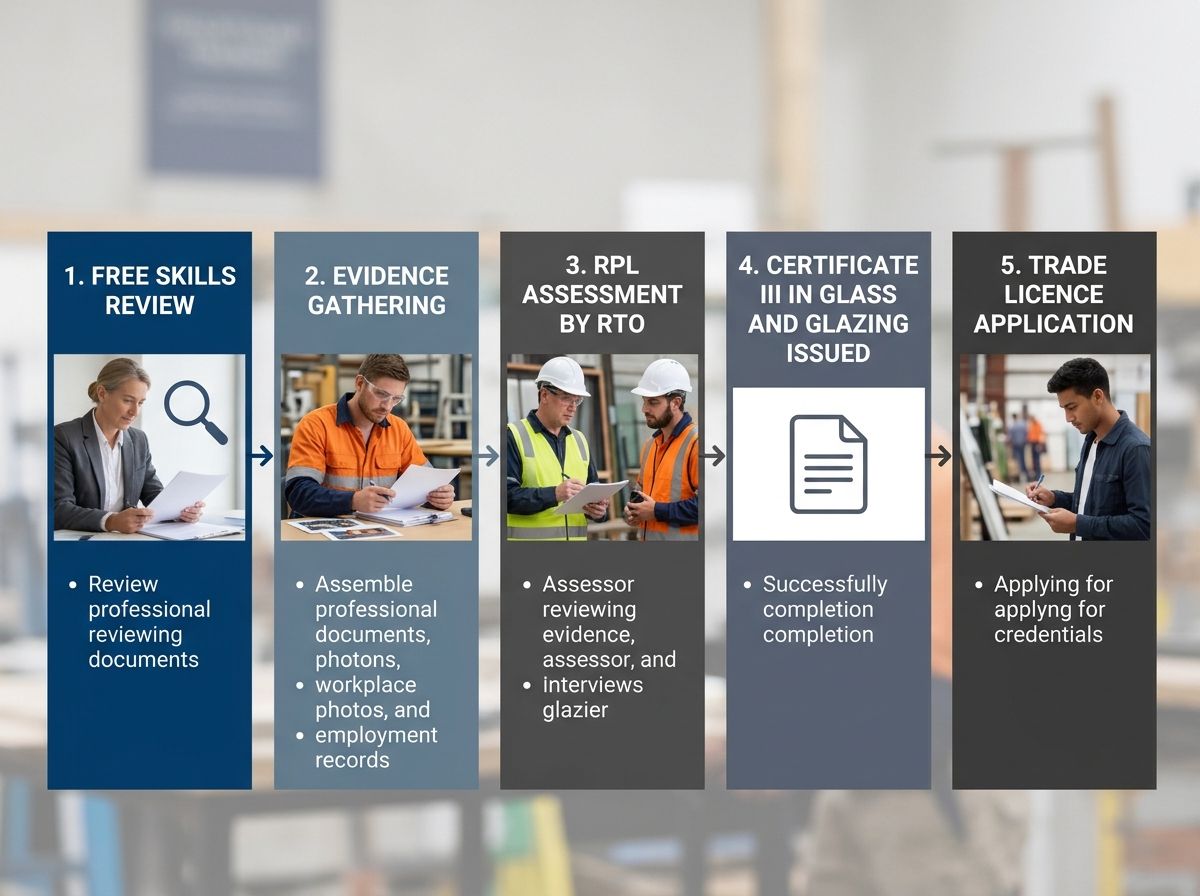
The process begins with a practical skills review. This is an honest discussion about your trade background, the specific glazing projects you have completed, and how your skills align with the qualification standards. This initial step determines if you are a suitable candidate before you make any financial or time commitments.
Once confirmed as a candidate, you will gather your evidence. For glaziers, this includes employment records or payslips, photos of completed installations, references from licensed builders or supervisors who know your work, and records of prior industry training. The exact documents you need depend on your background and the assessor's guidelines.
An assessor from the RTO will evaluate this documentation against the standards of the Certificate III in Glass and Glazing. The assessor verifies whether your evidence proves your competency. Depending on your paperwork, they may also ask for a practical demonstration or conduct a short interview.
If the assessor identifies any missing skills during the review, gap training is provided to help you meet the standard. This is a standard part of the process to ensure your final qualification is fully compliant, and it is provided at no extra cost to you.
Once the assessment is complete and your competency is confirmed, the RTO issues your Certificate III in Glass and Glazing. You can then use this qualification to support your trade licence application with the QBCC.
You can read more about the QLD glazing trade licence pathway and licensing requirements on our dedicated product page.
Deciding if RPL is the right path for your situation
RPL is not the right choice for everyone, and we believe in giving you a straightforward answer.
If you have hands-on experience in the glazing trade—working across various installations, using standard tools, and delivering high-quality results—you are likely a strong candidate. The main factor is not just your years on site, but whether you can document your work clearly for an assessor.
If you are relatively new to the glazing trade or if your experience is restricted to a narrow set of tasks, RPL may not be your best path. A traditional training program might suit your needs better. Our Free Skills Review is designed to give you a clear, honest answer on this before you make any decisions.
Our goal is to guide you toward the right path for your situation, not to enrol you in a program that does not fit. If RPL is not the right choice for your background, we will let you know directly.
Find out where your skills stand
You already have the trade skills. The next step is showing that your experience, once documented and assessed, meets the national licensing standards.
A glazing certificate and practical experience are distinct, but your hands-on experience is the direct proof used to build the qualification. The RPL pathway is designed to make that connection official.
The choice is yours. If you want to see if your background matches the requirements for the RPL pathway, our Free Skills Review is a sensible first step. It costs nothing and carries no obligation.
General information only, current at the date shown. Licensing rules change, so check the current requirements with the relevant regulator before you rely on them. RPL it Australia is a student support service, not a Registered Training Organisation; qualifications are assessed and issued by our partner RTOs.