How to qualify your best laborers as carpenters without losing them for four years
Think qualifying your workers means losing them to TAFE? The RPL pathway lets experienced laborers become formally qualified carpenters on the job.

The assumption costing you your best workers
You have the workers. They have the experience. The system says they need the qualifications. The moment you look into how to become a carpenter through official channels, you hit the same answer: a Certificate III in Carpentry, delivered through a three-to-four year apprenticeship with block release, classroom time, and months off the tools. For an employer running a site, that is a problem. It assumes your most capable laborer, who has been framing, fixing, and finishing for years, needs to start from scratch. That assumption is wrong.
What carpentry qualification actually means in Australia
The formal qualification for a carpenter in Australia is the Certificate III in Carpentry (CPC30220). This is a nationally recognised trade qualification that covers setting out, constructing, assembling, installing, and repairing products made from timber and non-timber materials, representing the full scope of residential and commercial carpentry work.
In Western Australia, CPC30220 is approved by the Department of Training and Workforce Development under state code BGB8. The qualification carries a VET Act condition: in WA, it can ordinarily only be obtained by fulfilling the obligations of an apprentice under a training contract, unless the person is seeking recognition of prior learning under section 60I of the VET Act.
That last clause matters. It is the pathway that changes options for employers with experienced workers already on site. State and territory licensing requirements vary, and you should always consult the relevant regulatory authority to confirm what applies in your specific situation.
Your laborers may already have the skills of a carpenter
Recognition of Prior Learning (RPL) is a formal assessment pathway under the Australian Qualifications Framework. It allows experienced workers to have their existing skills, knowledge, and on-the-job experience assessed against the units of competency in a qualification. The worker does not repeat what they already know; they demonstrate what they already do.
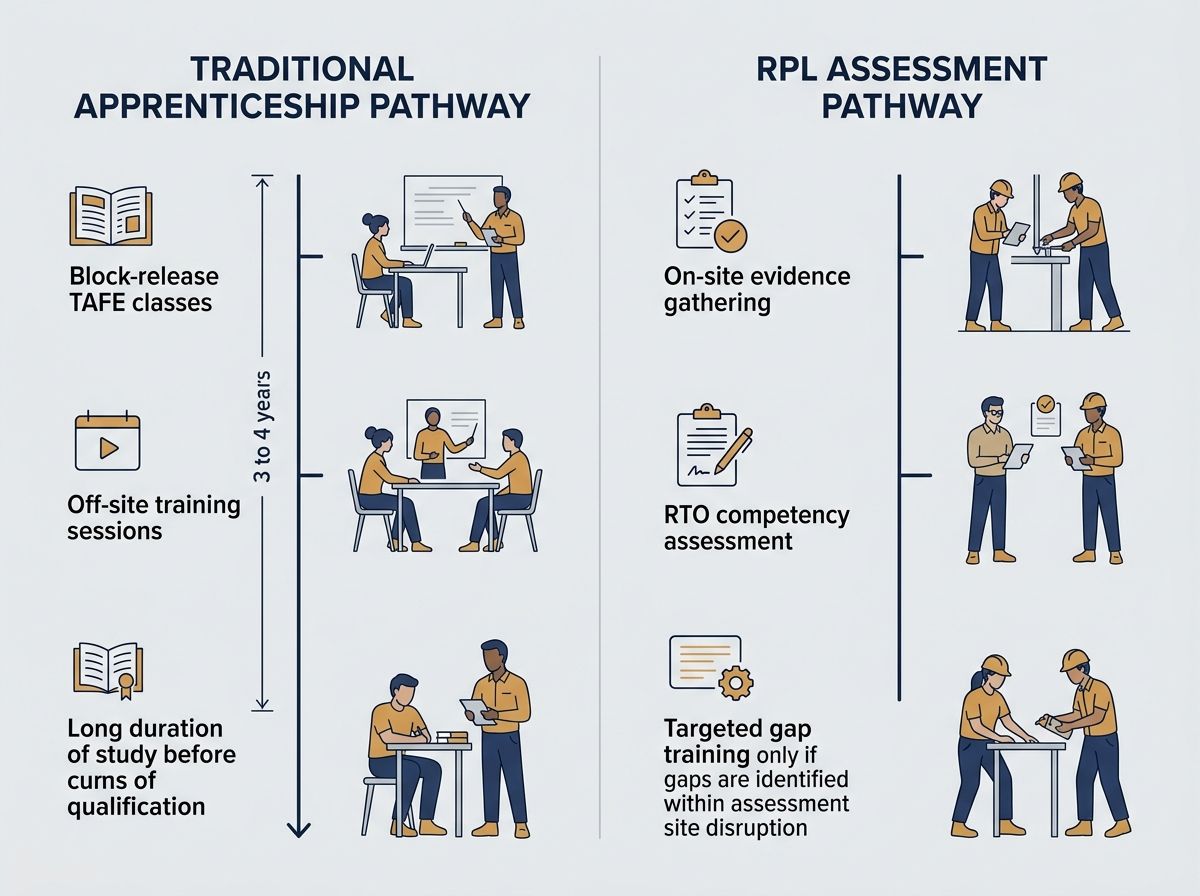
For a laborer who has spent years framing walls, erecting roof trusses, constructing ceiling frames, and completing timber fixing work, many of the core competencies in CPC30220 are already part of their daily practice. The qualification comprises 34 units, made up of 27 core and 7 elective units. The question is not whether the worker can do the work, but whether their experience has been formally assessed.
Registered training organisations are required to offer RPL as an entry pathway. At least one RTO with a Perth campus lists RPL as a delivery mode for CPC30220, conducting assessments virtually and providing gap training where required. Requirements vary by RTO, and individual eligibility depends on the evidence available.
Experience is evidence. The RPL process is how those skills are formally, nationally recognised.
How carpentry RPL works: what employers need to know
RPL is not a shortcut. It is a rigorous assessment of existing competency, conducted by a qualified assessor from a registered training organisation. The RTO conducts the assessment and issues the qualification, not RPL it. Our role at RPL it is to guide workers and employers through the process of gathering and presenting evidence effectively.
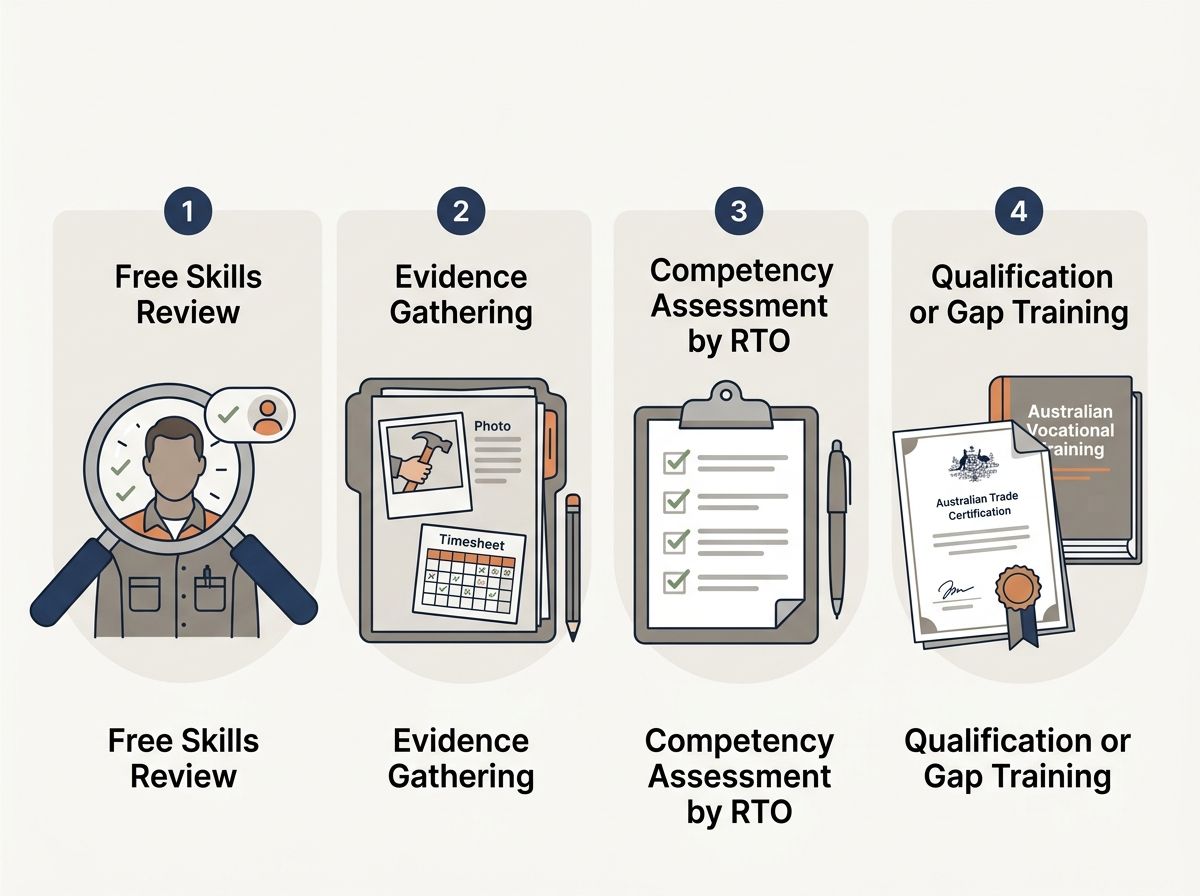
The process typically involves several stages. It begins with a skills review to assess whether RPL is a suitable pathway for the worker. Next comes evidence gathering, where the worker draws on their current job to build a portfolio demonstrating competency against the qualification's units. Then, an RTO assessor conducts a competency assessment, which may include a technical interview or practical observation. Finally, if any gaps are identified, the worker undertakes targeted gap training to address only what is missing.
Evidence for a carpentry RPL assessment can include photos of completed work, employment records, supervisor references, project documentation, and prior licences or tickets. Specific evidence requirements depend on the RTO and the units being assessed.
Indicative timeframes vary depending on the RTO, the completeness of evidence, and whether gap training is needed. Some RTOs state their RPL process can be completed within weeks of receiving compliant evidence, while others structure their programs over a longer period. These timeframes are indicative only and are not guaranteed. Actual duration depends on evidence readiness, assessment scheduling, and individual circumstances.
Importantly, Charles Darwin University notes that RPL is not time-referenced. There are no restrictions on how or when prior skills were acquired, provided those skills are current and match the elements and performance criteria of the individual unit.
The employer's role: qualifying workers without site disruption
The main difference between RPL and a traditional apprenticeship is that the evidence comes directly from the work your team already performs. You do not need to send them to a classroom; you simply document what happens on site every day.
Supervisors can provide third-party reports to verify competency. Site documentation, including job records, project photos, and safety logs, becomes evidence. The worker stays on the tools. Evidence gathering happens alongside their daily tasks, not instead of them.
This is the practical design of the RPL pathway. Your role as an employer is to support the evidence collection process, rather than funding a classroom, releasing workers for block training, or managing a four-year apprenticeship cycle.
Some RTOs offer online RPL processes, with gap training delivered through a digital portal. Others require practical assessment components. Requirements and delivery modes vary, and the right approach depends on the RTO and the worker's evidence profile.
What happens if there are gaps?
Not every experienced worker will demonstrate competency across every unit through RPL alone. Where gaps are identified, the RTO provides targeted training to address only what is missing. This is not a full apprenticeship; it simply bridges the gap between the worker's current skills and the qualification requirements.
Gap training means you only cover what is missing, rather than repeating what the worker already knows. One RTO, for example, schedules a trainer and assessor to conduct gap training and assessment when gaps are identified, noting that this may extend the overall RPL duration.
The possibility of gap training is not a failure of the RPL process. It is a feature that ensures the qualification is genuine. A worker who completes RPL, with or without gap training, has had their competency formally assessed against the national standard. This is what makes the qualification nationally recognised and credible.
The Western Australian context: why this matters now
Western Australia's construction sector operates under increasing compliance scrutiny. Building and Energy, the WA government agency overseeing the building, electrical, gas, painting, and plumbing industries, maintains a published Compliance and Enforcement Policy that describes a risk-based, intelligence-led approach to compliance and enforcement.
The agency's enforcement activity and decisions are described as effective and proportionate, and its remit extends to unregistered and unlicensed individuals and businesses that breach the legislation it administers. Enforcement outcomes are publicly reported through a disciplinary and prosecution media release collection.
At the same time, WA's industry bodies actively help tradespeople meet formal qualification and registration requirements. The WA Government's Builder Support Program, announced in November 2025, funded HIA WA and MBA WA to help skilled and qualified tradespeople become registered builders, including training on registration requirements and processes.
HIA WA Executive Director Michael McGowan described becoming a registered builder as 'a significant step, and often a challenging one', and noted that Western Australia needs greater builder capacity to meet its share of the National Housing Accord.
MBA WA CEO Matt Moran stated there is a need to increase the number of qualified and skilled people in the industry to keep pace with a growing population and rising demand.
The compliance environment in WA is changing. Employers who take steps to formally qualify their experienced workforce now are ahead of the curve, rather than scrambling to catch up when a contract requires documented credentials or a site audit raises questions.
Start with a free skills review with no obligation
Before committing to any pathway, employers and workers can access a free skills review to see if RPL is a suitable option. This is not an enrolment. It is an honest assessment of suitability, because RPL is not right for everyone, and the right guidance starts with an honest conversation.
Some workers will have strong evidence and a clear pathway, while others may need gap training. Some may not yet have sufficient experience to demonstrate the required competencies. The skills review is designed to give you an accurate picture before any commitment is made.
Recognition should not require starting over. If your workers have the experience, the question is whether that experience can be presented as evidence. That is what the skills review is for.
Ready to Get Recognised?
Start with a free skills review to find out if RPL is right for you.