Doing the work but missing the qualification: The WA carpentry licence gap
Experienced in WA carpentry but lack a licence? Learn how the credential gap impacts your projects and how RPL helps you get qualified.

You are running the site, but you cannot legally sign off on the work
You possess the necessary trade skills, and everyone on site knows it. Your clients, your crew, and the building contractors you work alongside respect your capability and rely on your technical judgment. However, when a residential or commercial construction project reaches a specific financial scale, or when a client requests formal trade credentials before signing a contract, your hands-on history is not visible to the regulatory system.
This is the difficult situation many experienced Western Australian carpenters face after years spent framing roofs, fitting out interiors, fixing cladding, and installing joinery on local sites. You have built a solid reputation job by job. Yet, without a formal carpentry licence, you cannot legally take on independent building contracts, submit tenders for major projects, or work directly for clients on regulated building developments.
This is a licensing issue rather than a skill issue. You understand your trade inside out from years on the tools. In Western Australia, the regulatory authority responsible for building and construction licensing is the Building and Energy division of the Department of Mines, Industry Regulation and Safety. This department sets the rules, and those rules mandate a formal licence for specific types of carpentry work.
While this regulatory barrier is frustrating for experienced tradespeople, a practical pathway exists to bridge the gap and secure your credentials. Resolving the issue begins with understanding how the Western Australian licensing system operates and identifying the qualifications required to obtain your trade licence.
If you want to read more about the wider regulatory context, our article on the contractors licence WA credential gap explains the broader system.
What the WA carpentry licence requires
In Western Australia, carpentry work classified as regulated building work requires the tradesperson executing or supervising it to hold a licence from Building and Energy. For individual tradespeople looking to contract for work, the necessary class is the Trades (Contractor) Licence. This credential is required for individuals who wish to operate as independent contractors and sign off on their own projects.
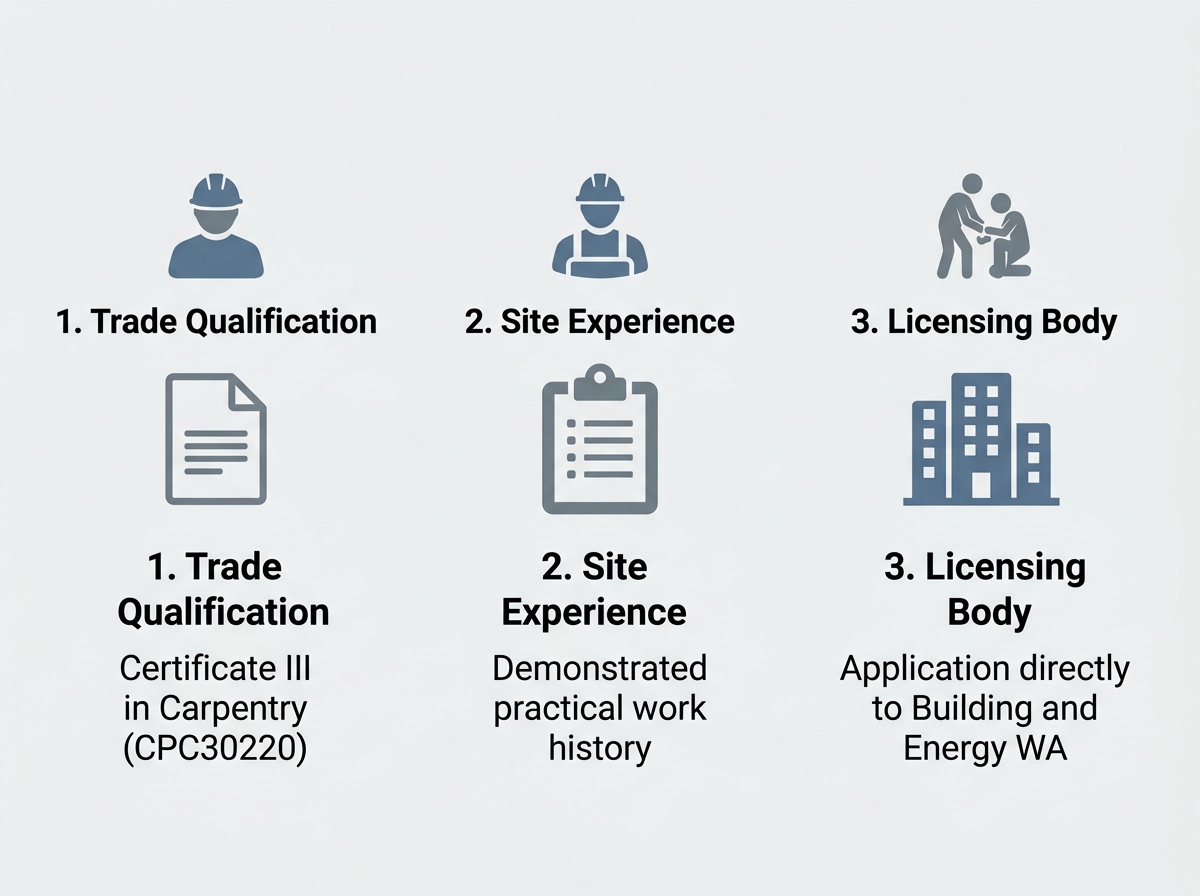
To qualify for this licence, you must hold a recognised trade qualification. The standard qualification is the Certificate III in Carpentry (CPC30220), which is a national qualification covering the core skills and competencies of the trade, including framing, roofing, and external cladding. This qualification is the educational benchmark for the licensing authority in Western Australia.
In addition to this qualification, Building and Energy requires applicants to show relevant industry experience and meet fit and proper person criteria. You must submit your application directly to Building and Energy. Since requirements, processing times, and fees can change over time, you should check their official website for current details before submitting your application.
For experienced carpenters, the main hurdle is that the qualification is mandatory. Your application cannot progress without it, no matter how many years of practical experience you have on site. The licensing authority does not make exceptions for experience alone, making the qualification the critical first step.
To read a detailed breakdown of this pathway, visit our page on the WA carpentry licence requirements.
The threshold that restricts unlicensed carpenters
Western Australian building law defines when a licence is required to contract for or execute building work. If your projects fall under regulated building work, which includes most residential and commercial carpentry, you cannot legally contract for those jobs or take responsibility for them without a licence. This threshold is strictly enforced by the regulator across Western Australia.
This rule places experienced carpenters who work under other builders or operate informally in a difficult position. This arrangement functions as long as you stay within specific limits. However, if you want to take on larger independent projects, tender under your own business name, or deal directly with clients on regulated work, the lack of a licence stops you completely.
The consequences of working outside these legal boundaries are serious. Building and Energy enforces these regulations, and unlicensed building work carries substantial financial penalties under WA law. You also face insurance issues, as public liability policies often do not cover claims for work completed without the correct licence. These are practical business risks caused by the credential gap.
The issue is not your ability to do the work. The issue is whether the licensing system recognises your skills. For many experienced WA carpenters, those skills are undocumented, which limits your business growth and stops you from taking on the projects you are capable of delivering.
Why returning to TAFE is not your only option
Recognition of Prior Learning, or RPL, is an assessment pathway within the Australian vocational education system. It allows tradespeople with existing skills and knowledge to have their competence assessed against the official standard, bypassing the need to repeat training they have already completed on site during their working life.
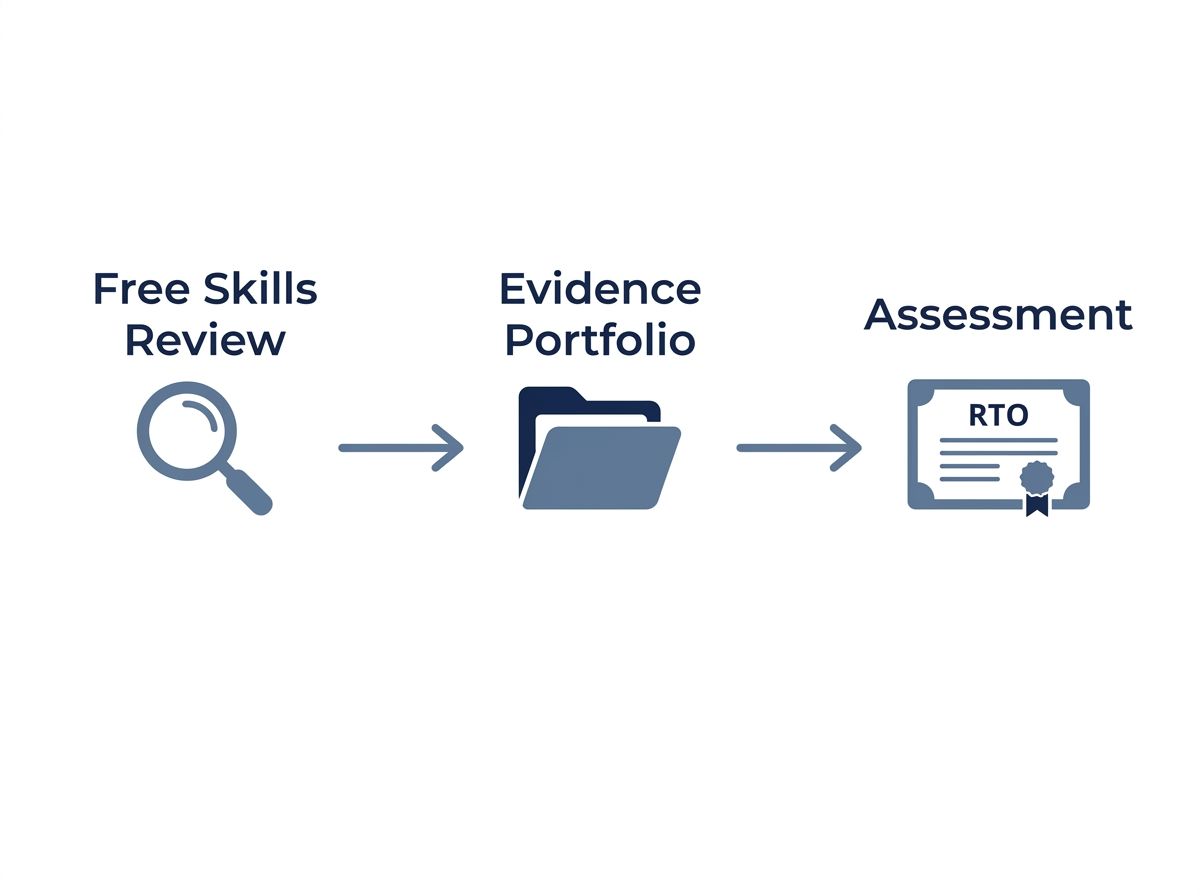
RPL is a rigorous assessment process, not a shortcut. A qualified assessor from a Registered Training Organisation (RTO) evaluates your skills to see if your experience meets the criteria for the Certificate III in Carpentry (CPC30220). If you meet the standards, the RTO issues the qualification. If the assessor identifies any gaps, you may need targeted training to address them.
For carpenters with years of experience, RPL is a practical alternative to returning to college for a full apprenticeship, which would mean repeating material you already know. The process acknowledges that trade skills are developed on the job, and treats years of practical experience as valid evidence of competence.
The process begins with a skills review to check your eligibility, followed by an evidence-gathering phase and a formal assessment by the RTO. The time required depends on your availability, the evidence you compile, and the RTO assessment timeline. Any duration estimates are only guides, as the assessment must be thorough and takes time to complete properly.
It is important to understand the role of RPL it. We guide and support you through the process by explaining what evidence you need, how to compile it, and what to expect during assessment. The actual evaluation is conducted by an assessor from a partner RTO, and that RTO issues the qualification if you are successful. RPL it is your adviser and facilitator, not the assessing body or issuer.
What evidence you need for a carpentry RPL assessment
A common misconception is that RPL requires years of meticulous, specialized record-keeping. In reality, your daily carpentry work naturally produces a substantial amount of evidence that is already available to you. Understanding what constitutes valid proof is key to a successful assessment by the Registered Training Organisation.
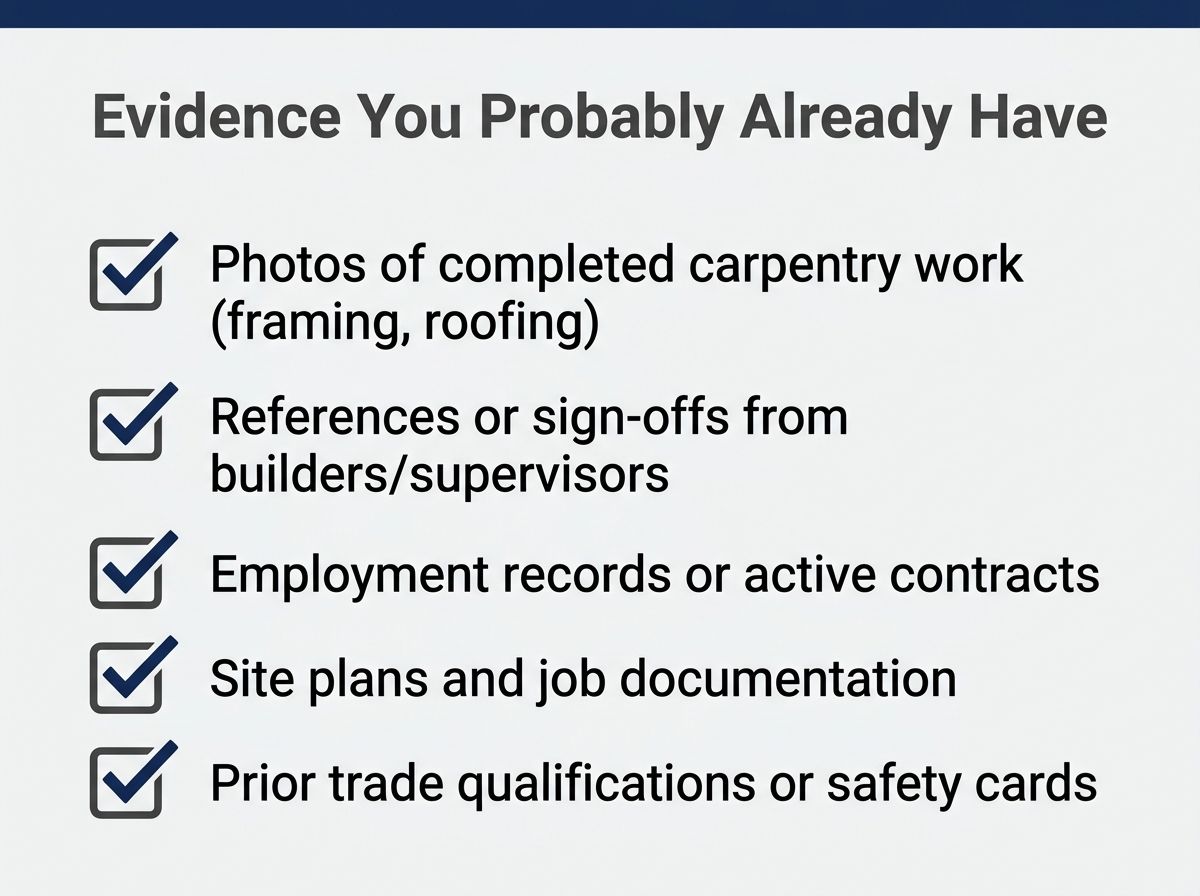
An assessor evaluates whether your evidence demonstrates competency across all units in the Certificate III in Carpentry. You can provide this proof in several ways:
- Photos of your completed work, including framing, roofing, joinery, fit-out, and formwork
- Reference letters or signed statements from builders, supervisors, or clients confirming your role and the quality of your work
- Employment contracts, pay slips, or group certificates verifying your years of work in the trade
- Site plans, work orders, job sheets, or safety documentation from projects you have worked on
- Previous training records, including partial qualifications, short courses, or overseas trade credentials
The assessor will also talk with you to discuss how you approach site tasks, solve problems, and manage safety. This conversation lets you explain your practical understanding directly to the assessor and demonstrates that your knowledge matches your hands-on experience on the job.
You have accumulated this evidence throughout your working life, even if you did not call it evidence at the time. Every job you complete adds to your portfolio of skills and helps satisfy the requirements of the qualification.
Deciding if RPL is the right option for you
RPL is not suitable for everyone, and clear guidance is important. This pathway is designed for tradespeople with broad experience across different areas of the trade, ensuring your skills match the multiple units in the Certificate III syllabus.
If you have spent years working on residential framing, roofing, fit-out, and formwork, and you have the work history to prove it, RPL is a viable option. However, if your experience is limited to a single area of carpentry or is relatively short, you might have skill gaps that require extra training.
The practical first step is a skills review. This is a straightforward conversation about your background and experience to explain how the assessment applies to you. The review is free and carries no obligation, giving you an honest assessment of your options.
What happens after you obtain your carpentry qualification
After you receive your Certificate III in Carpentry, whether through RPL, an apprenticeship, or training, you can begin your application with Building and Energy.
To apply for the Trades (Contractor) Licence, you must submit your qualification certificates, evidence of your trade experience, and complete the standard identity and character checks. Building and Energy reviews these documents and issues the licence once all criteria are satisfied.
A Certificate III issued through RPL by an RTO is nationally recognised and holds the same legal standing as a certificate gained through an apprenticeship. The qualification certificate does not state how your skills were assessed; it simply confirms that you meet the national standard.
Moving from an unlicensed carpenter to a licensed contractor in Western Australia involves several steps, but it is a structured pathway. Securing the qualification is the primary requirement. RPL provides a practical way to achieve this, allowing you to proceed with your licence application.
You can choose recognition instead of repeating training. Your industry experience should count toward your credentials.
For further details on how to apply for this licence, visit our guide on the WA carpentry licence.
If you are researching the wider licensing system in Western Australia, our article on the contractors licence WA experience gap explains how the rules apply to experienced builders.
Ready to Get Recognised?
Start with a free skills review to find out if RPL is right for you.