The 'Starting From Scratch' Myth: What Mature Career Pivoters Get Wrong About Hospitality Qualifications
Think you need to start at the bottom to get hospitality qualifications? If you have leadership, de-escalation, or inventory skills, you may already qualify via RPL.

The myth that sends experienced professionals to the back of the queue
You have the experience. You've managed a team, handled difficult customers, controlled stock, coordinated service delivery under pressure. And then someone tells you that to work in hospitality, you'll need to start as a kitchen hand.
That moment — the quiet indignity of being told your decade of professional experience doesn't count — is what we're naming here. Call it the Starting From Scratch Myth: the false belief that entering hospitality as a career pivoter means beginning at the absolute bottom, regardless of what you already know and can already do.
It's a myth that costs experienced workers time, money, and professional confidence. And it persists not because it's true, but because the hospitality training system was built for a different kind of entrant — the school leaver, the first-timer, the person who genuinely is starting from scratch. If that's not you, the default pathway was never designed with you in mind.
Recognition shouldn't require starting over. Your skills are real. The question is whether the formal system can see them — and that's a different problem entirely.
What hospitality qualifications actually mean
Hospitality qualifications in Australia are competency-based. That distinction matters more than most people realise.
A competency-based qualification describes what a person can do — not what they have studied. The Certificate III in Commercial Cookery, the Certificate IV in Kitchen Management, the Diploma of Hospitality Management: each is a framework of competency units. Each unit defines a specific skill or capability that a qualified person is expected to demonstrate.
This means the question is not 'what do I need to learn?' It is 'what do I need to demonstrate?' Those are fundamentally different questions — and for experienced professionals, the second question has a very different answer.
Hospitality qualifications are not training programs that produce competence. They are assessment frameworks that recognise it. If the competence already exists — built through years of work in another industry — the qualification pathway is about demonstrating that competence, not acquiring it from scratch.
The skills you already have (that hospitality calls something else)
This is where the myth starts to unravel. The skills that hospitality qualifications assess are not unique to hospitality. They are professional competencies that appear across industries — under different names, in different contexts, but with the same underlying capability.
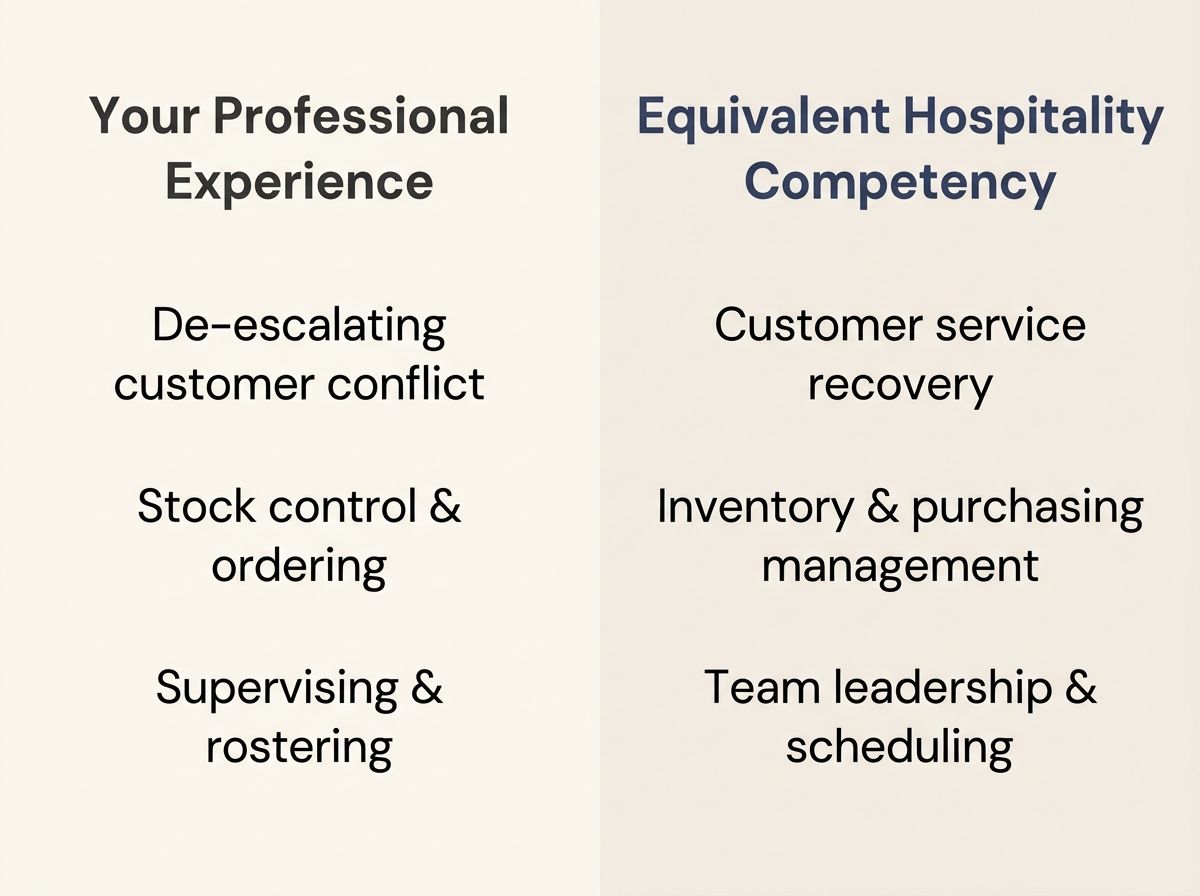
Consider what hospitality qualification frameworks typically assess: managing conflict and difficult customer interactions, controlling stock and ordering supplies, supervising and rostering a team, coordinating service delivery to a standard, maintaining compliance with food safety and workplace requirements. These are not exotic skills. They are the daily work of professionals across retail, logistics, aged care, events management, manufacturing, and community services.
- De-escalation and conflict resolution — if you've managed difficult customer interactions in retail, security, community services, or healthcare, you've been doing what hospitality calls customer conflict management
- Inventory and stock control — if you've ordered supplies, managed par levels, or reduced wastage in any operational role, you've been doing what hospitality calls stock control and purchasing
- Team supervision and rostering — if you've managed a team, allocated shifts, or coordinated staff across a service period, you've been doing what hospitality calls team leadership and scheduling
- Service coordination under pressure — if you've run a floor, managed a service delivery timeline, or kept a team performing during peak demand, you've been doing what hospitality calls service management
The skills exist. The gap is the label, not the competence. Hospitality uses its own vocabulary for capabilities that experienced professionals have been demonstrating for years in other contexts.
Recognition of Prior Learning — RPL — is the formal mechanism that does the translating. It maps what you already know and can already do onto the competency framework of the qualification you're seeking. It is not a shortcut. It is not a workaround. It is the assessment pathway that the Australian Qualifications Framework provides specifically for people whose competence was built outside a classroom.
Understanding this distinction changes how you approach the process entirely.
Why the system defaults to 'start over' — and why that default is wrong for you
The hospitality training system was not designed for you. That's not a criticism — it's a structural observation.
The default pathway through a hospitality qualification is a traineeship or a full-time study program. These pathways are designed for people who are genuinely building competence from the ground up — school leavers, career starters, people entering the workforce for the first time. The system produces capable hospitality workers. It does that well.
What it does not do well is see the experienced professional standing at the door with a decade of adjacent competence. The intake forms, the course structures, the employer expectations — they are calibrated for a different kind of entrant. When you arrive with management experience from another industry, the system's default response is to treat you like everyone else: start at the beginning.
That default is wrong for you. Not because the qualifications are unimportant — they are important, and the assessment is genuine — but because the training pathway was never the point. The qualification is the point. And there is a pathway to the qualification that starts where you actually are, not where the system assumes you must be.
What Recognition of Prior Learning actually looks like in hospitality
RPL is a rigorous, evidence-based assessment process. It is worth being clear about that — because the rigour is exactly what makes the resulting qualification meaningful.
The process involves working with a registered training organisation (RTO) to document your existing skills and experience as evidence against the competency units of the qualification you're seeking. That evidence might include references from supervisors or employers, records of work you've performed, documentation of systems you've managed, or third-party reports from people who can attest to your competence. A qualified assessor from the delivering RTO reviews that evidence and determines whether it demonstrates the required competencies.
Where gaps are identified — competencies that your background doesn't clearly cover — gap training is typically provided. This is not a failure of the process; it is the process working as intended. The goal is accurate recognition, not blanket approval.
The outcome, when competency is demonstrated, is a nationally recognised qualification. The same qualification that a trainee would receive. Recognised by the same employers, carrying the same weight. Because the assessment is genuine, the credential is genuine.
RPL does not produce a lesser qualification. It produces the same qualification through a different — and for experienced workers, more appropriate — assessment pathway.
How to know if your background is strong enough for hospitality RPL
Not every background will be suitable for RPL in hospitality. Honest suitability guidance matters here — because the right pathway for you depends on what you've actually done, not what you'd like to have done.
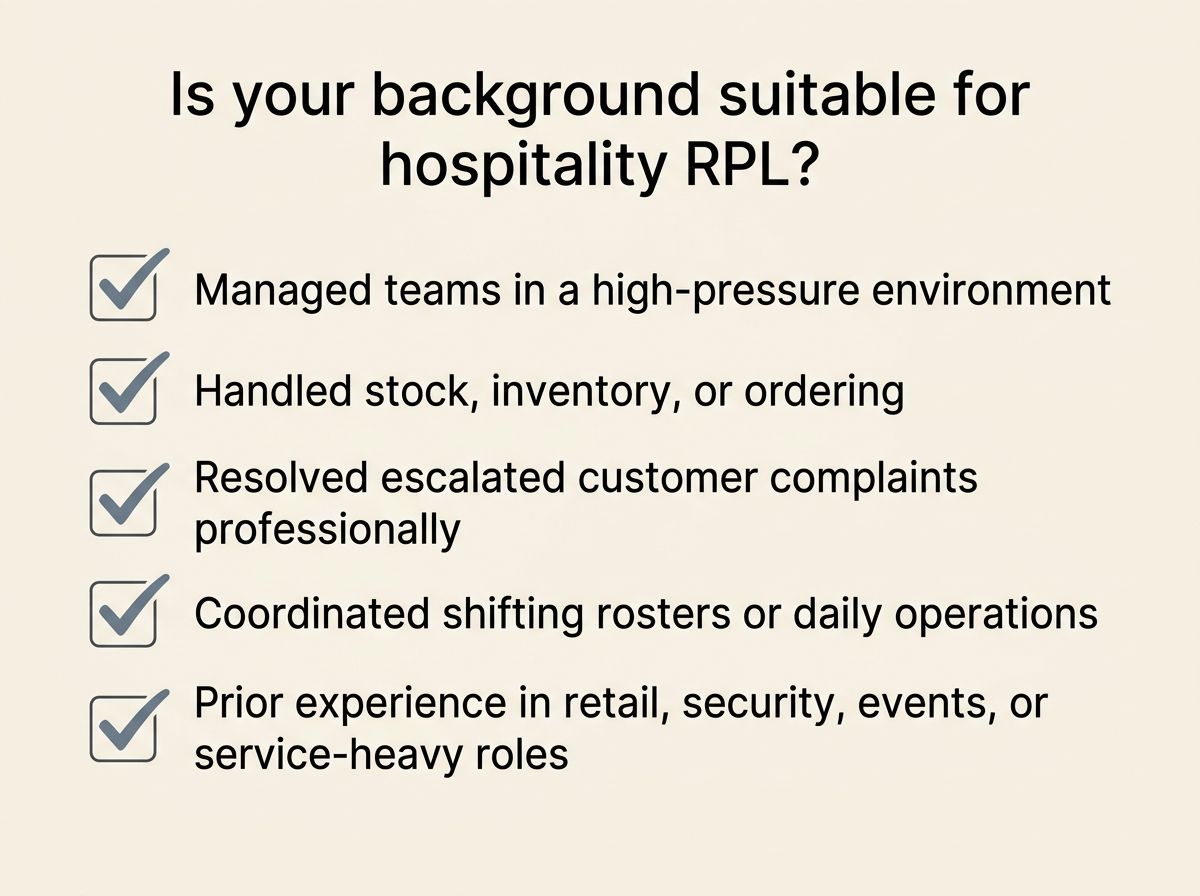
The following backgrounds tend to map well to hospitality qualification competencies:
- Retail management — particularly roles involving team supervision, stock control, and customer service in high-volume environments
- Events coordination — roles involving service delivery planning, supplier management, and on-the-day logistics
- Aged care or community services — particularly roles involving conflict resolution, person-centred service, and team coordination
- Food manufacturing or production — roles involving food safety compliance, quality control, and operational supervision
- Military catering or institutional food service — roles involving large-scale food production, compliance, and team management
- Hotel, resort, or accommodation operations in a non-food role — roles involving guest services, complaint handling, and operational coordination
If you have never worked in a food service, hospitality-adjacent, or service-delivery environment, RPL may not be the right pathway — and a Free Skills Review will tell you that honestly, before you commit to anything.
The question is not whether your background sounds impressive. The question is whether it maps to the specific competency units the qualification requires. That mapping is what a Free Skills Review assesses.
The recognition pathway: what happens next
If your background is suitable, the pathway forward is guided. You work with an RPL it adviser to understand which hospitality qualifications align with your experience, what evidence you'll need to gather, and what the assessment process involves. The complexity is navigated for you — not because the process is simple, but because you shouldn't have to navigate it alone.
The hospitality qualifications available via RPL cover a range of levels — from Certificate III through to Diploma — and the right qualification depends on the depth and breadth of your existing experience. Exploring those options is the natural starting point.
You can explore the hospitality qualifications available via RPL on the RPL it Hospitality and Tourism page.
Your skills speak for themselves. The Starting From Scratch Myth says they don't count in hospitality. The recognition pathway says otherwise — and the first step is finding out whether your background qualifies.
Ready to Get Recognised?
Start with a free skills review to find out if RPL is right for you.