Decades behind the chair, no certificate: Why it is catching up with you
You have built a loyal clientele over years of hairdressing. If you now need a Certificate III, your experience counts. Learn how to get certified.
By RPL it Australia6 min read
The day the paperwork finally mattered
You have been behind the chair for fifteen years, perhaps twenty. Your clients do not book with the salon; they book with you. They trust you with their colour, their cut, and how they feel when they walk out. That trust took years to build. Nobody handed it to you.
Then one day, something shifts. A new employer asks for your qualifications. A salon lease requires proof of certification. An insurance provider wants to see a formal credential before they cover your work. Or you are looking at a visa pathway and the paperwork asks for a qualification code you have never heard of: SHB30416.
Suddenly, a piece of paper that never seemed necessary stands between you and your next step. This is not because your skills have changed or your clients have doubts. It is because a formal system, which was not built around how you learned, now needs to see something it can file.
This is the moment that catches many experienced hairdressers off guard, and it is more common than you might think.
Twenty years of clients do not lie
You have consulted, created, and built a business on repeat clients who return because of your work, not where you studied.
The skills that make a hairdresser genuinely competent include reading a client's hair history, formulating colour, executing a cut that works with how hair actually grows, managing chemical treatments safely, and knowing when to refuse a request that will cause damage. These are not things you learn in a classroom and simply apply; you develop them over thousands of hours of real work, with real clients, and with real consequences.
The Certificate III in Hairdressing (SHB30416) covers competencies in client consultation, hair and scalp services, chemical treatments, cutting and styling techniques, and salon operations. For someone practicing for years, these are not new skills to acquire. They are skills you have already demonstrated repeatedly, professionally, and to a standard your clients trust.
Your experience is real. The formal system simply has not documented it yet.
Why the certificate did not matter until now
Many experienced hairdressers do not hold a formal Australian qualification. This is not because they neglected their training, but because their pathway (whether an apprenticeship under a senior stylist, training in an overseas salon, or learning through years of hands-on work) did not lead to the specific credential the current system recognises.
Hairdressing qualifications in Australia have been updated and restructured over the decades. Many experienced stylists trained under earlier systems that do not map directly to current codes. If you completed your training in the UK, New Zealand, Southeast Asia, or elsewhere, your skills are real, but your paperwork does not translate automatically.
Others trained informally, working alongside experienced stylists and building their skills chair by chair and client by client. The knowledge and practice are there, but the formal documentation is not.
This is a documentation gap, not a skills gap. That is a very different problem with a practical solution.
What recognition of prior learning actually means for a hairdresser
Recognition of Prior Learning (RPL) is a formal assessment process where a registered training organisation (RTO) evaluates whether your existing skills and knowledge meet the competency standards of a qualification. For hairdressers, that qualification is the SHB30416 Certificate III in Hairdressing.
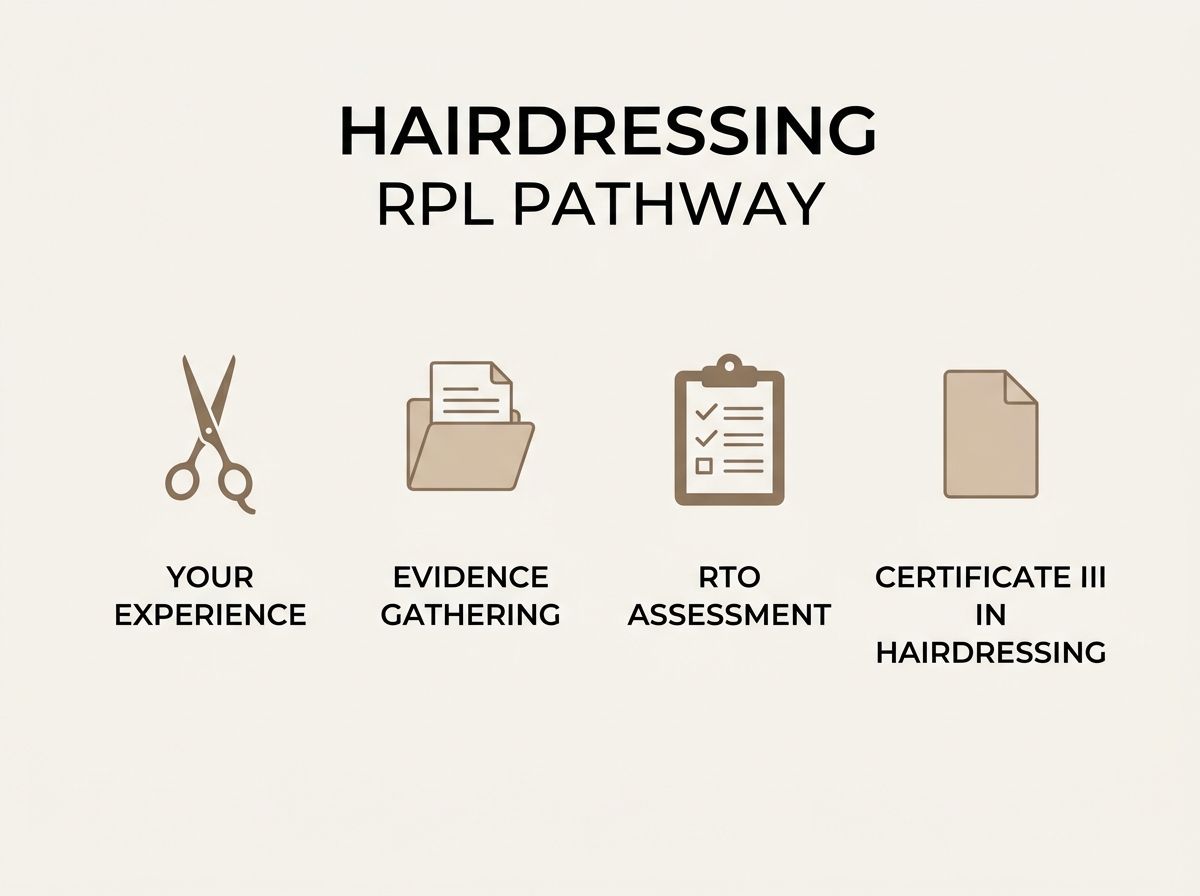
RPL is not a shortcut or a rubber stamp. It is a genuine assessment that takes your experience seriously enough to evaluate it against the same standards applied to formal study. The difference is that instead of sitting in a classroom learning what you already know, you present evidence of what you can do.
That evidence might include employment records, references from salon owners or senior stylists, a portfolio of your work, client testimonials, records of completed services, and sometimes a practical demonstration of your skills. The RTO's assessor reviews this evidence against the competency units of SHB30416 to make a professional judgement about whether you meet the standard.
If there are areas where your evidence does not fully demonstrate competency, gap training may be required. Reputable providers include this at no additional cost. The assessment is honest, and the outcome is earned.
RPL it does not assess or issue qualifications; that is the RTO's role. What RPL it does is guide you through the process, helping you understand what evidence to gather, how to present it, and what to expect. We handle the complexity so the dignity of your experience is preserved.
The moment of recognition: What changes when you hold the certificate
The Certificate III in Hairdressing (SHB30416) does not change what you know. It changes what the system can see.
Some salon leases, insurance providers, and employers now require formal hairdressing qualifications as a condition of business. For hairdressers looking at certain visa pathways, a recognised Australian qualification may be part of the requirements. For those considering salon ownership or franchise arrangements, formal credentials are increasingly part of the conversation.
None of these requirements exist to doubt your skill. They are about the formal system needing a document it can verify. Your clients already know what you can do, and the RPL pathway is how you give the rest of the world that same proof.
Recognition should not require starting over. For experienced hairdressers, it does not have to.
Salon managers facing similar credential requirements for business and franchise opportunities have navigated the same pathway.
Is your experience enough? Here is how to find out for free
If you have been working as a hairdresser for years (whether you trained in Australia or overseas, through an apprenticeship or informally) you may already have the experience needed to support an RPL application for the Certificate III in Hairdressing (SHB30416).
You do not need to guess. A Free Skills Review is an honest, no-obligation conversation about whether your background is likely to support the RPL pathway. It is not a sales call or a commitment. It is simply the honest answer to the question you are asking.
RPL may not be suitable for everyone, and the Free Skills Review will tell you that honestly if that is the case. It will not waste your time or push you toward a pathway that is not right for your situation.
Learn more about the Certificate III in Hairdressing (SHB30416) and the RPL pathway.
General information only, current at the date shown. Licensing rules change, so check the current requirements with the relevant regulator before you rely on them. RPL it Australia is a student support service, not a Registered Training Organisation; qualifications are assessed and issued by our partner RTOs.