Concretor or concreter? How you write the job spec changes your compliance risk
Concretor or concreter: both spellings are used, but neither protects you from compliance risk. Here's what the job spec actually needs to say in Victoria.
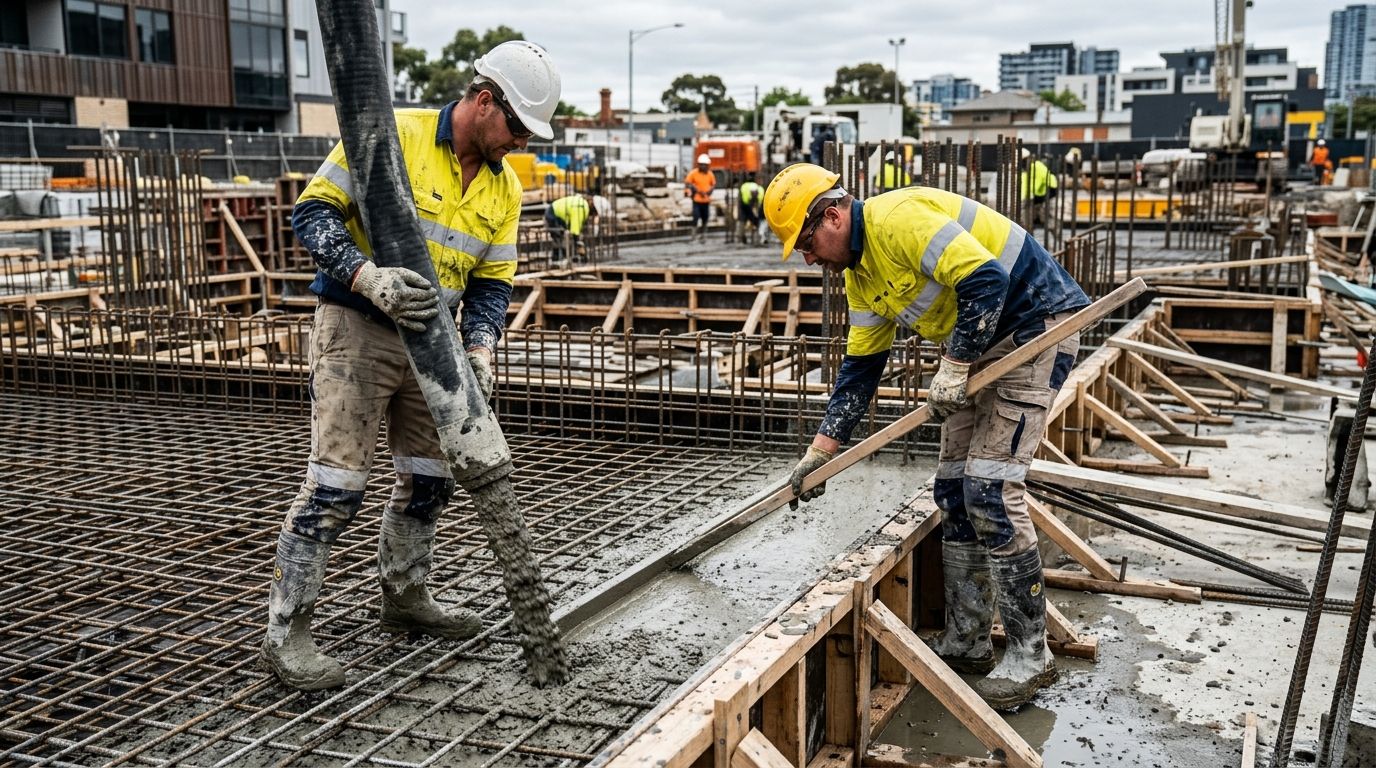
Concretor or concreter: how you write the job spec changes your compliance risk
Both spellings are widely used across Australia. You will find 'concreter' on local job boards, in trade publications, and in everyday conversations on site. You will find 'concretor' in official industry association documents and some government publications. Neither spelling is incorrect, and both refer to the exact same trade. If you searched for this because you were unsure which to use in a job advertisement or on a resume, you now have your answer.
But the spelling debate actually hides a much larger problem: the terminology confusion around this trade runs far deeper than just two letters. That confusion has real consequences, both for employers writing job descriptions and for experienced workers who have spent years doing the work without a formal qualification to prove their skills.
What the spelling debate is actually hiding
Scroll through Victorian job boards and you will see the same role advertised under half a dozen different titles: concretor, concreter, concrete labourer, concrete finisher, or concrete formwork carpenter. Employers often use these terms interchangeably without realising they describe roles with different scopes of work and, in some cases, different licensing requirements.
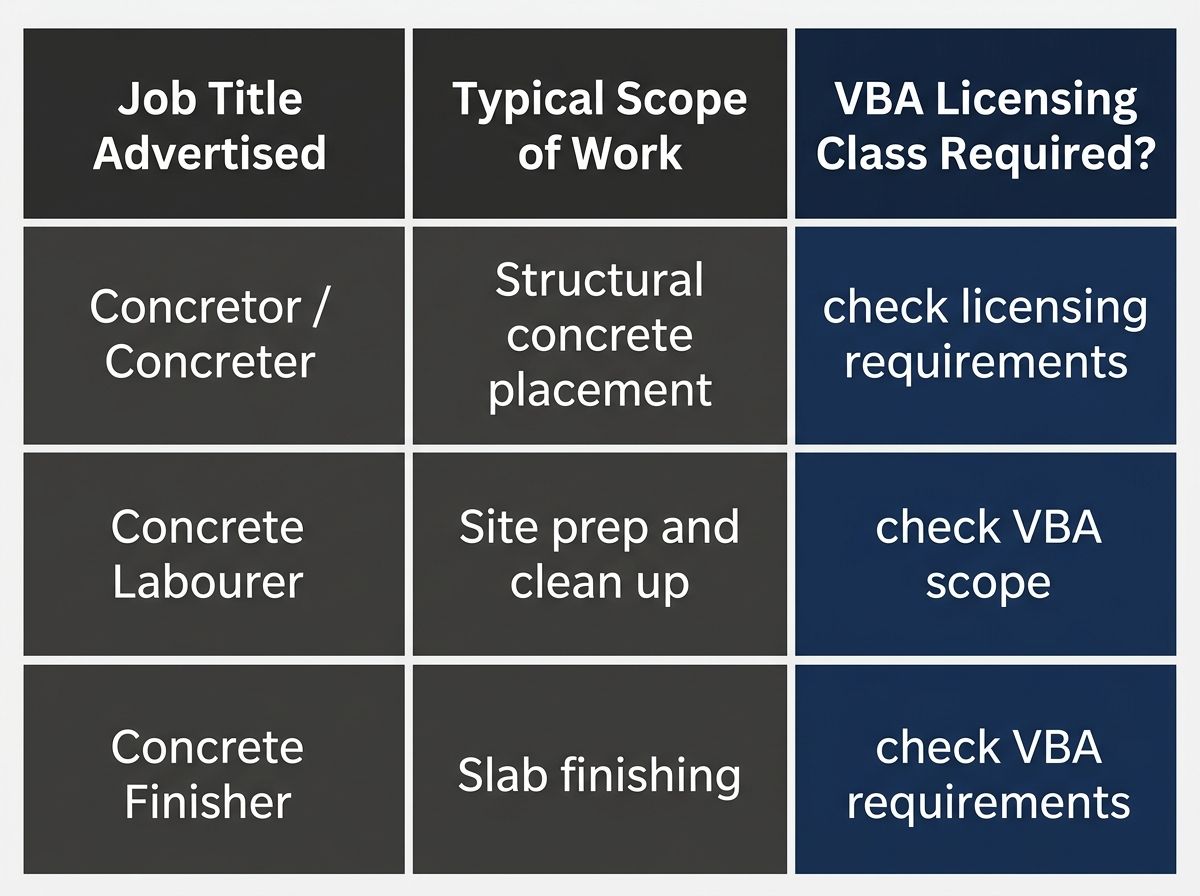
The spelling does not matter. The real issue is that vague or imprecise job descriptions can lead to hiring workers who lack the right credentials for their actual tasks. In Victoria, that is a serious compliance risk, far beyond a simple HR inconvenience.
What the VBA requires for concreting work in Victoria
The Victorian Building Authority (VBA) is the regulatory body responsible for licensing building practitioners in Victoria. Concreting work, particularly structural concreting, falls within the scope of work that requires a practitioner to hold the correct registration or licence.
The specific licensing requirements for concreting work in Victoria, including the exact licence classes that apply and the qualifications that underpin them, are set out by the VBA. Because these requirements can change, and because the consequences of getting them wrong are significant, we recommend visiting the VBA's own website for current details rather than summarising them here. What is clear is this: if the work is structural, assuming that any experienced worker can legally perform it without formal credentials is a high compliance risk.
The Certificate III in Concreting (CPC30320) is the nationally recognised qualification for this trade. It is listed on the national register at training.gov.au and covers the core competencies required for concreting work in Australia. Whether this qualification is the accepted underlying credential for a specific VBA licence class is a question the VBA can answer directly, and it is worth verifying before you write your next job specification.
The compliance risk hidden in your job description
Here is the insight that most employers miss: a job description is more than an advertisement. In a regulated industry, it is a formal statement of what the role actually involves and, by implication, what credentials the person filling it must hold.
When a job advertisement uses vague terminology, or when 'concrete labourer' is used to describe work that is actually structural concreting, it creates a gap between what the employer thinks they are hiring and what the law requires. That gap is where your compliance risk lives.
Performing building work in Victoria without the required registration or licence is an offence under Victorian building law. The specific penalties and enforcement mechanisms are set out in the Building Act 1993 (Vic) and administered by the VBA. We do not quote current penalty amounts here because these legal figures can change, and anyone with specific concerns should check directly with the VBA or seek legal advice. What is clear is that the VBA has enforcement powers, and unlicensed building work is within their scope to act on.
The risk affects both the worker and the employer. Employers who engage practitioners to perform work that requires a licence have their own compliance obligations. A job description that obscures the true nature of the work does not reduce that obligation; it simply makes it harder to prove that you completed appropriate checks.
For workers: your practical experience already counts
You have been doing this work for years. You know how to read a pour, manage formwork, control slump, and finish a slab. You have worked alongside licensed practitioners, you have been trusted with structural work, and you have never had a problem on site.
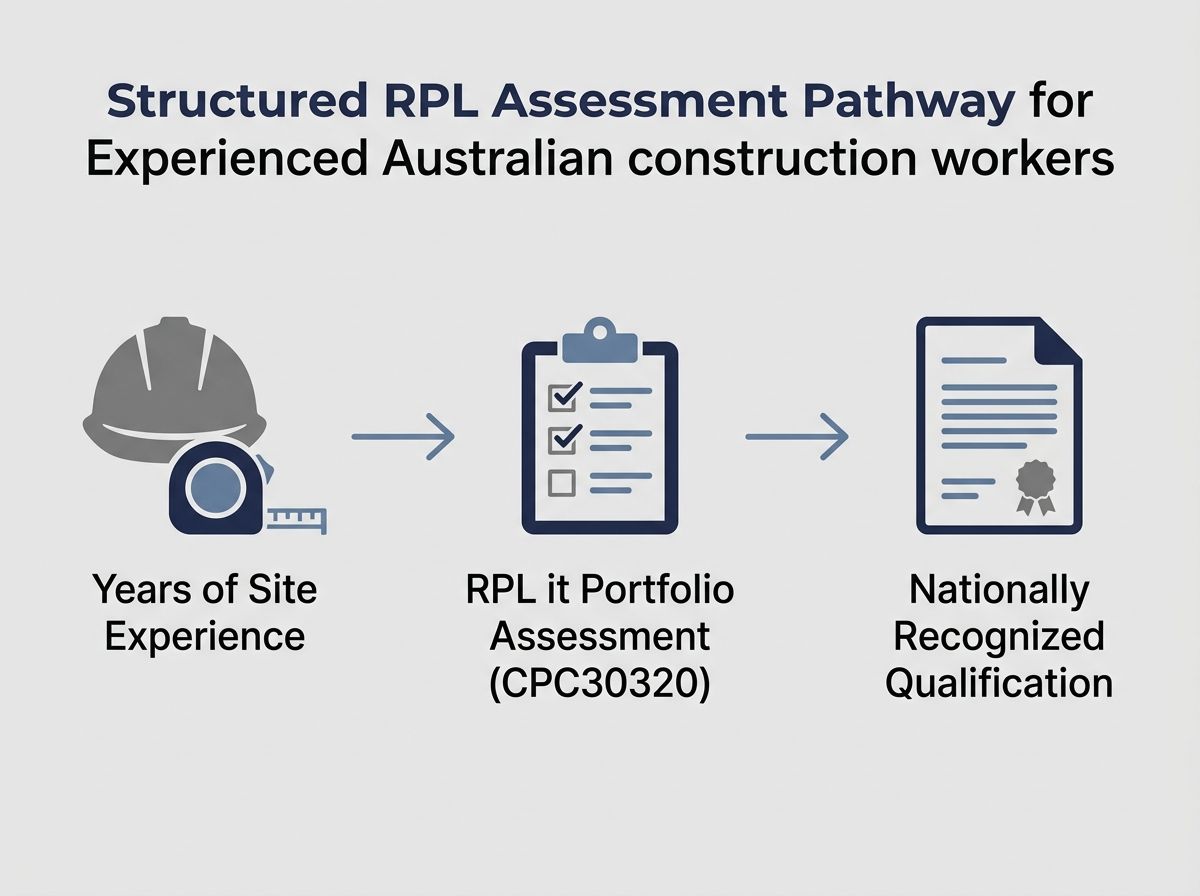
But you may not hold the formal qualification to prove it.
Recognition of Prior Learning (RPL) is a formal assessment pathway under the Australian Qualifications Framework. It allows your existing skills and experience to be assessed against the requirements of a nationally recognised qualification. For experienced concreters, that qualification is the Certificate III in Concreting (CPC30320).
The RPL process is a rigorous assessment rather than a shortcut or a rubber stamp. A qualified assessor from a registered training organisation evaluates whether your existing competency meets the national standard. If it does, you receive the qualification. If there are gaps, those are identified and can be addressed through targeted training rather than repeating what you already know.
The types of evidence that typically support an RPL application for a trade qualification include employment records, references from supervisors or site managers, photos or documentation of completed work, and records of relevant training or tickets. Because requirements can vary by RTO, it is worth starting that conversation early.
Your site experience is the evidence. The question is how to present it in a way that a formal assessment process can recognise.
Next steps: whether you are hiring or getting qualified
If you are an employer or HR professional, the action is straightforward: review the job descriptions you use for concreting roles and confirm that the scope of work described matches the licensing requirements that apply. If the work is structural, the person doing it needs to be appropriately credentialled. The VBA website is the authoritative source for current licence requirements in Victoria.
If you are a worker who has been doing this work for years and is now being asked to formalise your credentials, a pathway is available. Your experience is real. The question is whether it is formally recognised, and that is exactly what the RPL process is designed to answer.
Regardless of how you spell the job title, the compliance requirement remains the same. The work either requires a licence or it does not. The worker either holds the appropriate credential or they do not. A job description that obscures that distinction does not change the underlying obligation; it simply makes it harder to manage.
Ready to Get Recognised?
Start with a free skills review to find out if RPL is right for you.