Why NDIS Providers Ask for CHC43121 (Even When You've Done This Work for Years)
NDIS providers are not questioning your skills; they need to see CHC43121. If you trained overseas, here is how RPL helps you get recognised.

The NDIS compliance wall is not about your competence
It is not your practical support skills that NDIS providers are questioning; they are simply checking your official paperwork. If you have worked in disability support overseas and find that Australian employers constantly ask for a specific qualification, you are not alone in this experience. The qualification they need to see is CHC43121, the Certificate IV in Disability Support. This request is not a judgment on your professional ability. It is a strict regulatory compliance requirement, and understanding why it exists is the first step toward working through it.
NDIS-registered providers in Australia operate under the NDIS Quality and Safeguards Commission, which sets the standards required to maintain formal registration. Those standards include demonstrating that their workforce has the exact practical competencies needed to deliver safe, person-centred support. CHC43121 is the primary evidence of that competency in the Australian system. Without it, regardless of your background, where you trained, or your years of experience, employers face serious compliance risks. That is why they ask for it.
What CHC43121 is and why NDIS providers need to see it
CHC43121 is the Certificate IV in Disability Support, the nationally recognised Australian qualification for disability support workers. It sits on the Australian Qualifications Framework and is listed on the national training register at training.gov.au.
The qualification requires completion of ten units, comprising seven core and three electives. According to the official training.gov.au record, the core units cover key areas including person-centred behaviour support, community participation, social inclusion, ongoing skills development, services for individuals with complex needs, legal and ethical compliance, mental health support, and work health and safety. This qualification is specifically designed for workers who operate without direct supervision and may coordinate or lead a small team.
You can review the full qualification details, including the complete unit list, on the official national training register.
NDIS providers are not being difficult or unreasonable when they ask for this qualification. They are managing a real, binding regulatory obligation. Understanding this operational logic shifts the problem from a personal hurdle to a systemic requirement, which helps open a practical, recognised pathway to working through it.
The frustration of already knowing the work
You have supported individuals with complex communication needs. You have worked alongside families to manage care plans. You have handled challenging situations with calm professionalism. You have done this work in hospitals, community care settings, residential facilities, or private homes for years. The Australian system cannot see this experience yet, not because it is missing, but because it is not formatted for formal recognition here.
Peer-reviewed research published in 2025 shows that skilled migrants in Australia, including those with backgrounds in healthcare and community services, frequently face barriers because their foreign qualifications are not recognized. This often results in significant underemployment. The research indicates that overseas-trained professionals often work in roles well below their actual level of competence, not due to a skills deficit, but because their existing credentials do not translate automatically into the local regulatory framework.
The operational mismatch is clear. Australia actively recruits overseas-trained workers to address critical workforce shortages in health, aged care, and disability services. Parliamentary evidence confirms that the healthcare and care sector faced a workforce shortage crisis even before recent years, and demand has continued to grow.
The NDIS itself reflects this high demand. In 2024–25, the scheme committed $61.0 billion in support to participants, representing an increase of $6.5 billion or 11.8 per cent from the previous year. The workforce required to deliver these supports is under constant pressure. According to the NDS 2025 Workforce Census reported by the Productivity Commission, only 21 per cent of permanent disability support workers are employed full-time, and casual worker turnover rose to 26 per cent in the twelve months to December 2024.
The system needs experienced workers. Yet qualified, overseas-trained support professionals face barriers not because of their actual capabilities, but because of the format of their documentation. This systemic hurdle is highly frustrating, it is real, and it is not a reflection of your competence.
We explore this pattern in more detail in our article on skilled migrants working below their capacity in Australia.
Why the NDIS requires Australian qualification evidence, not just experience
The NDIS is a federally regulated scheme. The NDIS Quality and Safeguards Commission sets the strict standards that providers must meet to maintain their registration, which include clear workforce competency requirements. This entire framework exists specifically to protect participants, who are often in situations requiring skilled, highly accountable support.
The qualification requirement is not arbitrary. It is the specific mechanism through which the regulatory system verifies that a worker has been assessed against a defined national standard. An overseas qualification, however rigorous, has not been evaluated against Australian standards by an RTO. That is the documentation gap, not a competence gap.
Understanding this does not make the frustration disappear, but it clarifies where the problem actually sits. Your experience is not being dismissed. The issue is simply that your experience must be formally assessed and documented in Australian terms, and a recognised pathway exists to do exactly that.
How RPL translates your overseas experience into Australian evidence
Recognition of Prior Learning (RPL) is the formal Australian mechanism for assessing your existing competence against national qualification standards. It is not a shortcut or a workaround. It is a thorough, standard assessment process within the Australian Qualifications Framework, conducted by qualified assessors from Registered Training Organisations.
For CHC43121, RPL involves a qualified assessor reviewing your complete work history, documentation, references, and practical skills against the units of competency in the qualification. If your experience meets the standard across all required units, the qualification is awarded by the RTO. RPL it does not conduct assessments or issue qualifications; RTOs do. RPL it assists you through the process of compiling and presenting your evidence so that the formal assessment can proceed.
Your experience is valuable evidence. The only question is whether it has been formally assessed against Australian standards. That is where RPL fits in.
What your overseas experience might cover in CHC43121
CHC43121 contains seven core units and three elective units. The official training.gov.au record does not list any overseas qualification as an automatic equivalent. Instead, recognition decisions are made by an RTO through RPL by comparing your qualifications, transcripts, and hands-on experience against individual units.
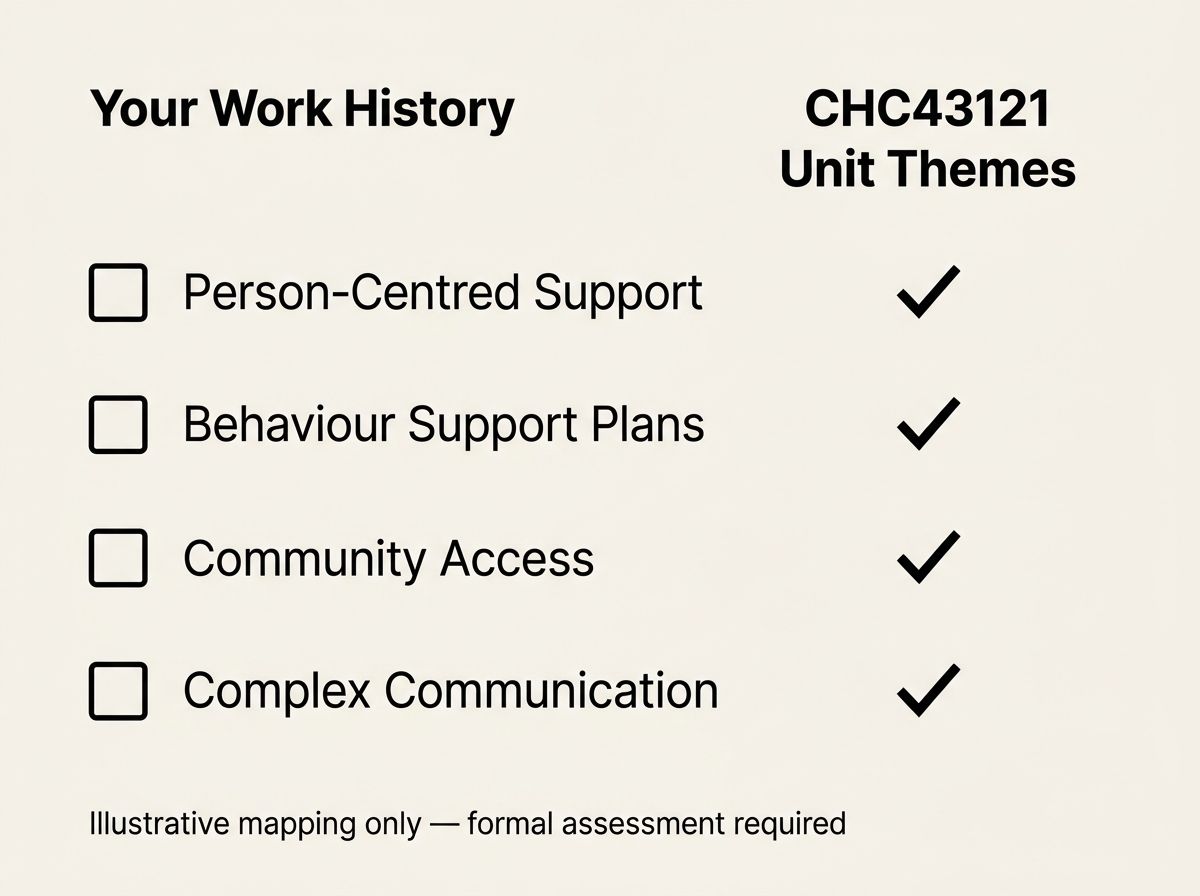
Even so, many overseas-trained disability support workers, allied health professionals, and care workers will find that their practical day-to-day experience maps directly to several of these units, even if they have never worked under the Australian qualification framework before. Consider these common practical examples:
- Have you supported people with complex communication needs or behaviour support plans? That experience can be mapped to the unit on person-centred behaviour support.
- Have you assisted clients with community participation or supported them to attend social activities? That maps directly to the community participation unit.
- Have you worked with clients who have mental health conditions alongside a physical or intellectual disability? That experience is relevant to the mental health unit.
- Have you managed client documentation, incident reporting, or other regulatory compliance in a care facility? That work can count toward the legal and ethical compliance unit.
- Have you worked without direct supervision or coordinated a team of support staff? The qualification covers this exact level of professional responsibility.
This list is illustrative, not a formal assessment. Whether your specific experience meets the standard for each unit is a determination made solely by a qualified RTO assessor, not by this article. But if you recognise your own work history in these examples, that is a strong signal worth exploring.
The reality: not everyone will qualify through RPL
RPL is a thorough and rigorous process. Not every overseas-trained worker will have the exact documented evidence required to meet all ten units in CHC43121. Some units, particularly those covering Australian legislation, national regulatory frameworks, or NDIS-specific rules, require evidence that overseas experience alone cannot always easily or fully satisfy.
Where gaps are identified, the RTO can provide gap training for those specific units. This is a standard part of the RPL process and does not mean starting the qualification from scratch. It simply means completing the targeted training needed to meet the units your existing evidence does not fully cover.
Honest suitability guidance before enrolment is the foundation of a trustworthy RPL process. We would rather help you find the correct pathway than enrol you in the wrong program. A Free Skills Review is the starting point for understanding whether your specific background is assessable before you commit to anything.
The first step: a Free Skills Review
Your experience is real. The question is whether it has been formally assessed against Australian compliance requirements. A Free Skills Review is the starting point. It is free, carries no obligation, and is designed to give you a clear picture before you make any decisions.
It is not a sales call. It is a straightforward diagnostic discussion about your background, the units in CHC43121, and whether your documentation is likely to support a successful RPL assessment. The decision to proceed is entirely yours.
Ready to Get Recognised?
Start with a free skills review to find out if RPL is right for you.