Why Your Best Guards Keep Missing Out on Supervisor Roles (And How to Fix It)
Your most experienced guards can't be promoted without a Certificate III in Security Operations. Here's how RPL fast-tracks the qualification without pulling them off the roster.

The promotion problem no one talks about in private security
Have you ever had to pass over a great guard for a supervisor role because of a missing piece of paper? If you run a security firm, the answer is almost certainly yes. You have guards who know your sites, handle difficult situations with composure, and hold the trust of clients — yet they cannot be formally promoted because they do not hold the Certificate III in Security Operations (CPP31318).
This is not a performance problem. It is a structural one. The qualification wall sits between operational capability and formal recognition, and it affects security firms across Australia every day. Experienced guards stay in patrol roles they have outgrown. Supervisory positions go to external candidates who are less familiar with your operations. The firm absorbs the cost of that mismatch — in recruitment fees, onboarding time, and the quiet frustration of your best people.
The Certificate III in Security Operations is a nationally recognised qualification that many state licensing frameworks reference as a requirement for supervisory and specialist security roles. In a number of Australian states, holding this qualification supports licensing for roles beyond standard guard duties. Requirements vary by state, so it is worth confirming what applies in your jurisdiction — but the operational reality is consistent: without CPP31318, your guards' promotion options are limited regardless of how capable they are.
The good news is that this problem has a solution. And it does not require pulling your best people off the roster.
What the Certificate III in Security Operations actually covers
CPP31318 is the nationally recognised qualification code for the Certificate III in Security Operations. It sits within the CPP Property Services Training Package and is delivered by registered training organisations (RTOs) across Australia. According to the official training.gov.au listing, the qualification requires 14 units of competency — 8 core units and 6 elective units.
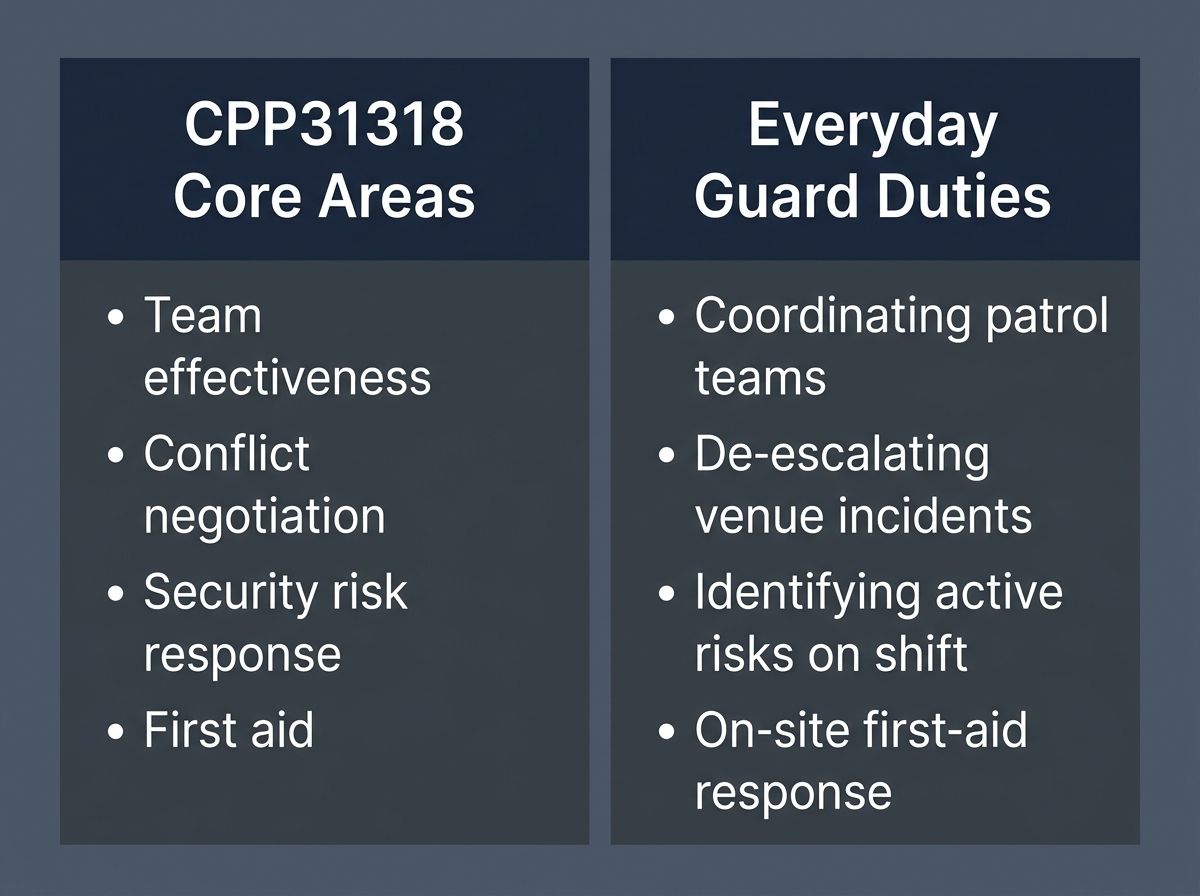
The core units cover areas that experienced guards deal with every shift: working effectively in a security team, managing conflict through negotiation, responding to security risk situations, and applying first aid principles. The elective units let candidates tailor the qualification to their specific operational context — options include crowd control, armed guarding, and monitoring centre operations, among others.
For a guard who has been working in licensed security for several years, this content is not new. It is what they do. The gap is not between their capability and the qualification's requirements — it is between their lived experience and the formal evidence that demonstrates that experience to an assessor.
Why sending your guards back to class is not the answer
The traditional pathway to CPP31318 involves enrolling in a formal course — typically delivered over several months, often requiring attendance at a training facility or block-release study periods. For a security firm, this creates a run of operational problems.
Every shift your guard attends training is a shift you need to cover. Overtime costs accumulate. Rosters tighten. Client coverage commitments come under pressure. And for the guard themselves, sitting through training that covers skills they have already been applying for years can feel less like professional development and more like a bureaucratic imposition.
The financial reality compounds this. Security guards in Australia earn hourly rates that vary by role, state, and award classification — and every training day represents a direct cost in replacement labour, not just the course fee itself. For firms managing multiple sites and tight margins, the traditional study pathway is a significant operational disruption for a qualification that experienced guards should, in principle, already be able to demonstrate.
There is a better-suited pathway for experienced workers. It is called Recognition of Prior Learning — and it is a formal, legitimate assessment process under the Australian Qualifications Framework.
How RPL works for experienced security guards
Recognition of Prior Learning (RPL) is a formal assessment pathway available for all nationally recognised qualifications in Australia, including CPP31318. It allows a candidate to demonstrate competency through evidence of their existing skills and experience — rather than repeating training they have already mastered through years of on-the-job work.
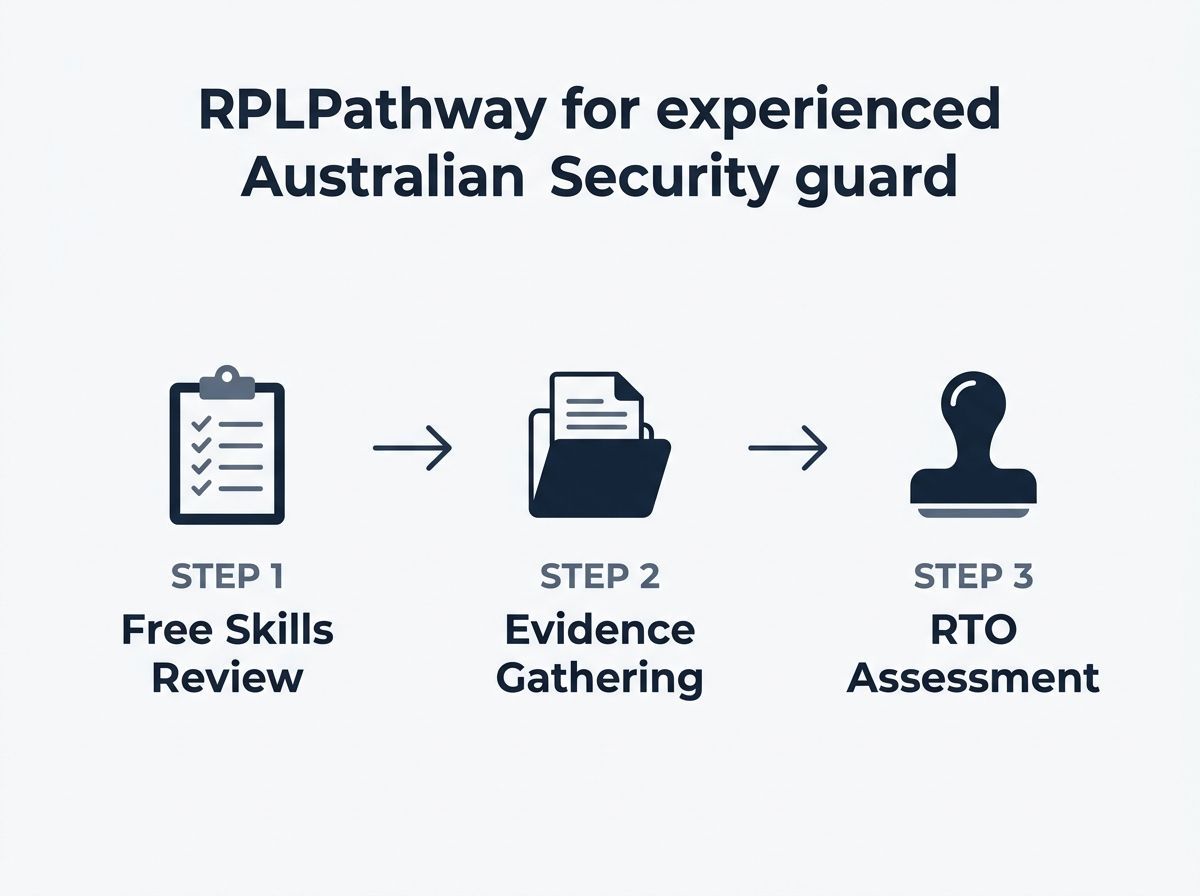
The process is straightforward in principle. A candidate gathers evidence that shows they can meet the competency requirements of each unit in the qualification. That evidence is assessed by a qualified assessor from a registered training organisation. If the evidence is sufficient, the RTO issues the qualification. RPL it guides candidates through the evidence-gathering process — we do not conduct assessments or award qualifications. That role belongs to the RTO.
For CPP31318, the types of evidence that typically support an RPL application include employment records and position descriptions that confirm the candidate's security roles, supervisor or manager references that speak to their operational performance, incident reports and shift logs that show how they have responded to real situations, and copies of their current security licence. Some RTOs may also accept written statements, third-party observation reports, or records of relevant training completed during employment.
The key difference from traditional study is that the guard's existing work is the evidence. They are not learning new material — they are presenting what they already know in a form that a qualified assessor can evaluate against the qualification's standards.
In terms of timeline, RPL assessment for CPP31318 is generally significantly shorter than the traditional study pathway, which can span twelve months or more. The exact duration depends on the RTO's processing schedule and how readily the candidate can compile their evidence — but for a guard with solid documentation of their work history, the process is considerably more efficient than full course enrolment.
What qualifies a guard for the RPL pathway?
RPL is not automatically suitable for every guard, and honest suitability guidance matters here. The pathway works best for candidates who have meaningful, documented experience in licensed security roles — typically several years of operational work across contexts that align with the qualification's core competency areas.
Guards who are well-suited to RPL for CPP31318 generally have a current security licence, a solid employment history in security roles, and the ability to provide documentary evidence of their work. This might include payslips, employment contracts, references from supervisors or clients, and records of incidents or situations they have managed.
Guards who are newer to the industry, or who have worked in a narrow range of security contexts, may find that their evidence does not fully cover all the required units. In those cases, gap training — targeted study in specific areas — may be needed alongside the RPL assessment. This is a normal part of the process and does not mean the candidate starts from scratch. It means the assessment identifies exactly where additional evidence or learning is required, and addresses only those gaps.
The honest starting point for any employer considering this pathway is a suitability assessment — before any enrolment or financial commitment. That is precisely what the Free Skills Review is designed to provide.
The business case: promoting from within without disrupting the roster
For security firm owners, RPL for CPP31318 is not just a compliance solution — it is a workforce decision. Consider what internal promotion through RPL actually delivers compared to external recruitment.
When you recruit an external supervisor, you pay a recruitment fee, invest time in onboarding, and accept a period of reduced operational effectiveness while the new hire learns your sites, your clients, and your team. Industry data suggests that recruitment fees for supervisor-level roles typically represent a meaningful percentage of annual salary — and security supervisor salaries in Australia generally sit in the range of $85,000 to $115,000 depending on role and location. The total cost of an external hire, including recruitment, onboarding, and the productivity gap, is rarely trivial.
When you qualify an internal guard through RPL, the guard stays on the roster while the evidence is gathered. There is no onboarding period — they already know your operations. There is no client relationship to rebuild — they are already trusted on site. And the investment in their qualification builds loyalty in a way that external recruitment cannot replicate.
The guard who earns their Certificate III in Security Operations through RPL knows that their employer recognised their existing capability and invested in making it formal. That matters in an industry where experienced staff are not easy to replace.
How to start: the Free Skills Review
If you have a guard who is operationally ready for a supervisor role but lacks the Certificate III in Security Operations, the first step is straightforward. A Free Skills Review assesses whether their experience and documentation are sufficient to support an RPL application — before any enrolment or financial commitment is made.
The review is honest. If the guard's experience is a strong fit for RPL, you will know. If there are gaps that need to be addressed first, you will know that too. The goal is to give you accurate information so you can make the right decision for your team — not to push you toward an outcome that does not serve your guards or your business.
For guards who want to understand the pathway from their own perspective, the article below covers how experienced security professionals approach the RPL process.
Your guards have the experience. The qualification wall is real — but it is not permanent. Recognition of Prior Learning exists precisely because experience can be evidence. The decision about whether to explore this pathway is yours.
Ready to Get Recognised?
Start with a free skills review to find out if RPL is right for you.