You Don't Need to Start from Scratch in Private Security
Ex-military or police? Your service record already maps to the cert 3 security qualification. Here's how RPL recognises what you've already done — without repeating it.

The lie private security recruiters tell experienced candidates
You have the experience. Years of it. High-stakes, real-world, operationally demanding experience that most people in a classroom will never come close to. And yet, somewhere along the way, a recruiter — or a job ad, or a well-meaning colleague — told you that moving into private security means starting at the bottom. Entry level. From scratch.
That is not a reflection of your capability. It is a failure of recognition. The private security industry has a formal qualification standard — the Certificate III in Security Operations (CPP31318) — and the competencies it assesses are not abstract. They are practical. Operational. Exactly the kind of thing that military service and policing develop, day after day, year after year. The problem is not what you know. The problem is that your knowledge exists in the wrong form for formal recognition.
That is a solvable problem. And it is exactly what Recognition of Prior Learning exists to address.
What the cert 3 security qualification actually assesses
The Certificate III in Security Operations (CPP31318) is a nationally recognised qualification on the Australian Qualifications Framework. It is the standard entry-level credential for professional security operations roles in Australia. But here is what matters: it assesses competency, not time in a classroom.
CPP31318 includes eight core units and six elective units. The core units cover working effectively in a security team, applying conflict management techniques, responding to security risk situations, and managing security information. Elective units can extend into areas such as firearms handling, crowd management, and working with security databases — depending on the specialisation pathway chosen.
Read that list again. Team effectiveness. Conflict management. Risk response. Security information management. These are not abstract academic concepts. They are operational realities that military personnel and police officers navigate constantly.
The counterintuitive truth: your service record is already evidence
The conventional wisdom says private security is entry-level work that requires starting from zero. The truth runs the other way — for ex-military and police, the cert 3 security qualification is not a starting point. It is formal recognition of what you already know.
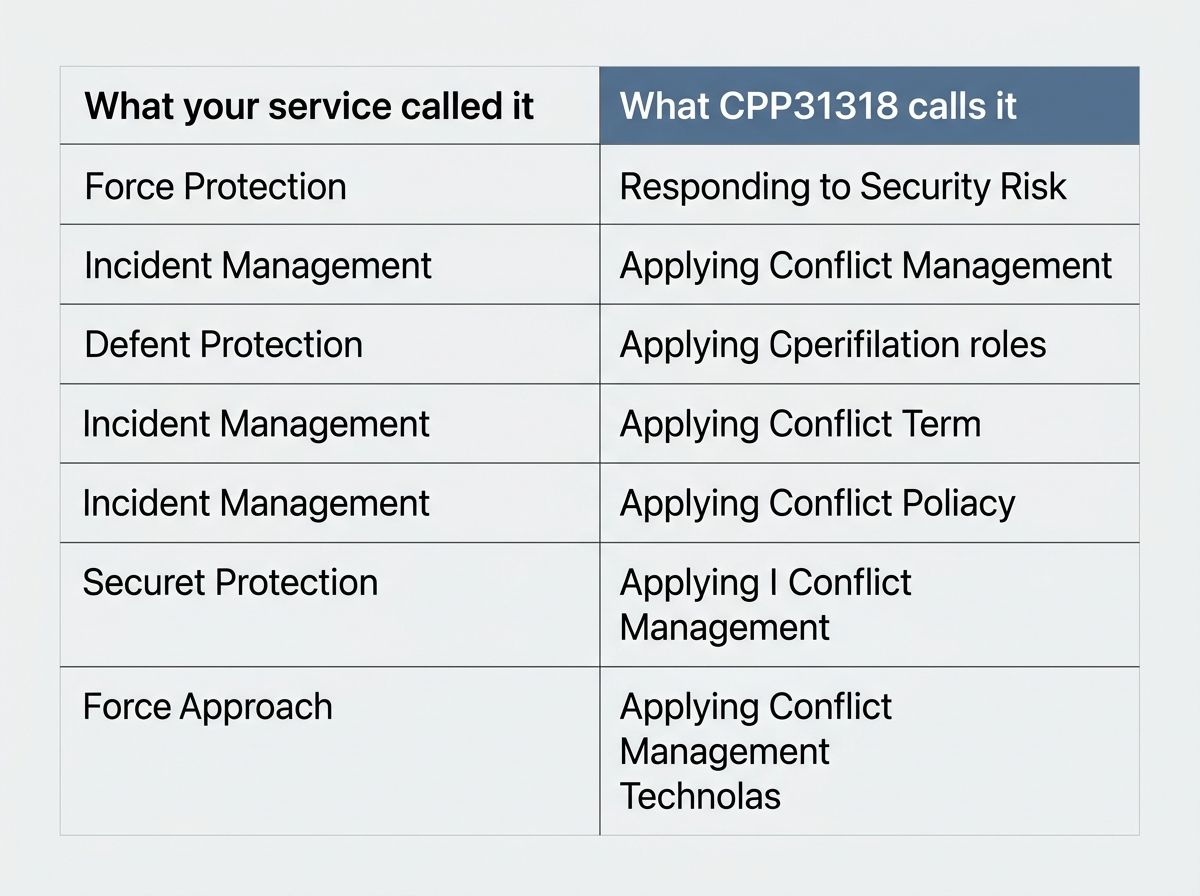
Consider what ADF service produces. Military Police personnel enforce access control, conduct patrols, manage incidents, and apply use-of-force protocols — all within a structured command environment that demands precise documentation and clear communication under pressure. Infantry and combat roles develop threat assessment, situational awareness, and rapid decision-making in high-stakes environments. Intelligence roles build skills in information gathering, analysis, and reporting that map directly to security information management.
Consider what policing produces. State and federal police officers manage conflict daily — de-escalating volatile situations, applying proportionate responses, and documenting incidents with precision. Crowd management, access control, and working within legal and procedural frameworks are not elective skills for police. They are core duties.
What the ADF calls 'force protection operations,' CPP31318 calls 'responding to security risk situations.' What police call 'incident management,' CPP31318 calls 'applying conflict management techniques.' The language is different. The competency is the same. Your experience is real. It just needs to be presented in the language the qualification system understands.
That translation is not automatic. It requires a structured assessment process. But the underlying competency — the thing that actually matters — is already there.
Why Recognition of Prior Learning exists for exactly this situation
Recognition of Prior Learning — RPL — is a formal assessment pathway within Australia's vocational education and training system. According to the Australian Skills Quality Authority (ASQA), RPL allows individuals to have their existing skills, knowledge, and experience assessed against the requirements of a qualification, without repeating learning they have already effectively completed.
It is not a shortcut. It is not a workaround. It is a rigorous, nationally recognised assessment method that exists precisely because competency can be developed outside a classroom — through work, through service, through years of doing the thing the qualification describes.
For ex-military and police moving into private security, RPL is not a compromise pathway. It is the appropriate one. The assessment is conducted by a qualified assessor from a Registered Training Organisation (RTO). The assessor evaluates your evidence against the units of competency in CPP31318. If gaps are identified — areas where your documented experience does not fully meet the standard — gap training is typically provided to address them. The qualification issued at the end is identical to one earned through traditional study. It carries the same national recognition.
What RPL changes is the starting point. Instead of beginning with the assumption that you know nothing, it begins with the assumption that you may already know a great deal — and then assesses whether that is true.
What evidence from your service actually counts
This is where the abstract becomes practical. An RPL assessment for CPP31318 requires evidence — documentation that demonstrates your competency against the qualification's units. For ex-military and police candidates, that evidence already exists. It is sitting in your service record.
Typical evidence types relevant to a security RPL assessment include:
- ADF Statement of Service or discharge documentation — confirms your role, rank, and length of service
- Duty statements and position descriptions — documents the specific tasks and responsibilities you held
- Training records and competency logs — records formal training completed during service, including use-of-force, first aid, and communications
- References from commanding officers or supervisors — third-party confirmation of your performance and competency
- Incident reports and operational logs — contemporaneous records of the work you actually did
- Police service records, performance reviews, and duty statements — for current or former state and federal police officers
- Certificates of completion for relevant in-service training — firearms handling, crowd management, emergency response
The principle is straightforward: the assessor needs to see evidence that you have done the thing the unit describes. Your service record, properly presented, is a portfolio of exactly that evidence. The challenge is not gathering it — you already have it. The challenge is organising and presenting it in a way that maps clearly to the qualification's requirements. That is where guided support makes a real difference.
The honest part: what RPL for a security qualification actually involves
RPL is not a rubber stamp. The assessment is genuine, and the outcome is not predetermined. Here is what the process typically involves.
First, a skills review — an initial conversation to understand your background and assess whether RPL is likely to be a suitable pathway for you. This is the honest starting point. Not everyone will be suitable, and a credible guide will tell you that upfront rather than enrol you in a pathway that does not fit.
If RPL is appropriate, you move into evidence gathering — compiling and organising the documentation from your service record that maps to CPP31318's units of competency. This is the most time-intensive part of the process, and it is where structured support is most valuable.
The evidence is then assessed by a qualified assessor from the delivering RTO. The assessor evaluates whether your documented experience demonstrates the required competency for each unit. Where gaps are identified, gap training is provided — typically at no additional cost — to address the specific areas where your evidence does not fully meet the standard.
Indicative timeframes for an RPL assessment for CPP31318 vary depending on the completeness of your evidence and the RTO's assessment capacity. As a general guide, the process can take anywhere from several weeks to a few months. These timeframes are indicative, not guaranteed — your specific circumstances will determine the actual duration.
The qualification issued at the end — if the assessment is successful — is a nationally recognised Certificate III in Security Operations. It is the same qualification, carrying the same weight, as one earned through any other pathway.
The Free Skills Review: find out where you actually stand
You have the experience. The question this article has been building toward is: does your specific service record map to the cert 3 security qualification? That is not a question anyone can answer in a general article. It depends on your role, your documented duties, your training records, and the specific units of competency in CPP31318.
The Free Skills Review answers that question honestly. It is not a sales call. It is not a commitment to enrol. It is a no-obligation assessment of whether your background is likely to be suitable for RPL — and if so, what the pathway forward looks like. If it is not the right fit, you will be told that too. That honesty is the point.
Your skills are real. The Free Skills Review helps determine whether they map to what CPP31318 is looking for. The decision is yours.
Ready to Get Recognised?
Start with a free skills review to find out if RPL is right for you.