Locked out of Tier 1 sites? How to qualify your concreting crew without sending them back to trade school
Major construction sites demand a Certificate III in Concreting. If your crew has experience but no qualification, RPL provides a compliant pathway.

Monday morning. Your crew is at the gate. The site manager shakes his head and tells you they need to see qualifications before anyone goes through. Your concreters have poured thousands of cubic metres of concrete. They know formwork, steel reinforcement, placement, finishing, and curing better than most people who have sat in a classroom. But they do not have the credentials, and without that paperwork, they cannot get onto the job site.
This situation is a daily reality for concreting subcontractors and employers across Australia. Major construction projects, including commercial builds, infrastructure works, and government contracts, increasingly require documented qualifications for site access and subcontractor prequalification. The standard qualification for these concreting trades is the Certificate III in Concreting (CPC30320).
If your crew has the practical experience but lacks the formal credential, this guide explains what the qualification involves, why it is necessary, and how Recognition of Prior Learning (RPL) offers a compliant assessment pathway that does not require experienced concreters to study alongside apprentices in a classroom.
Why major construction projects ask for documented qualifications
Principal contractors on major projects have strict obligations under Australian work health and safety legislation. To manage this responsibility, they must verify that subcontractors and their workers are competent to perform the scheduled work. Formal qualifications are the most direct way to prove this competency, providing documented, nationally recognised evidence that a worker has met clear industry standards.
Government-run prequalification schemes formalise these expectations. In Victoria, the Construction Supplier Register requires builders tendering for projects over $750,000 to meet eligibility criteria. These criteria cover occupational health and safety management, industrial relations, insurances, financial standing, and, for specific trade categories, professional qualifications relevant to the work.
These requirements vary by project, principal contractor, state, and contract type. While no single national rule applies to every job site, the industry trend is clear. Major projects are asking for more workforce credentials, not fewer. For concreting trades, this requirement usually means holding a Certificate III in Concreting.
What is the Certificate III in Concreting (CPC30320)?
The Certificate III in Concreting (CPC30320) is the national qualification for trade concreters in Australia. This AQF Level 3 qualification is listed on the national training register as the current standard for the sector. It covers skills required across the entire scope of work, including formwork, steel reinforcement, concrete placement, compaction, surface finishing, curing, and job site safety requirements.
In New South Wales, the Building Commission lists CPC30320 as an accepted qualification for a general concreting licence or certificate. This credential is required to carry out residential concreting work valued at more than $5,000 in labour and materials. Older qualifications, including CPC30318 and CPC30313, remain recognised, alongside specific Certificate III qualifications in Formwork, Falsework, and Construction Carpentry.
The NSW licensing threshold applies to residential work in that state. For commercial projects, major infrastructure sites, and other jurisdictions, the requirements are set by the respective regulators, asset owners, and head contractors. Despite these regional differences, CPC30320 remains the benchmark qualification that formally verifies concreting competency at the trade level.
The NSW Building Commission publishes the official list of accepted qualifications for a general concreting licence, including CPC30320 and previous versions.
Why trade school is not the answer for experienced concreters
Sending an experienced concreter back to trade school is highly inefficient because they already understand the trade. Forcing them to attend classes on basic formwork, reinforcement placement, and concrete pouring is repetitive rather than educational. It also causes unnecessary operational delays and undervalues the skills they have developed over years on the tools.
The traditional delivery of the CPC30320 qualification through a formal traineeship usually takes twelve to twenty-four months, combining daily paid work with scheduled training sessions at your worksite.
For example, one private registered training organisation lists the qualification as a twelve to fourteen month program delivered on-site. Candidates must be employed in the industry and hold a valid White Card to enrol.
For a worker who has been pouring concrete for ten years, standard classroom courses are impractical. They already have the technical knowledge and practical skills. They simply lack the formal credential that proves it. This is exactly why the RPL process exists.
How RPL works for the Certificate III in Concreting
Recognition of Prior Learning, or RPL, is a formal assessment pathway rather than a shortcut. It evaluates a worker's existing skills against national qualification standards. A qualified assessor from a registered training organisation (RTO) conducts this review. The resulting qualification is fully accredited because the assessment process is rigorous and compliant.
Vocational education and training principles demand that assessments are flexible. RTOs must evaluate skills and knowledge regardless of how or where they were learned, taking into account each candidate's specific background, informal training, and prior on-site experience.
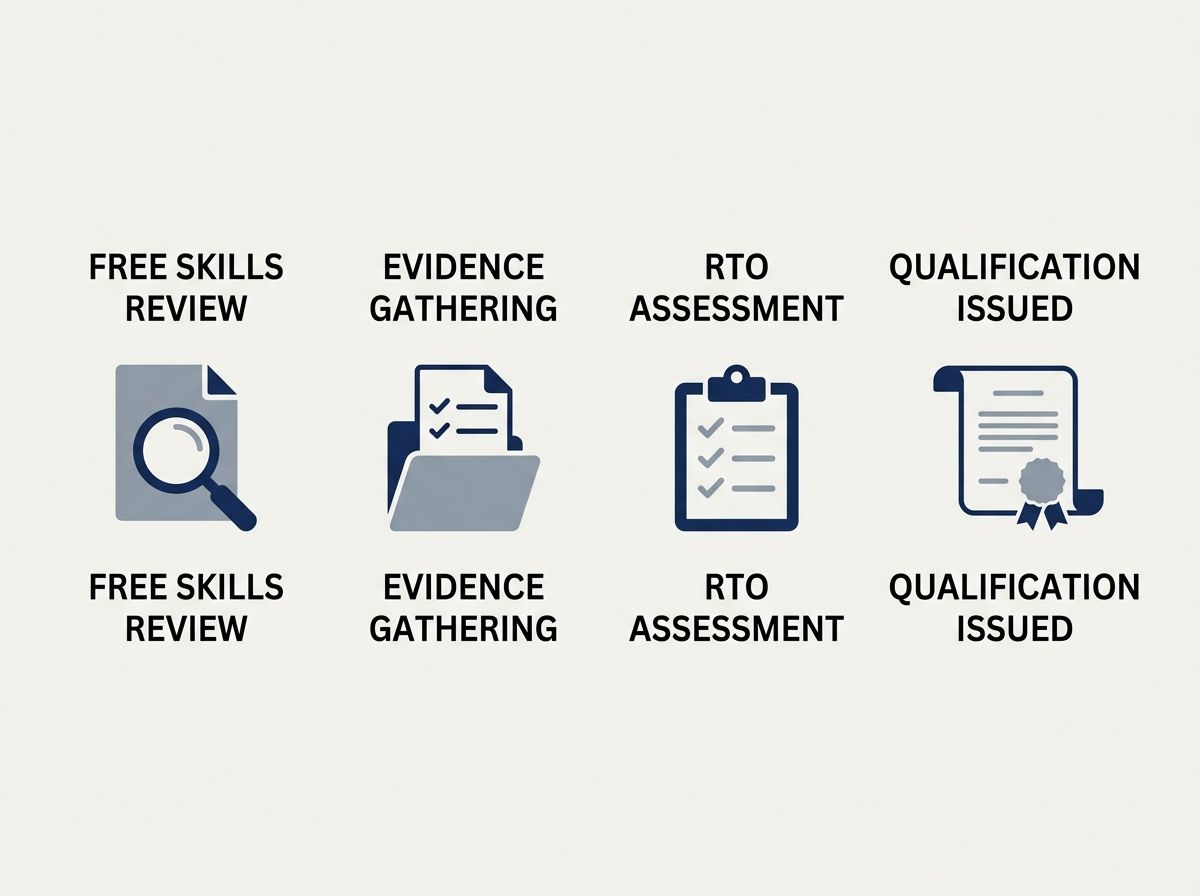
To achieve the Certificate III in Concreting through RPL, candidates generally progress through four key stages:
- Free Skills Review: An initial evaluation to determine if the worker's experience aligns with the qualification requirements, with absolutely no upfront commitment.
- Evidence Gathering: The candidate, with active support from their employer, compiles documentation of past work, including site logs, photos, safety files, and general employment records.
- Assessment: A qualified assessor from the RTO reviews the submitted evidence, conducts a technical skills interview, and may inspect on-site work to verify competency against the qualification units.
- Qualification Issuance: Once competency is successfully demonstrated across all required units, the registered training organisation awards the nationally accredited Certificate III in Concreting.
Please note that the registered training organisation performs the assessment and issues the final certificate. RPL it helps candidates and employers compile the necessary evidence and navigate the formal steps. The assessor's determination is independent.
What evidence does your concreting crew need to gather?
Experienced concreters often possess more proof of their skills than they expect. The trick is knowing how to collect and structure this information. Assessors require evidence that is valid, sufficient, authentic, and current. This ensures the files accurately reflect the worker's current skill levels and match the competency standards of the qualification.
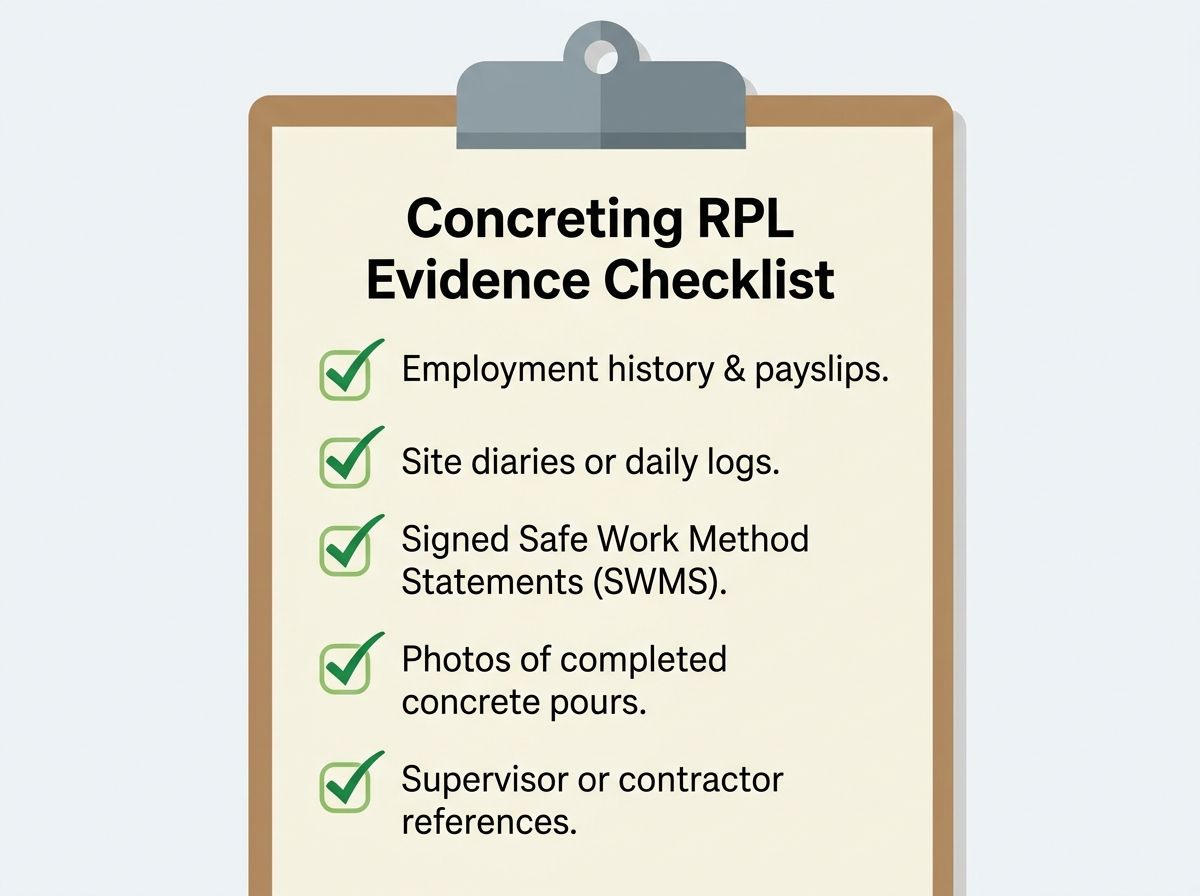
For a concreting RPL application, standard evidence includes:
- Employment contracts, payslips, and tax records verifying the length and exact scope of past concreting jobs
- Detailed site diaries, daily work logs, or client job sheets that record specific completed projects
- Signed Safe Work Method Statements (SWMS) and safety analysis reports from previous project locations
- Clear photographs or video recordings of finished trade work, including concrete pours, formwork, and detailed finishes
- Official reference letters or statutory declarations from licensed builders, head contractors, or site managers
- Work health and safety induction records, active White Cards, and other site credentials
- Transcripts, certificates, or records of any previous formal trade study, even if left incomplete
The quality and clarity of the submitted files directly impact the speed of the assessment. A worker with organised, complete evidence will progress through the process much faster than someone with missing documents. This is where active employer assistance makes a difference.
The employer's role: How to support your crew through the RPL process
Employers play an active role in the RPL process and are often the primary source of required evidence. An employer who can provide clear, specific details about a worker's daily duties, including projects completed, tasks handled, and exact employment dates, will strengthen the application.
Master Builders NSW, operating as an RTO, states that RPL candidates must provide a complete history of past employers, along with employment durations and references to confirm their industry experience.
Employers can support their staff through the process by:
- Writing formal reference letters or signing statutory declarations that verify the worker's trade duties and exact employment dates
- Providing clear copies of company site records, safety compliance plans, and daily project files that the worker actively contributed to
- Granting secure site access for hands-on assessment tasks if the RTO assessor needs to observe practical work in person
- Managing and coordinating the evidence-gathering process across multiple workers if you need to qualify your entire concreting team
Most RPL programs allow workers to complete tasks online or on-site, minimising disruption to your daily operations.
In Western Australia, the Construction Training Fund offers eligible workers a rebate of up to $400 for RPL assessments, subject to specific guidelines. These criteria vary, so you should check current requirements with both the fund and your chosen RTO.
The WA Construction Training Fund lists official details on RPL subsidies and eligibility terms on its website.
What happens if there are gaps in your crew's evidence?
Gap training does not mean starting the course from scratch. It simply addresses specific areas where evidence is missing.
Some workers may find they cannot provide sufficient proof for every unit within the qualification. If these gaps occur, the RTO delivers targeted training for those specific units. This targeted study is normally covered under the RPL enrolment, ensuring the worker does not spend time relearning skills they have already proven.
Assessors cannot assume competency if the evidence is incomplete. If your files are insufficient, the assessor will point out the gap, and the training provider will offer options for reassessment or practical supplementary tasks.
For experienced concrete contractors with solid work histories, gap training is usually minor or completely unnecessary. For workers with gaps in their employment records, it might cover a few selected units. Regardless of the situation, the process remains highly targeted and avoids starting the entire trade course again.
How long does it take to get a Certificate III in Concreting through RPL?
The time required to complete the process varies. It depends on how quickly you gather your evidence, the RTO's current schedule, and whether any training gaps are found. No training provider can guarantee an exact completion date, and any schedule should be considered an estimate.
For context, one RTO states that experienced concreters can complete the CPC30320 RPL process within two to eight weeks, depending on their existing knowledge and background.
Standard vocational sector guidelines also indicate that typical RPL applications take between two and eight weeks to assess, depending on the complexity of the file, though this timeline is a general industry estimate.
Compared to a standard one or two year traineeship, this pathway is significantly faster for experienced workers. The primary factor is evidence quality. A candidate who starts with neat, comprehensive documents will progress through their assessment much faster than someone who has to reconstruct their employment history.
The NSW Government advises all applicants to verify qualification availability with a registered training provider and check the National Training Register before starting any training or RPL application.
The NSW Government provides clear guidance on general concreting work, including recommendations to check course availability with an RTO prior to starting RPL.
Start with a free skills review: No commitment required
The most logical first step is not immediate enrolment. It is an honest evaluation to see if RPL matches your crew's current skill levels.
A Free Skills Review gives you a clear assessment of whether your workers' experience matches the Certificate III in Concreting standard before you make any financial commitment. If RPL is the correct path, you will learn exactly what documents to prepare and how the process works. If it is not suitable, you will receive clear feedback so you can plan your next steps with confidence.
Your team has the practical capability. The key step is organizing that capability into valid evidence. That is the exact process we help you navigate.
Ready to Get Recognised?
Start with a free skills review to find out if RPL is right for you.