Why Your 10 Years on the Salon Floor Don't Show Up on Paper
You've been doing the work of a senior hairdresser for years. But without a Cert 4 in hairdressing, the system doesn't see it. Here's why — and what changes.

The promotion that went to someone you trained
You have the experience. You know it. Your clients know it. The other stylists on the floor know it — because you trained half of them.
But when the senior stylist position opened up, it went to someone else. Someone newer. Someone who hadn't been doing this as long as you have. Someone who had a Cert 4 in hairdressing.
You watched it happen. Maybe you said nothing. Maybe you asked why. Either way, the answer came back to the same thing: the qualification. The piece of paper. The credential that proves — on paper — what you already demonstrate every day on the floor.
This is not a story about one unlucky moment. It is a pattern. It repeats. And it has a name.
The qualification wall cycle: how it keeps repeating
The Qualification Wall Cycle is the recurring pattern that keeps experienced hairdressers stuck — not because they lack skill, but because their skill exists in the wrong form for formal systems to read.
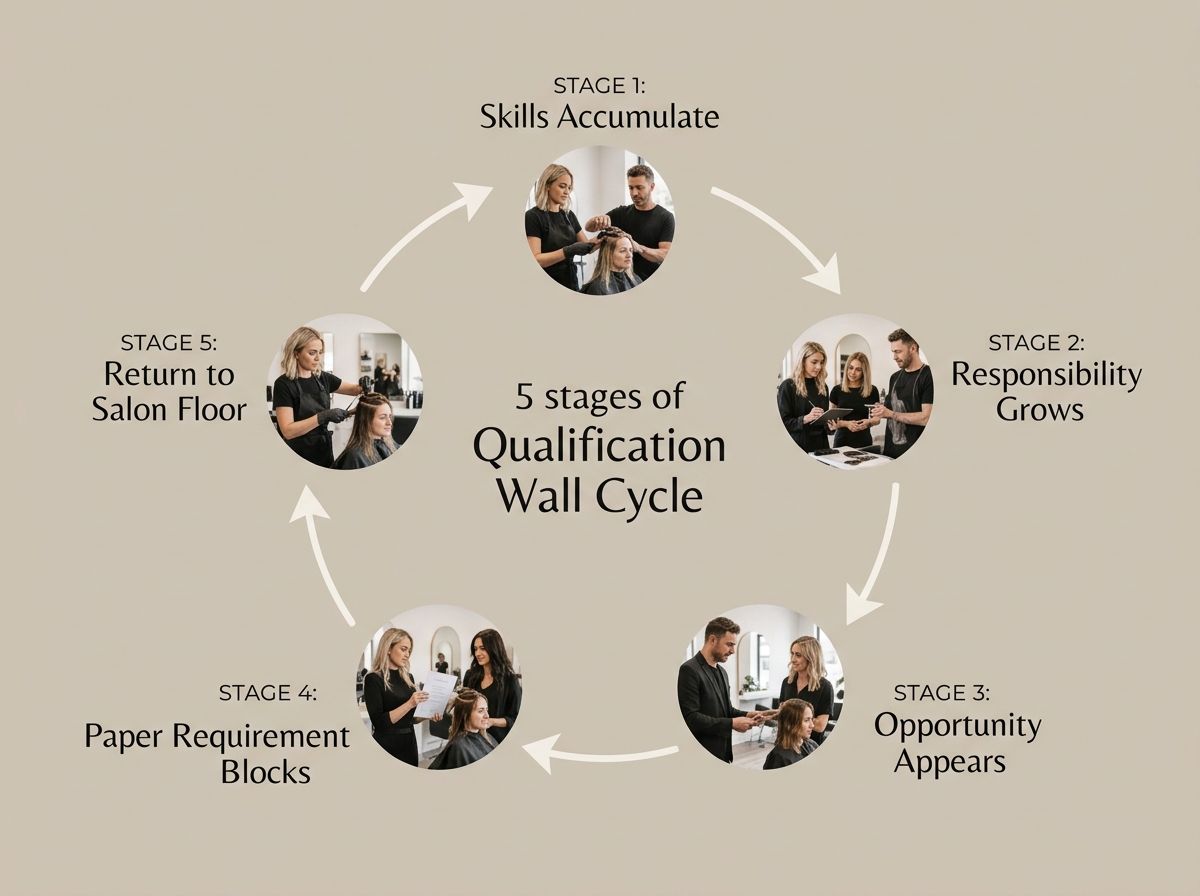
Here is how it unfolds, stage by stage:
- Stage 1 — Skills accumulate. You learn through doing. Hundreds of cuts, colours, and consultations. You develop technique that no classroom replicates. Your hands know things your resume cannot say.
- Stage 2 — Responsibility grows. You become the person others come to. You train new starters. You handle the difficult clients. You open and close. You manage the floor when the owner is away. You are, in practice, a senior stylist.
- Stage 3 — An opportunity appears. A senior role. A management title. A pay classification that reflects what you actually do. You see it. You want it. You apply.
- Stage 4 — The paper requirement blocks you. The role requires a Certificate IV in Hairdressing. Or the employer uses it as a filter. Or the award classification is tied to the qualification. Your experience is real. But it is not in the right form.
- Stage 5 — Someone else gets it. They have less time on the floor. They may have less skill. But they have the certificate. The cycle completes.
- Stage 6 — You return to the floor. And the cycle begins again.
The same pattern plays out across industries — from aged care to automotive to hospitality. The form of evidence matters as much as the evidence itself. For hairdressers, the Qualification Wall Cycle is particularly common because so much of the craft is learned through practice, not through formal study.
What the Cert 4 in hairdressing actually covers — and what you already know
The Certificate IV in Hairdressing is a nationally recognised qualification. It covers advanced technical skills, client consultation, salon management, business operations, and the supervision of others.
For someone who has been working as a hairdresser for a decade, that description may sound familiar. Because it describes what you already do.
The qualification is structured around units of competency — specific, assessable areas of practice. Those units include things like:
- Providing advanced hairdressing services — the technical work you perform daily
- Developing and maintaining salon services — the operational knowledge you have built over years
- Coordinating salon services — the floor management you do informally
- Providing client consultation services — the conversations you have with every client
- Managing a small team — the supervision and training you already provide to junior staff
- Applying safe work practices — the health and safety awareness that is second nature after years on the floor
This is not a complete or verified unit list — qualification content is confirmed by the delivering registered training organisation and may vary. But the pattern is consistent: the Certificate IV in Hairdressing describes the work of an experienced, senior hairdresser. If you have been doing that work, the qualification may already reflect your practice.
The gap is not in your skill. The gap is in the documentation.
Understanding how daily salon work maps to formal qualification units is the first step in seeing whether RPL is a viable pathway.
Why experience in the wrong form stays invisible
Experience is not less than education. It is a different form of evidence.
Formal credentialing systems are designed to read evidence in a specific form: documented, assessed, verified by a qualified assessor from a registered training organisation. Experience that exists in practice — in your hands, in your client relationships, in the institutional memory of the salon — is real. But it is not readable by the system in that form.
This is not a flaw in you. It is a mismatch of form. The system is not designed to be hostile to experienced workers. It is designed to assess competency through a structured process. The problem is that most experienced hairdressers have never had their competency formally assessed — not because it is lacking, but because no one ever asked them to document it.
Recognition of Prior Learning — RPL — exists precisely to address this mismatch. It is a formal assessment pathway under the Australian Qualifications Framework that allows a qualified assessor to evaluate existing competency against the units of a qualification. It does not require you to re-learn what you already know. It requires you to demonstrate that you know it.
The distinction matters. RPL is not a shortcut. It is a rigorous assessment process. But it is one that reads experience — when that experience is properly documented and presented as evidence.
What changes when the paper catches up to the practice
Formal recognition does not change what you know. It changes what the system can see.
For experienced hairdressers, a Certificate IV in Hairdressing can open doors that experience alone cannot. Senior stylist roles that require the qualification as a condition of employment. Management positions that use it as a screening criterion. Pay classifications tied to formal credentials under industry award structures.
It also changes how you appear on paper — to employers, to clients, to the industry. Your career, accurately reflected. Your expertise, formally acknowledged. The years of work, counted.
None of this is guaranteed by the qualification alone. Formal recognition is one part of a career. But for experienced hairdressers who have been blocked by the paper requirement, it removes a specific and concrete barrier.
The same gap between skill and paper shows up across the beauty industry — in nail technology, in beauty therapy, in salon management. The credential is not the whole story. But without it, the story is incomplete.
The same gap between skill and paper shows up across the beauty industry — and the frustration of being overlooked despite years of expertise is widely shared.
How RPL translates salon floor experience into a Cert 4 in hairdressing
RPL is not a different qualification. It is a different pathway to the same qualification. The Certificate IV in Hairdressing awarded through RPL is the same nationally recognised credential as one awarded through traditional study. The difference is in how competency is assessed.
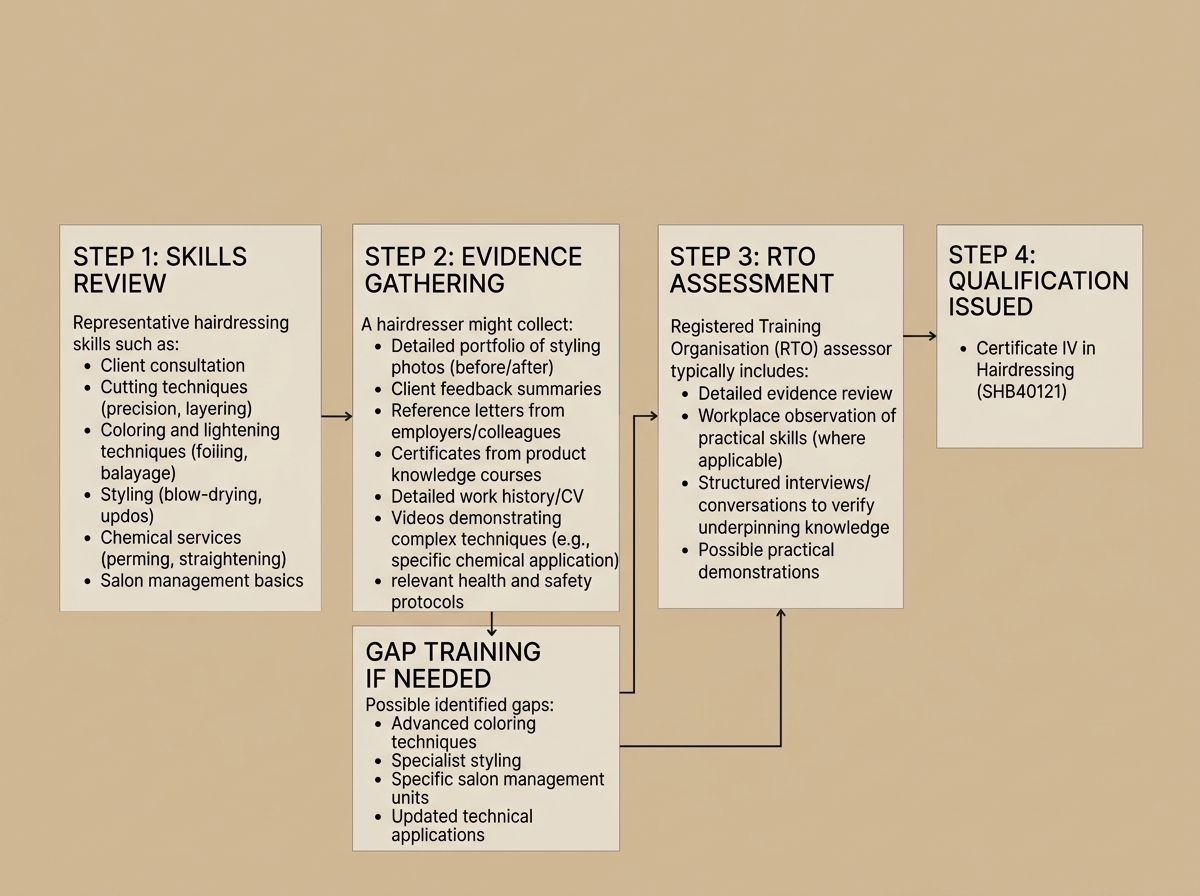
In a traditional study pathway, competency is demonstrated through coursework, practical assessments, and supervised practice over time. In an RPL pathway, competency is demonstrated through evidence of existing practice — and assessed by a qualified assessor from a registered training organisation.
The RPL process typically involves:
- A skills review — an honest assessment of your experience against the qualification's units, to identify where your practice is strong and where gaps may exist
- Evidence gathering — compiling documentation that demonstrates your competency: employment records, references from employers or supervisors, records of training you have provided, client consultation records, and potentially a practical skills demonstration
- Assessment by a qualified assessor — a qualified assessor from the delivering RTO reviews your evidence against each unit of competency
- Qualification awarded — where competency is demonstrated across all units, the qualification is issued. Where gaps are identified, gap training is provided to address them.
Gap training is a normal part of the RPL process. It does not mean the assessment has failed — it means the process has identified specific areas where additional evidence or practice is needed. Gap training is typically included as part of the RPL package.
RPL it guides candidates through the evidence-gathering and documentation process. The assessment itself — and the qualification — is conducted and issued by the registered training organisation.
Past training records, including any previous VET qualifications, can also form part of your RPL evidence.
Is RPL for Cert IV hairdressing right for you?
RPL for the Certificate IV in Hairdressing is most likely to be suitable for candidates who have substantial, recent, and relevant experience. That typically means:
- Several years of experience working as a hairdresser in a professional salon environment
- A broad range of services performed — not just one or two specialisations, but across the scope of what the qualification covers
- Experience supervising, training, or mentoring other staff — even informally
- Ongoing, current practice — RPL assesses what you can demonstrate now, not just what you did years ago
RPL is not suitable for everyone. Candidates who are early in their career, or whose experience is narrow in scope, may find that a traditional study pathway — or a combination of study and RPL — is more appropriate. An honest suitability assessment before you commit to any pathway is the right first step.
The decision is yours. A Free Skills Review is the honest first step — free, no obligation, and designed to tell you whether RPL is the right pathway for your experience. It is not a sales call. It is a genuine assessment of whether your background is a strong fit for the RPL process.
Ready to Get Recognised?
Start with a free skills review to find out if RPL is right for you.