You've Done Acrylics for 5 Years, But Your Resume Says Otherwise
Your experience as a nail technician is real, but your resume might not show it. Learn how a Certificate III in Nail Technology validates your existing skills.
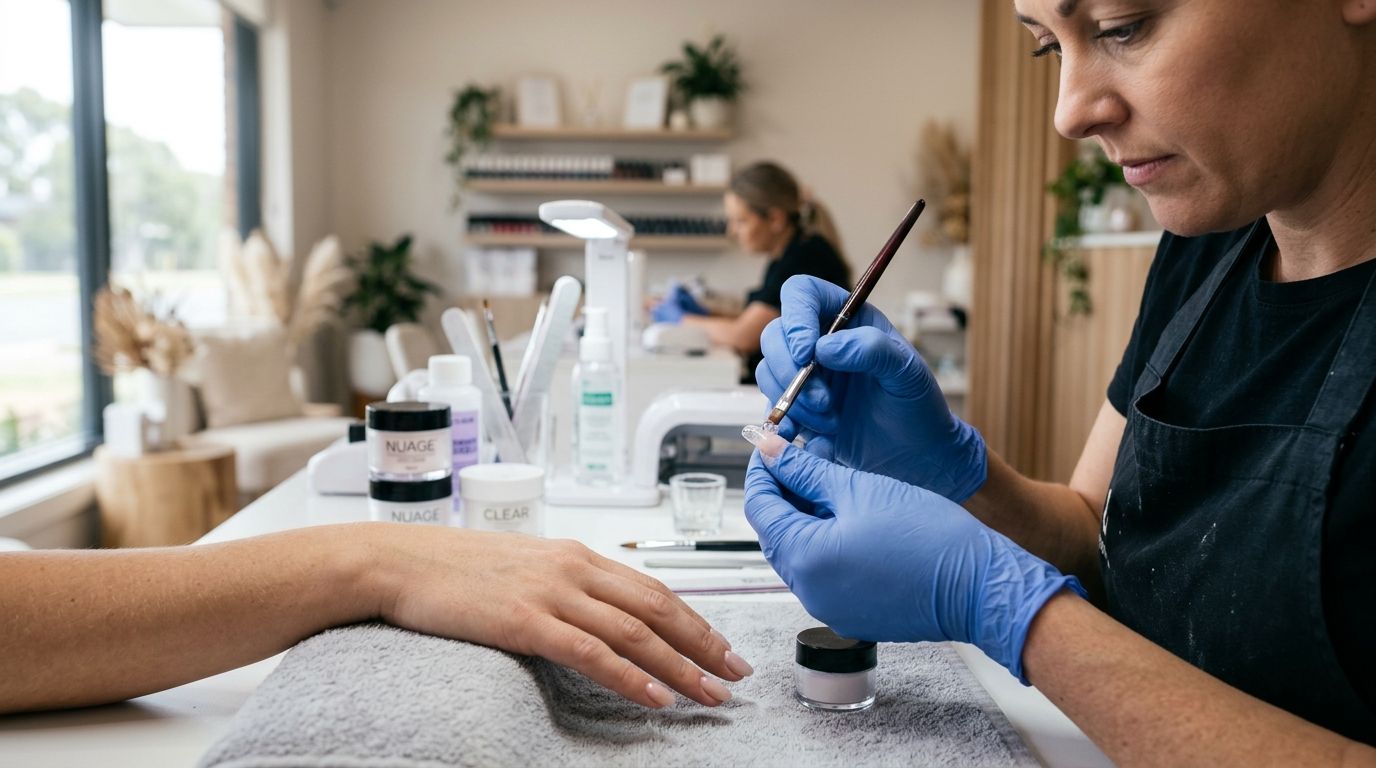
The nail technician who knows everything, but has nothing on paper
You have the experience. You can sculpt a full acrylic set without using a physical form. You know the exact difference between a soak-off gel and a hard gel simply by feel. You have managed your own client books, handled difficult conversations, and spent hours showing junior technicians how to prep a nail bed correctly. You have worked at this high level for years.
Yet your resume, which is meant to represent your entire professional life, does not show any of this work. It lists past job titles and perhaps a salon name or two. It fails to explain what you actually know, what you can do on a daily basis, or how long you have worked at a level that most industry professionals would consider highly advanced.
This gap between your practical knowledge and your resume is not a personal failure on your part. It is a structural problem that is best described as the invisible resume. Your skills are real and your experience is deep. However, formal systems like job applications, senior roles, and industry benchmarks cannot verify your ability without an official qualification to confirm it.
The Certificate III in Nail Technology (SHB30321) is that official qualification. This guide is not written to convince you to go back to a physical classroom. It is designed to help you identify a pattern that experienced nail technicians across Australia face regularly, and to clarify your actual career options.
The pattern: how experienced nail technicians become invisible
This is not an isolated situation unique to you. It follows a predictable cycle that plays out across the nail technology industry. Once you see this cycle mapped out, you will likely identify exactly where your own career currently stands.
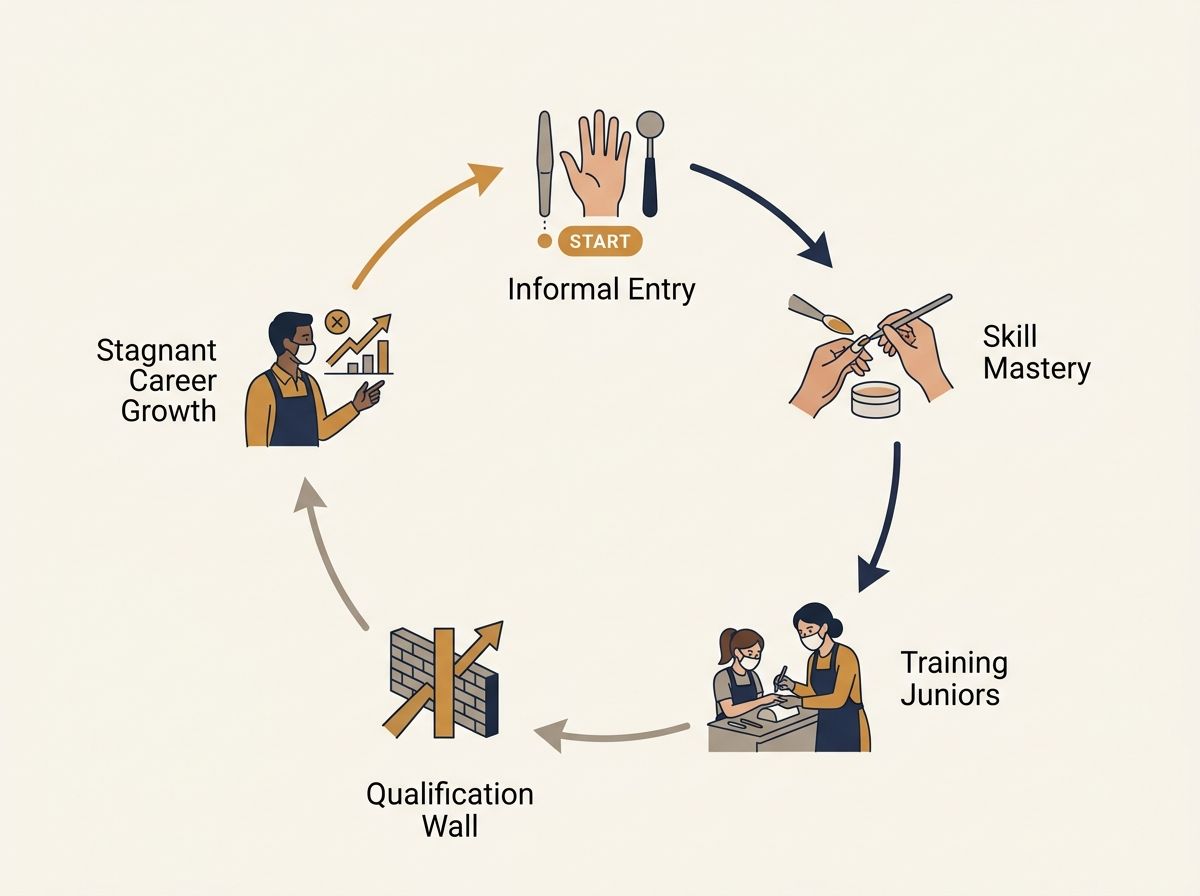
- Stage 1: You enter the industry informally. Most experienced technicians did not start with a formal qualification. They learned on the job, from a mentor, through salon training, or by practising independently until their work was of professional standard.
- Stage 2: You build advanced skills through daily repetition and client demand. As client requests and trends change, you adapt. Over several years, you build a technical skill set that goes far beyond basic work, including sculpting, gel systems, detailed nail art, client consultations, hygiene protocols, and deep product knowledge.
- Stage 3: You become the person others learn from. Eventually, you stop learning the basics and start teaching them. When a new technician joins the salon, you show them the correct techniques. You become the informal trainer, the quality benchmark, and the person the salon owner trusts to train new staff.
- Stage 4: You hit the qualification wall. A senior role opens up or a better-paying position becomes available. When you apply or ask for a pay review, the business asks for your formal qualifications. They ask for the Certificate III in Nail Technology (SHB30321), which is a credential you never needed before this moment.
- Stage 5: You watch someone with less experience advance past you. This is the frustrating part. A technician with fewer years of work, less hands-on skill, and a shorter client list gets the position or the higher pay rate because they hold the certificate. You may have trained them yourself, but the recruitment system only looks for the piece of paper.
This is the experience penalty. It is an invisible ceiling that affects skilled workers when salons and compliance systems require credentials that were not mandatory when you first entered the workforce. If you recognize your own career in this cycle, you are not alone, and you have practical options.
We have written about this dynamic across multiple industries. The experience penalty is a structural issue, not a personal failure.
What the Certificate III in Nail Technology actually covers
The Certificate III in Nail Technology, coded as SHB30321, is a nationally recognised qualification under the Australian Qualifications Framework (AQF). It is the standard industry credential for professional nail technicians working in Australian salons.
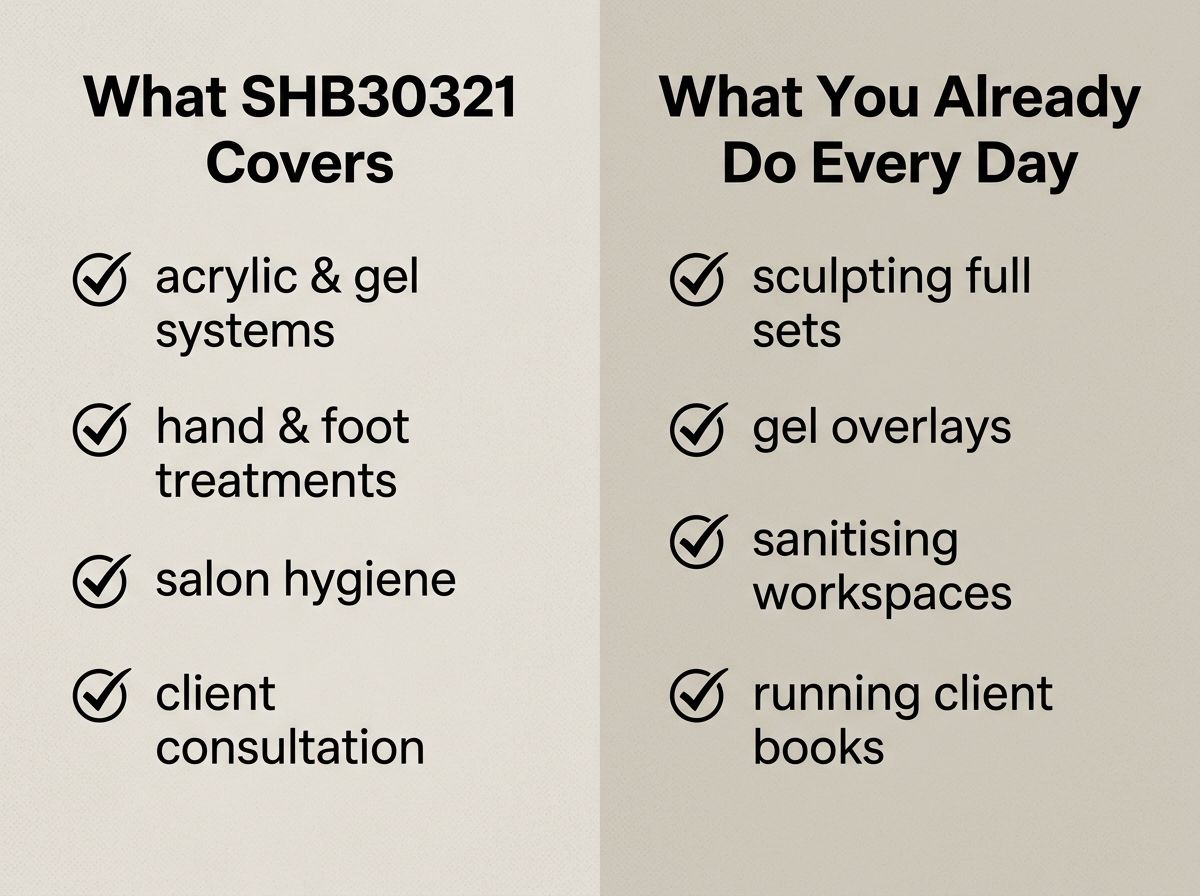
The qualification covers the primary competencies required for professional nail technology. These areas include nail preparation and treatment, applying acrylic and gel nail systems, extensions, nail art, client communication, salon hygiene, infection control, and the workplace safety standards required in a retail salon environment.
If you have been working as a nail technician for years, you perform these tasks daily. The qualification does not outline new skills you need to learn. Instead, it defines the skills you already use, structured in a format that assessors use to evaluate capability against national training standards.
This distinction is important. The Certificate III in Nail Technology is not a training course you must sit through to learn the trade. For experienced operators, it is a qualification that can be achieved through assessment, allowing you to demonstrate your existing skills rather than relearning your daily job.
Why training junior staff is the clearest sign you are ready
Experienced nail technicians often share this specific frustration: they spend weeks training junior staff, correcting their prep work, teaching them proper application, and managing client interactions, only to watch those junior staff earn higher rates because they hold a qualification.
That frustration is understandable, but it is also practical evidence of your own seniority.
Teaching a skill requires a different level of understanding than simply performing it. To teach, you must understand both the technique and the underlying reasoning, translating your physical habits into clear instructions that a beginner can follow. If you train junior technicians, you are already operating at a high level of industry competency.
In Recognition of Prior Learning, assessors look for proof that you have applied these skills consistently in a professional setting over time. Workplace documents, manager references, client portfolios, and records of training others are the types of evidence that support an RPL application. The exact requirements depend on the registered training organisation conducting the assessment, but the core principle is simple. Your career is the evidence, and the goal is to document it correctly.
The qualification wall: what happens when salons require formal credentials
For a long time, many nail technicians had no reason to consider the Certificate III in Nail Technology. They built their businesses, client books, and local reputations purely on the quality of their hands-on work.
While that remains true in some local salons, industry practices are shifting. As the sector becomes more professional, formal qualifications are frequently listed in job advertisements, award wage discussions, and requirements for senior roles. Employers, especially larger salon groups or those managing strict compliance guidelines, increasingly use the Certificate III as a baseline standard.
This change is not a criticism of your hands-on work. It is a structural transition as the industry standardises its operations. The formal credential acts as a reliable verification of your skill set, offering a clear national benchmark that employers, insurers, and clients can quickly verify.
Crucially, the Certificate III in Nail Technology is a nationally recognised qualification. This means it is not tied to any single employer or salon. It is your personal property. Wherever your career takes you next, whether you remain in your current job, join a new business, or open your own salon, the qualification remains with you.
Recognition, not repetition: what RPL means for nail technicians
Recognition of Prior Learning (RPL) is the formal assessment process used to evaluate your existing skills against qualification standards. It is not a shortcut or an easy workaround. It is a structured assessment pathway within the Australian vocational system designed specifically for individuals who already possess the skills described in a qualification.
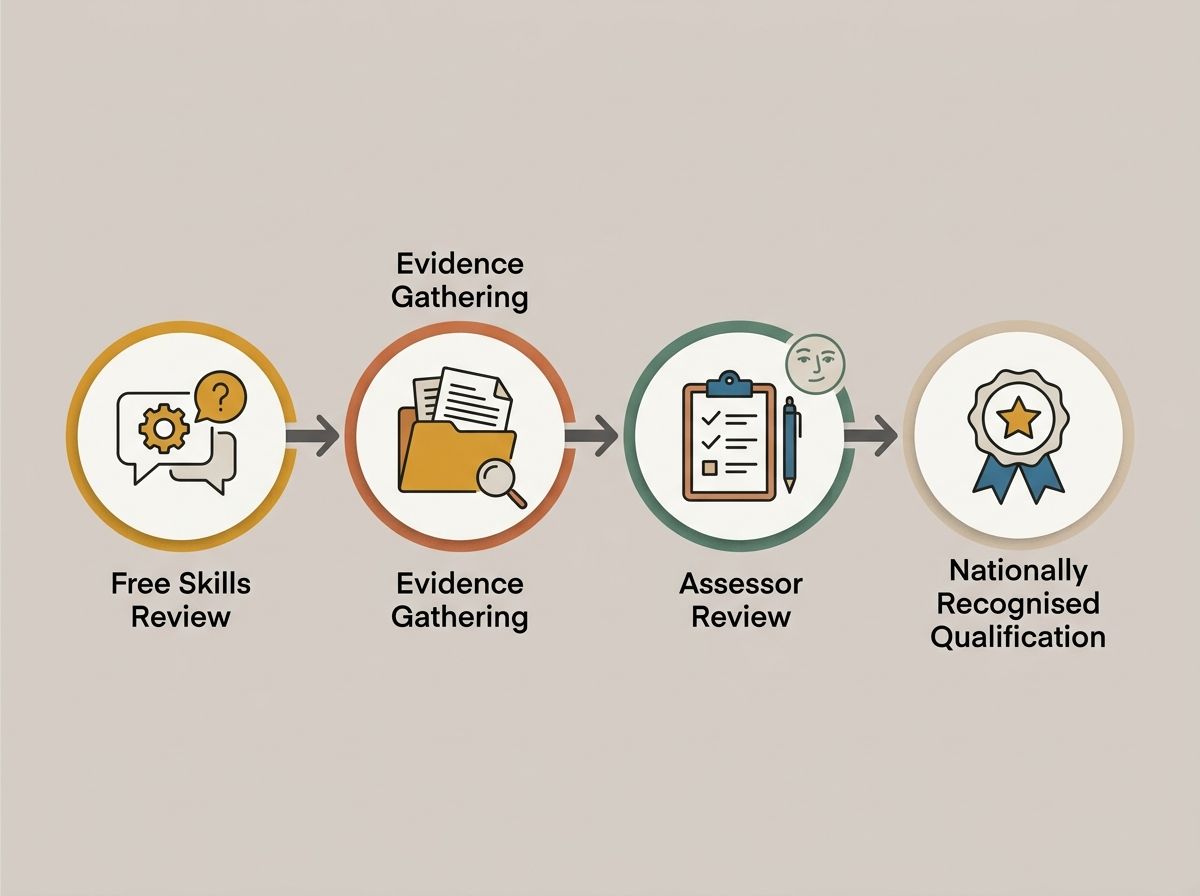
For an experienced technician, RPL means being assessed on your current daily work, rather than sitting through training for skills you already use. The assessment is completed by a qualified assessor from a registered training organisation (RTO). RPL it is not an RTO and does not issue qualifications. Instead, RPL it guides you through the process, helping you determine if your experience aligns with the standards, helping you compile your evidence, and introducing you to a partner RTO for formal evaluation.
A realistic look at RPL shows it is not an automatic rubber stamp. Assessors must carefully check your evidence against national standards. Sometimes, this process identifies skills gaps where your documented experience does not cover every unit. If that occurs, target gap training is provided to address those specific areas. The process focuses on verifying genuine competence through proper professional standards.
For many experienced technicians, an RPL pathway is a more practical route to achieving the Certificate III than enrolling in a standard beginner training course. Suitability depends entirely on your specific background and how your work history aligns with the training requirements. A Free Skills Review is designed to clarify this alignment for you.
Is this you? A diagnostic for experienced nail technicians
The following scenarios describe the regular work of a nail technician who is likely a good candidate for a Certificate III in Nail Technology RPL pathway. Review these points to see how many match your current experience.
- You have worked as a nail technician for at least two years in a professional salon environment.
- You apply acrylic nail systems, including sculpting and tips, to a reliable professional standard.
- You work with gel systems, including extensions and overlays, as a regular service for your clients.
- You handle client consultations, including assessing nail health, discussing product options, and managing expectations.
- You follow salon hygiene and infection control procedures automatically as part of your daily routine.
- You have trained, mentored, or supervised at least one junior nail technician in your salon.
- You manage your own client bookings or assist with the general daily operations of the salon.
- You have worked in your roles long enough that the tasks are second nature, but you do not hold a formal qualification.
If these points match your working week, your daily experience is the foundation of your evidence. The next step is verifying if that history aligns with the required standards, which is what we assess in a Free Skills Review.
Your next step: a Free Skills Review
The Certificate III in Nail Technology represents the work you complete daily. The real question is whether your current work history meets the formal standards, and you do not have to figure that out on your own.
A Free Skills Review with RPL it is a direct, no-obligation discussion about your background and how it matches the requirements of the Certificate III in Nail Technology (SHB30321). This is not an enrolment or a formal commitment. It is a straightforward review of your work history so you can decide if you want to proceed.
Many professionals who complete this review find their skills match the qualification and that RPL is a clear pathway forward. Others find minor skill gaps that are best addressed first. In either case, you get a clear overview of your options so you can make your own choice.
Ready to Get Recognised?
Start with a free skills review to find out if RPL is right for you.