From Freelance Stylist to Salon Manager: The Hidden Advantage of Your Practical Experience
Running a mobile salon teaches you scheduling, pricing, and client management. Learn how your experience maps to a Certificate IV in Hairdressing via RPL.

The qualification wall that shouldn't exist
You have been doing this for years. You manage your own bookings, set your prices, source your own products, and build your client base, often across multiple locations in a single week. You have trained junior stylists informally, handled difficult client situations with professionalism, and kept your workspace compliant with hygiene standards without anyone directing you to.
Then you look at a salon manager role. The job description asks for a Certificate IV in Hairdressing. Suddenly, a decade of real-world experience is completely invisible to the recruitment application form.
This is not a skills problem. It is a recognition problem. Your competence exists; it simply exists in a format that formal systems do not recognize. That is the exact problem the Certificate IV in Hairdressing, achieved through Recognition of Prior Learning, is designed to solve.
What the Certificate IV in Hairdressing actually assesses
Most freelance stylists assume the Certificate IV in Hairdressing (SHB40216) is primarily about technical skills like cutting, colouring, and styling. These are skills you already have in abundance. That assumption is only partly correct.
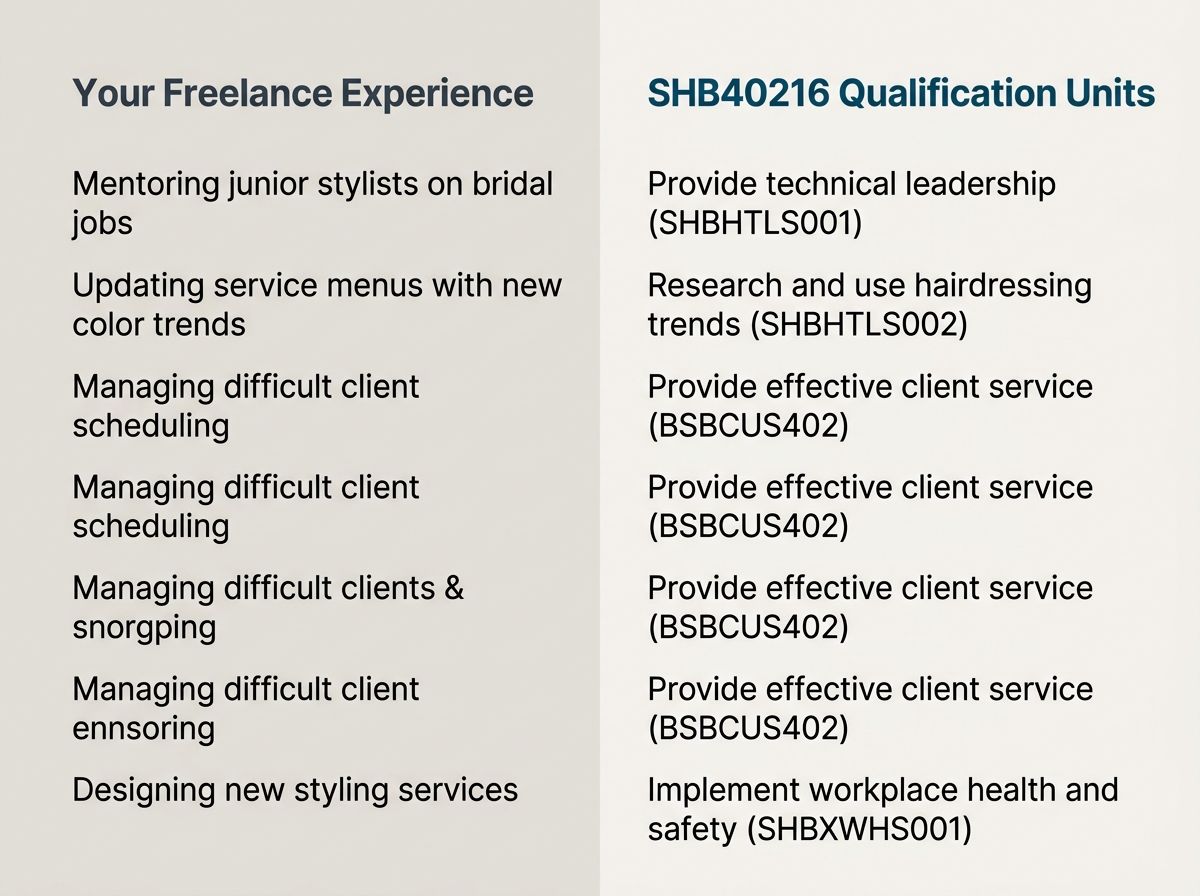
According to the National Training Register, SHB40216 is structured around 11 units: two core units and nine electives. The two core units are SHBHTLS001 'Provide technical leadership to hairdressing teams' and SHBHTLS002 'Research and use hairdressing trends to advance creative work.' These are not entry-level technical units; they are leadership and professional development units.
The qualification's official description states it reflects the role of skilled senior hairdressers who work independently, and that many at this level provide technical leadership, training, and support to team members. Pathways include working as a senior hairdresser, a freelance session stylist, or a technical advisor in product companies.
Beyond the core units, the elective structure allows for business-focused content. Group B electives include units such as BSBWOR502 'Lead and manage team effectiveness', BSBMKG413 'Promote products and services', and BSBINN301 'Promote innovation in a team environment'. There are also training and mentoring units available for those who supervise or develop other stylists.
The business and management electives listed in Group B are flagged as superseded on the National Training Register. If you are exploring this qualification, check the current unit status directly on training.gov.au or with your chosen registered training organisation (RTO), as unit availability may vary.
The freelance business skills that already map to the qualification
Here is what the qualification calls it: 'Provide technical leadership to hairdressing teams.' Here is what you call it: mentoring the junior stylist who assists you on bridal jobs, or walking a new contractor through your colour correction process.
Here is what the qualification calls it: 'Research and use hairdressing trends to advance creative work.' Here is what you call it: staying current with balayage techniques, attending industry events, and updating your service menu to reflect what clients are actually asking for.
Here is what the qualification's elective structure allows for: promoting products and services, leading team effectiveness, and innovating within a salon environment. Here is what you call it: recommending retail products to clients, managing your own supplier relationships, and figuring out how to grow your income without adding more hours to your week.
The point is not that every freelance activity maps perfectly to a unit. The point is that the qualification was designed to recognise the competencies of experienced, senior hairdressers who work independently, and that description fits a skilled freelance operator more accurately than it fits someone fresh from a Certificate III.
According to one RPL provider, relevant experience for SHB40216 may include advanced haircutting, creative colouring, colour correction, balayage, bridal and event styling, client consultations, product recommendations, and salon supervision. Freelance work with private clients, as well as experience from bridal and event styling, is also described as a potential source of RPL evidence.
Whether your specific experience is sufficient is something an assessor determines rather than a simple checklist. But if you have been running your own hairdressing business for several years, there is a reasonable case that your experience is worth exploring.
Why formal recognition matters for your next step
The Certificate IV in Hairdressing is a nationally recognised qualification under the Australian Qualifications Framework. At the time of publication, no occupational licensing or specific legislative requirements apply to it, meaning there is no legal obligation for employers to require it.
But employer preferences and legal requirements are different things. Many salon groups and structured salon environments use formal qualifications as a practical filter when hiring for senior and management-adjacent roles. Without a credential, a freelancer's decade of experience can be invisible to a hiring process that relies on qualification fields in an application form.
It is also worth understanding how the Certificate IV fits within the overall hairdressing training framework. For roles specifically described as salon management, overseeing day-to-day operations, planning, and monitoring team performance, the Diploma of Salon Management (SHB50216) is the qualification more commonly associated with that level of responsibility. The Certificate IV is structured as a pathway toward that diploma, not a replacement for it.
For a freelance stylist, the Certificate IV represents a practical step: formal recognition of senior-level technical and leadership competency, and a credential that opens doors to structured employment, further study, or a more credible position when negotiating with salon owners or clients. It is not the end of the road; it is the first formal marker on it.
The Australian Government's Your Career site maintains a national occupation listing for Hair and Beauty Salon Manager (ANZSCO 142114), recognising it as a distinct occupational category in the Australian labour market.
If you are also considering how transferable skills translate into formal beauty industry credentials more broadly, this article on clinic management pivots explores a related pathway.
How RPL translates your experience into a formal qualification
Recognition of Prior Learning (RPL) is a formal assessment pathway available through registered training organisations (RTOs) across Australia. It allows an assessor to evaluate your existing skills and knowledge against the competency standards of a qualification without requiring you to repeat training you have already completed through experience.
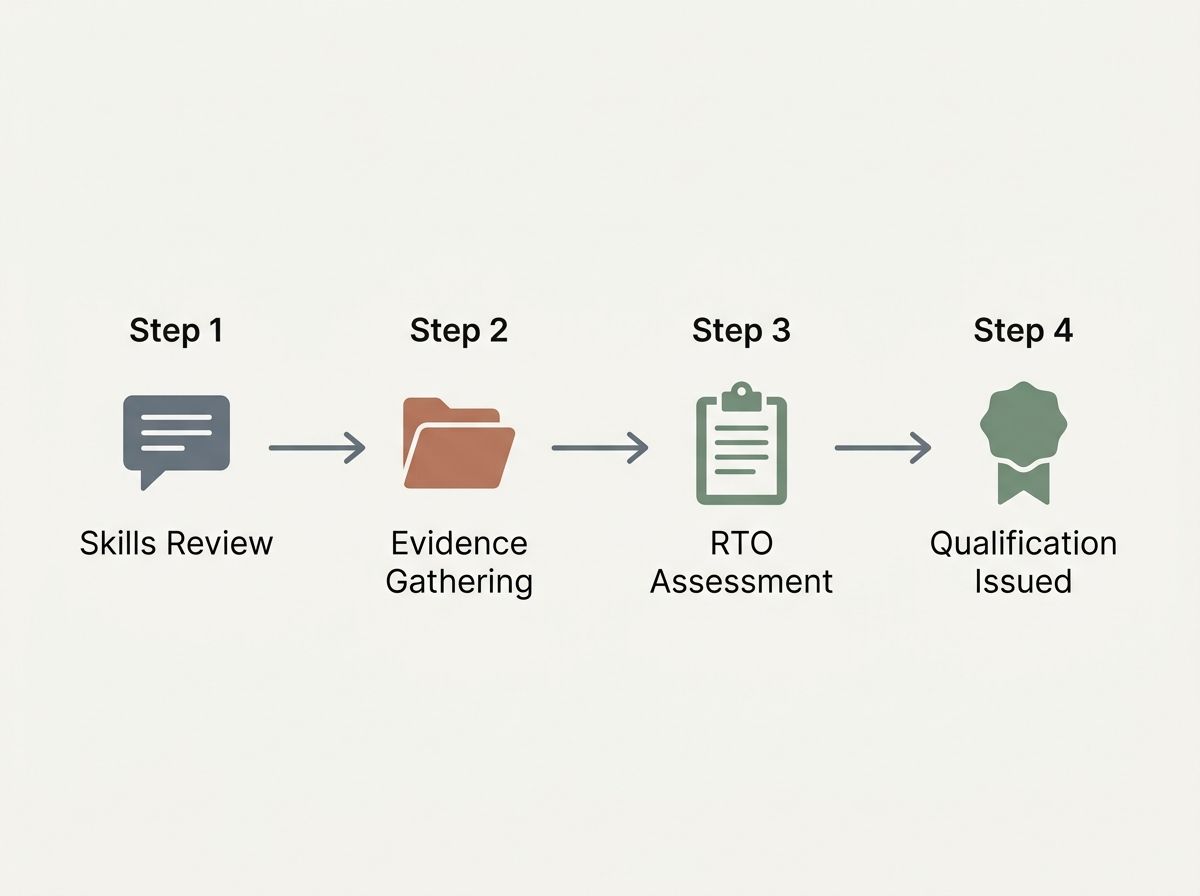
For a freelance hairdresser, this means presenting evidence of what you already do. Based on guidance from RTOs and RPL providers, commonly accepted evidence types include a resume or curriculum vitae, references from employers or clients, photos or videos of your work, job descriptions or service menus, work samples, certificates or records of prior training, and third-party reports from colleagues or supervisors.
For the management and leadership units within SHB40216, evidence that demonstrates how you have led, trained, or supported other stylists, even informally, may be relevant. This could include references from clients or collaborators who can speak to your professional conduct, or documentation of how you have managed your own business operations.
RPL assessors typically evaluate evidence against principles of validity, authenticity, currency, and sufficiency. Most RTOs expect evidence to be reasonably current, typically from the past two to three years, though this varies by qualification and provider.
The RPL process itself is conducted by a qualified assessor from the delivering RTO, either in person or online. The timeframe varies depending on how quickly you can gather your evidence, how quickly previous employers or training organisations can verify information, and whether any gap training is identified.
General RPL guidance from RTOs suggests the process can take anywhere from a few weeks to a few months. If gaps in your competency are identified during assessment, gap training may be required. This is a normal part of the process, not a failure, and it is addressed before the qualification is issued.
It is important to understand the roles clearly: RPL it guides you through the evidence-gathering and documentation process, while the RTO conducts the assessment and issues the qualification. The qualification is nationally recognised because the assessment is genuine.
For a broader overview of how the RPL application process works in Australia, this step-by-step guide from an RTO covers the general stages from initial enquiry through to assessment.
The National Training Register on training.gov.au is the authoritative source for the current unit packaging and entry requirements for SHB40216.
What a Free Skills Review can tell you in one conversation
Before committing to anything, a Free Skills Review maps your existing experience against the qualification requirements. It is a no-obligation conversation designed to answer one question: does what you already do count?
Not everyone will be suitable for RPL. The review exists to find that out honestly, before enrolment, not after. If your experience aligns well with the qualification's competency standards, the review will tell you. If there are gaps, you will know what they are and what addressing them might involve.
Your skills are your asset. The Free Skills Review helps determine whether they match the standards for the Certificate IV in Hairdressing. The decision about what to do next is entirely yours.
Ready to Get Recognised?
Start with a free skills review to find out if RPL is right for you.