You're already halfway to being a heavy diesel mechanic (you just don't know it)
Light vehicle, ag, or plant mechanic eyeing heavy diesel? Your existing skills may already meet most AUR31120 requirements. Here is what transfers.
The assumption that's costing mechanics a better career
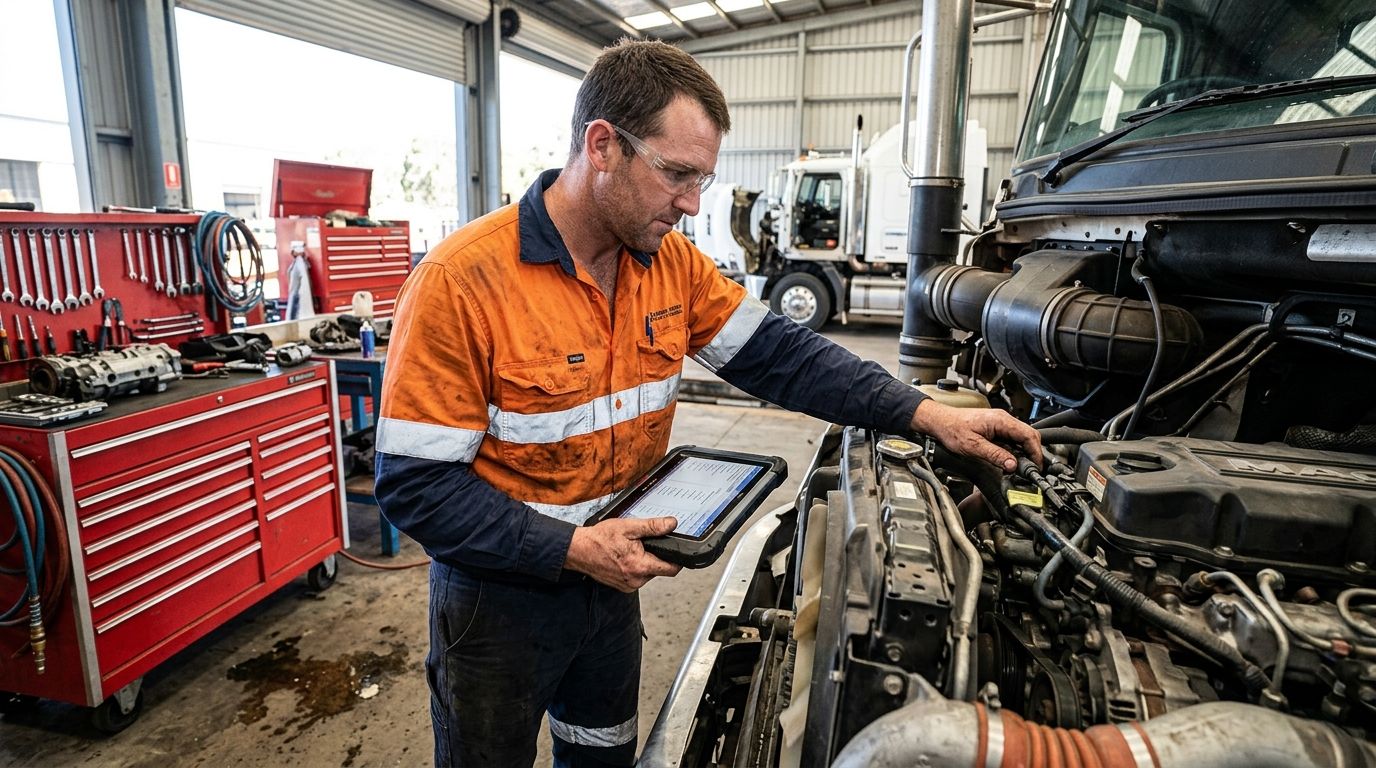
You've been working on engines for years. You can diagnose a fault before the scan tool finishes loading. You have rebuilt drivetrains, traced electrical gremlins, and kept machinery running in conditions that would stump most workshop apprentices. Now you are looking at heavy commercial vehicles, such as big rigs, fleet trucks, or mining support vehicles, and thinking you would need to start an apprenticeship from scratch to get the qualification.
That assumption is wrong. It costs experienced mechanics years of unnecessary repetition.
The mental model most mechanics carry when they consider crossing into heavy commercial vehicle work is that a different vehicle class requires starting a different trade from the beginning. It feels logical. But when you look at what the Certificate III in Heavy Commercial Vehicle Mechanical Technology (AUR31120) actually requires, and compare it against what a light vehicle, agricultural, or mining plant mechanic already does on a daily basis, the picture looks very different.
Your skills speak for themselves. The question is whether the formal system has recognised them yet.
What 'heavy commercial vehicle mechanical technology' actually means
The AUR31120 Certificate III in Heavy Commercial Vehicle Mechanical Technology is the nationally recognised Australian qualification for tradespeople who perform a broad range of diagnostic, maintenance, and repair tasks on heavy commercial vehicles. This includes trucks, buses, heavy transport equipment, and similar vehicles used in freight, construction, mining, and fleet operations.
The qualification covers 36 units in total, including 22 core and 14 elective units. These units cover engine systems, drivetrain and transmission, braking systems, electrical and electronic systems, hydraulics, steering and suspension, and safe working practices. It matches the real-world scope of maintaining and repairing large commercial vehicles across these industries.
If you're a working mechanic reading that list, the overlap is clear. These are not foreign systems. They are the same fundamental disciplines you work with every day, scaled up, applied to heavier vehicles, and governed by a different set of manufacturer specifications. The qualification is the formal recognition of that competency.
For a full overview of the qualification and what the RPL pathway looks like, see the
The skills you already have, and where they come from
This is the part most mechanics do not expect. The competency overlap between related mechanical backgrounds and AUR31120 is substantial. The qualifications are not identical, but the underlying technical disciplines are the same.
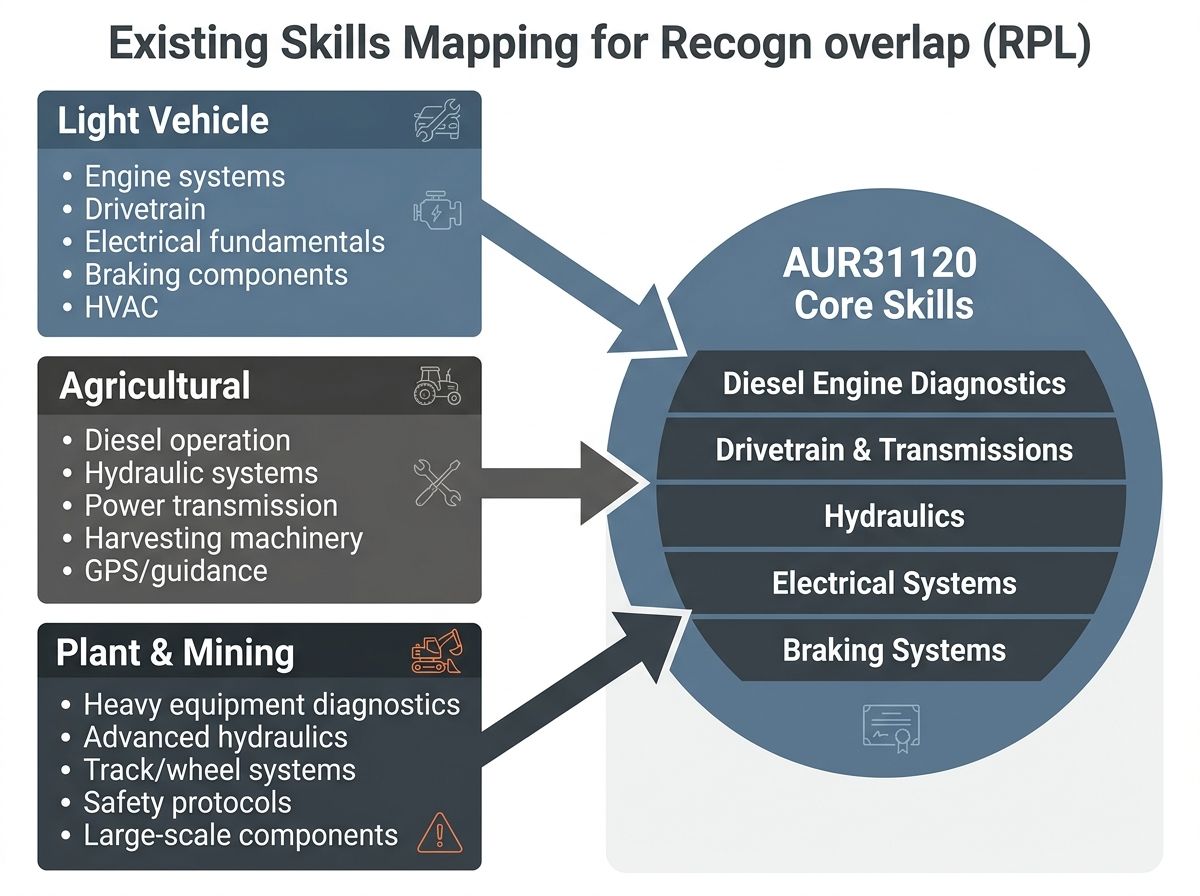
Consider what a light vehicle mechanic does every working day. They diagnose and repair compression ignition and spark ignition engines. They service and repair braking systems, steering and suspension, electrical systems, and drivetrains. They use diagnostic equipment, interpret fault codes, and apply safe working practices. The AUR training package, which governs both AUR30620 (Certificate III in Light Vehicle Mechanical Technology) and AUR31120, shares technical disciplines across these qualifications. In South Australia's approved unit list, for example, the unit AURHTE102 'Diagnose and repair heavy vehicle compression ignition engines' appears across both the agricultural mechanical technology and heavy commercial vehicle qualifications, which demonstrates how unit codes are shared across these pathways.
Agricultural mechanics have a different but equally relevant set of skills. Diagnosing and repairing large diesel engines, working with hydraulic systems under load, and maintaining complex drivetrain components on critical machinery are the daily realities of agricultural mechanical work. The AUR training package release documentation notes that specialist skill sets can provide credit towards multiple AUR qualifications, including both agricultural mechanical technology and heavy commercial vehicle mechanical technology pathways.
Mining and plant mechanics often have the strongest overlap of all. Heavy diesel engines, hydraulic systems, electrical diagnostics on complex equipment, and drivetrain maintenance on vehicles larger than most road trucks are tasks that map directly onto the core competency areas of AUR31120. The scale is familiar, and the technical discipline is the same.
Recognition of Prior Learning (RPL) exists for situations like this. As Charles Darwin University describes it in relation to AUR31120, RPL acknowledges skills and knowledge acquired through previous training, work, or life experience. This acknowledgement applies regardless of how or where those skills were attained, including experience gained in different industries.
Importantly, RPL is not time-referenced. The assessment does not focus on when you learned to diagnose a diesel engine. Instead, it focuses on whether you can demonstrate current competency against the unit requirements.
In New South Wales, both AUR30620 (light vehicle) and AUR31120 (heavy commercial vehicle) are accepted qualifications for motor mechanic tradesperson licensing, which is a regulatory recognition that these qualifications address overlapping occupational competencies.
What is actually different about heavy commercial vehicles
Honest guidance is important here. There are genuine differences between light vehicle or agricultural work and heavy commercial vehicle mechanical technology, and a rigorous RPL assessment will identify those differences.
Heavy commercial vehicles operate under different load ratings, braking standards, and regulatory frameworks. Air brake systems, for example, are a core competency area in AUR31120 that most light vehicle mechanics have not worked with directly. The scale of drivetrain components, including gearboxes, differentials, and axle assemblies, is substantially greater, and the diagnostic and repair procedures reflect that scale. Heavy vehicle electrical systems, while sharing fundamental principles with light vehicle work, involve different configurations and fault-finding approaches.
Agricultural mechanics often have stronger overlap in diesel engine and hydraulic systems than in heavy vehicle braking or road transport-specific electrical systems. Plant mechanics may have excellent hydraulic and diesel competency but less exposure to road-going heavy vehicle compliance requirements.
These are not insurmountable gaps. They are areas where an RPL assessment will identify what evidence you can provide and where gap training may be required. Gap training, where needed, is provided as part of the RPL process. This is not a failure of the pathway, but rather the system working as it should.
Your background does not make you identical to someone who has spent a decade on heavy trucks, but it does make you far closer to that standard than the assumption of starting from scratch suggests.
How RPL turns your experience into a recognised qualification
Recognition of Prior Learning is a formal assessment pathway under the Australian Qualifications Framework. Rather than a shortcut or a workaround, it is a rigorous process that assesses whether your existing skills and knowledge meet the competency standards that make up a qualification.
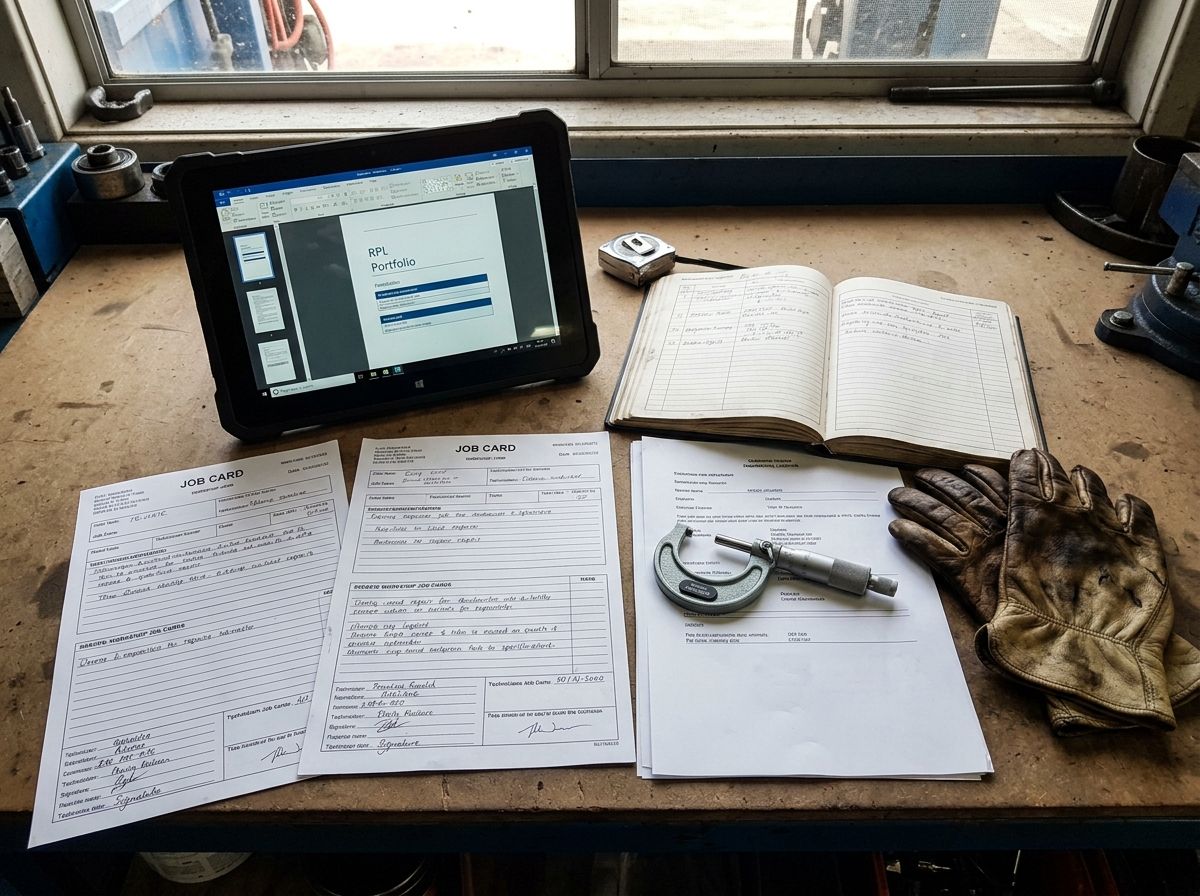
For AUR31120, the RPL process involves a qualified assessor from a registered training organisation (RTO) reviewing evidence of your competency against each unit in the qualification. That evidence can include paid work experience, employer references, logbooks, photographs of work completed, third-party reports from supervisors, and practical demonstrations. CDU notes that RPL can include skills from paid or unpaid work experience, and that the assessment is not time-referenced. This means skills gained five years ago are as valid as skills gained last month, provided they are current and match the unit requirements.
Where gaps are identified in areas where your background does not yet cover a specific unit, gap training is provided. The duration of an RPL assessment varies depending on the evidence you supply, the units covered, and the processes of the RTO. Your chosen RTO can advise on what to expect for your specific situation.
RPL it guides candidates through this process by helping you understand what evidence is needed, how to present your experience, and what to expect at each stage. A qualified assessor from the delivering RTO conducts the assessment itself. The qualification is nationally recognised because the assessment is genuine.
The Gordon, an RTO delivering AUR31120, notes that previous relevant experience may qualify a student for RPL, and previously completed relevant units may be eligible for credit transfer. This confirms that cross-industry mechanical experience is a recognised basis for RPL consideration.
Is this the right move for you? Three questions worth asking
RPL is not suitable for everyone, and honest suitability guidance matters more than a quick enrolment. Before taking the next step, consider these three questions:
- Have you worked hands-on with diesel engines, drivetrains, or hydraulic systems in a professional capacity as a regular part of your role? The depth and regularity of your experience matters more than the specific vehicle type.
- Can you demonstrate that your skills are current? RPL assesses competency as it stands today. If your relevant experience is recent and ongoing, that works in your favour. If it has been several years since you worked in a relevant role, consider whether your skills remain current against the unit requirements.
- Do you have evidence of your work? Logbooks, employer references, photographs, records of completed jobs, or third-party reports from supervisors are all useful, as the RPL process is evidence-based. The stronger your documentation, the more straightforward the assessment.
If you answered yes to most of these, your experience is worth a closer look. A Free Skills Review is the appropriate first step. It gives you an honest assessment of your likely suitability before you commit to anything.
What happens after you get the qualification
AUR31120 opens doors across a range of industries that depend on heavy commercial vehicles, including transport and logistics, mining, construction, defence, fleet management, and municipal operations. Heavy commercial vehicle technicians are among the roles the qualification directly supports.
The broader motor mechanic workforce, which includes diesel motor mechanics, employs around 112,600 people in Australia, according to Jobs and Skills Australia, with annual employment growth of approximately 1,800 positions. The occupation group is predominantly full-time, with 91% of motor mechanics working full-time compared with 69% across all occupations.
On earnings, the broader motor mechanics occupation records median full-time earnings of around $1,622 per week before tax, according to JSA data. Specialist heavy vehicle and diesel work can attract higher rates in practice, and a formal trade qualification changes your award classification. This moves you from an unqualified assistant rate to a qualified tradesperson rate under the Vehicle Repair, Services and Retail Award.
Job-board salary aggregation from Indeed suggests heavy equipment mechanics in Australia average around $99,959 per year, though this figure is indicative only and actual earnings vary with employer, location, experience, and enterprise agreements.
What the qualification does, above all, is make your experience visible. Before formal recognition, your competency exists in the work you do every day. After formal recognition, it exists in a nationally recognised credential that employers, licensing bodies, and industry partners can see and act on.
You have done the work. The question is whether the formal system reflects it. The decision is yours.
For more on how formal recognition changes what employers see when they look at your experience, read
Ready to Get Recognised?
Start with a free skills review to find out if RPL is right for you.