The site induction that finally sent you home: Why unlicensed carpenters are getting caught out
Experienced carpenters are being turned away at site gates across Australia. Here's why compliance is tightening, and how carpentry RPL gets you back on site.

The morning it stopped being theoretical
You pull up to the site at seven. Tools in the ute. You know this job; you've been doing work like it for years. Framing, structural fit-out, the kind of work that goes up fast and stays solid. You've done it in the rain, in the heat, on sites bigger than this one.
The site induction is routine. White card. Site-specific safety briefing. Emergency procedures. You've done a hundred of these. Then the form asks for your trade qualification. CPC30220. Certificate III in Carpentry.
You don't have it. Not the formal one. You have the skills, fifteen years of them, but not the piece of paper the principal contractor's system requires. And so, for the first time, or maybe not the first time, you are turned away.
This is the moment. Not a hypothetical. Not a future risk. It is happening to experienced carpenters across Australia right now on tier-one residential builds, commercial fit-outs, and government infrastructure projects. The gate is real. The problem is real. And it is not going away.
Why this is happening more, not less
The compliance environment on Australian construction sites has been tightening for years. This is not driven by a single change, but by a combination of factors. Work health and safety legislation, insurance requirements, and principal contractor liability frameworks have all moved in the same direction: toward formal documentation of subcontractor competency.
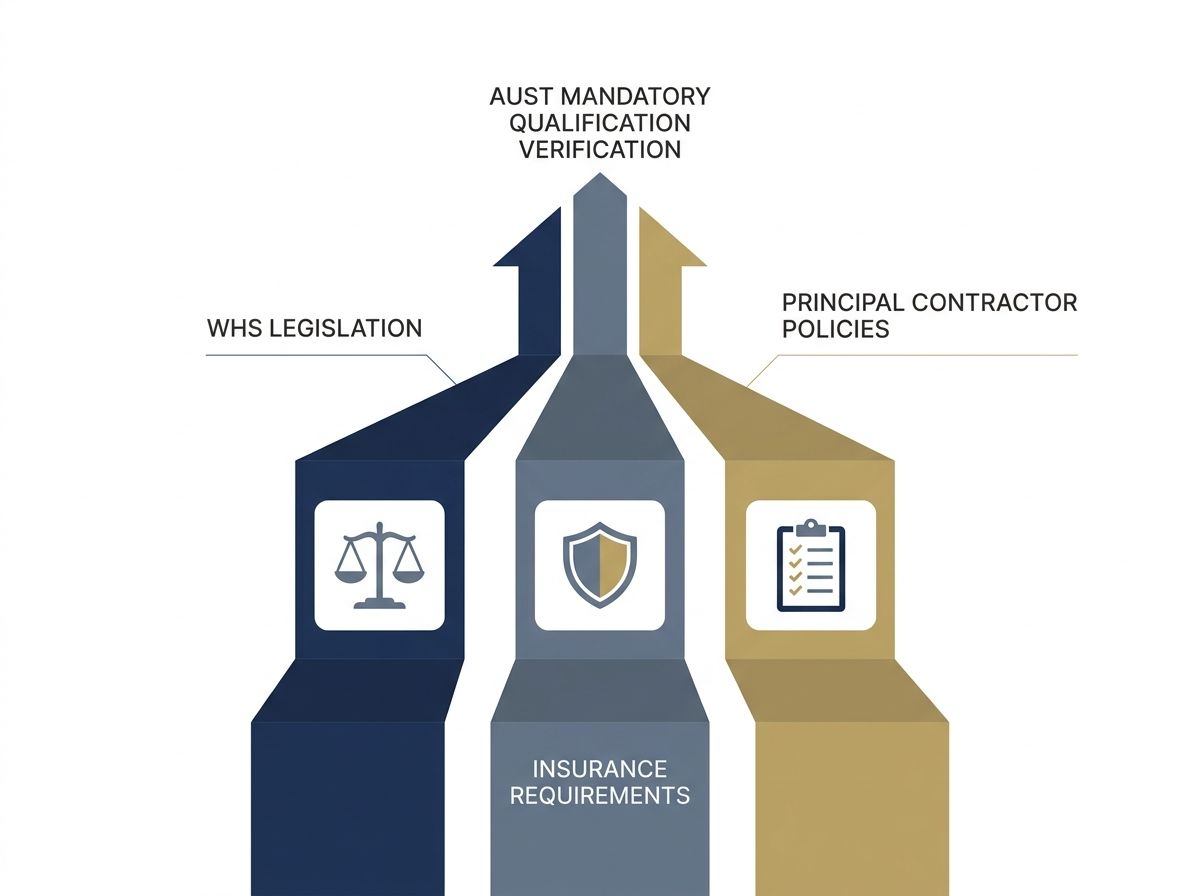
Under the national WHS harmonisation framework, principal contractors bear primary responsibility for site safety, including the work performed by subcontractors. That liability creates a powerful incentive to verify that everyone on site holds the qualifications their role requires.
At the procurement level, the picture is similar. Infrastructure Australia's 2025 Infrastructure Market Capacity Report notes that for government construction projects above $7.5 million, tender responses must demonstrate capability to meet Australian Standards, and agencies are required to make reasonable inquiries to confirm compliance. The expectation of formal capability demonstration is now embedded in how major projects are procured.
State-level reforms are reinforcing this direction. In New South Wales, SafeWork NSW has been revising the Tunnels Under Construction Code of Practice to embed consistent safety standards, which were developed in collaboration with industry to strengthen compliance and early intervention. NSW is also actively exploring harmonisation of qualifications across jurisdictions and recognition of trade qualifications for critical skills areas.
None of this is uniform. Requirements vary by state, by principal contractor, and by project type. But the direction is consistent: formal qualification verification is becoming the baseline, not the exception. If you are working as a subcontractor on any significant construction site in Australia, the question of your formal credentials is increasingly likely to come up.
What 'unlicensed' actually means on a modern construction site
Here is what needs to be said clearly: for most of the carpenters being caught out at site inductions, 'unlicensed' does not mean unskilled. It means their competence exists in the wrong form for formal recognition.
You can read a structural plan. You can frame a wall to tolerance. You can manage a subcontract, supervise a crew, and solve the kind of problems that only come with years on the tools. None of that is in question. What the site induction form is asking for is a CPC30220, the nationally recognised Certificate III in Carpentry, which is a different thing entirely.
This is what might be called a recognition gap. Not a skills gap. The competence is there. The formal evidence of that competence is not. The system cannot see what it cannot verify. And on a modern tier-one construction site, if the system cannot see it, you are not getting through the gate.
That distinction matters. Because the solution to a recognition gap is not going back to TAFE and learning carpentry again. The solution is presenting what you already know in a form the formal system can assess. That is exactly what Recognition of Prior Learning (carpentry RPL) is designed to do.
The real cost of staying unlicensed
The cost of not having the qualification is not abstract. It is days off site. Lost income. Contracts you cannot tender for independently. And in some states, it is a legal exposure that goes well beyond inconvenience.
In Queensland, the QBCC is explicit: carrying out or offering to carry out building work without the appropriate licence is an offence. Unlicensed contractors cannot quote, cannot sign building contracts, and cannot perform the work. If discovered, they must stop work immediately. The QBCC maintains a zero-tolerance policy, and some breaches can result in courts imposing imprisonment. Unlicensed contractors in Queensland are regularly fined. For current penalty amounts, check directly with the QBCC.
The QBCC outlines exactly what constitutes unlawful building work and what happens when you are caught, including the requirement to stop work immediately.
In NSW, some exemptions from the unlicensed work offence exist for specific categories, such as council employees doing residential building work in the ordinary course of their duties. But for most self-employed carpenters and subcontractors, the licensing requirement applies. For current NSW penalty information, contact NSW Fair Trading directly.
Insurance is a separate but related concern. Public liability insurance is a practical baseline for any carpenter working on site; most builders and head contractors require a Certificate of Currency showing coverage before work can start. Insurers and brokers typically ask about licensing status and the nature of the work as part of underwriting. According to insurance broker guidance, many policies include general exclusions for illegal activities. Whether unlicensed work affects your specific coverage depends on your policy terms, and that is a conversation worth having with your insurer before the question becomes urgent.
Marsh Australia's guidance for carpenters outlines common insurance exclusions and the types of cover typically needed for trade work.
The picture is consistent across states: staying unlicensed is not a neutral position. It is an ongoing exposure to lost work, legal risk, and the kind of site-gate moment that turns a working day into a wasted one.
What carpentry RPL actually is, and what it is not
Recognition of Prior Learning (RPL) is a formal assessment process conducted by a registered training organisation (RTO). For carpentry, it evaluates whether your existing experience and skills meet the national standard for the Certificate III in Carpentry (CPC30220). If the assessment confirms competency, the qualification is issued. If gaps are identified, gap training is provided to address them.
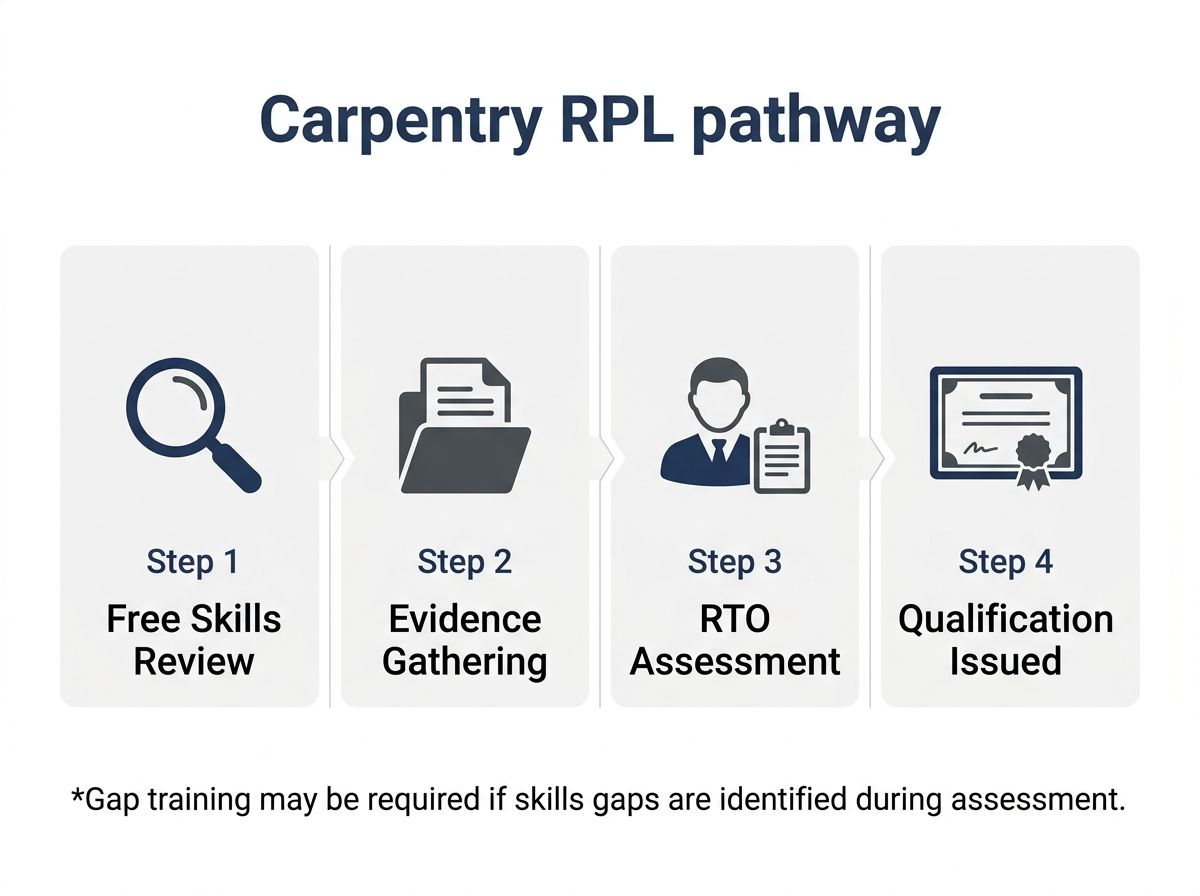
RPL is not a shortcut, a loophole, or a way to purchase a certificate. It is a rigorous, nationally recognised assessment pathway that applies the same standard as any other route to the CPC30220. The difference is that instead of sitting through units you already know, the assessment focuses on whether you can demonstrate that knowledge through evidence of your actual work.
The assessment is conducted by the delivering RTO, not by RPL it. RPL it guides you through the process, helping you understand what evidence is needed, how to gather it, and how to present it. The assessor from the RTO makes the competency determination. Gap training, if required, is part of the process and is provided at no additional cost.
Experience can be evidence. That is the core of what RPL does: it creates a pathway for competence that already exists to be formally assessed and acknowledged. Recognition, not repetition.
What counts as evidence for a carpentry RPL assessment
Experienced carpenters typically have more evidence than they realise. Years of site work generates a documentary trail. The question is not whether the evidence exists; it is whether it has been gathered and presented in a way the assessment process can use.
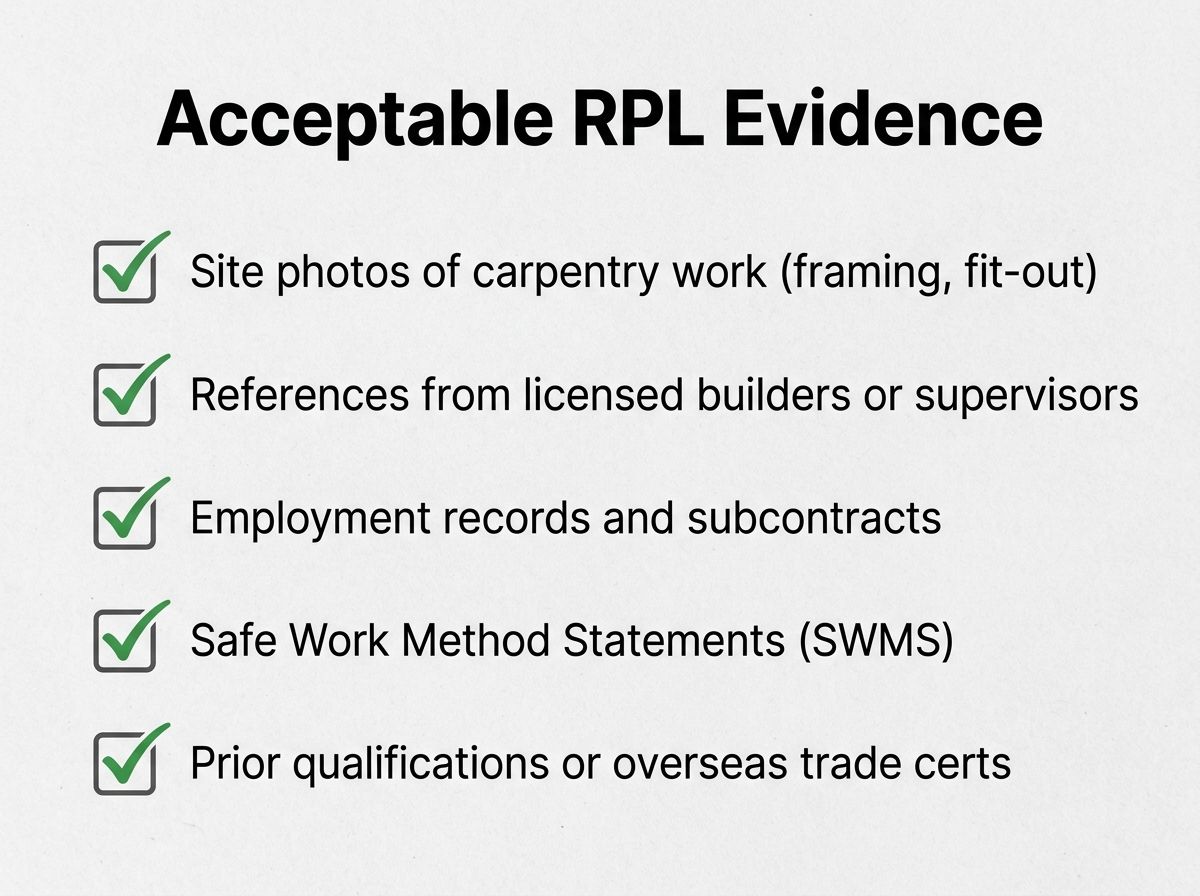
For a CPC30220 RPL assessment, evidence typically includes:
- Photographs of completed work, including framing, roofing, structural fit-out, joinery, and other carpentry tasks you have performed
- References from builders, site supervisors, or project managers who can verify your work and your competency
- Subcontract agreements or employment records showing the nature and scope of work you have undertaken
- Safe Work Method Statements (SWMS) you have prepared or worked under
- Toolbox talk records or site safety documentation you have contributed to
- Any prior qualifications or training records, including overseas trade qualifications or certificates
If you trained and worked as a carpenter overseas, that experience can be considered as part of an RPL assessment. Your international work history, overseas qualifications, and employment records can all contribute to your evidence portfolio. The starting point for understanding how your specific background maps to the Australian standard is a Free Skills Review.
A chippy who has spent a decade on residential builds in Queensland, five years doing commercial fit-out in Victoria, or fifteen years across a range of structural and finishing work almost certainly has the raw material for an RPL assessment. The task is not finding the experience; it is organising and presenting it.
Infrastructure Australia's 2025 report notes that NSW is exploring recognition of trade qualifications obtained overseas for critical skills areas, signaling that the policy environment is moving toward broader recognition of diverse experience.
The practical bridge back to site
Carpentry RPL is the most direct pathway from the site-gate moment to being back on site with the right documentation. It does not require you to stop working. It does not require you to sit in a classroom and repeat what you already know. It requires you to present what you have already done in a form a qualified assessor can evaluate.
The process begins with a Free Skills Review, which is an honest, no-obligation assessment of whether your experience is likely to meet the standard for CPC30220. If it does, you move into evidence gathering and then formal assessment by the RTO. If gaps are identified, gap training addresses them. The qualification is issued when competency is confirmed.
Other experienced tradies are navigating the same compliance wall, and finding that their years of work are exactly what the assessment process is designed to recognise.
The experience of being turned away at the gate is not unique to carpentry.
The decision is yours. But the pathway is clear. If you want to know where you stand before committing to anything, a Free Skills Review is where to start; it costs nothing and commits you to nothing.
Start with a free skills review
Before committing to anything, find out whether your carpentry experience is likely to meet the standard. The Free Skills Review is a no-obligation starting point that offers an honest assessment of whether RPL is the right pathway for your situation. If it is not, you will be told that too.
You have the experience. The question is whether it can be presented as evidence. That is exactly what the Free Skills Review is designed to answer.
The decision is yours.
Ready to Get Recognised?
Start with a free skills review to find out if RPL is right for you.