Locked Out of Site? Why Your Carpentry Experience Isn't Enough for Compliance Anymore
Experienced carpenter told you need formal certification to stay on site? Carpentry RPL assesses what you already know. Find out if your experience qualifies.
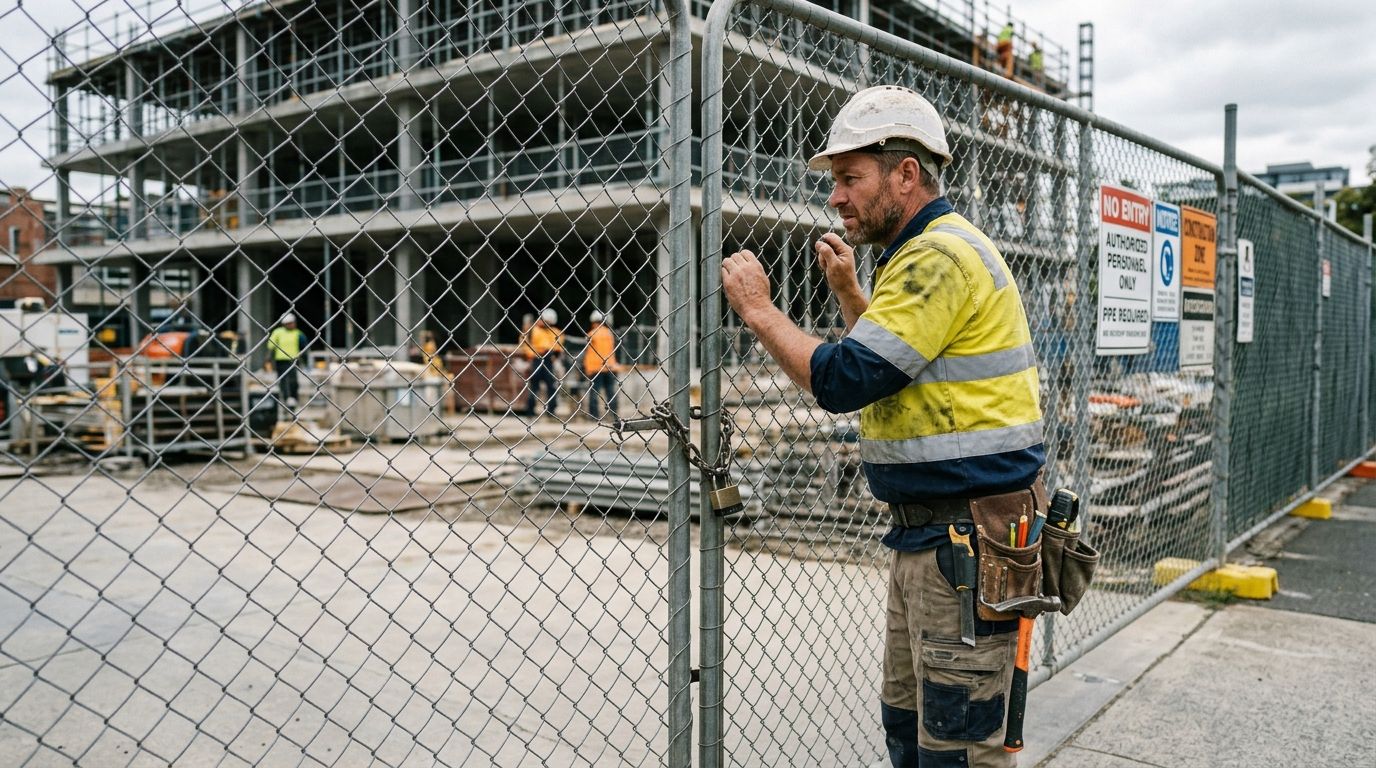
The moment everything changed: You showed up and couldn't work
You have been doing this for years. Framing, formwork, fit-out, across residential and commercial jobs. You know how a site runs. You have worked alongside apprentices who are now running their own crews. And then one morning, you show up to a site you have worked on before, or a new commercial job you were looking forward to, and you are turned away at the gate.
Not because your work is poor. Not because you did anything wrong. It is because you do not have a formal Certificate III in Carpentry (the CPC30220) and the principal contractor's WHS management plan requires it.
This is not a hypothetical. It is happening to experienced carpenters across Australia as compliance requirements tighten on commercial and government-funded construction projects. Your skills are real and your experience is deep. But in formal systems, experience without paper is experience the system cannot see.
Why this is happening now: The compliance shift that changed the rules
The construction industry in Australia is large and growing. According to Jobs and Skills Australia, around 9.3 per cent of Australian workers have their main job in construction, with employment reaching 1,371,500 as of early 2026. That scale brings scrutiny, and with scrutiny comes documentation requirements.
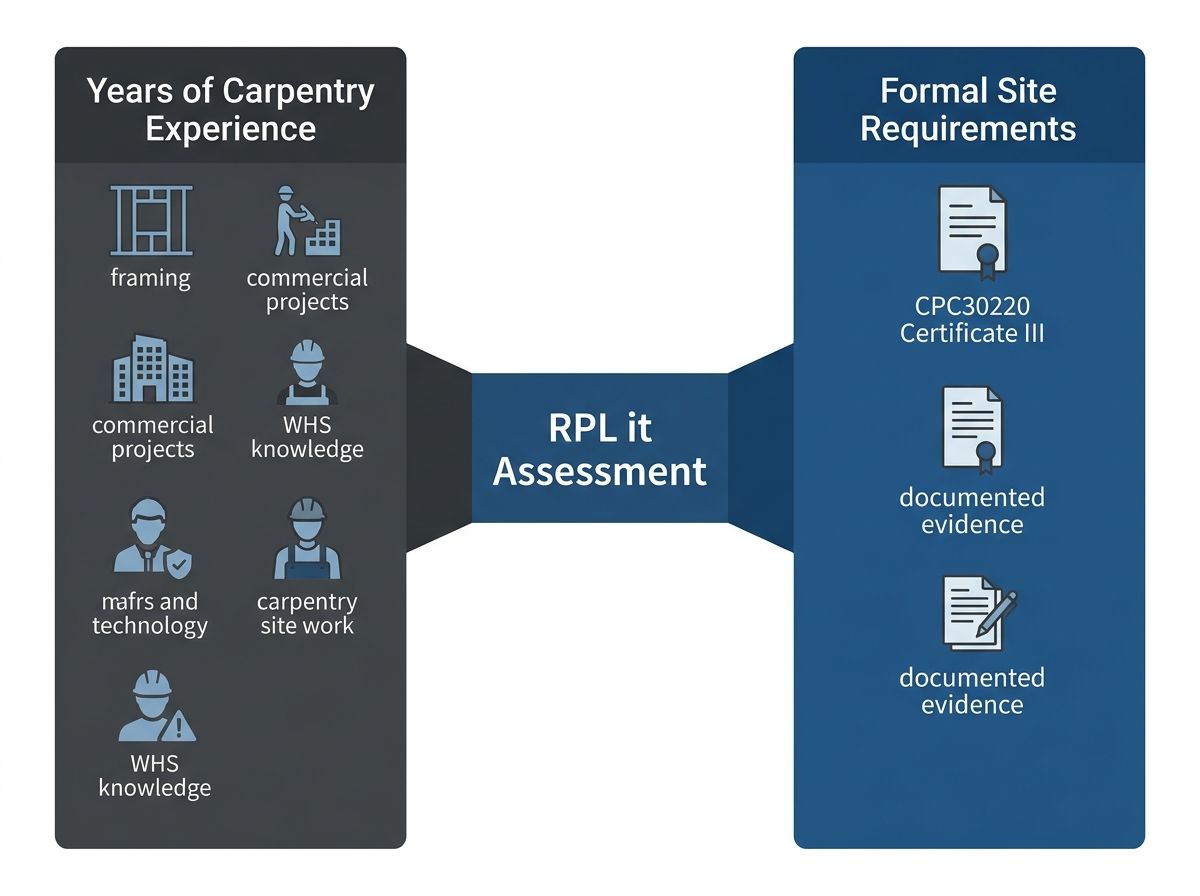
Principal contractors on commercial and government-funded projects are now required to prepare and manage Work Health and Safety management plans. These plans increasingly specify that trade workers, including carpenters, must hold nationally recognised qualifications. This is not about whether you can do the work. It is about whether the formal system can verify that you can.
Licensing requirements for carpentry vary across states and territories. In Queensland, for example, the QBCC requires licence applicants to demonstrate technical skills through accepted evidence, which can include formal qualifications, apprenticeship papers, or an RPL certificate from a Registered Training Organisation. Other states have their own licensing bodies and requirements. What is consistent across jurisdictions is the direction: formal credentials are increasingly expected, not optional.
Industry bodies have long called for national consistency in how construction skills are certified. The push for formal recognition of trade competencies is not new, but the enforcement of it at the site-access level is becoming more common, particularly on larger commercial and government-contracted projects.
What the Certificate III in Carpentry covers, and why you probably already know it
The CPC30220 Certificate III in Carpentry is Australia's nationally recognised trade qualification for carpenters. It covers carpentry work across both residential and commercial construction sites, which is the work experienced carpenters do every day.
The qualification includes units covering setting out and constructing wall frames, installing structural timber, working safely at heights, reading and interpreting plans and specifications, applying WHS requirements on site, and using carpentry tools and equipment. If you have been working as a carpenter for several years, you are likely already doing most of what this qualification formally documents.
The CPC30220 is typically the qualification awarded at the completion of a carpentry apprenticeship. For those who came up through the trade without a formal apprenticeship, or whose apprenticeship was completed overseas, the qualification may never have been formally issued, even though the competency is there.
This is the core of the problem. The work is real and the skills are real. The qualification is missing because your competency was never formally assessed and documented.
What carpentry RPL actually is, and what it is not
Recognition of Prior Learning (RPL) is a formal assessment process under the Australian Qualifications Framework. It evaluates skills, knowledge, and experience gained through work, and can lead to a nationally recognised qualification. It is not a shortcut, nor is it a purchased certificate. It is a genuine assessment of whether your existing competency meets the national standard.
In a carpentry RPL assessment, a qualified assessor from a Registered Training Organisation reviews evidence of your existing skills and knowledge against the units of competency in the CPC30220. If your competency is demonstrated across the required units, the qualification is issued. If gaps are identified, gap training is typically provided at no additional cost to address those specific areas before the qualification is issued.
The evidence used in an RPL assessment may include a resume and employment history, references or statutory declarations from employers or supervisors, photographs or videos of completed work, job descriptions, work samples, and certificates or prior training records. Requirements vary by RTO and qualification, and your assessor will confirm what evidence is needed for your specific situation.
The assessment may also include an interview with a qualified assessor, conducted in person or online, to validate your experience and clarify any aspects of your evidence.
What carpentry RPL is not: it is not a way to bypass legitimate assessment. It is not a guarantee of qualification, and it is not suitable for everyone. Honest suitability guidance matters. If your experience does not yet meet the standard, a good RPL provider will tell you that before you enrol, not after.
The warning signs: When your situation has become urgent
Some situations are worth monitoring, but others require immediate action. If any of the following applies to you, your compliance gap has become a risk that needs resolving:
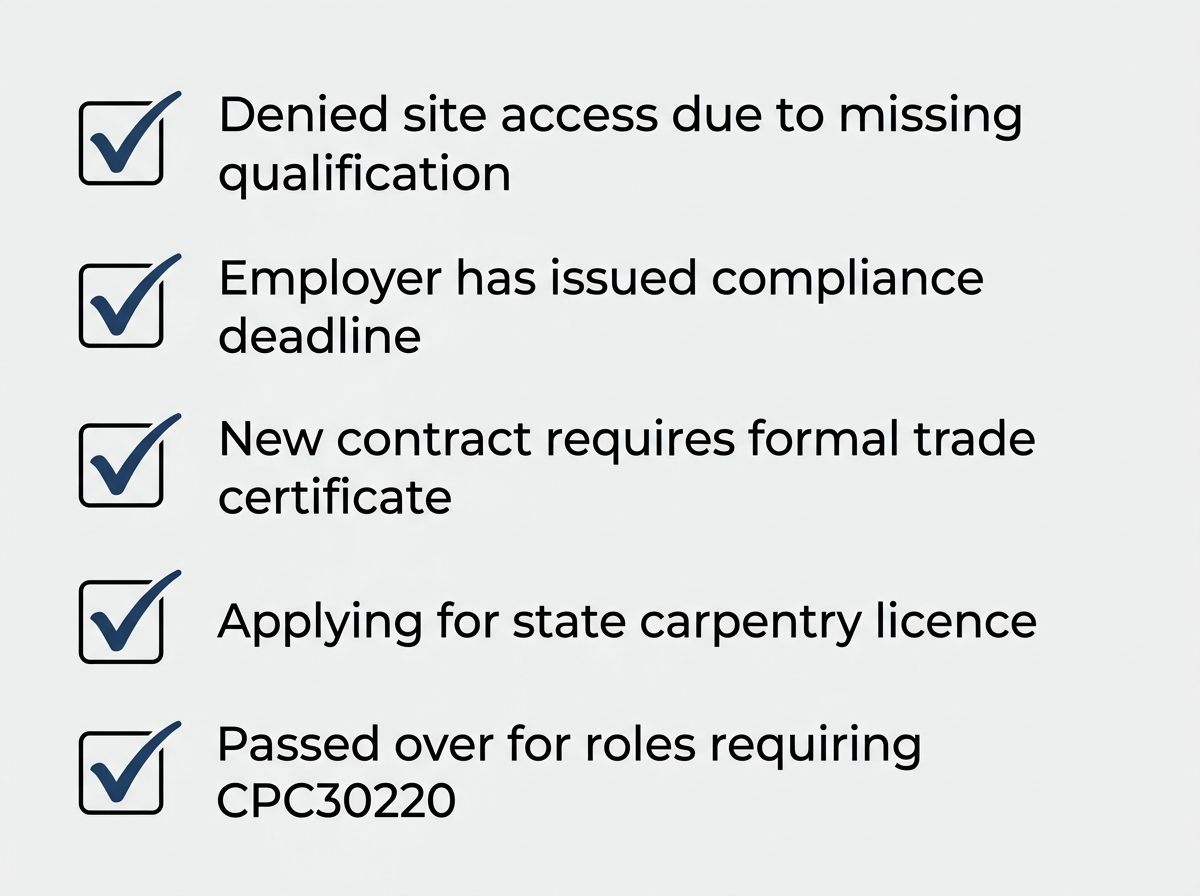
- You have been denied access to a commercial or government-funded construction site because you do not hold a formal carpentry qualification.
- Your employer has issued a deadline requiring you to obtain the Certificate III in Carpentry to stay in your current role.
- A new contract or project you were expecting to work on requires all carpenters to hold CPC30220 or equivalent.
- You are applying for a carpentry licence and the state authority requires evidence of a formal qualification.
- You are being passed over for roles or projects that require formal certification, despite having the practical skills to do the work.
If you recognise your situation in any of these points, a Free Skills Review can show you if your experience qualifies for RPL, with no commitment required.
What happens if you wait: The cost of leaving the gap open
Delaying does not make the compliance requirement go away; it compounds the problem. The construction industry's direction toward formal documentation of trade competency is structural, not temporary. More projects, particularly those involving government funding or large principal contractors, are specifying formal qualification requirements as part of their WHS management obligations.
Operating without the required credentials can result in being excluded from sites, losing access to roles you are qualified to perform, and, in some states, potential penalties for unlicensed trade work.
The gap between your experience and your formal record is real, but it is navigable. Recognition of Prior Learning exists precisely for this situation: experienced workers whose competency is genuine but whose formal documentation has not kept pace with what the system now requires.
How the carpentry RPL process works: From evidence to assessment
The carpentry RPL process follows a structured pathway. Understanding what is involved helps you plan around your existing work commitments, as the process is designed to work alongside your job, not require you to stop working.
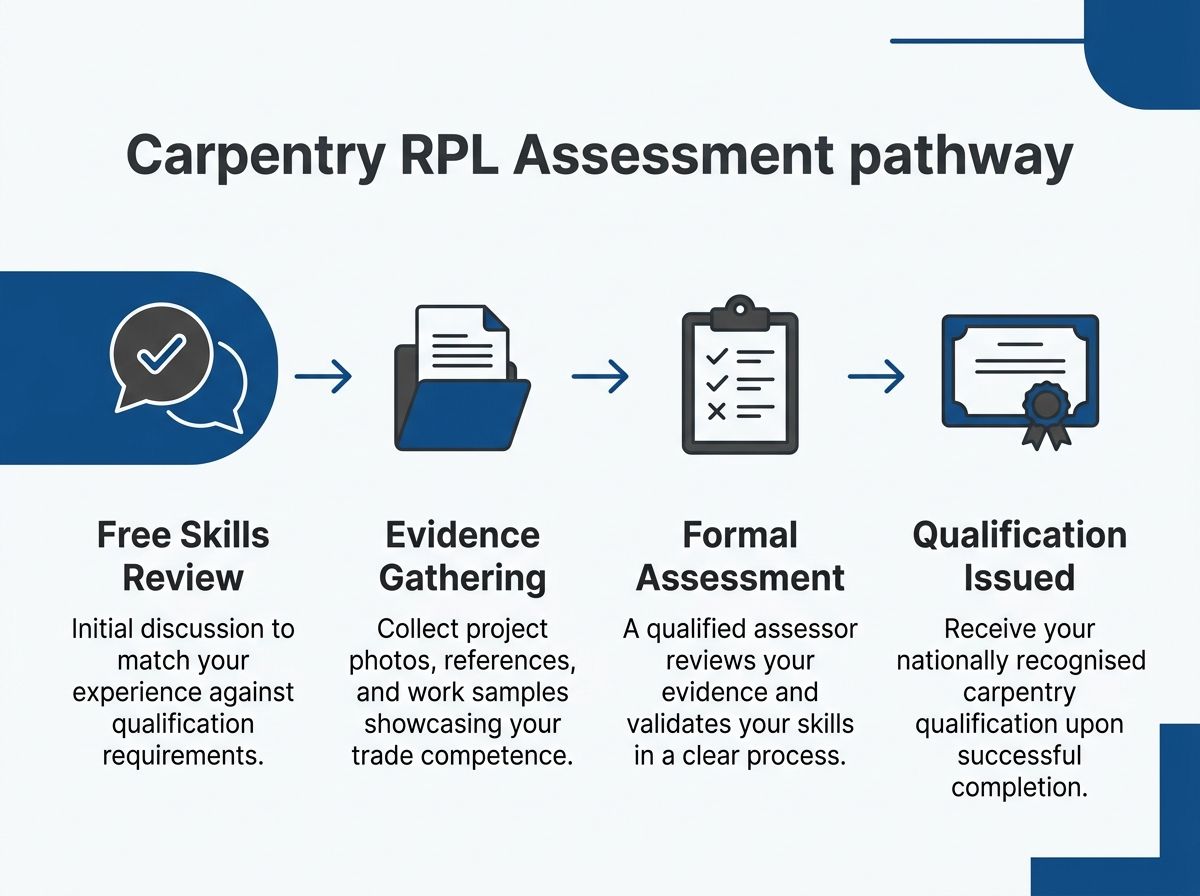
- Step 1: Free Skills Review. An initial conversation to assess whether your experience and background are likely to meet the requirements for RPL. This is a no-obligation step that exists to give you honest guidance before you commit to anything.
- Step 2: Evidence Gathering. Working with your RPL provider to compile the evidence that demonstrates your competency. This may include employment records, references, work photographs, and other documentation relevant to the CPC30220 units.
- Step 3: Formal Assessment. A qualified assessor from the delivering RTO reviews your evidence and may conduct an interview or practical observation to validate your competency against the national standard.
- Step 4: Qualification Issued (or Gap Training). If your competency is demonstrated across the required units, the Certificate III in Carpentry is issued by the RTO. If gaps are identified, targeted gap training is provided before the qualification is issued.
How long does the process take? One ASQA-regulated RTO notes that carpentry RPL can take from a few weeks to a couple of months, depending on how quickly evidence can be gathered. The Western Australian Construction Training Fund advises that the duration depends on how much RPL is being applied for and is confirmed by the RTO assessor. These are indicative timeframes, and your assessor will give you a more specific picture based on your situation.
For carpenters in Queensland, the QBCC outlines the accepted evidence for demonstrating technical skills when applying for a carpentry licence, which includes an RPL certificate from a Registered Training Organisation.
State licensing requirements vary across Australia. If you are working toward a carpentry licence in your state, check with your relevant state authority, such as the QBCC in Queensland, NSW Fair Trading, or the Victorian Building Authority, to understand how an RPL qualification fits into the licensing pathway in your jurisdiction.
Your experience has value. The question is whether the system can see it.
The problem is not that you lack skill. The problem is that your skill exists in a form the formal system cannot yet read. Years of framing walls, reading plans, managing materials, and working safely on site constitute real competency. Carpentry RPL is the process that makes it visible.
It does not create new skills. It presents your existing ones as formal evidence, assessed against the national standard for the Certificate III in Carpentry.
You have the experience. The question is whether it qualifies for RPL. A Free Skills Review is the first step: a no-obligation conversation that gives you an honest answer before you commit to anything. The decision is yours.
The Certificate III in Carpentry (CPC30220) is the nationally recognised qualification for carpenters in Australia, covering work across residential and commercial construction sites.
For a general overview of how the RPL application process works in Australia, including what types of evidence are typically accepted, this step-by-step guide covers the key stages.
Ready to Get Recognised?
Start with a free skills review to find out if RPL is right for you.