The hidden compliance risk in your butcher shop
Unqualified senior butchers create audit risks. Discover how RPL secures your business compliance without taking your best staff off the floor.

The butcher who runs the floor without formal qualifications
Are your best butchers your biggest audit risk? You already know who this person is. They are the ones who open the shop, train new starters, prepare the difficult primal cuts, and keep the floor running when you are away. They have done this for years, sometimes decades. Their skill is visible every working day. Their documentation is not.
This is not unusual in retail butchery. It is the standard. Most experienced butchers in Australia learned their trade on the job through hands-on mentorship, daily repetition, and hard-won practical knowledge. The trade was passed down directly rather than formally taught. For a long time, that system worked. The problem is that formal systems now require documented proof of competency. On-the-job learning, no matter how deep, leaves no paper trail that a food safety auditor, an insurer, or a supply contract manager can verify.
The most capable person on your floor may be the one with the least documentation. That gap between visible expertise and formal qualification is the compliance risk most butcher shop owners have never named.
Why this pattern persists in retail butchery
The retail butchery industry has historically relied on on-the-job training pathways rather than classroom-based vocational education. Apprenticeships existed, but many experienced butchers entered the trade through informal mentorship arrangements. They learned from senior tradespeople, built skills over years of daily practice, and never needed a certificate to prove what their hands could do.
Skills Insight, the industry skills body responsible for the meat processing training package, has identified that current retail butchery qualifications require updates to reflect how the industry actually operates. This includes addressing the gap between what experienced workers know and what formal systems recognise. The qualification framework has evolved, but the workforce has not always kept pace.
Skills Insight is currently undertaking a Retail Butchery and Smallgoods Project to redesign qualifications and address identified skill gaps in the sector.
The result is a recurring cycle. Experienced butchers accumulate genuine competency over years of work. Formal systems require documented evidence of that competency, but the documentation does not exist. The compliance gap opens quietly, without anyone intending it.
What the compliance risk looks like in practice
The risk is not theoretical. It surfaces at specific, inconvenient moments, and it tends to surface across more than one front at once.
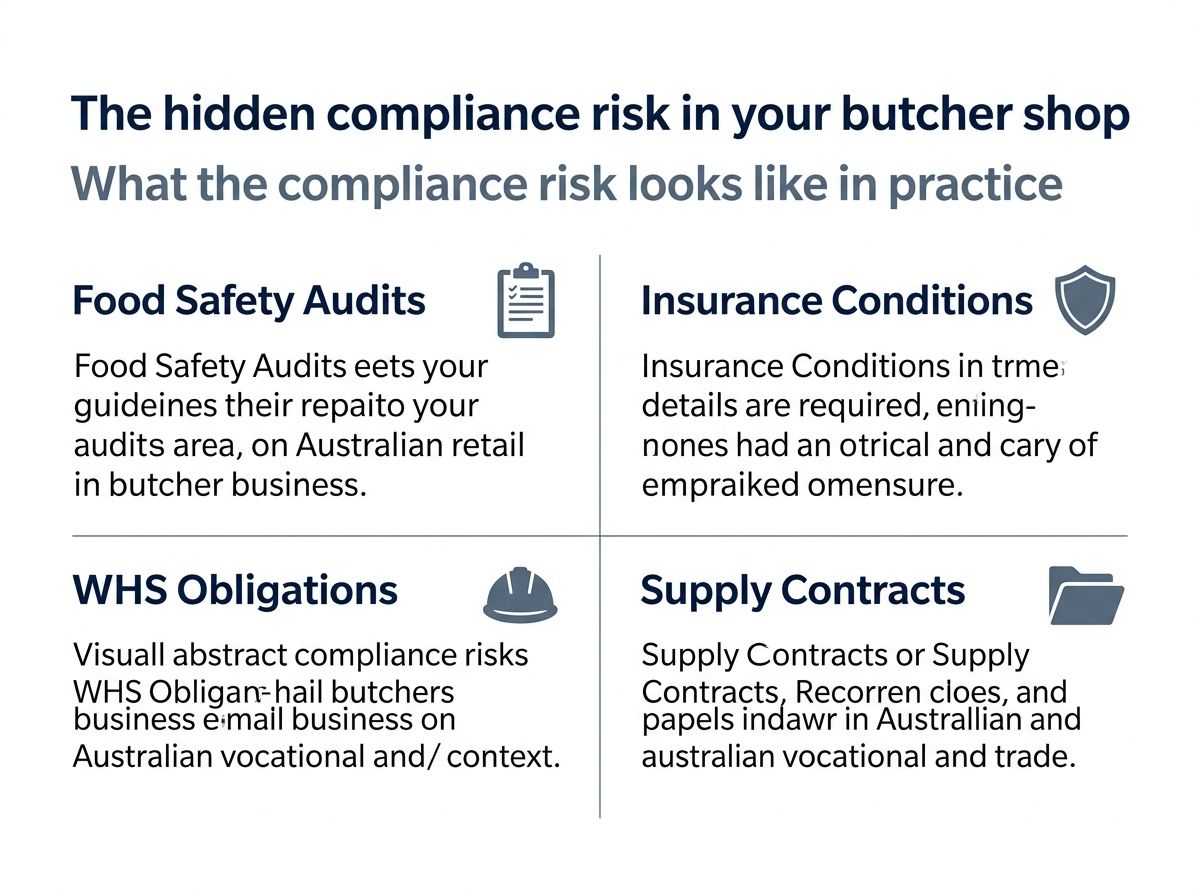
Food safety compliance is the most immediate exposure. Under the FSANZ Food Standards Code, food businesses must ensure staff have the skills and knowledge to handle food safely. State food authorities, including the NSW Food Authority and Safe Food Queensland, require retail meat businesses to have a qualified Food Safety Supervisor and to demonstrate that staff competencies meet food safety standards. An audit finding that links a food safety incident to unqualified staff can have serious consequences for a business's licence to operate.
Safe Food Queensland outlines specific requirements for retail butcher businesses, including staff competency and food safety management obligations.
Insurance is a second exposure point. Public liability and business insurance policies for food businesses often include conditions related to staff competency and compliance with food safety legislation. If a claim arises from a food safety incident and it is shown that staff lacked formal qualifications, insurers may scrutinise whether the business met its duty of care obligations. This is not a guaranteed outcome because policy language varies, but it is a risk worth understanding before an incident occurs.
Supply contracts are a third exposure point. Retail butcher shops supplying hospitality venues, aged care facilities, schools, or institutional clients are increasingly required to demonstrate workforce compliance during supplier qualification. A shop that cannot verify its staff hold recognised qualifications may find itself excluded from tender processes or supply arrangements it previously took for granted.
The same pattern plays out across other trades: experienced workers, no paper trail, and hidden compliance exposure that surfaces at the worst possible moment.
The real cost of the qualification gap
When butcher shop owners think about compliance risk, they tend to think about penalties. The actual cost is broader, and in many cases, the hidden costs outweigh any regulatory fine.
Consider what happens when a key operator needs to get formally qualified through traditional study. The Certificate III in Meat Processing (Retail Butcher) delivered through a TAFE or registered training organisation typically takes one to two years and can cost several thousand dollars in fees, depending on the provider and the state. That is before you account for the lost hours when your most experienced person is off the floor attending classes or completing assessments. For a small retail butcher shop, removing a senior operator from the floor, even part-time, creates a bottleneck that affects every other staff member and every customer interaction.
There is also the opportunity cost. A shop that cannot demonstrate a formally qualified workforce may be unable to bid for supply contracts, expand into new markets, or satisfy the compliance requirements of a new commercial landlord or business partner. The qualification gap does not just create risk; it limits growth.
And there is the human cost. Asking an experienced butcher to sit through training that covers what they already know, simply because the system requires it, is a clear message. It says their years of work do not count. That message lands. Recognition, not repetition, is what experienced workers deserve.
The cost of traditional study for experienced workers is a pattern that plays out across every trade, and the maths rarely favours the employer.
What the Certificate III in Meat Processing covers
The Certificate III in Meat Processing (Retail Butcher), qualification code AMP30815, is the nationally recognised qualification for experienced retail butchery work in Australia. It includes 44 units of competency: 37 core units and 7 elective units. There are no formal entry requirements.
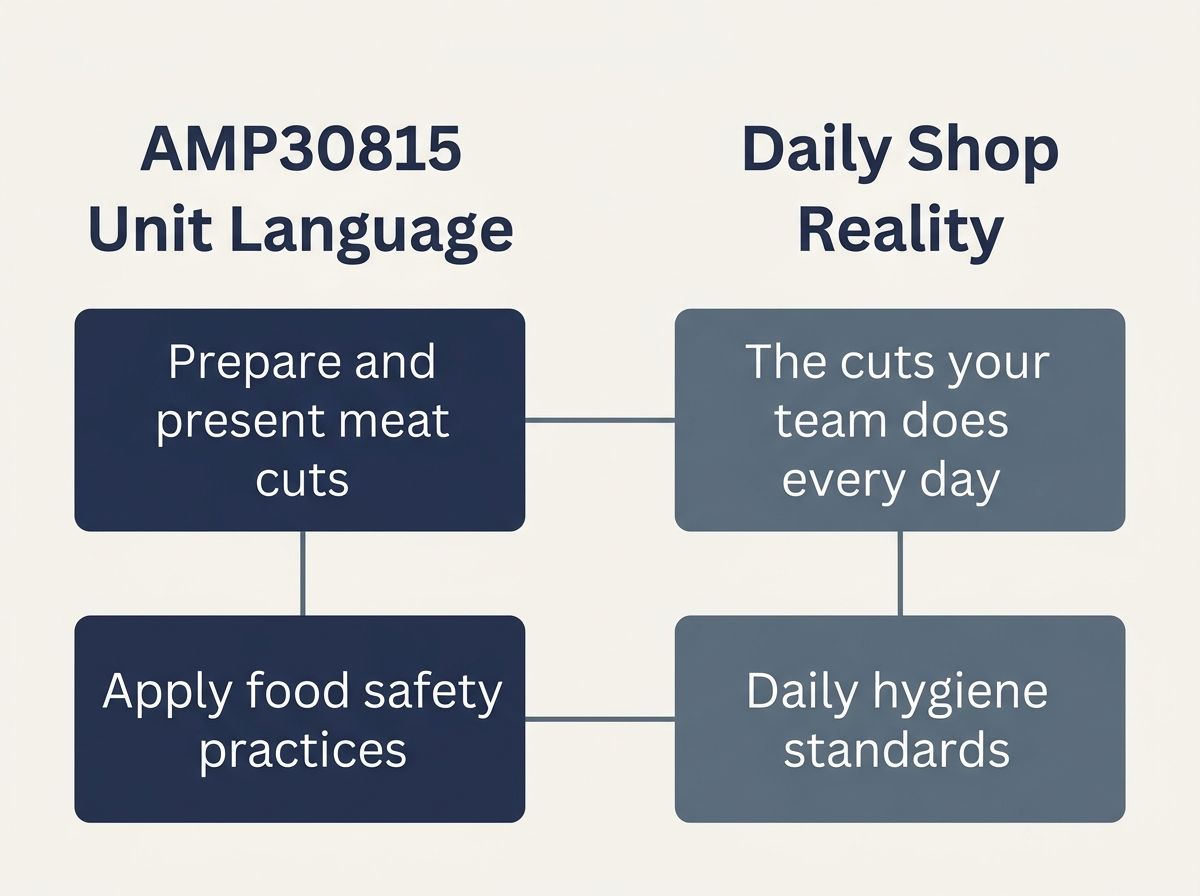
When most butcher shop owners look at a list of qualification units, they see unfamiliar language. When they look at what those units actually describe, they recognise their staff's daily work. Here is how that translates:
- Units covering the preparation and presentation of meat cuts for retail sale, which is the core daily work of your experienced staff.
- Units covering food safety practices and hygiene standards, which are the daily compliance behaviours your senior staff already model and enforce.
- Units covering customer service and product knowledge, reflecting the routine conversations your best butchers have with customers.
- Units covering workplace health and safety, representing the safe handling practices your experienced staff demonstrate and teach to new starters.
- Units covering stock management and product quality, which are the decisions your senior operators make automatically when receiving and rotating stock.
The full unit of competency list for AMP30815 is available on the national training register at training.gov.au.
The qualification does not describe skills your experienced staff need to acquire. It describes skills they already have. The gap is not competency. The gap is documentation.
How RPL works for experienced butchers
Recognition of Prior Learning (RPL) is the formal assessment pathway that allows experienced workers to have their existing skills assessed against a qualification's units of competency. It is not a shortcut or a workaround. It is a rigorous assessment process that recognises existing competence rather than requiring repetition of what has already been learned.
For experienced retail butchers, RPL typically involves gathering evidence that demonstrates competency across the qualification's units. That evidence can include employment records and payslips that verify years of relevant work, references or third-party verification from supervisors, records of any prior training or certificates held, and practical demonstrations or workplace observations where required.
The assessment is conducted by a qualified assessor from a registered training organisation (RTO). The RTO issues the qualification, not RPL it. RPL it guides the candidate and the employer through the evidence-gathering and documentation process, so the assessment can proceed with the strongest possible case.
It is important to be direct about what RPL involves. Gap training may be required if the assessment identifies areas where the evidence does not fully demonstrate competency. Where gap training is needed, it is targeted, covering only the specific areas identified rather than the entire qualification. The process is supported, not left to the candidate to navigate alone.
Securing your team's qualifications without losing them to classroom study
The pattern is clear: experienced staff, deep competency, no paper trail, and hidden compliance exposure. It is a cycle that repeats across retail butchery businesses of every size, not because owners are negligent, but because the industry evolved in a way that left formal documentation behind.
RPL breaks the cycle. Your staff stay on the floor. The evidence-gathering process works around their schedule. The assessment recognises what they already know. The qualification, a nationally recognised Certificate III in Meat Processing (Retail Butcher), closes the compliance gap without requiring your most experienced people to sit through training they do not need.
As an employer, you can initiate the RPL process on behalf of your staff, though your staff will need to consent and participate in the evidence-gathering process. Many butcher shop owners find it more effective to drive this themselves rather than waiting for staff to self-initiate. A conversation with your team about why the qualification matters, and that the process is designed to recognise what they already know rather than testing them on things they have not learned, tends to land well.
Experience can be evidence. Your staff have the experience. The pathway exists to demonstrate it formally. The decision is yours.
To learn more about the Certificate III in Meat Processing (Retail Butcher) and how RPL it supports candidates through the process, visit the qualification page.
Ready to Get Recognised?
Start with a free skills review to find out if RPL is right for you.