You can run a perfect bead, but your pay packet says otherwise: The welder trade trap
Skilled welders often earn less than qualified peers for the same structural work. Learn how RPL helps close the credential gap in Victoria.
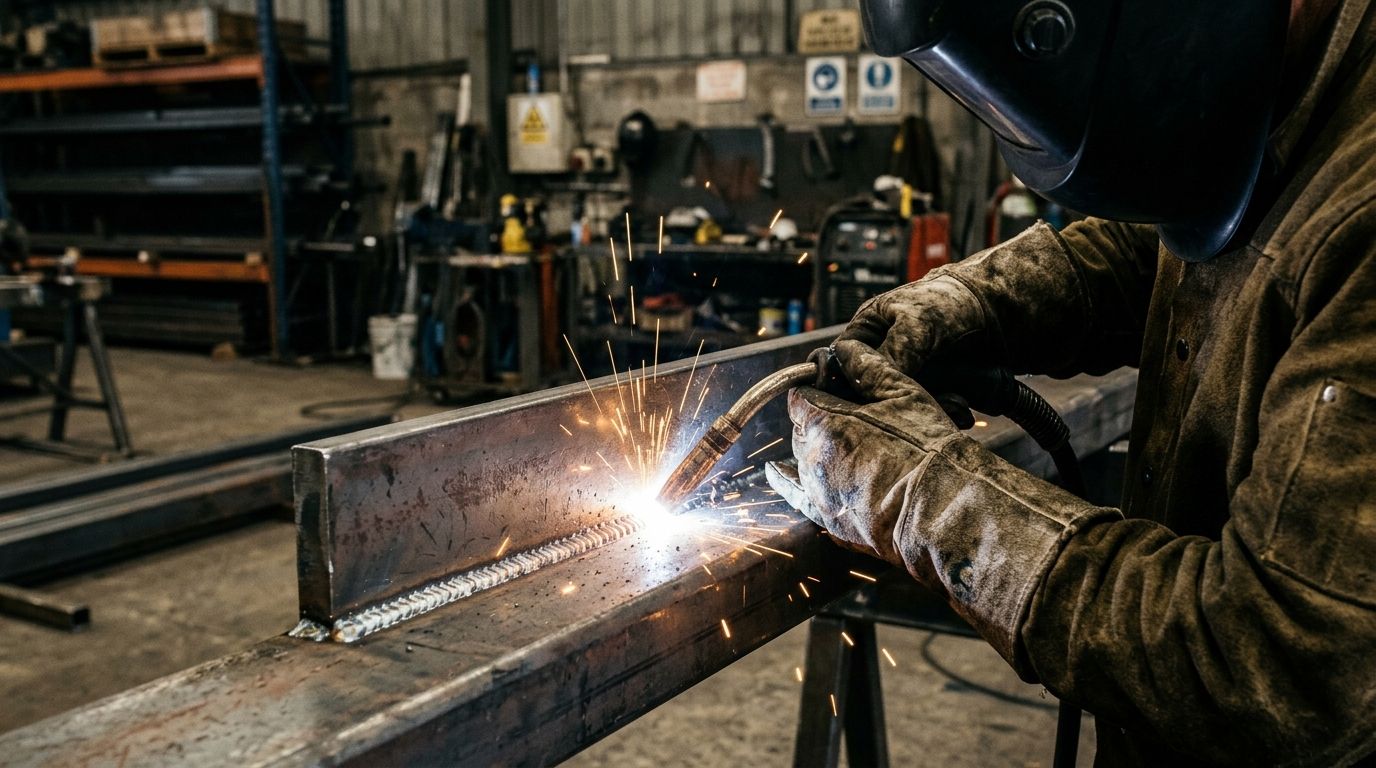
The bead is perfect. The pay packet isn't.
You have the experience. You know it, the worker beside you knows it, and your supervisor knows it too. You are performing identical structural welds to the same specifications on the same site, yet your pay classification remains lower. This is not because your work is inferior, but simply because he holds a qualification and you do not.
This is a credential gap rather than a skills gap, and in Victoria's construction and manufacturing industries, this gap has real financial consequences. Enterprise agreements and modern awards frequently tie pay classifications to formal trade qualifications. The system is designed to be verifiable, not necessarily fair. If your competency exists only in your hands and your work history, formal compliance systems cannot see it.
This is the welder trade trap. You are skilled enough to perform the work, but you lack the formal qualification required to be paid at the trade rate you deserve. This article outlines why this gap exists, where it costs you the most, and how Recognition of Prior Learning (RPL) offers a practical pathway that respects the skills you already possess.
What 'welder trade' actually means in Victoria
In Australia, formal trade status for welders is associated with the Certificate III in Engineering - Fabrication Trade. TAFE SA lists this qualification under national code MEM31925, describing it as a nationally accredited course designed for boilermakers and welders across the manufacturing, mining, and related industries. The qualification covers core fabrication techniques, including welding and thermal cutting processes. You should confirm the current code and release details on training.gov.au or with an RTO assessor, as packaging rules can change between releases.
TAFE SA describes the Certificate III in Engineering - Fabrication Trade (MEM31925) as covering fabrication techniques like welding and thermal cutting processes, designed for apprentice boilermakers and welders in manufacturing and related industries.
Many experienced welders hold coded welder certificates, such as qualifications under AS/NZS 2980 or the successor standard AS/NZS ISO 9606-1. These certifications verify that a welder can produce welds to a specific procedure and are widely required on structural and pressure welding projects. They represent a genuine and recognised form of skill verification, but they are not the same as an AQF trade qualification. A coded certificate confirms process-specific competency, whereas a Certificate III in Engineering - Fabrication Trade is a full qualification under the Australian Qualifications Framework. The two are complementary rather than interchangeable. Coded certificates can serve as supporting evidence in an RPL assessment, but they do not replace the qualification itself. You should confirm specific evidence requirements with your chosen RTO.
In Victoria, the Victorian Building Authority (VBA) and WorkSafe Victoria are the regulatory bodies that set licensing and compliance requirements affecting training delivery and qualification issuance in the construction and engineering sectors. As the Victorian Government's guidance notes, these regulatory bodies provide advice on licensing and requirements that impact training delivery or qualification issuance. Requirements vary by occupation, project type, and contract. If you are uncertain about the specific regulatory requirements for your work, the VBA and WorkSafe Victoria are the appropriate starting points.
Why the pay gap exists — and why it is not about your skill
The pay gap between qualified and unqualified welders doing the same work does not reflect competency. It reflects how enterprise agreements, modern awards, insurance requirements, and site compliance frameworks are structured. These systems reward verifiable credentials rather than demonstrated ability, as they are built for compliance auditors and payroll administrators rather than the tradespeople on the tools.
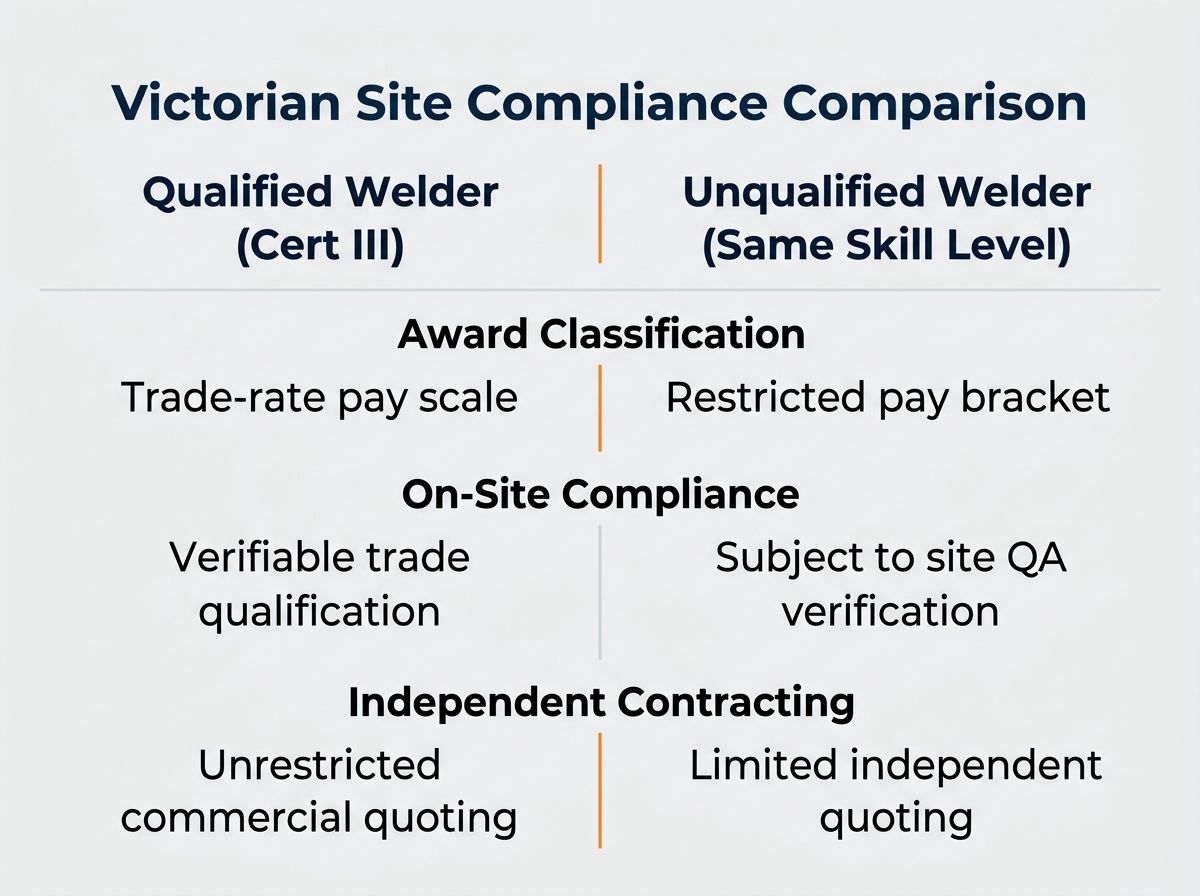
Enterprise agreements and awards in manufacturing and construction industries tie pay classifications to formal trade qualifications. A worker holding a Certificate III in Engineering - Fabrication Trade is often classified at a higher pay grade than an unqualified worker performing the same tasks, because the qualification is the documented basis for that classification. The qualification serves as the administrative trigger for the pay rate. Without it, the payroll system has no mechanism to recognise what you can do.
The same pattern plays out across other trade sectors. If you have experienced this in another field, you will recognise the dynamic immediately.
Three areas where the credential gap costs you most
You face lower pay, restricted site access, and less professional freedom. This credential gap does not simply exist in one area—it compounds across your entire working life.
First is your pay classification. When enterprise agreements and awards tie pay grades to formal qualifications, two welders running identical structural beads on the same site can be paid at different rates. The qualified tradesperson's classification is documented and defensible under the award, whereas yours is not, regardless of the high quality of your work.
Second is site access and compliance. WorkSafe Victoria identifies the absence of documentation verifying welder qualifications or competency as an unsafe on-site practice. Regulator guidance states that Australian Standards require a quality assurance system for on-site structural welding that includes verifying the qualifications or competency of the welder. Duty holders, generally the builder, must ensure that specifications are met, and these specifications typically require compliance with Australian Standards like AS1554.1:2014. In practice, site-level quality assurance and contractor prequalification processes often require evidence of formal qualification or competency before structural welding work can begin. Specific requirements vary by site, project specification, and contract.
WorkSafe Victoria's guidance on risk controls for on-site structural welding identifies the absence of welder qualification documentation as an unsafe practice and sets out quality assurance requirements for verifying welder competency.
Third is the self-employment ceiling. If you want to quote and invoice independently for structural fabrication or welding work, particularly on commercial or industrial projects, lacking a formal trade qualification can limit your ability to demonstrate compliance to clients, insurers, and principal contractors. The qualification is more than a pay-grade trigger; it is the documented basis for professional credibility in a market that increasingly demands verifiable credentials.
How RPL works for experienced welders
Recognition of Prior Learning (RPL) is a formal assessment process where a qualified assessor from an RTO evaluates your existing skills, knowledge, and experience against the units of a nationally recognised qualification. If you demonstrate competency, the qualification is awarded. RPL is not a shortcut or a rubber stamp; it is a rigorous assessment pathway that treats your practical experience as valid evidence.
Your experience is your evidence. That is the core principle. A decade of running structural beads, working to welding procedure specifications, and delivering compliant welds across multiple processes and materials is not invisible; it simply exists in the wrong format for formal systems to recognise. RPL is the guided process that translates that experience into the credential those systems require.
For an experienced welder, RPL involves working with an assessor to compile a portfolio of evidence mapping your experience against the units of the Certificate III in Engineering - Fabrication Trade. The assessor reviews your evidence, conducts an interview, and may require a practical demonstration. If they find gaps between your skills and the qualification requirements, they provide gap training to help you complete the trade. The qualification is nationally recognised because the assessment standard is genuine.
RPL is conducted by Registered Training Organisations (RTOs) regulated by the Australian Skills Quality Authority (ASQA). The qualification issued through RPL carries the same standing as one earned through a traditional apprenticeship or classroom pathway, because you are assessed against the exact same standards of competency.
What welding experience counts as evidence
A common concern for experienced welders considering RPL is whether they have enough documented evidence. In most cases, they have more than they think. The evidence does not need to be highly complex; it simply must be authentic, relevant, and sufficient to prove competency against the units of the qualification.
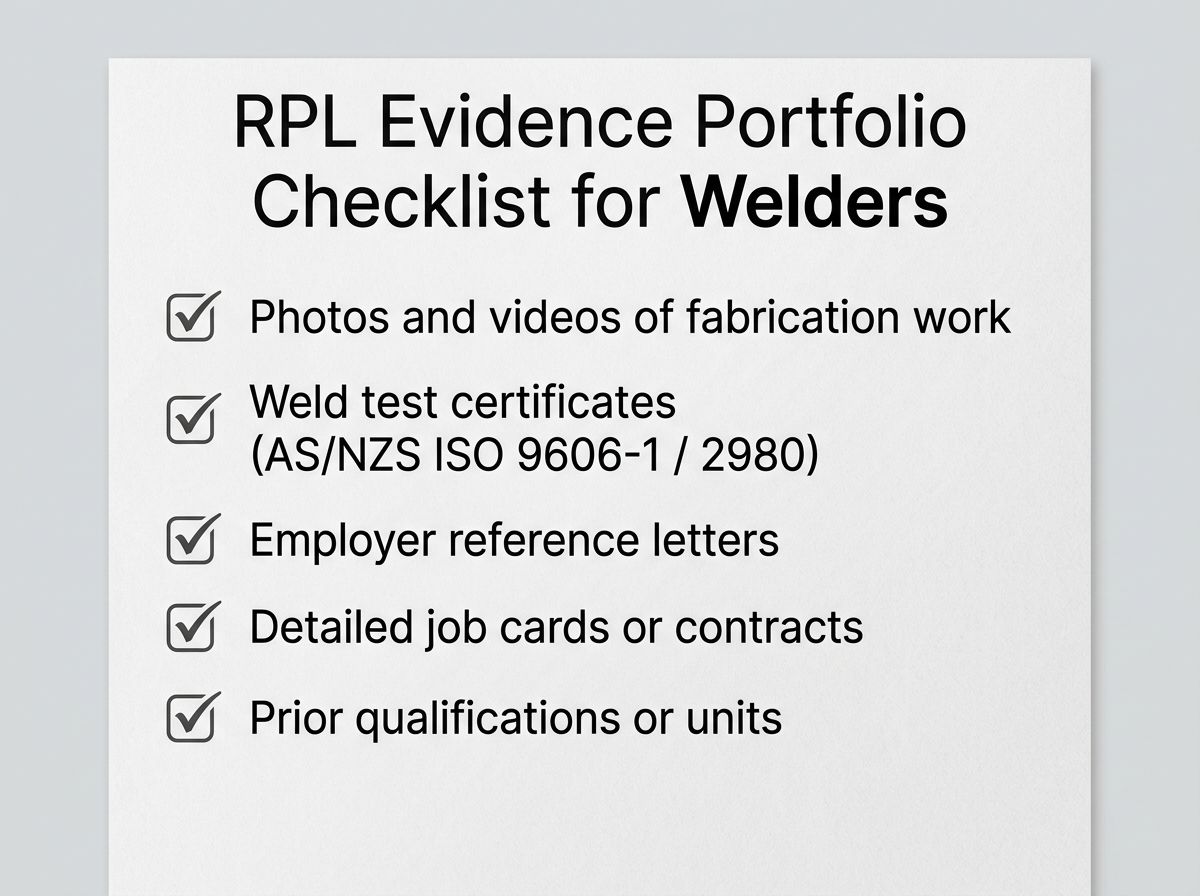
For welding and metal fabrication RPL, evidence portfolios generally combine the following items:
- Photos and videos of completed fabrication work and structural welds
- Weld test certificates or qualification records, including coded certificates under AS/NZS 2980 or AS/NZS ISO 9606-1
- Job records such as contracts, timesheets, invoices, or site diaries
- Employer references or supervisor statutory declarations confirming your role and duties
- Prior trade certificates, tickets, or relevant licences
- Welding procedure specifications (WPS) or qualification records (WPQR) you have used on the job
Assessors map your real experience against the units of the qualification. Evidence showing breadth—such as different welding processes like MIG, TIG, stick, and flux-core across varied materials, thicknesses, drawings, and tolerances—supports your application alongside depth in specific areas. A practical demonstration with an assessor is a standard part of welding RPL, allowing them to verify your technique and consistency against the trade standard.
Evidence requirements vary between training providers and specific qualifications. Confirm what your RTO requires before you begin gathering your documents.
For welding and metal fabrication RPL, evidence portfolios generally include photos of work, weld test certificates, job records, employer references, and prior certificates, with requirements varying by RTO.
Is RPL right for every welder?
RPL is not for everyone. It is a rigorous assessment, and the outcome depends entirely on the evidence you provide and the competency you demonstrate. A welder with six months of experience is not in the same position as someone with six years of experience. The assessment process is thorough, and gaps in your experience will be identified.
Based on available provider guidance, welders with two to three years or more of hands-on experience across various welding processes and materials are typically better positioned to pursue RPL. One fabrication RPL provider lists a minimum of two to three years of metal fabrication and welding experience, covering a range of tasks, as an guide for entry. Another provider notes that most RPL candidates need to show at least two to three years of relevant work history. These are indicative figures from commercial providers rather than fixed national minimums, as requirements vary by RTO and qualification.
The breadth and quality of your experience are as important as its duration. Welders who have worked across multiple processes like MIG, TIG, stick, and flux-core on varied materials, thicknesses, and tolerances are well-suited for RPL. If your experience is narrow or repetitive, you may need gap training to meet specific units. Gap training is a standard part of the process, ensuring the final qualification is robust and genuine.
Note that a vocational RPL qualification issued by an RTO is separate from a migration skills assessment conducted by Trades Recognition Australia (TRA). If you are seeking a skills assessment for migration, TRA has its own requirements and process. A standard vocational qualification does not substitute for a TRA assessment.
The simple answer to whether RPL is right for you depends on your experience, evidence, and your target qualification. A Free Skills Review is the most direct way to find out, with no obligation or costs involved.
Your next step: A free skills review
You have the experience. The question is whether that experience can be compiled as evidence and mapped against the qualification standard. A Free Skills Review is designed to answer exactly that.
A Free Skills Review is an honest, no-obligation assessment to determine if your welding experience is suitable for RPL. This is not a sales pitch or a commitment to enrol. It is the first step—a practical conversation about what you have done, what you can document, and whether RPL is the right pathway for you.
If you are working toward a welder trade qualification in Victoria, the product page for the Trade Licence VIC Welder has further information on what formal trade status involves in this state.
Learn more about formal welder trade status in Victoria.
Your skills are real, and your experience is valuable. The next step is entirely up to you.
Ready to Get Recognised?
Start with a free skills review to find out if RPL is right for you.