Why your veteran chippies are a QBCC fine waiting to happen
Your most experienced carpenters may be your biggest QBCC compliance risk. Here is why, and how RPL fixes it without pulling them off site.

The worker you trust most may be the one without a licence
There is a particular kind of trust that builds slowly on a job site. It comes from watching someone frame a wall without checking a plan, read a structure by eye, or solve structural problems early. Your veteran chippies have earned that trust. They are the ones you put on the complicated tasks, and the ones you rely on when a new crew member needs to be shown how things are done properly.
Here is the reality: experience and QBCC compliance are entirely separate things. A carpenter with twenty years on the tools may never have held a carpentry licence in Queensland. In most cases, nobody ever asked. The work was of a high standard, the sites ran smoothly, and the question simply never came up.
That gap between obvious competence and formal compliance is where the risk lives. It stays invisible right up until the moment it becomes an issue.
If you have carpenters operating without a licence, the consequences extend beyond compliance. It also shapes what work they can legally quote and take on. See how unlicensed carpenters are limiting their own earning potential.
What the QBCC actually requires, and why experience is not enough
The Queensland Building and Construction Commission (QBCC) regulates building work in Queensland. For carpentry work that meets the threshold for regulated building work, a licence is required. The specific licence class for structural carpentry work, the financial threshold, and the precise requirements to obtain that licence are set by the QBCC. You should verify these details directly at qbcc.qld.gov.au before making any compliance decisions.
What is consistently clear in the Queensland licensing framework is this: a QBCC licence is held by the individual, not the business. A company's own licence does not automatically authorise an unlicensed worker to perform regulated building work on that company's behalf. The licence travels with the person. If the individual performing the work does not hold the relevant licence, that work may not be compliant, regardless of who employs them or how long they have been in the trade.
Years of experience, a strong reputation, and an employer's trust do not substitute for a formal licence. The QBCC does not assess competence informally; it assesses physical documentation. If that documentation is missing, the exposure is real for both the individual worker and potentially for the business itself.
The specific penalty amounts for unlicensed building work in Queensland are set by legislation and must be verified from current QBCC enforcement information. What matters for this conversation is that these penalties exist, they apply to regulated work performed without the required licence, and they are substantial. Employers who assume their company licence covers all workers on site may be carrying a liability they have not fully accounted for.
The audit scenario nobody plans for
QBCC compliance checks can be triggered in several ways, such as homeowner complaints or proactive compliance audits. The specific mechanisms and frequency of these checks should be verified through current QBCC information, as enforcement approaches change. When an audit occurs, inspectors will ask to see evidence that the individuals performing regulated work hold the appropriate licences.
Picture the scenario. A homeowner raises a concern about work on their property, and a QBCC inspector attends the site. They ask to see the licence of the carpenter who performed the structural work. Your most experienced chippy, the one who has been framing houses since before some of your younger workers were born, does not have a licence. The work is excellent and the structure is sound, but none of that changes what happens next.
This is not a hypothetical scenario designed to alarm. It is how the compliance mechanism works. The quality of the work is assessed separately from the licensing status of the person who did it. Both matter, but only one of them has been going unexamined on your sites.
Why the most experienced workers are often unlicensed
This is the counterintuitive part. The workers most likely to be operating without a formal carpentry licence are not the ones who lack skill. They are often the ones with the most experience.
The carpentry trade in Queensland has a long licensing history. The specific timeline of when formal licences became mandatory, and any historical transitional provisions, should be verified through QBCC records. In practice, there is a clear pattern: workers who entered the trade through informal pathways or built their careers through on-site experience often have deep competence but incomplete paperwork.
The longer they have been on the tools, the more likely they skipped the formal pathway. This was not due to a lack of ability, but because nobody required them to prove their skills to a regulator. The work spoke for itself, until the rules changed.
Your best carpenter's skills are real, even if the documentation has not caught up. That is not a personal failing; it is a legacy of how the industry evolved. Fortunately, it is a gap you can close.
How to fix the gap without pulling them off site
Recognition of Prior Learning (RPL) is a formal assessment pathway within the Australian vocational education and training system. It allows experienced workers to have their skills and knowledge assessed against the requirements of a national qualification, without making them repeat training from scratch.
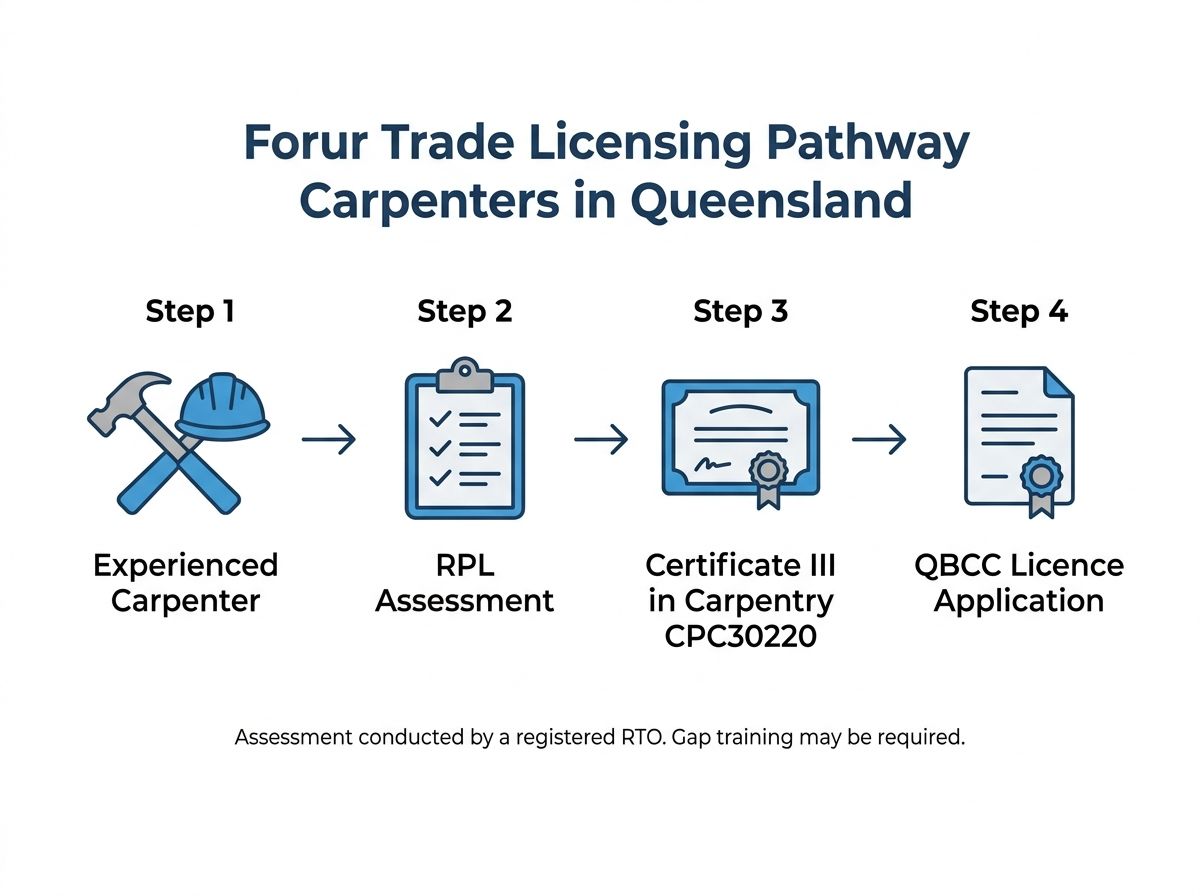
For carpentry, the relevant qualification is the Certificate III in Carpentry (CPC30220). This is the national qualification that underpins the licensing pathway in Queensland. The specific steps to move from a completed qualification to a QBCC licence application, including any additional experience evidence, financial requirements, or insurance obligations, must be verified directly with the QBCC, as licensing requirements can change.
What RPL does is address the qualification component of that pathway. A qualified assessor from a registered training organisation (RTO) reviews the evidence a worker can provide, such as employment records, references from supervisors, site documentation, photographs of completed work, and in many cases a practical assessment. The assessor then determines whether the evidence demonstrates competency against the national qualification standards.
Workers remain on site throughout this process. The evidence gathering happens around the job, not instead of it. There is no block release and no classroom attendance required. The assessment is conducted by the RTO, and RPL it supports candidates through the evidence-gathering process to help them present their experience clearly and completely.
To be clear, RPL is not a shortcut or a guaranteed outcome. If gaps are identified during the assessment, gap training is required and can be completed as part of the process. The qualification is nationally recognised because the assessment is rigorous. RPL simply removes the need to repeat learning that has already occurred on the job.
What employers can do right now
The first step is to establish where your workforce stands. Confirm whether every carpenter performing regulated building work on your sites holds a current QBCC licence in the relevant class. The QBCC maintains a licence register; you should verify the current search process directly at qbcc.qld.gov.au, as confirming individual statuses may require direct contact with the regulator.
Once you have a clear picture of who holds what, the next conversation is with the workers who have the skills but lack the documentation. Most of them already know this gap exists. What they may not know is that there is a pathway that does not require them to sit in a classroom for months or step away from the job site.
That conversation can start with a Free Skills Review. This is a no-obligation assessment of whether RPL is a suitable option, completed before any enrolment decision is made. It provides the clarity you and your worker need to make an informed choice with no commitment and no pressure.
- Confirm the licence status of every carpenter performing regulated building work on your sites
- Identify the workers who have the skills but lack a current QBCC carpentry licence
- Talk to those workers about the RPL pathway
- Use a Free Skills Review to assess suitability before making any commitment
The compliance risk is real. The solution is available. The decision is yours.
Ready to Get Recognised?
Start with a free skills review to find out if RPL is right for you.